Short-Term Electricity Load Forecasting with TimesNet: Cross-Paradigm Benchmarking of Multi-Periodicity Modeling
DOI:
https://doi.org/10.12928/biste.v8i5.17218Keywords:
Timesnet, Adaptive Multi-Periodicity Modeling, Fast Fourier Transform-Based Period Detection, Electricity-Demand Forecasting, Day-Ahead ForecastingAbstract
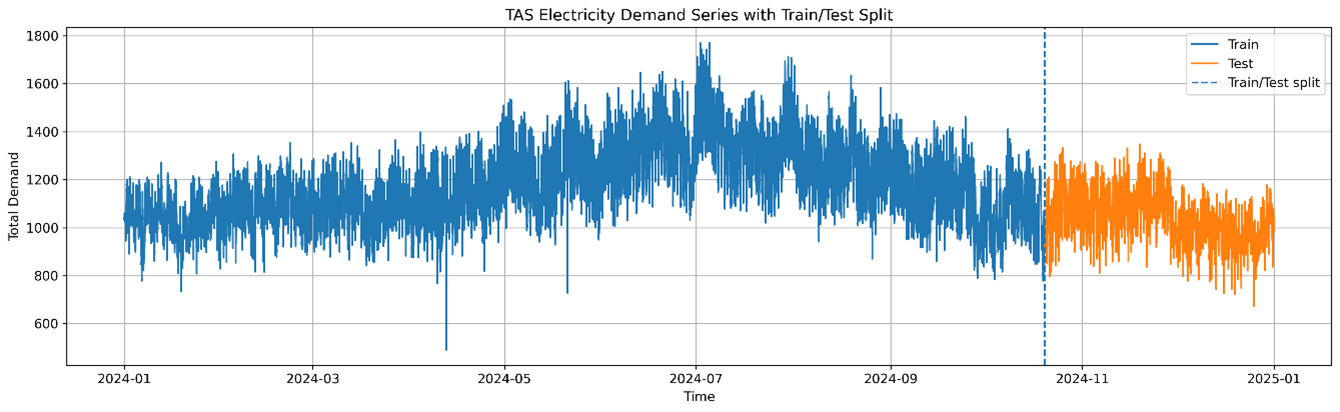
Short-term load forecasting is essential for reliable power-system scheduling and operation, but electricity demand contains nonlinear variations and overlapping periodic patterns that are difficult to represent using a single temporal mechanism. This study evaluates whether explicit multi-periodicity modeling provides a measurable forecasting advantage under a common cross-paradigm benchmarking protocol. The research contribution is a cross-paradigm comparison of TimesNet with Seasonal Naive, support vector regression, long short-term memory, and temporal convolutional network models using the same target series, chronological partitions, forecast origins, and evaluation criteria. Experiments use the 2024 Tasmania electricity-demand series at a 5-min resolution. Each model receives a seven-day historical window of 2,016 observations and directly predicts the following day through a 288-step horizon. The adopted TimesNet implementation further incorporates seven deterministic calendar encodings known at each forecast origin and averages the predictions obtained from three independently initialized models. Within each TimesBlock, seven dominant frequency components are adaptively selected using fast Fourier transform-based period detection and represented through two-dimensional temporal tensors. TimesNet achieves the best overall performance, with an MAE of 47.53, an RMSE of 60.21, a MAPE of 4.66%, an sMAPE of 4.63%, and an R² of 0.6682. Relative to LSTM, the strongest baseline, it reduces MAE, RMSE, and MAPE by 11.26%, 12.15%, and 12.41%, respectively. Its low bias and seasonal MASE further indicate stable performance. These results show that multi-period temporal representation can improve day-ahead load forecasting and support more reliable operational planning. However, the findings are limited to a single-region, single-year electricity-demand target supplemented with deterministic calendar encodings.
References
S. Akhtar, S. Shahzad, A. Zaheer, H. S. Ullah, H. Kilic, R. Gono, M. Jasiński, and Z. Leonowicz, “Short-term load forecasting models: A review of challenges, progress, and the road ahead,” Energies, vol. 16, no. 10, p. 4060, 2023, https://doi.org/10.3390/en16104060.
M. G. Pinheiro, S. C. Madeira, and A. P. Francisco, “Short-term electricity load forecasting—A systematic approach from system level to secondary substations,” Appl. Energy, vol. 332, p. 120493, 2023, https://doi.org/10.1016/j.apenergy.2022.120493.
Z. Deng, B. Wang, Y. Xu, T. Xu, C. Liu, and Z. Zhu, “Multi-scale convolutional neural network with time-cognition for multi-step short-term load forecasting,” IEEE Access, vol. 7, pp. 88058–88071, 2019, https://doi.org/10.1109/ACCESS.2019.2926137.
J. W. Taylor and P. E. McSharry, “Short-term load forecasting methods: An evaluation based on European data,” IEEE Trans. Power Syst., vol. 22, no. 4, pp. 2213–2219, 2007, https://doi.org/10.1109/TPWRS.2007.907583.
S. Guha, S. Katyayanan, G. Mallya and R. O. Panicker, "Hybrid Vector Auto Regression and Tree-Based Ensembles for Energy Load Forecasting: A Case Study," in IEEE Access, vol. 13, pp. 151773-151787, 2025, https://doi.org/10.1109/ACCESS.2025.3603620.
Y. Liang, S. Wang, and X. Ma, “Research and prediction based on multiple linear regression and machine learning,” in 2024 IEEE 3rd Int. Conf. Electr. Eng. Big Data Algorithms (EEBDA), pp. 1398–1401, 2024, https://doi.org/10.1109/EEBDA60612.2024.10485891.
D. Fakhri et al., “Forecasting failure load of sandstone under different freezing-thawing cycles using Gaussian process regression method and grey wolf optimization algorithm,” Theor. Appl. Fract. Mech., vol. 125, p. 103876, 2023, https://doi.org/10.1016/j.tafmec.2023.103876.
W. Lizhen, Z. Yifan, W. Gang, and H. Xiaohong, “A novel short-term load forecasting method based on mini-batch stochastic gradient descent regression model,” Electr. Power Syst. Res., vol. 211, p. 108226, 2022, https://doi.org/10.1016/j.epsr.2022.108226.
Y. Bi, M. Guo, Q. Sui, J. Liang, K. Zhang, and K. Chen, “A hybrid method based on linear regression and genetic programming-based symbolic regression for short-term load forecasting,” Appl. Soft Comput., vol. 196, p. 115111, 2026, https://doi.org/10.1016/j.asoc.2026.115111.
S. Smyl, G. Dudek, and P. Pełka, “Contextually enhanced ES-dRNN with dynamic attention for short-term load forecasting,” Neural Networks, vol. 169, pp. 660–672, 2024, https://doi.org/10.1016/j.neunet.2023.11.017.
M. Choubey, J. S. Yadav, and R. K. Chaurasiya, “Stacking model for short-term electrical load forecasting,” in 2023 3rd Int. Conf. Energy, Power Electr. Eng. (EPEE), pp. 1285–1290, 2023, https://doi.org/10.1109/EPEE59859.2023.10351850.
A. Ali et al., “An explainable and latent space-based deep learning model for improved short-term load forecasting,” Results Eng., vol. 29, p. 109148, 2026, https://doi.org/10.1016/j.rineng.2026.109148.
J. Wen, Y. Peng, W. Zhang, X. Huang, and Z. Wang, “Short-term power load forecasting based on TCN-LSTM model,” in Proc. 2024 IEEE 6th Int. Conf. Civ. Aviat. Saf. Inf. Technol. (ICCASIT), pp. 734–738, 2024, https://doi.org/10.1109/ICCASIT62299.2024.10827868.
M. Al-suod et al., “Forecasting energy consumption of a mining plant using artificial neural networks,” IEEE Access, vol. 13, pp. 63237–63247, 2025, https://doi.org/10.1109/ACCESS.2025.3558445.
H. Joon, D. Kim, H. Tak, and J. Yong, “Interpretable probabilistic forecasting of building multi-energy loads using residual learning and global attention-enabled transformer: A case study for residential buildings in South Korea,” Energy Build., vol. 361, p. 117424, 2026, https://doi.org/10.1016/j.enbuild.2026.117424.
K. Bian, J. Xu, H. Wang, and J. Ding, “A new method for short-term load forecasting based on weighted fusion,” Appl. Therm. Eng., vol. 280, p. 128313, 2025, https://doi.org/10.1016/j.applthermaleng.2025.128313.
N. M. M. Bendaoud, N. Farah, and S. Ben Ahmed, “Applying load profiles propagation to machine learning-based electrical energy forecasting,” Electr. Power Syst. Res., vol. 203, p. 107635, 2022, https://doi.org/10.1016/j.epsr.2021.107635.
F. Emmanuel et al., “Enhancing heating, ventilation, and air-conditioning efficiency in tropical hospitals: A hybrid grey-neural approach for reverse cycle cooling load forecasting,” Energy, vol. 5, p. 100061, 2026, https://doi.org/10.1016/j.energ.2026.100061.
J. Luo, Y. Zheng, T. Hong, A. Luo, and X. Yang, “Fuzzy support vector regressions for short-term load forecasting,” Fuzzy Optim. Decis. Mak., vol. 23, no. 3, pp. 363–385, 2024, https://doi.org/10.1007/s10700-024-09425-x.
Y. Lu and G. Wang, “A load forecasting model based on support vector regression with whale optimization algorithm,” Multimed. Tools Appl., vol. 82, no. 7, pp. 9939–9959, 2023, https://doi.org/10.1007/s11042-022-13462-2.
G. Duan, Y. Du, Y. Shang, H. Xue, and R. Zhang, “Research on support vector regression short-time traffic flow prediction model for secondary roads based on associated road analysis,” Appl. Sci., vol. 15, no. 4, p. 1779, 2025, https://doi.org/10.3390/app15041779.
W. Tang and F. Kong, “Short-term power load forecasting based on spatio-temporal multicore support vector regression,” in 2023 2nd Asia Power Electr. Technol. Conf. (APET), pp. 750–755, 2023, https://doi.org/10.1109/APET59977.2023.10489025.
R. Rodríguez-Pérez and J. Bajorath, “Evolution of support vector machine and regression modeling in chemoinformatics and drug discovery,” J. Comput.-Aided Mol. Des., vol. 36, no. 5, pp. 355–362, 2022, https://doi.org/10.1007/s10822-022-00442-9.
X. Huang, Y. Han, J. Yan, and X. Zhou, “Hybrid forecasting model of building cooling load based on EMD-LSTM-Markov algorithm,” Energy Build., vol. 321, p. 114670, 2024, https://doi.org/10.1016/j.enbuild.2024.114670.
V. K. Saini, R. Kumar, A. S. Al-Sumaiti, A. Sujil, and E. Heydarian-Forushani, “Learning-based short-term wind speed forecasting models for smart grid applications: An extensive review and case study,” Electr. Power Syst. Res., vol. 222, p. 109502, 2023, https://doi.org/10.1016/j.epsr.2023.109502.
V. Veeramsetty, K. R. Reddy, M. Santhosh, A. Mohnot, and G. Singal, “Short-term electric power load forecasting using random forest and gated recurrent unit,” Electr. Eng., vol. 104, no. 1, pp. 307–329, 2022, https://doi.org/10.1007/s00202-021-01376-5.
T. Kavzoglu and A. Teke, “Predictive performances of ensemble machine learning algorithms in landslide susceptibility mapping using random forest, extreme gradient boosting (XGBoost) and natural gradient boosting (NGBoost),” Arab. J. Sci. Eng., vol. 47, no. 6, pp. 7367–7385, 2022, https://doi.org/10.1007/s13369-022-06560-8.
Z. Li et al., “Fuel economy and emission optimization of spark-ignition pure methanol engine based on gradient boosting neural network and many-objective Bayesian optimization,” Fuel, vol. 426, p. 139573, 2026, https://doi.org/10.1016/j.fuel.2026.139573.
P. Saini and S. K. Parida, “A novel probabilistic gradient boosting model with multi-approach feature selection and iterative seasonal trend decomposition for short-term load forecasting,” Energy, vol. 294, p. 130975, 2024, https://doi.org/10.1016/j.energy.2024.130975.
M. Mohamed, F. E. Mahmood, M. A. Abd, M. Rezkallah, and A. Hamadi, “Load demand forecasting using eXtreme Gradient Boosting (XGBoost),” in 2023 IEEE Ind. Appl. Soc. Annu. Meet., pp. 1–7, 2023, https://doi.org/10.1109/IAS54024.2023.10406613.
Z. Qinghe, X. Wen, H. Boyan, W. Jong, and F. Junlong, “Optimized extreme gradient boosting model for short term electric load demand forecasting of regional grid system,” Sci. Rep., vol. 12, no. 1, p. 17578, 2022, https://doi.org/10.1038/s41598-022-22024-3.
Z. Song, F. Xiao, Z. Chen, and H. Madsen, “Probabilistic ultra-short-term solar photovoltaic power forecasting using natural gradient boosting with attention-enhanced neural networks,” Energy AI, vol. 20, p. 100496, 2025, https://doi.org/10.1016/j.egyai.2025.100496.
S. Islam, T. M. R. Bashar, and M. Munem, “Enhanced very short-term load forecasting with multi-lag feature engineering and prophet-XGBoost-CatBoost architecture,” Energy, vol. 335, p. 137981, 2025, https://doi.org/10.1016/j.energy.2025.137981.
J. Song, “Optimized XGBoost based sparrow search algorithm for short-term load forecasting,” in 2021 IEEE Int. Conf. Comput. Sci. Artif. Intell. Electron. Eng. (CSAIEE), pp. 213–217, 2021, https://doi.org/10.1109/CSAIEE54046.2021.9543453.
A. Sharbati, Y. Noorollahi, A. Hajinezhad, and H. Yousefi, “Decoding the energy paradox: An interpretable XGBoost-SHAP framework for forecasting decoupled demand futures,” Results Eng., vol. 29, p. 109741, 2026, https://doi.org/10.1016/j.rineng.2026.109741.
S. Wang and J. Ma, “A novel ensemble model for load forecasting: Integrating random forest, XGBoost, and seasonal naive methods,” in Proc. 2023 2nd Asian Conf. Front. Power Energy (ACFPE), pp. 114–118, 2023, https://doi.org/10.1109/ACFPE59335.2023.10455494.
Q. Yang, Y. Lin, S. Kuang, and D. Wang, “A novel short-term load forecasting approach for data-poor areas based on K-MIFS-XGBoost and transfer-learning,” Electr. Power Syst. Res., vol. 229, p. 110151, 2024, https://doi.org/10.1016/j.epsr.2024.110151.
D. Barochiner, R. Lado, L. Carletti, and F. Pintar, “A machine learning approach to address 1-week-ahead peak demand forecasting using the XGBoost algorithm,” in 2022 IEEE Bienn. Congr. Argentina (ARGENCON), 2022, https://doi.org/10.1109/ARGENCON55245.2022.9939986.
B. Predić et al., “Cloud-load forecasting via decomposition-aided attention recurrent neural network tuned by modified particle swarm optimization,” Complex Intell. Syst., vol. 10, no. 2, pp. 2249–2269, 2024, https://doi.org/10.1007/s40747-023-01265-3.
W. Waheed, Q. Xu, M. Aurangzeb, S. Iqbal, S. Hanif, and Z. M. S. Elbarbary, “Empowering data-driven load forecasting by leveraging long short-term memory recurrent neural networks,” Heliyon, vol. 10, no. 24, p. e40934, 2024, https://doi.org/10.1016/j.heliyon.2024.e40934.
O. Şahin and B. Çubukçu, “A hybrid time series forecasting model combining recurrent neural networks and ensemble learning for furniture sales prediction,” Ain Shams Eng. J., vol. 17, no. 7, p. 104219, 2026, https://doi.org/10.1016/j.asej.2026.104219.
S. Ben and F. Ziel, “Recurrent neural networks with linear structures for electricity price forecasting,” Renew. Sustain. Energy Rev., vol. 231, p. 116773, 2026, https://doi.org/10.1016/j.rser.2026.116773.
D. Salman, M. Kusaf, and Y. K. Elmi, “Using recurrent neural network to forecast day and year ahead performance of load demand: A case study of France,” in 2021 10th Int. Conf. Power Sci. Eng. (ICPSE), pp. 23–27, 2021, https://doi.org/10.1109/ICPSE53473.2021.9656827.
S. Frizzo, L. Oriel, E. Cardozo, E. Cristian, S. Coelho, and V. Cocco, “Hypertuned wavelet convolutional neural network with long short-term memory for time series forecasting in hydroelectric power plants,” Energy, vol. 313, p. 133918, 2024, https://doi.org/10.1016/j.energy.2024.133918.
S. Singh and M. M. Tripathi, “A comparative analysis of extreme gradient boosting technique with long short-term memory and layered recurrent neural network for electricity demand forecasting,” in 2021 6th Int. Conf. Recent Trends Electron. Information, Commun. Technol. (RTEICT), pp. 297–302, 2021, https://doi.org/10.1109/RTEICT52294.2021.9573988.
S. M. Praminta, H. Aji, and E. Y. Ikhsan, “Emerging and evaluating long short term memory (LSTM) network for load forecast in Java Bali system,” in Proc. 2023 4th Int. Conf. High Volt. Eng. Power Syst. (ICHVEPS), pp. 797–801, 2023, https://doi.org/10.1109/ICHVEPS58902.2023.10257331.
Z. Meng, Y. Xie, and J. Sun, “Short-term load forecasting using neural attention model based on EMD,” Electr. Eng., vol. 104, no. 3, pp. 1857–1866, 2022, https://doi.org/10.1007/s00202-021-01420-4.
F. Liu, T. Dong, Q. Liu, Y. Liu, and S. Li, “Combining fuzzy clustering and improved long short-term memory neural networks for short-term load forecasting,” Electr. Power Syst. Res., vol. 226, p. 109967, 2024, https://doi.org/10.1016/j.epsr.2023.109967.
Z. Zhang, Y. Dong, and W. C. Hong, “Long short-term memory-based twin support vector regression for probabilistic load forecasting,” IEEE Trans. Neural Netw. Learn. Syst., vol. 36, no. 1, pp. 1764–1778, 2023, https://doi.org/10.1109/TNNLS.2023.3335355.
X. Li, S. Wang, and Z. Chen, “Hierarchical reconciliation of convolutional gated recurrent units for unified forecasting of branched and aggregated district heating loads,” Energy, vol. 313, p. 134097, 2024, https://doi.org/10.1016/j.energy.2024.134097.
C. Li, G. Li, K. Wang, and B. Han, “A multi-energy load forecasting method based on parallel architecture CNN-GRU and transfer learning for data-deficient integrated energy systems,” Energy, vol. 259, p. 124967, 2022, https://doi.org/10.1016/j.energy.2022.124967.
N. Rezaei, R. Rajabi, and A. Estebsari, “Electricity price forecasting model based on gated recurrent units,” in 2022 IEEE Int. Conf. Environ. Electr. Eng. 2022 IEEE Ind. Commer. Power Syst. Eur. (EEEIC / I&CPS Europe), pp. 1–5, 2022, https://doi.org/10.1109/EEEIC/ICPSEurope54979.2022.9854746.
J. Wang, K. Wang, Z. Li, H. Lu, H. Jiang, and Q. Xing, “A multitask integrated deep-learning probabilistic prediction for load forecasting,” IEEE Trans. Power Syst., vol. 39, no. 1, pp. 1240–1250, 2024, https://doi.org/10.1109/TPWRS.2023.3257353.
W. Gouvêa et al., “Hybrid CF-CNN-BiLSTM hypertuned by Bayesian optimization for thermal power generation and decarbonization forecasting,” Int. J. Electr. Power Energy Syst., vol. 172, p. 111199, 2025, https://doi.org/10.1016/j.ijepes.2025.111199.
H. Majidiyan, H. Enshaei, and D. Howe, “CNN-assisted automated order selection for SARIMAX in online ship roll prediction,” Ocean Eng., vol. 348, p. 124064, 2026, https://doi.org/10.1016/j.oceaneng.2025.124064.
Z. Yang, Y. Zheng, W. Qin, F. Tang, H. Liu, and B. Wang, “Low Earth orbit satellite clock bias prediction using the CNN-LSTM neural network model,” Measurement, vol. 280, p. 121895, 2026, https://doi.org/10.1016/j.measurement.2026.121895.
E. Avdevičius, M. Eskander, and D. Schulz, “Energy price prediction with CEEMDAN-STL and hybrid neural network using Time2Vec attention-based CNN-biGRU,” in IEEE PES Innov. Smart Grid Technol. Eur. (ISGT Europe), pp. 1–5, 2024, https://doi.org/10.1109/ISGTEUROPE62998.2024.10863496.
X. Tian, X. Wang, Z. Li, Y. Zheng, and W. Deng, “A hybrid MIMO-CNN-BiLSTM-AM model for efficient prediction of motion responses and mooring tension of FOWTs,” Ocean Eng., vol. 357, p. 125577, 2026, https://doi.org/10.1016/j.oceaneng.2026.125577.
Z. Xu et al., “PhaCIA-TCNs: Short-term load forecasting using temporal convolutional networks with parallel hybrid activated convolution and input attention,” IEEE Trans. Netw. Sci. Eng., vol. 11, no. 1, pp. 427–438, 2024, https://doi.org/10.1109/TNSE.2023.3300744.
A. S. Türkoğlu, B. Erkmen, Y. Eren, O. Erdinç, and İ. Küçükdemiral, “Integrated approaches in resilient hierarchical load forecasting via TCN and optimal valley filling based demand response application,” Appl. Energy, vol. 360, p. 122722, 2024, https://doi.org/10.1016/j.apenergy.2024.122722.
A. Wan, Z. Xiong, K. Al-bukhaiti, R. Yin, and J. Yuan, “An integrated TCN-ECA-BiLSTM and TD3 framework for high-accuracy forecasting and optimal load allocation in combined heat and power systems,” Energy, vol. 350, p. 140670, 2026, https://doi.org/10.1016/j.energy.2026.140670.
D. Tan, Z. Tang, F. Zhou, and Y. Xie, “A novel hybrid model based on EMD-improved TCN-improved TST for short-term railway traction load forecasting,” IEEE Trans. Transp. Electrif., vol. 11, no. 2, pp. 6418–6427, 2024, https://doi.org/10.1109/TTE.2024.3509855.
T. Bashir, H. Wang, M. Tahir, and Y. Zhang, “Wind and solar power forecasting based on hybrid CNN-ABiLSTM, CNN-transformer-MLP models,” Renew. Energy, vol. 239, p. 122055, 2025, https://doi.org/10.1016/j.renene.2024.122055.
H. Liao and K. K. Radhakrishnan, “Short-term load forecasting with temporal fusion transformers for power distribution networks,” in Proc. 2022 IEEE Sustain. Power Energy Conf. (iSPEC), pp. 1–5, 2022, https://doi.org/10.1109/iSPEC54162.2022.10033079.
Z. Li, H. Wang, and F. Zhang, “DDformer: Transformer with dynamic variable fusion and dynamic difference attention for multivariate time series long-term forecasting,” Neurocomputing, vol. 672, p. 132716, 2026, https://doi.org/10.1016/j.neucom.2026.132716.
C. Xu and G. Chen, “Interpretable transformer-based model for probabilistic short-term forecasting of residential net load,” Int. J. Electr. Power Energy Syst., vol. 155, p. 109515, 2024, https://doi.org/10.1016/j.ijepes.2023.109515.
C. Wang, Y. Wang, Z. Ding, and K. Zhang, “Probabilistic multi-energy load forecasting for integrated energy system based on Bayesian transformer network,” IEEE Trans. Smart Grid, vol. 15, no. 2, pp. 1495–1508, 2023, https://doi.org/10.1109/TSG.2023.3296647.
J. Wang, L. Zhao, J. Gu, Y. Lei, and J. Su, “A hybrid model for short-term load forecasting in integrated energy systems based on adaptive signal decomposition and BResNet-transformer,” Electr. Power Syst. Res., vol. 260, p. 113302, 2026, https://doi.org/10.1016/j.epsr.2026.113302.
D. Wang, D. Peng, D. Huang, H. Zhao, and B. Qu, “MMEMformer: A multi-scale memory-enhanced transformer framework for short-term load forecasting in integrated energy systems,” Energy, vol. 322, p. 135762, 2025, https://doi.org/10.1016/j.energy.2025.135762.
W. Yu, Y. Dai, W. Wang, T. Ren, and M. Leng, “Short-term photovoltaic forecasting: A parallel TimesNet and AT-Informer-AT method,” Renew. Energy, vol. 258, p. 125012, 2026, https://doi.org/10.1016/j.renene.2025.125012.
Y. Zhang, S. Dong, M. Liu, Z. Ling, W. Gang, and C. Zhang, “A fast and accurate multi-user load forecasting method based on coupled traditional neural networks and a time-series large model,” J. Clean. Prod., vol. 546, p. 147799, 2026, https://doi.org/10.1016/j.jclepro.2026.147799.
M. Cai, M. Pipattanasomporn, and S. Rahman, “Day-ahead building-level load forecasts using deep learning vs traditional time-series techniques,” Appl. Energy, vol. 236, pp. 1078–1088, 2019, https://doi.org/10.1016/j.apenergy.2018.12.042.
A. Kathirgamanathan, A. Patel, A. S. Khwaja, B. Venkatesh, and A. Anpalagan, “Performance comparison of single and ensemble CNN, LSTM, and traditional ANN models for short‐term electricity load forecasting,” IET J. Eng., vol. 2022, no. 5, pp. 550–565, 2022, https://doi.org/10.1049/tje2.12132.
C. Yıldız, “An integrated model based on deep kernel extreme learning machine and variational mode decomposition for day-ahead electricity load forecasting,” Neural Comput. Appl., vol. 35, no. 25, pp. 18763–18781, 2023, https://doi.org/10.1007/s00521-023-08702-x.
F. Villano et al., “From physics to machine learning in forecasting thermal load of a district-heated residential building: Assessment of different methods and influence of input data,” Energy Build., vol. 361, p. 117435, 2026, https://doi.org/10.1016/j.enbuild.2026.117435.
B. Biswal, S. Deb, S. Datta, T. Selim, and U. Cali, “Review on smart grid load forecasting for smart energy management using machine learning and deep learning techniques,” Energy Rep., vol. 12, pp. 3654–3670, 2024, https://doi.org/10.1016/j.egyr.2024.09.056.
M. Rahman et al., “Design and deployment of a hybrid machine learning framework for power forecasting and optimization with API-driven architecture,” Next Res., vol. 11, p. 101934, 2026, https://doi.org/10.1016/j.nexres.2026.101934.
M. Abumohsen, A. Yousef, M. Owda, and A. Abumihsan, “Hybrid machine learning model combining of CNN-LSTM-RF for time series forecasting of Solar Power Generation,” e-Prime - Adv. Electr. Eng. Electron. Energy, vol. 9, p. 100636, 2024, https://doi.org/10.1016/j.prime.2024.100636.
A. A. Alshdadi, A. A. Almazroi, and N. Ayub, “IoT-driven load forecasting with machine learning for logistics planning,” Internet of Things, vol. 29, p. 101441, 2025, https://doi.org/10.1016/j.iot.2024.101441.
S. Sarker, A. Sarker, A. Razzak, and Z. R. Khan, “Hybrid deep learning-based multivariate forecasting of relative humidity and air temperature: A case study of the Rangpur Division, Bangladesh,” Expert Syst. Appl., vol. 298, p. 133184, 2026, https://doi.org/10.1016/j.eswa.2026.133184.
M. Sajid, M. Adnan, S. Eldeen, G. Mohamed, and M. Tariq, “A hybrid deep learning framework for short-term load forecasting with improved data cleansing and preprocessing techniques,” Results Eng., vol. 24, p. 103560, 2024, https://doi.org/10.1016/j.rineng.2024.103560.
C. Sekhar and R. Dahiya, “Robust framework based on hybrid deep learning approach for short term load forecasting of building electricity demand,” Energy, vol. 268, p. 126660, 2023, https://doi.org/10.1016/j.energy.2023.126660.
W. Chen, F. Rong, and C. Lin, “Short-term building electricity load forecasting with a hybrid deep learning method,” Energy Build., vol. 330, p. 115342, 2025, https://doi.org/10.1016/j.enbuild.2025.115342.
Published
How to Cite
Issue
Section
License
Copyright (c) 2026 Trung Dung Nguyen, Tuan Anh Nguyen

This work is licensed under a Creative Commons Attribution-ShareAlike 4.0 International License.
Authors who publish with this journal agree to the following terms:
- Authors retain copyright and grant the journal right of first publication with the work simultaneously licensed under a Creative Commons Attribution License that allows others to share the work with an acknowledgment of the work's authorship and initial publication in this journal.
- Authors are able to enter into separate, additional contractual arrangements for the non-exclusive distribution of the journal's published version of the work (e.g., post it to an institutional repository or publish it in a book), with an acknowledgment of its initial publication in this journal.
- Authors are permitted and encouraged to post their work online (e.g., in institutional repositories or on their website) prior to and during the submission process, as it can lead to productive exchanges, as well as earlier and greater citation of published work (See The Effect of Open Access).

This journal is licensed under a Creative Commons Attribution-ShareAlike 4.0 International License.