Analysis of Swarm Size and Iteration Count in Particle Swarm Optimization for Convolutional Neural Network Hyperparameter Optimization in Short-Term Load Forecasting
DOI:
https://doi.org/10.12928/biste.v7i3.13953Keywords:
Particle Swarm Optimization, Convolutional Neural Networks Load Forecasting, Hyperparameter Optimization, Time Series ForecastingAbstract
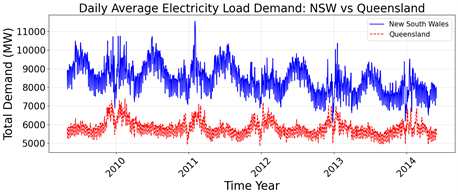
Short-term load forecasting (STLF) is critical in modern power system planning and operation. However, the effectiveness of deep learning models such as Convolutional Neural Networks (CNNs) depends on selecting hyperparameters, which are traditionally tuned through time-consuming trial-and-error processes. The research contribution of this study is to systematically analyze how two key parameters—swarm size and iteration count—in Particle Swarm Optimization (PSO) affect the performance of CNN hyperparameter tuning for STLF. A CNN architecture with fixed convolutional depth is optimized using PSO over selected hyperparameters, including the number of filters, batch size, and training epochs. The experiments use two regional Australian electricity load datasets: New South Wales (NSW) and Queensland (QLD). A three-fold cross-validation strategy is employed, and the Mean Absolute Percentage Error (MAPE) is used as the primary evaluation metric. The results show that optimal PSO configurations vary significantly between datasets, with smaller swarm sizes and moderate iteration counts yielding favorable trade-offs between forecasting accuracy and computational cost. However, the reliance on MAPE, sensitivity to near-zero values, and fixed CNN architecture impose limitations. This study provides practical guidance for selecting PSO settings in deep learning-based STLF and demonstrates that tuning PSO configurations can significantly enhance model performance while reducing computational overhead. Future work may explore adaptive or hybrid optimization methods and extend to more diverse forecasting scenarios.
References
H. Mohd, P. Lazim, and P. Hajek, “An Optimized Hybrid Forecasting Model and Its Application to Air Pollution Concentration,” Arab. J. Sci. Eng., 2020, https://doi.org/10.1007/s13369-020-04572-w.
M. Saviozzi, S. Massucco, and F. Silvestro, “Implementation of advanced functionalities for Distribution Management Systems: Load forecasting and modeling through Artificial Neural Networks ensembles,” Electr. Power Syst. Res., vol. 167, no. September 2018, pp. 230–239, 2019, https://doi.org/10.1016/j.epsr.2018.10.036.
K. Yang, H. Wang, Q. Yang, Y. Shi, C. Zhu, and J. Bi, “An Ensemble Broad Learning Scheme for Short-Term Load Forecasting,” Proc. - 2022 Chinese Autom. Congr. CAC 2022, vol. 2022, pp. 4901–4905, 2022, https://doi.org/10.1109/CAC57257.2022.10056068.
H. Oqaibi and J. Bedi, “A data decomposition and attention mechanism-based hybrid approach for electricity load forecasting,” Complex Intell. Syst., vol. 10, no. 3, pp. 4103–4118, 2024, https://doi.org/10.1007/s40747-024-01380-9.
[5] M. Choubey, J. S. Yadav, and R. K. Chaurasiya, “Stacking Model for Short-Term Electrical Load Forecasting,” 2023 3rd Int. Conf. Energy, Power Electr. Eng. EPEE 2023, pp. 1285–1290, 2023, https://doi.org/10.1109/EPEE59859.2023.10351850.
H. Liu, Y. Tang, Y. Pu, F. Mei, and D. Sidorov, “Short-term Load Forecasting of Multi-Energy in Integrated Energy System Based on Multivariate Phase Space Reconstruction and Support Vector Regression Model,” Electr. Power Syst. Res., vol. 210, no. April, p. 108066, 2022, https://doi.org/10.1016/j.epsr.2022.108066.
A. Livas-García, O. May Tzuc, E. Cruz May, R. Tariq, M. Jimenez Torres, and A. Bassam, “Forecasting of locational marginal price components with artificial intelligence and sensitivity analysis: A study under tropical weather and renewable power for the Mexican Southeast,” Electr. Power Syst. Res., vol. 206, no. November 2021, p. 107793, 2022, https://doi.org/10.1016/j.epsr.2022.107793.
O. Cagcag Yolcu, H. K. Lam, and U. Yolcu, “Short-term load forecasting: cascade intuitionistic fuzzy time series—univariate and bivariate models,” Neural Comput. Appl., vol. 5, 2024, https://doi.org/10.1007/s00521-024-10280-5.
Z. Chen, T. Jin, X. Zheng, Y. Liu, Z. Zhuang, and M. A. Mohamed, “An innovative method-based CEEMDAN–IGWO–GRU hybrid algorithm for short-term load forecasting,” Electr. Eng., vol. 104, no. 5, pp. 3137–3156, 2022, https://doi.org/10.1007/s00202-022-01533-4.
S. K. Panda and P. Ray, “An Effect of Machine Learning Techniques in Electrical Load forecasting and Optimization of Renewable Energy Sources,” J. Inst. Eng. Ser. B, vol. 103, no. 3, pp. 721–736, 2022, https://doi.org/10.1007/s40031-021-00688-1.
W. Khan, W. Somers, S. Walker, K. de Bont, J. Van der Velden, and W. Zeiler, “Comparison of electric vehicle load forecasting across different spatial levels with incorporated uncertainty estimation,” Energy, vol. 283, no. February, p. 129213, 2023, https://doi.org/10.1016/j.energy.2023.129213.
Z. Liao, H. Pan, and X. Fan, “Multiple Wavelet Convolutional Neural Network for Short-Term Load Forecasting,” vol. 8, no. 12, pp. 9730–9739, 2021, https://doi.org/10.1109/JIOT.2020.3026733.
F. C. de Lima Duarte, P. S. G. de Mattos Neto, and P. R. A. Firmino, “A hybrid recursive direct system for multi-step mortality rate forecasting,” J. Supercomput., vol. 80, no. 13, pp. 18430–18463, 2024, https://doi.org/10.1007/s11227-024-06182-x.
A. Ghasemieh, A. Lloyed, P. Bahrami, P. Vajar, and R. Kashef, “A novel machine learning model with Stacking Ensemble Learner for predicting emergency readmission of heart-disease patients,” Decis. Anal. J., vol. 7, no. May, p. 100242, 2023, https://doi.org/10.1016/j.dajour.2023.100242.
G. F. Fan et al., “A new intelligent hybrid forecasting method for power load considering uncertainty,” Knowledge-Based Syst., vol. 280, no. 58, p. 111034, 2023, https://doi.org/10.1016/j.knosys.2023.111034.
J. Wang and J. Cao, “Deep Learning Reservoir Porosity Prediction Using Integrated Neural Network,” Arab. J. Sci. Eng., no. 0123456789, 2021, https://doi.org/10.1007/s13369-021-06080-x .
T. Nguyen Da, M. Y. Cho, and P. Nguyen Thanh, “Optimizing K-means clustering center selection with density-based spatial cluster in radial basis function neural network for load forecasting of smart solar microgrid,” Electr. Eng., pp. 1-16, 2024, https://doi.org/10.1007/s00202-024-02599-y.
Z. Sheng, H. Wang, G. Chen, B. Zhou, and J. Sun, “Convolutional residual network to short-term load forecasting,” Appl. Intell., vol. 51, no. 4, pp. 2485–2499, 2021, https://doi.org/10.1007/s10489-020-01932-9.
X. Chen, M. Yang, Y. Zhang, J. Liu, and S. Yin, “Load Prediction Model of Integrated Energy System Based on CNN-LSTM,” 2023 3rd Int. Conf. Energy Eng. Power Syst. EEPS 2023, pp. 248–251, 2023, https://doi.org/10.1109/EEPS58791.2023.10257124.
Y. Li, Y. Ye, Y. Xu, L. Li, X. Chen, and J. Huang, “Two-stage forecasting of TCN-GRU short-term load considering error compensation and real-time decomposition,” Earth Sci. Informatics, vol. 17, no. 6, pp. 5347-5357, 2024, https://doi.org/10.1007/s12145-024-01456-7.
C. Tong, L. Zhang, H. Li, and Y. Ding, “Attention-based temporal–spatial convolutional network for ultra-short-term load forecasting,” Electr. Power Syst. Res., vol. 220, no. December 2022, p. 109329, 2023, https://doi.org/10.1016/j.epsr.2023.109329.
N. M. M. Bendaoud, N. Farah, and S. Ben Ahmed, “Applying load profiles propagation to machine learning based electrical energy forecasting,” Electr. Power Syst. Res., vol. 203, no. October 2021, p. 107635, 2022, https://doi.org/10.1016/j.epsr.2021.107635.
R. Keshvari, M. Imani, and M. Parsa Moghaddam, “A clustering-based short-term load forecasting using independent component analysis and multi-scale decomposition transform,” J. Supercomput., vol. 78, no. 6, pp. 7908–7935, 2022, https://doi.org/10.1007/s11227-021-04195-4.
S. Yin, Z. Chen, W. Liu, and Z. Su, “Ultra short term charging load forecasting based on improved data decomposition and hybrid neural network,” IEEE Access, vol. 13, no. April, pp. 58778–58789, 2025, https://doi.org/10.1109/ACCESS.2025.3555737.
G. Tricarico, F. Gonzalez-Longatt, F. Marasciuolo, O. Ishchenko, M. Dicorato, and G. Forte, “Sizing and Siting of Energy Storage Systems for Mitigating Forecast Mismatch in Transmission Grid,” IEEE Trans. Ind. Appl., vol. 61, no. 1, pp. 1–12, 2025, https://doi.org/10.1109/TIA.2025.3532580.
B. Li, Y. Mo, F. Gao, and X. Bai, “Short-term probabilistic load forecasting method based on uncertainty estimation and deep learning model considering meteorological factors,” Electr. Power Syst. Res., vol. 225, no. August, p. 109804, 2023, https://doi.org/10.1016/j.epsr.2023.109804.
Y. R. K. Teeparthi, “Distribution System State Estimation with Convolutional Generative Adversarial Imputation Networks for Missing Measurement Data,” Arab. J. Sci. Eng., 2023, https://doi.org/10.1007/s13369-023-08393-5.
Y. K. Ahranjani, M. Beiraghi, and R. Ghanizadeh, “Short time load forecasting for Urmia city using the novel CNN-LTSM deep learning structure,” Electr. Eng., 2024, https://doi.org/10.1007/s00202-024-02361-4.
O. Rubasinghe, X. Zhang, T. K. Chau, Y. H. Chow, T. Fernando, and H. H. C. Iu, “A Novel Sequence to Sequence Data Modelling Based CNN-LSTM Algorithm for Three Years Ahead Monthly Peak Load Forecasting,” IEEE Trans. Power Syst., vol. 39, no. 1, pp. 1932–1947, 2024, https://doi.org/10.1109/TPWRS.2023.3271325.
Y. Guo, J. Wang, Y. Zhong, T. Wang, and Z. Sui, “A Novel Electrical Load Forecasting Model for Extreme Weather Events Based on Improved Gated Spiking Neural P Systems and Frequency Enhanced Channel Attention Mechanism,” IEEE Access, vol. 13, no. November 2024, pp. 4884–4911, 2025, https://doi.org/10.1109/ACCESS.2025.3525479.
Z. Lin, L. Xie, and S. Zhang, “A compound framework for short-term gas load forecasting combining time-enhanced perception transformer and two-stage feature extraction,” Energy, vol. 298, no. April, p. 131365, 2024, https://doi.org/10.1016/j.energy.2024.131365.
C. Wei, D. Pi, M. Ping, and H. Zhang, “Short-term load forecasting using spatial-temporal embedding graph neural network,” Electr. Power Syst. Res., vol. 225, no. August, p. 109873, 2023, https://doi.org/10.1016/j.epsr.2023.109873.
B. Chen and Y. Wang, “Short-Term Electric Load Forecasting of Integrated Energy System Considering Nonlinear Synergy between Different Loads,” IEEE Access, vol. 9, pp. 43562–43573, 2021, https://doi.org/10.1109/ACCESS.2021.3066915.
V. K. Saini, R. Kumar, A. S. Al-Sumaiti, A. Sujil, and E. Heydarian-Forushani, “Learning based short term wind speed forecasting models for smart grid applications: An extensive review and case study,” Electr. Power Syst. Res., vol. 222, no. May, p. 109502, 2023, https://doi.org/10.1016/j.epsr.2023.109502.
T. Bashir, H. Wang, M. Tahir, and Y. Zhang, “Wind and solar power forecasting based on hybrid CNN-ABiLSTM, CNN-transformer-MLP models,” Renew. Energy, vol. 239, no. August 2024, p. 122055, 2025, https://doi.org/10.1016/j.renene.2024.122055.
B. Mechanism, J. Xiao, P. Liu, H. Fang, and X. Liu, “Short-Term Residential Load Forecasting With Baseline-Refinement Profiles and,” IEEE Trans. Smart Grid, vol. 15, no. 1, pp. 1052–1062, 2024, https://doi.org/10.1109/TSG.2023.3290598.
R. Lu et al., “A Novel Sequence-to-Sequence-Based Deep Learning Model for Multistep Load Forecasting,” IEEE Trans. Neural Networks Learn. Syst., vol. 36, no. 1, pp. 638–652, 2024, https://doi.org/10.1109/TNNLS.2023.3329466.
F. Gao, J. Song, and X. Shao, “Short-term interval-valued load forecasting with a combined strategy of iHW and multioutput machine learning,” Ann. Oper. Res., vol. 346, no. 3, pp. 2009–2033, 2025, https://doi.org/10.1007/s10479-024-06446-y.
N. A. Nguyen, T. D. Dang, E. Verdú, and V. Kumar Solanki, “Short-term forecasting electricity load by long short-term memory and reinforcement learning for optimization of hyper-parameters,” Evol. Intell., vol. 16, no. 5, pp. 1729–1746, 2023, https://doi.org/10.1007/s12065-023-00869-5.
X. Wang, “Short-term Power Load Forecasting Model Based on Model Fusion,” pp. 141–144, 2020, https://doi.org/10.1109/AIAM50918.2020.00035.
Y. Huang, Y. Zhao, Z. Wang, X. Liu, and Y. Fu, “Sparse dynamic graph learning for district heat load forecasting,” Appl. Energy, vol. 371, no. March, p. 123685, 2024, https://doi.org/10.1016/j.apenergy.2024.123685.
D. Kiruthiga and V. Manikandan, “Levy flight-particle swarm optimization-assisted BiLSTM + dropout deep learning model for short-term load forecasting,” Neural Comput. Appl., vol. 35, no. 3, pp. 2679–2700, 2023, https://doi.org/10.1007/s00521-022-07751-y.
X. T. Luong, V. H. Bui, D. T. Do, T. H. Quach, and V. A. Truong, “An Improvement of Maximum Power Point Tracking Algorithm Based on Particle Swarm Optimization Method for Photovoltaic System,” Proc. 2020 5th Int. Conf. Green Technol. Sustain. Dev. GTSD 2020, no. November, pp. 53–58, 2020, https://doi.org/10.1109/GTSD50082.2020.9303110.
M. Pratap, Y. Rohit, and D. Kumar, “Resource Provisioning Through Machine Learning in Cloud Services,” Arab. J. Sci. Eng., 2021, https://doi.org/10.1007/s13369-021-05864-5.
W. Liu et al., “Short-term load forecasting based on elastic net improved GMDH and difference degree weighting optimizations,” Appl. Sci., vol. 8, no. 9, 2018, https://doi.org/10.3390/app8091603.
T. A. Nguyen and T. N. Tran, “Improving Short-Term Electrical Load Forecasting with Dilated Convolutional Neural Networks: A Comparative Analysis,” J. Robot. Control, vol. 6, no. 2, pp. 560–569, 2025, https://doi.org/10.18196/jrc.v6i2.24967.
Published
How to Cite
Issue
Section
License
Copyright (c) 2025 Tuan Anh Nguyen, Thanh Ngoc Tran

This work is licensed under a Creative Commons Attribution-ShareAlike 4.0 International License.
Authors who publish with this journal agree to the following terms:
- Authors retain copyright and grant the journal right of first publication with the work simultaneously licensed under a Creative Commons Attribution License that allows others to share the work with an acknowledgment of the work's authorship and initial publication in this journal.
- Authors are able to enter into separate, additional contractual arrangements for the non-exclusive distribution of the journal's published version of the work (e.g., post it to an institutional repository or publish it in a book), with an acknowledgment of its initial publication in this journal.
- Authors are permitted and encouraged to post their work online (e.g., in institutional repositories or on their website) prior to and during the submission process, as it can lead to productive exchanges, as well as earlier and greater citation of published work (See The Effect of Open Access).

This journal is licensed under a Creative Commons Attribution-ShareAlike 4.0 International License.