One-Step-Ahead Half-Hourly Electricity Demand Forecasting in Tasmania Using an Informer-Based Deep Learning Model
DOI:
https://doi.org/10.12928/biste.v8i5.17217Keywords:
Electricity Demand Forecasting, Informer, Deep Learning, Convolutional Neural Network, Multilayer PerceptronAbstract
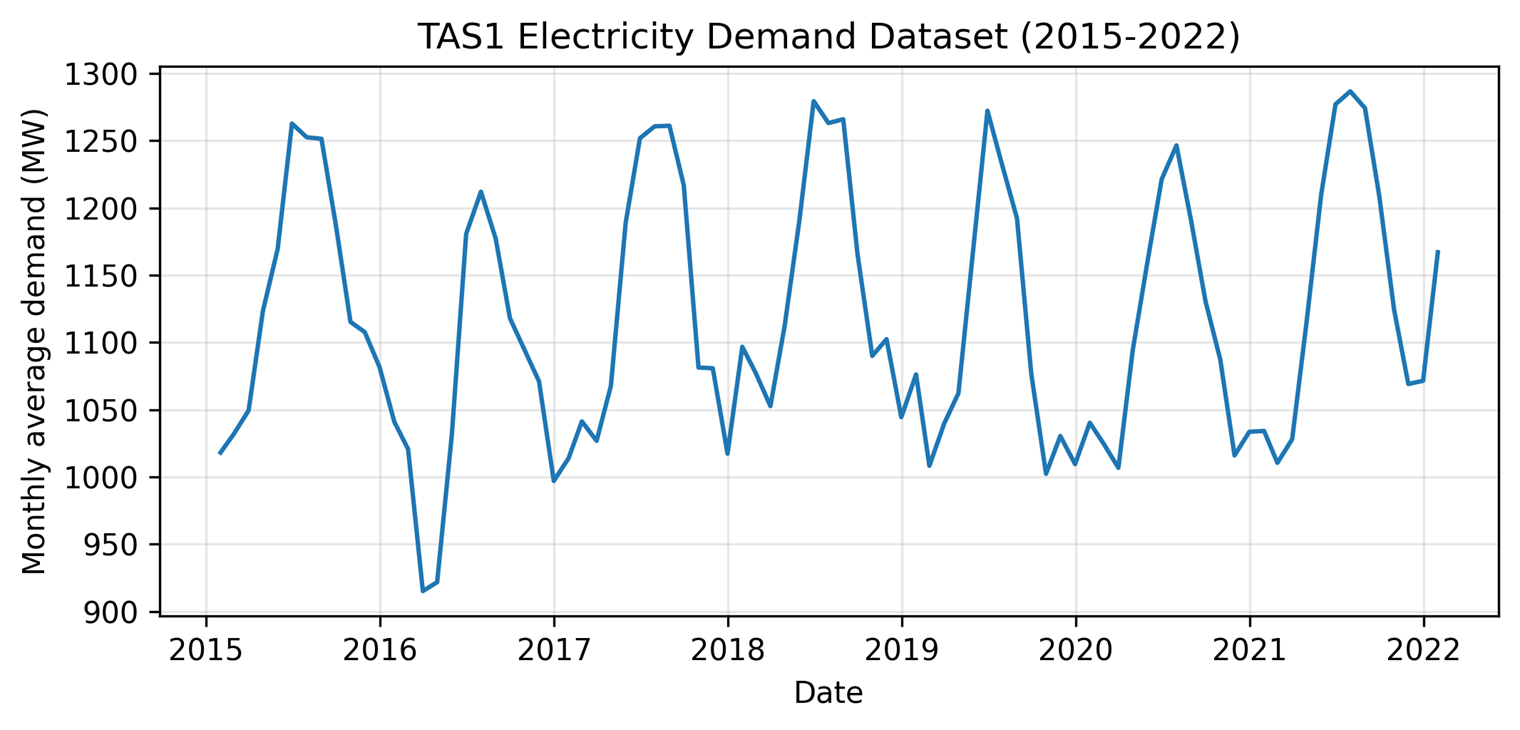
Short-term electric load forecasting is essential for secure and economical power-system operation, yet accurate prediction remains challenging because electricity demand is nonlinear, non-stationary, and influenced by recurring daily and weekly patterns. Although Informer has been widely studied for long-sequence forecasting, its effectiveness and computational trade-offs for one-step-ahead half-hourly load forecasting have not been sufficiently examined through overall, high-load, peak-load, and runtime analyses. The research contribution is a dataset-specific, multi-perspective evaluation of an Informer-based forecasting model against convolutional neural network (CNN) and multilayer perceptron (MLP) baselines using Tasmanian electricity demand data. The experiment uses 122,736 half-hourly observations collected from 1 January 2015 to 1 January 2022. Informer is implemented using NeuralForecast with a one-step forecasting horizon, 336 historical lags, robust scaling, calendar covariates, and rolling evaluation over a common test set of 24,538 samples. Informer achieves an MAE of 16.9317 MW, an MSE of 536.0205, an RMSE of 23.1521 MW, and a MAPE of 1.5832%, providing the best overall accuracy. It reduces MAE and MAPE by 20.22% and 17.67% relative to CNN, and by 42.22% and 39.45% relative to MLP, respectively. Informer also performs best under the top-10% high-load conditions; however, CNN produces the smallest error at the single maximum-load point. MLP records the shortest implementation-specific elapsed time, while Informer achieves the strongest overall forecasting accuracy; however, the reported runtimes were obtained using different software frameworks and timing procedures. These findings demonstrate the practical potential of attention-based long-sequence modeling while highlighting limitations related to peak forecasting, model-specific input lengths, and evaluation on a single regional dataset.
References
Y. Eren and I. B. Küçükdemiral, “A comprehensive review on deep learning approaches for short-term load forecasting,” Renew. Sustain. Energy Rev., vol. 189, p. 114031, 2024, https://doi.org/10.1016/j.rser.2023.114031.
K. Ullah, M. Ahsan, S. M. Hasanat, M. Haris, H. Yousaf, S. F. Raza, and Z. Ullah, “Short-term load forecasting: A comprehensive review and simulation study with CNN-LSTM hybrids approach,” IEEE Access, vol. 12, pp. 111858–111881, 2024, https://doi.org/10.1109/ACCESS.2024.3440631.
A. L’Heureux, K. Grolinger, and M. A. M. Capretz, “Transformer-based model for electrical load forecasting,” Energies, vol. 15, no. 14, p. 4993, 2022, https://doi.org/10.3390/en15144993.
H. Zhou, S. Zhang, J. Peng, S. Zhang, J. Li, H. Xiong, and W. Zhang, “Informer: Beyond efficient transformer for long sequence time-series forecasting,” Proc. AAAI Conf. Artif. Intell., vol. 35, no. 12, pp. 11106–11115, 2021, https://doi.org/10.1609/aaai.v35i12.17325.
Z. Zhao, C. Xia, L. Chi, X. Chang, W. Li, T. Yang, and A. Y. Zomaya, “Short-term load forecasting based on the Transformer model,” Information, vol. 12, no. 12, p. 516, 2021, https://doi.org/10.3390/info12120516.
J. W. Chan and C. K. Yeo, “A Transformer-based approach to electricity load forecasting,” Electr. J., vol. 37, no. 2, p. 107370, 2024, https://doi.org/10.1016/j.tej.2024.107370.
S. H. Rafi, N. Al-Masood, S. R. Deeba, and E. Hossain, “A short-term load forecasting method using integrated CNN and LSTM network,” IEEE Access, vol. 9, pp. 32436–32448, 2021, https://doi.org/10.1109/ACCESS.2021.3060654.
H. Eskandari, M. Imani, and M. P. Moghaddam, “Convolutional and recurrent neural network-based model for short-term load forecasting,” Electr. Power Syst. Res., vol. 195, p. 107173, 2021, https://doi.org/10.1016/j.epsr.2021.107173.
M. N. Fekri, H. Patel, K. Grolinger, and V. Sharma, “Deep learning for load forecasting with smart meter data: Online adaptive recurrent neural network,” Appl. Energy, vol. 282, p. 116177, 2021, https://doi.org/10.1016/j.apenergy.2020.116177.
M. N. Fekri, K. Grolinger, and S. Mir, “Distributed load forecasting using smart meter data: Federated learning with recurrent neural networks,” Int. J. Electr. Power Energy Syst., vol. 137, p. 107669, 2022, https://doi.org/10.1016/j.ijepes.2021.107669.
D. Li, G. Sun, S. Miao, Y. Gu, Y. Zhang, and S. He, “A short-term electric load forecast method based on improved sequence-to-sequence GRU with adaptive temporal dependence,” Int. J. Electr. Power Energy Syst., vol. 137, p. 107627, 2022, https://doi.org/10.1016/j.ijepes.2021.107627.
W. Yang, J. Shi, S. Li, Z. Song, Z. Zhang, and Z. Chen, “A combined deep learning load forecasting model of single household resident user considering multi-time scale electricity consumption behavior,” Appl. Energy, vol. 307, p. 118197, 2022, https://doi.org/10.1016/j.apenergy.2021.118197.
P. P. Phyo and C. Jeenanunta, “Advanced ML-based ensemble and deep learning models for short-term load forecasting: Comparative analysis using feature engineering,” Appl. Sci., vol. 12, no. 10, p. 4882, 2022, https://doi.org/10.3390/app12104882.
K. Wu, J. Wu, L. Feng, B. Yang, R. Liang, S. Yang, and R. Zhao, “An attention-based CNN-LSTM-BiLSTM model for short-term electric load forecasting in an integrated energy system,” Int. Trans. Electr. Energy Syst., vol. 31, no. 1, p. e12637, 2021, https://doi.org/10.1002/2050-7038.12637.
Y. Wang, “An electricity load forecasting model based on multilayer dilated LSTM network and attention mechanism,” Frontiers in Energy Research, vol. 11, Art. no. 1116465, 2023, https://doi.org/10.3389/fenrg.2023.1116465.
H. Bian, Q. Wang, G. Xu, and X. Zhao, “Load forecasting of a hybrid deep learning model considering accumulated temperature effect,” Energy Rep., vol. 8, pp. 205–215, 2022, https://doi.org/10.1016/j.egyr.2021.11.082.
J. Cui, X. Zhang, F. Bi, C. Li, W. Kuang, K. Geng, and A. Bi, “Advanced short-term load forecasting with XGBoost-RF feature selection and CNN-GRU,” Processes, vol. 12, no. 11, p. 2466, 2024, https://doi.org/10.3390/pr12112466.
S. M. Hasanat, M. Ahsan, K. Ullah, M. Haris, H. Yousaf, S. F. Raza, and Z. Ullah, “Enhancing short-term load forecasting with a CNN-GRU neural network with an attention mechanism,” IEEE Access, vol. 12, pp. 188791–188805, 2024, https://doi.org/10.1109/ACCESS.2024.3511653.
X. Wen, H. Zhou, J. Liu, and Y. Zhang, “Deep learning-driven hybrid model for short-term load forecasting and smart grid information management,” Sci. Rep., vol. 14, p. 13632, 2024, https://doi.org/10.1038/s41598-024-63262-x.
Y. Wang, “Short-term power load forecasting using SSA-CNN-LSTM,” Syst. Sci. Control Eng., vol. 12, no. 1, p. 2343297, 2024, https://doi.org/10.1080/21642583.2024.2343297.
R. Zink, “Continual learning for very short-term load forecasting,” Appl. Energy, vol. 384, p. 126905, 2025, https://doi.org/10.1016/j.apenergy.2025.126905.
R. Panigrahi, N. R. Patne, B. V. S. Vardhan, and M. Khedkar, “Short-term load analysis and forecasting using stochastic approach considering pandemic effects,” Electr. Eng., vol. 106, pp. 3387–3401, 2024, https://doi.org/10.1007/s00202-023-02135-4.
O. Timur, “Short-term electric load forecasting for an industrial plant,” Energies, vol. 18, no. 5, p. 1144, 2025, https://doi.org/10.3390/en18051144.
H. I. Beloev, “Short-term electrical load forecasting based on XGBoost,” Energies, vol. 18, no. 19, p. 5144, 2025, https://doi.org/10.3390/en18195144.
M. J. Milovanović, M. M. Dragičević, N. R. Krečković, and B. D. Perović, “Short-term load forecasting with Taguchi-optimized single-layer feedforward neural networks: A MATLAB GUI,” ICCK Trans. Electr. Power Netw. Syst., vol. 1, no. 2, pp. 70–81, 2025, https://doi.org/10.62762/TEPNS.2025.295010.
K. H. Baesmat and F. Shokoohi, “Evaluation of aggregate vs. appliance-level forecasting,” Smart Cities, vol. 8, no. 6, p. 199, 2025, https://doi.org/10.3390/smartcities8060199.
J. Chen, “Short-term electricity load forecasting based on deep learning,” Appl. Sci., vol. 14, no. 14, p. 5966, 2024, https://doi.org/10.3390/app14145966.
F. Guo, “A hybrid stacking model for enhanced short-term load forecasting,” Electronics, vol. 13, no. 14, p. 2719, 2024, https://doi.org/10.3390/electronics13142719.
Q. Jiang, Y. Cheng, H. Le, C. Li, and P. X. Liu, “A stacking learning model based on multiple similar days for short-term load forecasting,” Mathematics, vol. 10, no. 14, p. 2446, 2022, https://doi.org/10.3390/math10142446.
F. U. M. Ullah, N. Khan, T. Hussain, M. Y. Lee, and S. W. Baik, “Diving deep into short-term electricity load forecasting: Comparative analysis and a novel framework,” Mathematics, vol. 9, no. 6, p. 611, 2021, https://doi.org/10.3390/math9060611.
H. Qiu, R. Hu, J. Chen, and Z. Yuan, “Short-term electricity load forecasting based on complete ensemble empirical mode decomposition with adaptive noise and improved sparrow search algorithm–convolutional neural network–bidirectional long short-term memory model,” Mathematics, vol. 13, no. 5, p. 813, 2025, https://doi.org/10.3390/math13050813.
B. Chen and Y. Wang, “Short-term electric load forecasting of integrated energy system considering nonlinear synergy between different loads,” IEEE Access, vol. 9, pp. 43562–43573, 2021, https://doi.org/10.1109/ACCESS.2021.3066915.
M. He, J. Zhang, and H. Wang, “A spatial-temporal attention network for short-term load forecasting of power systems,” Electr. Power Syst. Res., vol. 209, p. 107969, 2022, https://doi.org/10.1016/j.epsr.2022.107969.
M. A. H. Akhand, S. Ahmed, M. A. Rahman, and M. M. H. Rahman, “Short-term load forecasting using deep learning and optimization techniques: A review,” Neural Comput. Appl., vol. 35, pp. 15463–15494, 2023, https://doi.org/10.1007/s00521-023-08448-4.
M. F. H. Shiblee and P. Koukaras, “Short-term load forecasting in the Greek power system,” Energies, vol. 18, no. 19, p. 5060, 2025, https://doi.org/10.3390/en18195060.
B. Magalhães, J. C. Ferreira, and J. S. Cardoso, “Short-term load forecasting based on optimized deep learning models,” Energies, vol. 17, no. 8, p. 1926, 2024, https://doi.org/10.3390/en17081926.
Q. Cheng, Y. Zhang, and X. Liu, “Short-term load forecasting based on similar day theory and BWO-VMD,” Energies, vol. 18, no. 9, p. 2358, 2025, https://doi.org/10.3390/en18092358.
B. W.-K. Yiu, T. Zhang, and C. W. Lee, “Short-term load forecasting using regularized greedy forest-based ensemble model,” IEEE Access, vol. 12, pp. 112426–112439, 2024, https://doi.org/10.1109/ACCESS.2024.3441642.
H. H. Goh et al., “Multi-convolution feature extraction and recurrent neural network dependent model for short-term load forecasting,” IEEE Access, vol. 9, pp. 118528–118540, 2021, https://doi.org/10.1109/ACCESS.2021.3107954.
B. Farsi, M. Amayri, N. Bouguila, and U. Eicker, “On short-term load forecasting using machine learning techniques and a novel parallel deep LSTM-CNN approach,” IEEE Access, vol. 9, pp. 31191–31212, 2021, https://doi.org/10.1109/ACCESS.2021.3060290.
X. Ji, H. Huang, D. Chen, K. Yin, Z. Zuo, Z. Chen, and R. Bai, “A hybrid residential short-term load forecasting method using attention mechanism and deep learning,” Buildings, vol. 13, no. 1, p. 72, 2023, https://doi.org/10.3390/buildings13010072.
S. Lu and T. Bao, “Short-term electricity load forecasting based on NeuralProphet and CNN-LSTM,” IEEE Access, vol. 12, pp. 84098–84112, 2024, https://doi.org/10.1109/ACCESS.2024.3407094.
A. Mathew, R. K. Mehta, and S. K. Singh, “Medium-term feeder load forecasting and boosting peak accuracy prediction using the PWP-XGBoost model,” Electr. Power Syst. Res., vol. 237, p. 111051, 2024, https://doi.org/10.1016/j.epsr.2024.111051.
Ş. Özdemir, Y. Demir, and Ö. Yildirim, “The effect of input length on prediction accuracy in short-term multi-step electricity load forecasting: A CNN-LSTM approach,” IEEE Access, 2025, https://doi.org/10.1109/ACCESS.2025.3540636.
T. H. Nguyen et al., “Hybrid HHO-Wavenet model applies in short-term load forecasting for microgrid system,” in Proc. 6th Int. Conf. Green Technol. Sustain. Dev. (GTSD), pp. 1177–1183, 2022, https://doi.org/10.1109/GTSD54989.2022.9989027.
O. Rubasinghe, X. Zhang, T. K. Chau, Y. H. Chow, T. Fernando, and H. H.-C. Iu, “A novel sequence-to-sequence data modeling based CNN-LSTM algorithm for three years ahead monthly peak load forecasting,” IEEE Trans. Power Syst., vol. 39, no. 1, pp. 1932–1947, Jan. 2024, https://doi.org/10.1109/TPWRS.2023.3271325.
Y. Wang, N. Zhang, and X. Chen, “A short-term residential load forecasting model based on LSTM recurrent neural network considering weather features,” Energies, vol. 14, no. 10, p. 2737, 2021, https://doi.org/10.3390/en14102737.
F. Rodrigues, C. Cardeira, J. M. F. Calado, and R. Melicio, “Short-term load forecasting of electricity demand for the residential sector based on modeling techniques: A systematic review,” Energies, vol. 16, no. 10, p. 4098, 2023, https://doi.org/10.3390/en16104098.
B. Ibrahim and J. Rabelo, “Machine learning for short-term load forecasting in smart grids,” Energies, vol. 15, no. 21, p. 8079, 2022, https://doi.org/10.3390/en15218079.
S. Akhtar, S. Shahzad, A. Zaheer, H. S. Ullah, H. Kilic, R. Gono, M. Jasiński, and Z. Leonowicz, “Short-term load forecasting models: A review of challenges, progress, and the road ahead,” Energies, vol. 16, no. 10, p. 4060, 2023, https://doi.org/10.3390/en16104060.
G. Aquila, L. B. S. Morais, V. A. D. de Faria, J. W. M. Lima, L. M. M. Lima, and A. R. de Queiroz, “An overview of short-term load forecasting for electricity systems operational planning: Machine learning methods and the Brazilian experience,” Energies, vol. 16, no. 21, p. 7444, 2023, https://doi.org/10.3390/en16217444.
M. D. Alanazi, “Enhancing short-term electrical load forecasting for sustainable energy management using a hybrid deep learning model,” Sustainability, vol. 15, no. 24, p. 16885, 2023, https://doi.org/10.3390/su152416885.
M. Wood, “Day-ahead electric load forecast: A comprehensive LSTM-based approach,” Forecasting, vol. 5, no. 1, pp. 244–258, 2023, https://doi.org/10.3390/forecast5010016.
Z. Huang, Y. Chen, and X. Wang, “Short-term load forecasting for regional smart energy systems,” Sustainability, vol. 16, no. 17, p. 7613, 2024, https://doi.org/10.3390/su16177613.
W. Cao, Y. Liu, and J. Zhang, “Residential load forecasting based on long short-term memory neural networks,” Sustainability, vol. 16, no. 24, p. 11252, 2024, https://doi.org/10.3390/su162411252.
Z. Yang, H. Liu, and Y. Li, “Forecasting very short-term power load with hybrid machine learning models,” Syst. Sci. Control Eng., vol. 13, no. 1, p. 2486136, 2025, https://doi.org/10.1080/21642583.2025.2486136.
H. Li, J. Wang, and X. Zhou, “Short-term power load forecasting for integrated energy systems based on deep learning,” Front. Energy Res., vol. 12, p. 1384142, 2024, https://doi.org/10.3389/fenrg.2024.1384142.
G.-F. Fan, Y.-Y. Han, J.-W. Li, L.-L. Peng, Y.-H. Yeh, and W.-C. Hong, “A hybrid model for deep learning short-term power load forecasting based on feature extraction statistical techniques,” Expert Syst. Appl., vol. 238, p. 122012, 2024, https://doi.org/10.1016/j.eswa.2023.122012.
C. Yin and S. Mao, “Fractional multivariate grey Bernoulli model combined with improved grey wolf algorithm: Application in short-term power load forecasting,” Energy, vol. 269, p. 126844, 2023, https://doi.org/10.1016/j.energy.2023.126844.
V. Ekambaram, A. Jati, N. Nguyen, P. Sinthong, and J. Kalagnanam, “TSMixer: Lightweight MLP-mixer model for multivariate time series forecasting,” in Proc—29th ACM SIGKDD Conf. Knowl. Discov. Data Mining, pp. 459–469, 2023, https://doi.org/10.1145/3580305.3599533.
K. Benidis et al., “Deep learning for time series forecasting: Tutorial and literature survey,” ACM Comput. Surv., vol. 55, no. 6, pp. 1–36, 2022, https://doi.org/10.1145/3533382.
A. Zeng, M. Chen, L. Zhang, and Q. Xu, “Are transformers effective for time series forecasting?” Proc. AAAI Conf. Artif. Intell., vol. 37, no. 9, pp. 11121–11128, 2023, https://doi.org/10.1609/aaai.v37i9.26317.
C. Challu, K. G. Olivares, B. N. Oreshkin, F. G. Ramirez, M. M. Canseco, and A. Dubrawski, “N-HiTS: Neural hierarchical interpolation for time series forecasting,” Proc. AAAI Conf. Artif. Intell., vol. 37, no. 6, pp. 6989–6997, 2023, https://doi.org/10.1609/aaai.v37i6.25854.
Z. Liu, H. Alavi, M. Li, and X. Zhang, “Self-supervised learning for time series forecasting: A review,” Knowl.-Based Syst., vol. 257, p. 109928, 2022, https://doi.org/10.1016/j.knosys.2022.109928.
K. G. Olivares, C. Challu, G. Marcjasz, R. Weron, and A. Dubrawski, “NeuralForecast: User-friendly state-of-the-art neural forecasting models,” J. Open Source Softw., vol. 7, no. 79, p. 4570, 2022, https://doi.org/10.21105/joss.04570.
P. Lara-Benitez, M. Carranza-Garcia, and J. C. Riquelme, “An experimental review on deep learning architectures for time series forecasting,” Int. J. Neural Syst., vol. 31, no. 3, p. 2130001, 2021, https://doi.org/10.1142/S0129065721300011.
C. Sun, Y. Zhang, and H. Wang, “Graph neural network-based short-term load forecasting framework with dilated temporal convolution,” Data Sci. Eng., vol. 9, pp. 100–115, 2024, https://doi.org/10.1007/s41019-023-00233-8.
D. Feng, D. Li, Y. Zhou, and W. Wang, “MLFGCN: Short-term residential load forecasting via graph attention temporal convolution network,” Frontiers in Neurorobotics, vol. 18, p. 1461403, 2024, https://doi.org/10.3389/fnbot.2024.1461403.
C. Cai, Y. Wang, and X. Li, “Short-term load forecasting based on deep learning and multi-layer stacked bidirectional LSTM,” Appl. Sci., vol. 11, no. 17, p. 8129, 2021, https://doi.org/10.3390/app11178129.
H. A. Al-Jamimi, M. A. Alotaibi, and A. K. Al-Othman, “Advancements in household load forecasting: Deep learning-based approaches and comparative analysis,” Electronics, vol. 12, no. 24, p. 4909, 2023, https://doi.org/10.3390/electronics12244909.
Published
How to Cite
Issue
Section
License
Copyright (c) 2026 Tuan Anh Nguyen

This work is licensed under a Creative Commons Attribution-ShareAlike 4.0 International License.
Authors who publish with this journal agree to the following terms:
- Authors retain copyright and grant the journal right of first publication with the work simultaneously licensed under a Creative Commons Attribution License that allows others to share the work with an acknowledgment of the work's authorship and initial publication in this journal.
- Authors are able to enter into separate, additional contractual arrangements for the non-exclusive distribution of the journal's published version of the work (e.g., post it to an institutional repository or publish it in a book), with an acknowledgment of its initial publication in this journal.
- Authors are permitted and encouraged to post their work online (e.g., in institutional repositories or on their website) prior to and during the submission process, as it can lead to productive exchanges, as well as earlier and greater citation of published work (See The Effect of Open Access).

This journal is licensed under a Creative Commons Attribution-ShareAlike 4.0 International License.