A Hybrid Ensemble Empirical Mode Decomposition–Temporal Convolutional Network Framework with LightGBM Residual Correction for Day-Ahead Electric Load Forecasting
DOI:
https://doi.org/10.12928/biste.v8i5.17013Keywords:
Day-Ahead Load Forecasting, Ensemble Empirical Mode Decomposition, LightGBM, Residual Correction, Temporal Convolutional NetworkAbstract
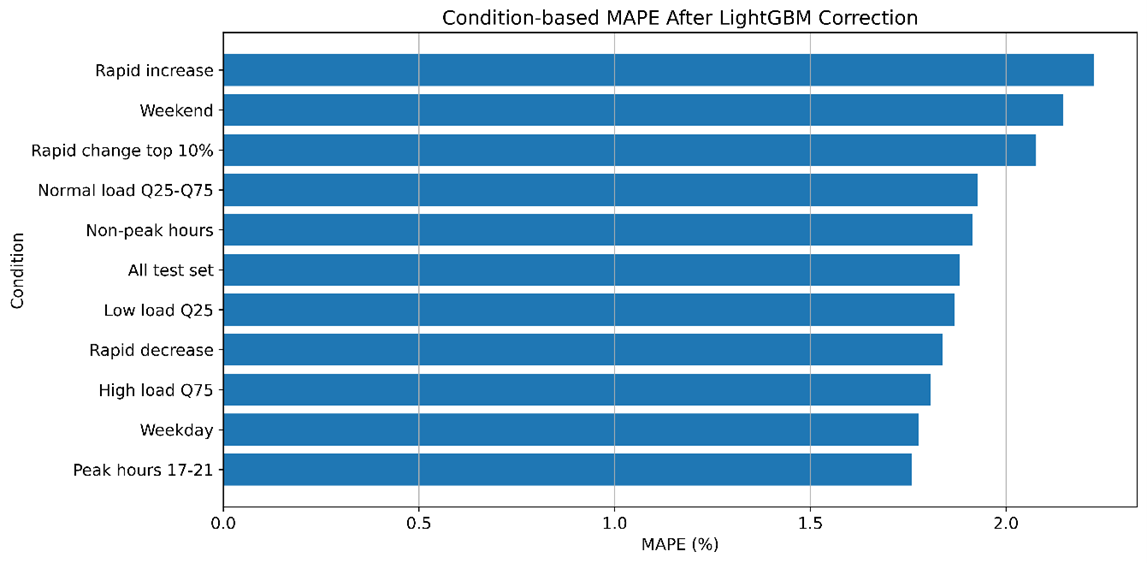
Accurate day-ahead load forecasting is essential for generation scheduling, reserve allocation, electricity-market operation, and reliable power-system management. However, half-hourly electricity demand is nonlinear and non-stationary, with short-term fluctuations, daily and weekly periodicity, and slowly varying trends occurring simultaneously. This study proposes a unified hybrid framework that combines ensemble empirical mode decomposition, a temporal convolutional network, and validation-calibrated LightGBM residual correction for direct day-ahead forecasting. The main contribution is the coordinated use of multi-scale signal representation, direct multi-output temporal learning, and controlled residual correction within a single forecasting pipeline. Ensemble empirical mode decomposition separates the original load series into nine intrinsic mode functions and one residue, which are organized as a synchronized ten-channel input. The temporal convolutional network then maps a seven-day historical window of 336 half-hourly observations directly to the subsequent 48 load values, avoiding recursive error propagation. LightGBM is subsequently trained to estimate structured residuals using the base forecast, forecast horizon, calendar variables, historical lags, rolling statistics, and decomposition-derived features. To limit overcorrection, the residual model is trained on an earlier validation subset, while a separate chronological calibration subset selects the correction coefficient, which was 0.30 in the reported experiment. Experiments using Queensland electricity-demand data from 2015 to 2019 yielded an RMSE of 156.92 MW, an MAE of 116.48 MW, a MAPE of 1.8825%, a WAPE of 1.8746%, and an R² of 0.9692 for the proposed framework. Under the stored offline evaluation setting, these error values were lower than those reported for the standalone LightGBM and raw-series temporal convolutional network baselines. Because the baseline pipelines contain closely matched but not completely identical test-origin sets, the comparisons are interpreted descriptively rather than as fully paired statistical evidence. In addition, EEMD is applied offline to the complete series; therefore, the reported results represent a decomposition-assisted benchmark rather than a strictly causal real-time forecasting implementation. The findings suggest that multi-scale representation, temporal convolution, and calibrated residual learning can provide complementary benefits under the considered experimental setting.
References
Y. Kong, Y. Kong, Y. Chen, J. Du, Y. Yang, and Q. Xu, “A bidding strategy for virtual power plants in the day-ahead market,” Energies, vol. 18, no. 18, p. 4874, 2025, https://doi.org/10.3390/en18184874.
K. K. Miskiw, E. Kraft, and S.-E. Fleten, “Coordinated bidding in sequential electricity markets: Effects of price-making,” Energy Economics, vol. 144, p. 108316, 2025, https://doi.org/10.1016/j.eneco.2025.108316.
A. Petrusic and A. Janjic, “Fuzzy Multiple Linear Regression for the Short Term Load Forecast,” in 2020 55th International Scientific Conference on Information, Communication and Energy Systems and Technologies ICEST, pp. 102–105, 2020, https://doi.org/10.1109/ICEST49890.2020.9232776.
L. Pérez-Domínguez, H. Garg, D. Luviano-Cruz, and J. L. García Alcaraz, “Estimation of linear regression with the dimensional analysis method,” Mathematics, vol. 10, no. 10, p. 1645, 2022, https://doi.org/10.3390/math10101645.
H. M. Al-Hamadi, “Long-term electric power load forecasting using fuzzy linear regression technique,” in 2011 IEEE Power Engineering and Automation Conference, vol. 3, pp. 96–99, 2011, https://doi.org/10.1109/PEAM.2011.6135023.
L. Han, P. Pinson, and J. Kazempour, “Trading data for wind power forecasting: A regression market with lasso regularization,” Electric Power Systems Research, vol. 212, p. 108442, 2022, https://doi.org/10.1016/j.epsr.2022.108442.
V. Urošević and A. M. Savić, “Temporal clustering for accurate short-term load forecasting using Bayesian multiple linear regression,” Applied Intelligence, vol. 55, no. 1, p. 10, 2025, https://doi.org/10.1007/s10489-024-05887-z.
M. Pleños, “Time Series Forecasting Using Holt-Winters Exponential Smoothing: Application to Abaca Fiber Data,” Zeszyty Naukowe Szkoły Główniej Gospodarstwa Wiejskiego w Warszawie - Problemy Rolnictwa Światowego, vol. 22, no. 2, pp. 17–29, 2022, https://doi.org/10.22630/prs.2022.22.2.6.
S. Sawalha and G. Al-Naymat, “An Adaptive Holt–Winters Model for Seasonal Forecasting of Internet of Things IoT Data Streams,” Internet of Things, vol. 6, no. 3, pp. 1–18, 2025, https://doi.org/10.3390/iot6030039.
U. I. Lezama Lope, A. Benavides-Vázquez, G. Santamaría-Bonfil, and R. Z. Ríos-Mercado, “Fast and Efficient Very Short-Term Load Forecasting Using Analogue and Moving Average Tools,” IEEE Transactions on Learning Technologies, vol. 21, no. 9, pp. 1015–1021, 2023, https://doi.org/10.1109/tla.2023.10251808.
A. Jarraya et al., “On-Site temperature and irradiance forecast tuning for improved load prediction in buildings,” Energy and Buildings, vol. 337, p. 115642, 2025, https://doi.org/10.1016/j.enbuild.2025.115642.
S. Deng, X. Dong, L. Tao, J. Wang, Y. He, and D. Yue, “Multi-type load forecasting model based on random forest and density clustering with the influence of noise and load patterns,” Energy, vol. 307, p. 132635, 2024, https://doi.org/10.1016/j.energy.2024.132635.
S. Sarker, A. Sarker, A. Razzak, and Z. R. Khan, “Hybrid Deep Learning-Based Multivariate Forecasting of Relative Humidity and Air Temperature: A Case Study of the Rangpur Division, Bangladesh,” Expert Systems with Applications, vol. 299, p. 133184, 2026, https://doi.org/10.1016/j.eswa.2026.133184.
U. Samal and A. Kumar, “Enhancing Software Reliability Forecasting Through a Hybrid ARIMA-ANN Model,” Arabian Journal for Science and Engineering, vol. 49, no. 5, pp. 6845–6859, 2023, https://doi.org/10.1007/s13369-023-08486-1.
S. Chen, R. Lin, and W. Zeng, “Short-Term Load Forecasting Method Based on ARIMA and LSTM,” in 2022 IEEE 25th International Conference on Computer Communication Technology ICCT, pp. 1913–1917, 2022, https://doi.org/10.1109/ICCT56141.2022.10073051.
J. A. C. Dias et al., “Enhanced Carbon Flux Forecasting via STL Decomposition and Hybrid ARIMA-ES-LSTM Model in Amazon Forest,” IEEE Access, vol. 13, pp. 84713–84726, 2025, https://doi.org/10.1109/ACCESS.2025.3561166.
H. Zhang, X. Liu, X. Gao, and Z. Liu, “Hybrid ARIMAX model integrating optimal time-lag selection and markov chain error correction for residential heating load forecasting,” Energy Reports, vol. 14, pp. 5259–5273, 2025, https://doi.org/10.1016/j.egyr.2025.11.082.
X. Guo, Q. Zhao, D. Zheng, Y. Ning, and Y. Gao, “A short-term load forecasting model of multi-scale CNN-LSTM hybrid neural network considering the real-time electricity price,” Energy Reports, vol. 6, pp. 1046–1053, 2020, https://doi.org/10.1016/j.egyr.2020.11.078.
H. Nagpal, A. Soppelsa, H. Madsen, and R. Fedrizzi, “An adaptive multi-seasonal ARIMA approach for domestic hot water load forecasting: A pilot study,” Energy and Buildings, vol. 347, p. 116226, 2025, https://doi.org/10.1016/j.enbuild.2025.116226.
G. F. Fan, R. T. Zhang, C. C. Cao, Y. H. Yeh, and W. C. Hong, “Applications of empirical wavelet decomposition, statistical feature extraction, and antlion algorithm with support vector regression for resident electricity consumption forecasting,” Nonlinear Dynamics, vol. 111, no. 21, pp. 20139–20163, 2023, https://doi.org/10.1007/s11071-023-08922-9.
Z. Zhang, Y. Dong, and W. C. Hong, “Long Short-Term Memory-Based Twin Support Vector Regression for Probabilistic Load Forecasting,” IEEE Transactions on Neural Networks and Learning Systems, vol. 36, no. 1, pp. 1764–1778, 2023, https://doi.org/10.1109/TNNLS.2023.3335355.
S. Sreekumar, J. Verma, A. Sujil, and R. Kumar, “One day forth forecasting of hourly electrical load using genetically tuned Support Vector Regression for smart grid frame work,” in 2015 2nd International Conference on Recent Advances in Engineering & Computational Sciences RAECS, pp. 1–6, 2016, https://doi.org/10.1109/RAECS.2015.7453405.
Z. Zhang, Q. Zhang, H. Liang, and B. Gorbani, “Optimizing electric load forecasting with support vector regression/LSTM optimized by flexible Gorilla troops algorithm and neural networks a case study,” Scientific Reports, vol. 14, no. 1, pp. 1–20, 2024, https://doi.org/10.1038/s41598-024-73893-9.
M. Safari, A. H. Rabiee, and J. Joudaki, “Developing a Support Vector Regression SVR Model for Prediction of Main and Lateral Bending Angles in Laser Tube Bending Process,” Materials, vol. 16, no. 8, p. 3251, 2023, https://doi.org/10.3390/ma16083251.
A. Lindholm, N. Wahlström, F. Lindsten, and T. B. Schön, Machine Learning: A First Course for Engineers and Scientists. 2022, https://doi.org/10.1017/9781108919371.
N. N. Sergeev and P. V. Matrenin, “Enhancing Efficiency of Ensemble Machine Learning Models for Short-Term Load Forecasting through Feature Selection,” in 2022 IEEE 23rd International Conference of Young Specialists on Micro/Nanotechnologies and Electron Devices EDM, pp. 368–371, 2022, https://doi.org/10.1109/EDM55285.2022.9855022.
Y. Chen, C. Lin, Y. Zhang, J. Liu, and D. Yu, “Day-ahead load forecast based on Conv2D-GRU_SC aimed to adapt to steep changes in load,” Energy, vol. 302, p. 131814, 2024, https://doi.org/10.1016/j.energy.2024.131814.
M. Ahmed, T. A. Elgalhud, M. Navid, S. Mir, and K. Grolinger, “Federated Online Learning for adaptive load forecasting across decentralized nodes,” International Journal of Electrical Power & Energy Systems, vol. 169, p. 110779, 2025, https://doi.org/10.1016/j.ijepes.2025.110779.
U. Singh and S. Vadhera, “Random Forest and Xgboost Technique for Short-Term Load Forecasting,” in 2022 1st International Conference on Sustainable Technology for Power and Energy Systems STPES, pp. 1–6, 2022, https://doi.org/10.1109/STPES54845.2022.10006635.
V. Veeramsetty, K. R. Reddy, M. Santhosh, A. Mohnot, and G. Singal, “Short-term electric power load forecasting using random forest and gated recurrent unit,” Electrical Engineering, vol. 104, no. 1, pp. 307–329, 2022, https://doi.org/10.1007/s00202-021-01376-5.
S. Wang and J. Ma, “A Novel Ensemble Model for Load Forecasting: Integrating Random Forest, XGBoost, and Seasonal Naive Methods,” in 2023 2nd Asian Conference on Frontiers of Power and Energy ACFPE, pp. 114–118, 2023, https://doi.org/10.1109/ACFPE59335.2023.10455494.
E. Nziyumva, R. Hu, C.-Y. Hsu, and J. Niyogisubizo, “Electrical load forecasting using hybrid of extreme gradient boosting and light gradient boosting machine,” in The International Conference on Image, Vision and Intelligent Systems ICIVIS 2021, vol. 813, pp. 1083–1093, 2022, https://doi.org/10.1007/978-981-16-6963-7_95.
P. Saini and S. K. Parida, “A novel probabilistic gradient boosting model with multi-approach feature selection and iterative seasonal trend decomposition for short-term load forecasting,” Energy, vol. 294, p. 130975, 2024, https://doi.org/10.1016/j.energy.2024.130975.
Z. Qinghe, X. Wen, H. Boyan, W. Jong, and F. Junlong, “Optimised extreme gradient boosting model for short term electric load demand forecasting of regional grid system,” Scientific Reports, vol. 12, no. 1, pp. 1–12, 2022, https://doi.org/10.1038/s41598-022-22024-3.
M. Mohamed, F. E. Mahmood, M. A. Abd, M. Rezkallah, and A. Hamadi, “Load Demand Forecasting Using eXtreme Gradient Boosting XGBoost,” in 2023 IEEE Industry Applications Society Annual Meeting IAS, pp. 1–7, 2023, https://doi.org/10.1109/IAS54024.2023.10406613.
S. Singh and M. M. Tripathi, “A Comparative Analysis of Extreme Gradient Boosting Technique with Long Short-Term Memory and Layered Recurrent Neural Network for Electricity Demand Forecas,” in 2021 6th International Conference on Recent Trends in Electronics, Information & Communication Technology RTEICT, pp. 297–302, 2021, https://doi.org/10.1109/RTEICT52294.2021.9573988.
G. Suo, L. Song, Y. Dou, Z. Cui, and A. X. Principle, “Multi-dimensional Short-term Load Forecasting Based on XGBoost and Fireworks Algorithm,” in 2019 18th International Symposium on Distributed Computing and Applications for Business Engineering and Science DCABES, pp. 245–248, 2019, https://doi.org/10.1109/DCABES48411.2019.00068.
L. Zhang and D. Jánošík, “Enhanced short-term load forecasting with hybrid machine learning models: CatBoost and XGBoost approaches,” Expert Systems with Applications, vol. 241, p. 122686, 2024, https://doi.org/10.1016/j.eswa.2023.122686.
M. Shafiuzzaman et al., “Enhanced very short-term load forecasting with multi-lag feature engineering and prophet-XGBoost-CatBoost architecture,” Energy, vol. 335, p. 137981, 2025, https://doi.org/10.1016/j.energy.2025.137981.
J. Zhou and M. Ding, “Short-term load forecasting for holidays based on similar days selecting and XGBoost model,” in 2023 IEEE 8th International Conference on Power and Renewable Energy ICPRE, pp. 1–5, 2023, https://doi.org/10.1109/ICPS58381.2023.10128055.
L. Semmelmann, S. Henni, and C. Weinhardt, “Load forecasting for energy communities: a novel LSTM-XGBoost hybrid model based on smart meter data,” Energy Informatics, vol. 5, no. 1, pp. 1–21, 2022, https://doi.org/10.1186/s42162-022-00212-9.
K. Mishra, A. Yadav, and N. D. Londhe, “Load demand forecasting of chhattisgarh state for demand management system with optimal feature selection using XGBOOST approach,” Electric Power Systems Research, vol. 253, p. 112567, 2026, https://doi.org/10.1016/j.epsr.2025.112567.
F. Wang, “Net Load Segmented Forecasting Method For Data Center Based on GS-LightGBM Model,” in 2023 IEEE IAS Global Conference on Renewable Energy and Hydrogen Technologies GlobConHT, pp. 1–6, 2023, https://doi.org/10.1109/GlobConHT56829.2023.10087415.
Z. Fang, J. Zhan, J. Cao, L. Gan, and H. Wang, “Research on Short-Term and Medium-Term Power Load Forecasting Based on STL-LightGBM,” in 2022 2nd International Conference on Electrical Engineering and Control Science IC2ECS, pp. 1047–1051, 2022, https://doi.org/10.1109/IC2ECS57645.2022.10088145.
Y. Miao and Z. Chen, “Short-term Load Forecasting Based on Echo State Network and LightGBM,” in 2023 IEEE International Conference on Predictive Control of Electrical Drives and Power Electronics PRECEDE, pp. 1–6, 2023, https://doi.org/10.1109/PRECEDE57319.2023.10174609.
Z. Wang, L. Chen, and C. Wang, “Weekly periodicity feature-driven CNN-GRU and LightGBM hybrid model for short-term multi-step building load forecasting,” Energy, vol. 355, p. 141163, 2026, https://doi.org/10.1016/j.energy.2026.141163.
Y. Tan, Z. Teng, C. Zhang, G. Zuo, Z. Wang, and Z. Zhao, “Long-Term Load Forecasting Based on Feature fusion and LightGBM,” in 2021 IEEE 4th International Conference on Power and Energy Applications ICPEA, pp. 104–109, 2021, https://doi.org/10.1109/ICPEA52760.2021.9639313.
V. Gundu and S. P. Simon, “Quality analysis of combined similar day and day ahead short-term load forecasting using recurrent neural networks,” Sādhanā, vol. 47, no. 1, p. 12, 2022, https://doi.org/10.1007/s12046-022-01825-2.
S. Khan et al., “Optimizing load demand forecasting in educational buildings using quantum-inspired particle swarm optimization QPSO with recurrent neural networks RNNs:a seasonal approach,” Scientific Reports, vol. 15, no. 1, pp. 1–19, 2025, https://doi.org/10.1038/s41598-025-04301-z.
B. Predić et al., “Cloud-load forecasting via decomposition-aided attention recurrent neural network tuned by modified particle swarm optimization,” Complex & Intelligent Systems, vol. 10, no. 2, pp. 2249–2269, 2024, https://doi.org/10.1007/s40747-023-01265-3.
S. Cantillo-Luna, R. Moreno-Chuquen, and J. A. Lopez Sotelo, “Intra-day Electricity Price Forecasting Based on a Time2Vec-LSTM Neural Network Model,” in 2023 IEEE Colombian Conference on Applications of Computational Intelligence ColCACI, pp. 1–6, 2023, https://doi.org/10.1109/ColCACI59285.2023.10225803.
C. Wang, X. Li, Y. Shi, W. Jiang, Q. Song, and X. Li, “Load forecasting method based on CNN and extended LSTM,” Energy Reports, vol. 12, pp. 2452–2461, 2024, https://doi.org/10.1016/j.egyr.2024.07.030.
P. Deka and P. Raquel, “Novel NSGA-II optimized LSTM and GRU models for short-term forecasting of residential heating load,” Energy and Buildings, vol. 344, p. 115999, 2025, https://doi.org/10.1016/j.enbuild.2025.115999.
Z. Sheng, Z. An, H. Wang, G. Chen, and K. Tian, “Residual LSTM based short-term load forecasting,” Applied Soft Computing, vol. 144, p. 110461, 2023, https://doi.org/10.1016/j.asoc.2023.110461.
O. Rubasinghe et al., “A Novel Sequence to Sequence Data Modelling Based CNN-LSTM Algorithm for Three Years Ahead Monthly Peak Load Forecasting,” IEEE Transactions on Power Systems, vol. 39, no. 2, pp. 1932–1947, 2024, https://doi.org/10.1109/TPWRS.2023.3271325.
L. Oumiguil and A. Nejmi, “Short-term PV plant power forecasting model using CNN-GRU with XGBoost algorithm,” Scientific African, vol. 31, p. e03184, 2026, https://doi.org/10.1016/j.sciaf.2026.e03184.
Q. Zhang et al., “Multi-load forecasting for regional integrated energy systems using a hybrid ResNet-GRU-MTL model with dynamic grey wolf optimization,” Renewable Energy, vol. 256, p. 124690, 2026, https://doi.org/10.1016/j.renene.2025.124690.
G. Liu et al., “Medium- and long-term load reliability forecasting method of power system based on CNN-GRU hybrid neural network,” Results in Engineering, vol. 28, p. 108263, 2025, https://doi.org/10.1016/j.rineng.2025.108263.
W. Li and W. Zhang, “Hybrid GRU-EKAN model for short-term load forecasting of industrial air compressors,” Measurement, vol. 267, p. 120631, 2026, https://doi.org/10.1016/j.measurement.2026.120631.
L. Fan, Y. Wan, Q. Xiao, and K. Liu, “Correction of near-surface methane concentrations using a CNN-RF hybrid model based on multi-scale feature extraction,” Atmospheric Pollution Research, vol. 17, no. 8, p. 103078, 2026, https://doi.org/10.1016/j.apr.2026.103078.
Z. Tian, W. Liu, W. Jiang, and C. Wu, “CNNs-Transformer based day-ahead probabilistic load forecasting for weekends with limited data availability,” Energy, vol. 293, p. 130666, 2024, https://doi.org/10.1016/j.energy.2024.130666.
D. Wang, “Forecasting language proficiency levels with CNN-LSTMs and real-time speech data,” Egyptian Informatics Journal, vol. 32, p. 100807, 2025, https://doi.org/10.1016/j.eij.2025.100807.
L. Manai, W. Mchara, M. Abdellatif, and M. Raissi, “WOA-FCM-CNN-WNN-informer: An advanced hybrid deep learning model for ultra-accurate PV power forecasting in electric mobility,” Intelligent Systems with Applications, vol. 29, p. 200630, 2026, https://doi.org/10.1016/j.iswa.2026.200630.
J. Ran, Y. Gong, Y. Hu, and J. L. Cai, “EV load forecasting using a refined CNN-LSTM-AM,” Electric Power Systems Research, vol. 238, p. 111091, 2025, https://doi.org/10.1016/j.epsr.2024.111091.
J. Zhang, X. Li, and Y. Ding, “Leveraging homogeneity-fusion-based TCN for enhanced batch residential load forecasting,” Electric Power Systems Research, vol. 259, p. 113189, 2026, https://doi.org/10.1016/j.epsr.2026.113189.
J. Tian, H. Liu, W. Gan, Y. Zhou, N. Wang, and S. Ma, “Short-term electric vehicle charging load forecasting based on TCN-LSTM network with comprehensive similar day identification,” Applied Energy, vol. 381, p. 125174, 2025, https://doi.org/10.1016/j.apenergy.2024.125174.
S. Pang et al., “A hybrid TCN-BiLSTM short-term load forecasting model for ship electric propulsion systems combined with multi-step feature processing,” Ocean Engineering, vol. 316, p. 119808, 2025, https://doi.org/10.1016/j.oceaneng.2024.119808.
S. A. Alsamraee and S. Khanna, “A hybrid transformer – TCN – GRU based model for thermal load forecasting of a large university campus,” Energy, vol. 344, p. 140114, 2026, https://doi.org/10.1016/j.energy.2026.140114.
J. Wen, Y. Peng, W. Zhang, X. Huang, and Z. Wang, “Short-term power load forecasting based on TCN-LSTM model,” in 2024 IEEE 6th International Conference on Civil Aviation Safety and Information Technology ICCASIT, pp. 734–738, 2024, https://doi.org/10.1109/ICCASIT62299.2024.10827868.
Y. Feng, J. Zhu, P. Qiu, X. Zhang, and C. Shuai, “Short-term Power Load Forecasting Based on TCN-BiLSTM-Attention and Multi-feature Fusion,” Arabian Journal for Science and Engineering, vol. 49, no. 11, pp. 15301–15317, 2024, https://doi.org/10.1007/s13369-024-09351-5.
Y. Wang, J. Chen, X. Chen, X. Zeng, and S. Member, “Short-Term Load Forecasting for Industrial Customers Based on TCN-LightGBM,” IEEE Transactions on Power Systems, vol. 36, no. 3, pp. 1984–1997, 2021, https://doi.org/10.1109/TPWRS.2020.3028133.
H. Li, S. Li, Y. Wu, Y. Xiao, Z. Pan, and M. Liu, “Short-term power load forecasting for integrated energy system based on a residual and attentive LSTM-TCN hybrid network,” Frontiers in Energy Research, vol. 12, p. 1384142, 2024, https://doi.org/10.3389/fenrg.2024.1384142.
Y. Li, Y. Ye, Y. Xu, L. Li, X. Chen, and J. Huang, “Two-stage forecasting of TCN-GRU short-term load considering error compensation and real-time decomposition,” Earth Science Informatics, vol. 17, no. 5, pp. 4381–4397, 2024, https://doi.org/10.1007/s12145-024-01456-7.
C. Fan, C. Ding, L. Xiao, F. Cheng, and Z. Ai, “Deep belief ensemble network based on MOEA/D for short-term load forecasting,” Nonlinear Dynamics, vol. 105, no. 3, pp. 2405–2430, 2021, https://doi.org/10.1007/s11071-021-06742-3.
G. F. Fan, Y. R. Liu, H. Z. Wei, M. Yu, and Y. H. Li, “The new hybrid approaches to forecasting short-term electricity load,” Electric Power Systems Research, vol. 213, p. 108759, 2022, https://doi.org/10.1016/j.epsr.2022.108759.
F. Yang, X. Fu, Q. Yang, and Z. Chu, “Decomposition strategy and attention-based long short-term memory network for multi-step ultra-short-term agricultural power load forecasting,” Expert Systems with Applications, vol. 238, p. 122226, 2024, https://doi.org/10.1016/j.eswa.2023.122226.
M. Yamasaki, R. Z. Freire, L. O. Seman, S. F. Stefenon, V. C. Mariani, and L. dos Santos Coelho, “Optimized hybrid ensemble learning approaches applied to very short-term load forecasting,” International Journal of Electrical Power & Energy Systems, vol. 155, p. 109579, 2024, https://doi.org/10.1016/j.ijepes.2023.109579.
S. Karamolegkos and D. E. Koulouriotis, “Advancing short-term load forecasting with decomposed Fourier ARIMA: A case study on the Greek energy market,” Energy, vol. 325, p. 135854, 2025, https://doi.org/10.1016/j.energy.2025.135854.
A. Kumar, A. J. Singh, and S. Kumar, “Forecasting wind speed over multiple horizons: Superiority of deep learning and decomposition-driven hybrid models,” Unconventional Resources, vol. 9, p. 100296, 2026, https://doi.org/10.1016/j.uncres.2025.100296.
Y. Liang, S. Wang, and X. Ma, “Research and Prediction Based on Multiple Linear Regression and Machine Learning,” in 2024 IEEE 3rd International Conference on Electrical Engineering, Big Data and Algorithms EEBDA, pp. 1398–1401, 2024, https://doi.org/10.1109/EEBDA60612.2024.10485891.
A. Rafati, M. Joorabian, E. Mashhour, and H. R. Shaker, “Machine learning-based very short-term load forecasting in microgrid environment: evaluating the impact of high penetration of PV systems,” Electrical Engineering, vol. 104, no. 4, pp. 2667–2677, 2022, https://doi.org/10.1007/s00202-022-01509-4.
A. Irankhah, M. H. Yaghmaee, and S. Ershadi-Nasab, “Optimized short-term load forecasting in residential buildings based on deep learning methods for different time horizons,” Journal of Building Engineering, vol. 84, p. 108505, 2024, https://doi.org/10.1016/j.jobe.2024.108505.
K. Song et al., “Short-term load forecasting based on CEEMDAN and dendritic deep learning,” Knowledge-Based Systems, vol. 294, p. 111729, 2024, https://doi.org/10.1016/j.knosys.2024.111729.
J. Wang, L. Zhao, J. Gu, Y. Lei, and J. Su, “A hybrid model for short-term load forecasting in integrated energy systems based on adaptive signal decomposition and BResNet-transformer,” Electric Power Systems Research, vol. 260, p. 113302, 2026, https://doi.org/10.1016/j.epsr.2026.113302.
D. Venkateswaran, R. Venkateswaran, C. Shin, W. Choi, and Y. Cho, “Novel VMD-Informer-LSTM architecture for solar radiation forecasting with signal decomposition and sparse attention for smart energy applications,” Expert Systems with Applications, vol. 305, p. 130612, 2026, https://doi.org/10.1016/j.eswa.2025.130612.
K. P. Wai, C. H. Koo, Y. F. Huang, and W. C. Chong, “Enhancing water quality index forecasting: a novel approach integrating signal decomposition and deep learning models for multi-step ahead predictions,” Ain Shams Engineering Journal, vol. 17, no. 6, p. 104133, 2026, https://doi.org/10.1016/j.asej.2026.104133.
Published
How to Cite
Issue
Section
License
Copyright (c) 2026 Tuan Anh Nguyen, Trung Dung Nguyen

This work is licensed under a Creative Commons Attribution-ShareAlike 4.0 International License.
Authors who publish with this journal agree to the following terms:
- Authors retain copyright and grant the journal right of first publication with the work simultaneously licensed under a Creative Commons Attribution License that allows others to share the work with an acknowledgment of the work's authorship and initial publication in this journal.
- Authors are able to enter into separate, additional contractual arrangements for the non-exclusive distribution of the journal's published version of the work (e.g., post it to an institutional repository or publish it in a book), with an acknowledgment of its initial publication in this journal.
- Authors are permitted and encouraged to post their work online (e.g., in institutional repositories or on their website) prior to and during the submission process, as it can lead to productive exchanges, as well as earlier and greater citation of published work (See The Effect of Open Access).

This journal is licensed under a Creative Commons Attribution-ShareAlike 4.0 International License.