Hybrid Bayesian–Hyperband Optimization of a One-Dimensional Convolutional Neural Network for Short-Term Load Forecasting
DOI:
https://doi.org/10.12928/biste.v7i4.14824Keywords:
Short-Term Load Forecasting, Hyperparameter Optimization, Bayesian Optimization, Hyperband, Optuna, TimeSeriesSplit, 1D-CNNAbstract
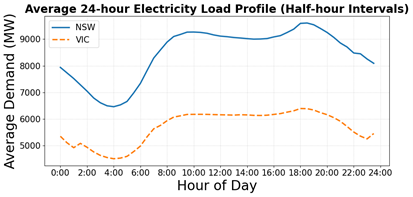
Short-term load forecasting (STLF) plays a crucial role in power system operation and electricity market planning. However, the forecasting accuracy of convolutional neural network (CNN) models strongly depends on properly tuned hyperparameters such as filter numbers, batch size, and loss function, while exhaustive tuning is computationally expensive. This paper proposes a one-dimensional CNN (1D-CNN) for STLF whose key hyperparameters are optimized by a hybrid Bayesian Optimization–Hyperband framework (BO-TPE-HB). The framework combines the Tree-structured Parzen Estimator (TPE), which guides the search towards promising regions of the hyperparameter space, with Hyperband’s multi-fidelity early-stopping strategy to terminate weak configurations early and save computation. The proposed approach is evaluated using half-hourly electricity load data from the Australian Energy Market Operator (AEMO) for New South Wales (NSW) and Victoria (VIC) from 2009 to 2014. Using a rolling-origin time-series cross-validation scheme on the training set and a chronologically separated hold-out test set, BO-TPE-HB explores 100 candidate configurations of a 4-layer 1D-CNN with a sliding window of 48 time steps. Model performance is assessed using MAE, MSE, RMSE, MAPE, and total hyperparameter optimization runtime. Experimental results show that the BO-TPE-HB–tuned CNN achieves test MAPE of 1.350% (MAE 105.98 MW, RMSE 143.71 MW) for NSW and 1.615% (MAE 89.13 MW, RMSE 124.25 MW) for VIC, outperforming Random Search, standalone TPE, and standalone Hyperband in terms of both prediction accuracy and computational efficiency, while requiring substantially less tuning time than plain Bayesian Optimization. These findings highlight that combining probabilistic search with resource-efficient early stopping provides a practical and reproducible way to enhance CNN-based STLF, and can be extended to multivariate inputs or other deep learning forecasting architectures in future work.
References
J. Wang, K. Wang, Z. Li, H. Lu, and H. Jiang, “Short-term power load forecasting system based on rough set, information granule and multi-objective optimization,” Appl. Soft Comput., vol. 146, p. 110692, 2023, https://doi.org/10.1016/j.asoc.2023.110692.
L. Baur, K. Ditschuneit, M. Schambach, C. Kaymakci, T. Wollmann, and A. Sauer, “Jou rna lP,” Energy AI, p. 100358, 2024, https://doi.org/10.1016/j.egyai.2024.100358.
B. Chen, W. Yang, B. Yan, and K. Zhang, “An advanced airport terminal cooling load forecasting model integrating SSA and CNN-Transformer,” Energy Build., vol. 309, p. 114000, 2024, https://doi.org/10.1016/j.enbuild.2024.114000.
R. C. Dadhich and P. C. Gupta, “Development of electric load prediction techniques for rajasthan region and suggestive measures for optimum use of energy using multi-objective optimization,” Electr. Power Syst. Res., vol. 214, p. 108837, 2023, https://doi.org/10.1016/j.epsr.2022.108837.
M. Sharma and P. Kaur, “Fog-based Federated Time Series Forecasting for IoT Data,” J. Netw. Syst. Manag., vol. 32, no. 2, pp. 1–24, 2024, https://doi.org/10.1007/s10922-024-09802-2.
A. Parizad and C. J. Hatziadoniu, “A Real-Time Multistage False Data Detection Method Based on Deep Learning and Semisupervised Scoring Algorithms,” IEEE Syst. J., vol. 17, no. 2, pp. 1753–1764, 2023, https://doi.org/10.1109/JSYST.2023.3265021.
C. Wang, G. Wang, Y. Liu, S. Ren, and J. Wang, “Short-term power load forecasting based on parallel decomposition,” Adv. Eng. Informatics, vol. 68, p. 103729, 2025, https://doi.org/10.1016/j.aei.2025.103729.
N. Shabbir, R. Ahmadiahangar, A. Rosin, M. Jawad, J. Kilter, and J. Martins, “XgBoost based Short-term Electrical Load Forecasting Considering Trends & Periodicity in Historical Data,” 2023 IEEE Int. Conf. Energy Technol. Futur. Grids, no. 856602, pp. 1–6, 2023, https://doi.org/10.1109/ETFG55873.2023.10407926.
W. Xiong, “Bus load forecasting based on maximum information coefficient and CNN-LSTM model,” 2023 IEEE Int. Conf. Image Process. Comput. Appl., pp. 659–663, 2023, https://doi.org/10.1109/ICIPCA59209.2023.10257944.
G. Yan, J. Wang, and M. Thwin, “A new Frontier in electric load forecasting: The LSV/MOPA model optimized by modified orca predation algorithm,” Heliyon, vol. 10, no. 2, p. e24183, 2024, https://doi.org/10.1016/j.heliyon.2024.e24183.
B. Harish, D. Panda, K. R. Konda, and A. Soni, “A Comparative Study of Forecasting Problems on Electrical Load Timeseries Data using Deep Learning Techniques,” Conf. Rec. - Ind. Commer. Power Syst. Tech. Conf., vol. 2023-May, pp. 1–5, 2023, https://doi.org/10.1109/ICPS57144.2023.10142125.
J. Song, “Optimized XGBoost based sparrow search algorithm for short-term load forecasting,” 2021 IEEE Int. Conf. Comput. Sci. Artif. Intell. Electron. Eng., no. 2, pp. 213–217, 2021, https://doi.org/10.1109/CSAIEE54046.2021.9543453.
M. Fan, Y. Hu, X. Zhang, H. Yin, Q. Yang and L. Fan, "Short-term Load Forecasting for Distribution Network Using Decomposition with Ensemble prediction," 2019 Chinese Automation Congress (CAC), pp. 152-157, 2019, https://doi.org/10.1109/CAC48633.2019.8997169.
X. Wang, H. Wang, B. Bhandari, and L. Cheng, AI-Empowered Methods for Smart Energy Consumption: A Review of Load Forecasting, Anomaly Detection and Demand Response, vol. 11, no. 3, 2024. https://doi.org/10.1007/s40684-023-00537-0.
Y. Luo, C. Gao, D. Wang, Z. Jiang, Y. Lv, and G. Xue, “Predictive model for sag and load on overhead transmission lines based on local deformation of transmission lines,” Electr. Power Syst. Res., vol. 214, 2022, 2023, https://doi.org/10.1016/j.epsr.2022.108811.
L. Zhang, D. Wu, and X. Luo, “An Error Correction Mid-term Electricity Load Forecasting Model Based on Seasonal Decomposition,” Conf. Proc. - IEEE Int. Conf. Syst. Man Cybern., pp. 2415–2420, 2023, https://doi.org/10.1109/SMC53992.2023.10394531.
A. Faustine, N. J. Nunes, and L. Pereira, “Efficiency through Simplicity: MLP-based Approach for Net-Load Forecasting with Uncertainty Estimates in Low-Voltage Distribution Networks,” IEEE Trans. Power Syst., vol. 40, no. 1, pp. 46–56, 2024, https://doi.org/10.1109/TPWRS.2024.3400123.
A. I. Arvanitidis, D. Bargiotas, A. Daskalopulu, D. Kontogiannis, I. P. Panapakidis, and L. H. Tsoukalas, “Clustering Informed MLP Models for Fast and Accurate Short-Term Load Forecasting,” Energies, vol. 15, no. 4, pp. 1–14, 2022, https://doi.org/10.3390/en15041295.
T. Bashir, H. Wang, M. Tahir, and Y. Zhang, “Wind and solar power forecasting based on hybrid CNN-ABiLSTM, CNN-transformer-MLP models,” Renew. Energy, vol. 239, p. 122055, 2025, https://doi.org/10.1016/j.renene.2024.122055.
J. H. Kim, B. S. Lee, and C. H. Kim, “A Study on the development of long-term hybrid electrical load forecasting model based on MLP and statistics using massive actual data considering field applications,” Electr. Power Syst. Res., vol. 221, p. 109415, 2023, https://doi.org/10.1016/j.epsr.2023.109415.
M. Alhussein, K. Aurangzeb, and S. I. Haider, “Hybrid CNN-LSTM Model for Short-Term Individual Household Load Forecasting,” IEEE Access, vol. 8, pp. 180544–180557, 2020, https://doi.org/10.1109/ACCESS.2020.3028281.
D. Chen, J. Zhang, and S. Jiang, “Forecasting the Short-Term Metro Ridership with Seasonal and Trend Decomposition Using Loess and LSTM Neural Networks,” IEEE Access, vol. 8, pp. 91181–91187, 2020, https://doi.org/10.1109/ACCESS.2020.2995044.
C. Li, R. Hu, C. Y. Hsu, and Y. Han, “Short-term Power Load Forecasting based on Feature Fusion of Parallel LSTM-CNN,” 2022 IEEE 4th Int. Conf. Power, Intell. Comput. Syst. ICPICS 2022, no. 4, pp. 448–452, 2022, https://doi.org/10.1109/ICPICS55264.2022.9873566.
Y. Da Jhong, C. S. Chen, B. C. Jhong, C. H. Tsai, and S. Y. Yang, “Optimization of LSTM Parameters for Flash Flood Forecasting Using Genetic Algorithm,” Water Resour. Manag., vol. 38, no. 3, pp. 1141–1164, 2024, https://doi.org/10.1007/s11269-023-03713-8.
A. Kumar and M. N. Alam, “Bidirectional LSTM Network-Based Short-Term Load Forecasting Method in Smart Grids,” 5th Int. Conf. Energy, Power, Environ. Towar. Flex. Green Energy Technol. ICEPE 2023, pp. 1–6, 2023, https://doi.org/10.1109/ICEPE57949.2023.10201537.
O. Rubasinghe, X. Zhang, T. K. Chau, T. Fernando, and H. H. C. Iu, “A Novel Sequence to Sequence based CNN-LSTM Model for Long Term Load Forecasting,” Proc. - 2022 IEEE Sustain. Power Energy Conf. iSPEC 2022, pp. 1–5, 2022, https://doi.org/10.1109/iSPEC54162.2022.10033062.
S. Cantillo-Luna, R. Moreno-Chuquen, and J. A. Lopez Sotelo, “Intra-day Electricity Price Forecasting Based on a Time2Vec-LSTM Neural Network Model,” 2023 IEEE Colomb. Conf. Appl. Comput. Intell. ColCACI 2023 - Proc., pp. 1–6, 2023, https://doi.org/10.1109/ColCACI59285.2023.10225803.
T. H. Bao Huy, D. N. Vo, K. P. Nguyen, V. Q. Huynh, M. Q. Huynh, and K. H. Truong, “Short-Term Load Forecasting in Power System Using CNN-LSTM Neural Network,” Conf. Proc. - 2023 IEEE Asia Meet. Environ. Electr. Eng. EEE-AM 2023, pp. 1–6, 2023, https://doi.org/10.1109/EEE-AM58328.2023.10395221.
S. M. H. Rizvi, “Time Series Deep learning for Robust Steady-State Load Parameter Estimation using 1D-CNN,” Arab. J. Sci. Eng., 2021, https://doi.org/10.1007/s13369-021-05782-6.
Q. Hua et al., “A Short-Term Power Load Forecasting Method Using CNN-GRU with an Attention Mechanism,” Energies, vol. 18, no. 1, pp. 1–17, 2025, https://doi.org/10.3390/en18010106.
X. Bu, Q. Wu, B. Zhou, and C. Li, “Hybrid short-term load forecasting using CGAN with CNN and semi-supervised regression,” Appl. Energy, vol. 338, p. 120920, 2023, https://doi.org/10.1016/j.apenergy.2023.120920.
Z. Tian, W. Liu, W. Jiang, and C. Wu, “CNNs-Transformer based day-ahead probabilistic load forecasting for weekends with limited data availability,” Energy, vol. 293, p. 130666, 2024, https://doi.org/10.1016/j.energy.2024.130666.
X. Chen, M. Yang, Y. Zhang, J. Liu, and S. Yin, “Load Prediction Model of Integrated Energy System Based on CNN-LSTM,” 2023 3rd Int. Conf. Energy Eng. Power Syst. EEPS 2023, pp. 248–251, 2023, https://doi.org/10.1109/EEPS58791.2023.10257124.
H. Kuang, Q. Guo, S. Li, and H. Zhong, “Short-term Power Load Forecasting Method in Rural Areas Based on CNN-LSTM,” Proc. 2021 IEEE 4th Int. Electr. Energy Conf. CIEEC 2021, pp. 7–11, 2021, https://doi.org/10.1109/CIEEC50170.2021.9510777.
Ş. Özdemir, Y. Demir, and Ö. Yildirim, “The Effect of Input Length on Prediction Accuracy in Short-Term Multi-Step Electricity Load Forecasting: A CNN-LSTM Approach,” IEEE Access, no. February, 2025, https://doi.org/10.1109/ACCESS.2025.3540636.
Y. K. Ahranjani, M. Beiraghi, and R. Ghanizadeh, “Short time load forecasting for Urmia city using the novel CNN-LTSM deep learning structure,” Electr. Eng., 2024, https://doi.org/10.1007/s00202-024-02361-4.
R. Liu, J. Shi, G. Sun, S. Lin, and F. Li, “A Short-term net load hybrid forecasting method based on VW-KA and QR-CNN-GRU,” Electr. Power Syst. Res., vol. 232, p. 110384, 2024, https://doi.org/10.1016/j.epsr.2024.110384.
H. Xu, F. Hu, X. Liang, G. Zhao, and M. Abugunmi, “A framework for electricity load forecasting based on attention mechanism time series depthwise separable convolutional neural network,” Energy, vol. 299, no. October 2023, p. 131258, 2024, https://doi.org/10.1016/j.energy.2024.131258.
B. Bischl et al., “Hyperparameter optimization: Foundations, algorithms, best practices, and open challenges,” Wiley Interdiscip. Rev. Data Min. Knowl. Discov., vol. 13, no. 2, pp. 1–43, 2023, https://doi.org/10.1002/widm.1484.
I. A. Ibrahim and M. J. Hossain, “Short-term multivariate time series load data forecasting at low-voltage level using optimised deep-ensemble learning-based models,” Energy Convers. Manag., vol. 296, p. 117663, 2023, https://doi.org/10.1016/j.enconman.2023.117663.
P. S. Pravin, J. Z. M. Tan, K. S. Yap, and Z. Wu, “Hyperparameter optimization strategies for machine learning-based stochastic energy efficient scheduling in cyber-physical production systems,” Digit. Chem. Eng., vol. 4, p. 100047, 2022, https://doi.org/10.1016/j.dche.2022.100047.
S. Atef and A. B. Eltawil, “Assessment of stacked unidirectional and bidirectional long short-term memory networks for electricity load forecasting,” Electr. Power Syst. Res., vol. 187, p. 106489, 2020, https://doi.org/10.1016/j.epsr.2020.106489.
A. A. M. Warad, K. Wassif, and N. R. Darwish, “An ensemble learning model for forecasting water-pipe leakage,” Sci. Rep., vol. 14, no. 1, pp. 1–17, 2024, https://doi.org/10.1038/s41598-024-60840-x.
[Z. Sheng, H. Wang, G. Chen, B. Zhou, and J. Sun, “Convolutional residual network to short-term load forecasting,” Appl. Intell., vol. 51, no. 4, pp. 2485–2499, 2021, https://doi.org/10.1007/s10489-020-01932-9.
M. Vijay and M. Saravanan, “Solar Irradiance Forecasting using Bayesian Optimization based Machine Learning Algorithm to Determine the Optimal Size of a Residential PV System,” Int. Conf. Sustain. Comput. Data Commun. Syst. ICSCDS 2022 - Proc., pp. 744–749, 2022, https://doi.org/10.1109/ICSCDS53736.2022.9761011.
N. B. Vanting, Z. Ma, and B. N. Jørgensen, “A scoping review of deep neural networks for electric load forecasting,” Energy Informatics, vol. 4, 2021, https://doi.org/10.1186/s42162-021-00148-6.
R. Panigrahi, N. R. Patne, B. V. Surya Vardhan, and M. Khedkar, “Short-term load analysis and forecasting using stochastic approach considering pandemic effects,” Electr. Eng., vol. 106, no. 3, pp. 3097–3108, 2024, https://doi.org/10.1007/s00202-023-02135-4.
J. Cardo-Miota, R. Trivedi, S. Patra, S. Khadem, and M. Bahloul, “Data-driven approach for day-ahead System Non-Synchronous Penetration forecasting: A comprehensive framework, model development and analysis,” Appl. Energy, vol. 362, 2024, https://doi.org/10.1016/j.apenergy.2024.123006.
A. D. Manchalwar, N. R. Patne, B. V. S. Vardhan, and M. Khedkar, “Peer-to-peer energy trading in a distribution network considering the impact of short-term load forecasting,” Electr. Eng., vol. 105, no. 4, pp. 2069–2081, 2023, https://doi.org/10.1007/s00202-023-01793-8.
S. Hanifi, A. Cammarono, and H. Zare-Behtash, “Advanced hyperparameter optimization of deep learning models for wind power prediction,” Renew. Energy, vol. 221, p. 119700, 2024, https://doi.org/10.1016/j.renene.2023.119700.
M. Madhiarasan, “Bayesian optimisation algorithm based optimised deep bidirectional long short term memory for global horizontal irradiance prediction in long-term horizon,” Front. Energy Res., vol. 13, pp. 1–15, 2025, https://doi.org/10.3389/fenrg.2025.1499751.
T. N. Tran and T. A. Nguyen, “Hyperparameter Optimization for Deep Learning Modeling in Short-Term Load Forecasting,” Int. J. Electr. Comput. Eng. Syst., vol. 16, no. 6, pp. 443–450, 2025, https://doi.org/10.32985/ijeces.16.6.2.
T. C. Hakyemez and O. Adar, “Testing the Efficacy of Hyperparameter Optimization Algorithms in Short-Term Load Forecasting,” arXiv preprint arXiv:2410.15047, 2024, https://doi.org/10.48550/arXiv.2410.15047.
K. V. A. Reddy, S. R. Ambati, Y. S. Rithik Reddy, and A. N. Reddy, “AdaBoost for Parkinson’s Disease Detection using Robust Scaler and SFS from Acoustic Features,” Proc. - 1st Int. Conf. Smart Technol. Commun. Robot. STCR 2021, pp. 1–6, 2021, https://doi.org/10.1109/STCR51658.2021.9588906.
Q. Shen, L. Mo, G. Liu, J. Zhou, Y. Zhang, and P. Ren, “Short-Term Load Forecasting Based on Multi-Scale Ensemble Deep Learning Neural Network,” IEEE Access, vol. 11, pp. 111963–111975, 2023, https://doi.org/10.1109/ACCESS.2023.3322167.
K. Zhu, Y. Li, W. Mao, F. Li, and J. Yan, “LSTM enhanced by dual-attention-based encoder-decoder for daily peak load forecasting,” Electr. Power Syst. Res., vol. 208, p. 107860, 2022, https://doi.org/10.1016/j.epsr.2022.107860.
N. Giamarelos and E. N. Zois, “Boosting short term electric load forecasting of high & medium voltage substations with visibility graphs and graph neural networks,” Sustain. Energy, Grids Networks, vol. 38, p. 101304, 2024, https://doi.org/10.1016/j.segan.2024.101304.
J. F. Torres, D. Gutiérrez-Avilés, A. Troncoso, and F. Martínez-Álvarez, “Random Hyper-parameter Search-Based Deep Neural Network for Power Consumption Forecasting,” Lect. Notes Comput. Sci. (including Subser. Lect. Notes Artif. Intell. Lect. Notes Bioinformatics), vol. 11506 LNCS, pp. 259–269, 2019, https://doi.org/10.1007/978-3-030-20521-8_22.
C. Xu and G. Chen, “Interpretable transformer-based model for probabilistic short-term forecasting of residential net load,” Int. J. Electr. Power Energy Syst., vol. 155, p. 109515, 2024, https://doi.org/10.1016/j.ijepes.2023.109515.
A. Groß, A. Lenders, F. Schwenker, D. A. Braun, and D. Fischer, “Comparison of short-term electrical load forecasting methods for different building types,” Energy Informatics, vol. 4, 2021, https://doi.org/10.1186/s42162-021-00172-6.
W. G. Buratto, R. N. Muniz, A. Nied, and G. V. Gonzalez, “Seq2Seq-LSTM with Attention for Electricity Load Forecasting in Brazil,” IEEE Access, vol. 12, pp. 1–1, 2024, https://doi.org/10.1109/access.2024.3365812.
A. Jahani, K. Zare, and L. Mohammad Khanli, “Short-term load forecasting for microgrid energy management system using hybrid SPM-LSTM,” Sustain. Cities Soc., vol. 98, p. 104775, 2023, https://doi.org/10.1016/j.scs.2023.104775.
F. Widmer, S. Nowak, B. Bowler, P. Huber, and A. Papaemmanouil, “Data-driven comparison of federated learning and model personalization for electric load forecasting,” Energy AI, vol. 14, p. 100253, 2023, https://doi.org/10.1016/j.egyai.2023.100253.
E. Yang and C. H. Youn, “Temporal Data Pooling With Meta-Initialization for Individual Short-Term Load Forecasting,” IEEE Trans. Smart Grid, vol. 14, no. 4, pp. 3246–3258, 2023, https://doi.org/10.1109/TSG.2022.3225805.
S. Li, J. Wang, H. Zhang, and Y. Liang, “Short-term load forecasting system based on sliding fuzzy granulation and equilibrium optimizer,” Appl. Intell., vol. 53, no. 19, pp. 21606–21640, 2023, https://doi.org/10.1007/s10489-023-04599-0.
S. Ryu and Y. Yu, “Quantile-Mixer: A Novel Deep Learning Approach for Probabilistic Short-term Load Forecasting,” IEEE Trans. Smart Grid, vol. 15, no. 2, pp. 2237–2250, 2023, https://doi.org/10.1109/TSG.2023.3290180.
V. K. Saini, R. Kumar, A. S. Al-Sumaiti, A. Sujil, and E. Heydarian-Forushani, “Learning based short term wind speed forecasting models for smart grid applications: An extensive review and case study,” Electr. Power Syst. Res., vol. 222, p. 109502, 2023, https://doi.org/10.1016/j.epsr.2023.109502.
R. Kottath, P. Singh, and A. Bhowmick, Swarm-based hybrid optimization algorithms: an exhaustive analysis and its applications to electricity load and price forecasting, vol. 27, no. 19. Springer Berlin Heidelberg, 2023. https://doi.org/10.1007/s00500-023-07928-0.
R. Chandrasekaran and S. K. Paramasivan, “Advances in Deep Learning Techniques for Short-term Energy Load Forecasting Applications: A Review,” Arch. Comput. Methods Eng., vol. 32, no. 2, pp. 663–692, 2024, https://doi.org/10.1007/s11831-024-10155-x.
X. Li, H. Guo, L. Xu, and Z. Xing, “Bayesian-Based Hyperparameter Optimization of 1D-CNN for Structural Anomaly Detection,” Sensors, vol. 23, no. 11, 2023, https://doi.org/10.3390/s23115058.
A. Irankhah, S. R. Saatlou, M. H. Yaghmaee, S. Ershadi-Nasab, and M. Alishahi, “A parallel CNN-BiGRU network for short-term load forecasting in demand-side management,” 2022 12th Int. Conf. Comput. Knowl. Eng. ICCKE 2022, pp. 511–516, 2022, https://doi.org/10.1109/ICCKE57176.2022.9960036.
A. Neubauer, S. Brandt, and M. Kriegel, “Explainable multi-step heating load forecasting: Using SHAP values and temporal attention mechanisms for enhanced interpretability,” Energy AI, vol. 20, p. 100480, 2025, https://doi.org/10.1016/j.egyai.2025.100480.
Published
How to Cite
Issue
Section
License
Copyright (c) 2025 Trung Dung Nguyen, Nguyen Anh Tuan

This work is licensed under a Creative Commons Attribution-ShareAlike 4.0 International License.
Authors who publish with this journal agree to the following terms:
- Authors retain copyright and grant the journal right of first publication with the work simultaneously licensed under a Creative Commons Attribution License that allows others to share the work with an acknowledgment of the work's authorship and initial publication in this journal.
- Authors are able to enter into separate, additional contractual arrangements for the non-exclusive distribution of the journal's published version of the work (e.g., post it to an institutional repository or publish it in a book), with an acknowledgment of its initial publication in this journal.
- Authors are permitted and encouraged to post their work online (e.g., in institutional repositories or on their website) prior to and during the submission process, as it can lead to productive exchanges, as well as earlier and greater citation of published work (See The Effect of Open Access).

This journal is licensed under a Creative Commons Attribution-ShareAlike 4.0 International License.