Intelligent Tutoring Systems for Adaptive and Personalized Learning in Vocational Education: A Systematic Literature Review
DOI:
https://doi.org/10.12928/biste.v8i4.16270Keywords:
Systematic Literature Review, PRISMA, Intelligent Tutoring System, Artificial Intelligence in Education, Learning Analytics, Educational Data Mining, Vocational EducationAbstract
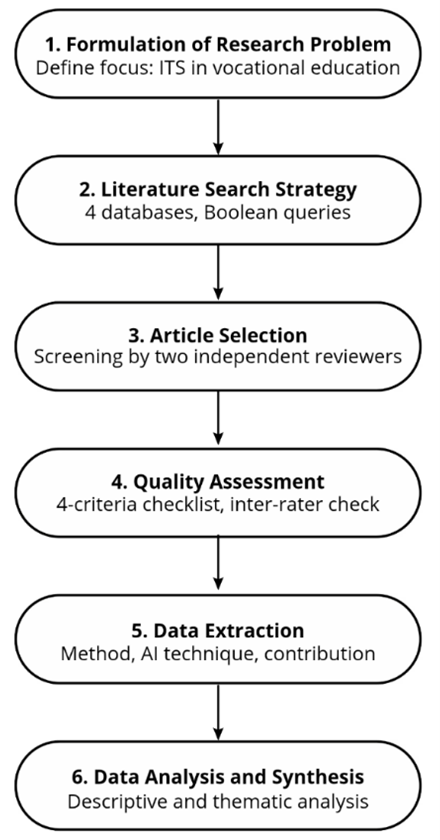
Rapid advances in Artificial Intelligence (AI) have driven the growth of Intelligent Learning Systems (ITS) that support adaptive and personalized learning, however, the implementation of ITS in vocational education remains limited and has not been fully integrated into real-world, competency-based training environments. The research contribution of this study is threefold: a comprehensive synthesis of recent AI-based ITS research, a quantified account of the persistent research gap in vocational-education applications, and a conceptual framework for implementing ITS in vocational settings that integrates competency-based content, dual cognitive-psychomotor student modelling, and simulation-based pedagogy. This study applies a Systematic Literature Review guided by the PRISMA protocol. From 300 articles identified across major scientific databases, a staged process of screening, eligibility assessment, and quality assessment yielded 30 articles published between 2019 and 2025 for final analysis. The findings show a sharp increase in ITS publications, with 46.7% published in 2025 alone, driven largely by the adoption of generative AI and large language models. By research type, 50% were systematic reviews, 23.3% empirical studies, 13.3% technology-development studies, and 13.3% conceptual studies. Most studies (63.3%) were conducted in general education contexts, while only 6.7% specifically addressed vocational or workforce-based education, confirming a clear and persistent research gap. ITS was found to effectively support adaptive learning through dynamic content adjustment, personalized learning pathways, real-time feedback, and data-driven performance prediction enabled by the integration of Learning Analytics and Educational Data Mining. AI-based ITS holds substantial potential to enhance learning effectiveness, but further empirical research is needed to validates its implementation in vocational education, particularly through the conceptual framework proposed in this study.
References
E. G. Popkova, P. De Bernardi, Y. G. Tyurina, and B. S. Sergi, “A theory of digital technology advancement to address the grand challenges of sustainable development,” Technol. Soc., vol. 68, p. 101831, 2022, https://doi.org/10.1016/j.techsoc.2021.101831.
H. Zangana, A. K. Mohammed, M. Omar, F. M. Mustafa, and A. V. Vitianingsih, “Adaptive Resonance Theory-Based Approach for Robust and Efficient Face Recognition,” Vokasi Unesa Bull. Eng. Technol. Appl. Sci., vol. 2, no. 3, pp. 602–618, 2025, https://doi.org/10.26740/vubeta.v2i3.38709.
J. M. Dubinsky and A. A. Hamid, “The neuroscience of active learning and direct instruction,” Neurosci. Biobehav. Rev., vol. 163, p. 105737, 2024, https://doi.org/10.1016/j.neubiorev.2024.105737.
M. Madanchian and H. Taherdoost, “Results in Engineering The impact of artificial intelligence on research efficiency,” Results Eng., vol. 26, p. 104743, 2025, https://doi.org/10.1016/j.rineng.2025.104743.
M. I. Abubakar, A. Ore-Ofe, A. Umar, I. Ibrahim, L. A. Olugbenga, and A. A. Abiola, “Design Of an Enterprise Network Terminal Security Solution,” Vokasi Unesa Bull. Eng. Technol. Appl. Sci., vol. 2, no. 3, pp. 412–427, 2025, https://doi.org/10.26740/vubeta.v2i3.39105.
H. Li, Q. Li, Z. Xu, and X. Ye, “Digital technologies,” J. Digit. Econ., vol. 3, pp. 240–248, 2024, https://doi.org/10.1016/j.jdec.2025.02.001.
W. F. Yu, “AI as a co-creator and a design material: Transforming the design process,” Des. Stud., vol. 97, p. 101303, 2025, https://doi.org/10.1016/j.destud.2025.101303.
R. Hussein, Inaam Salman Aboud, and Rasha Majid Hassoon, “Password Authentication Using Modify Multi-Connect Architecture Associative Memory,” Vokasi Unesa Bull. Eng. Technol. Appl. Sci., vol. 2, no. 2 SE-Article, pp. 333–341, Jun. 2025, https://doi.org/10.26740/vubeta.v2i2.38218.
L. Chen, P. Chen and Z. Lin, "Artificial Intelligence in Education: A Review," in IEEE Access, vol. 8, pp. 75264-75278, 2020, https://doi.org/10.1109/ACCESS.2020.2988510.
E. Ukwandu, O. Omisade, K. Jones, S. Thorne, and M. Castle, “The future of teaching and learning in the context of emerging artificial intelligence technologies,” Futures, vol. 171, no. May 2024, p. 103616, 2025, https://doi.org/10.1016/j.futures.2025.103616.
A. Haleem, M. Javaid, M. A. Qadri, and R. Suman, “Understanding the role of digital technologies in education: A review,” Sustain. Oper. Comput., vol. 3, pp. 275–285, 2022, https://doi.org/10.1016/j.susoc.2022.05.004.
T. Kabudi, I. Pappas, and D. H. Olsen, “Computers and Education : Arti fi cial Intelligence AI-enabled adaptive learning systems : A systematic mapping of the literature,” Comput. Educ. Artif. Intell., vol. 2, p. 100017, 2021, https://doi.org/10.1016/j.caeai.2021.100017.
A. Konstantinidis, “An integrative review of the literature on factors influencing student well-being in the learning environment,” Int. J. Educ. Res. Open, vol. 7, p. 100384, 2024, https://doi.org/10.1016/j.ijedro.2024.100384.
F. F. Mvondo, J. F. Wounba, and G. E. Nkeng, “Development of an AHP-Based Multi-criteria Decision Model for prioritizing Road-Related Infrastructure in Cameroon: Case Studies of Bogo-Guirvidig and Bingambo-Grandzambi projects,” Vokasi Unesa Bull. Eng. Technol. Appl. Sci., vol. 3, no. 1, pp. 129–152, 2026, https://doi.org/10.26740/vubeta.v3i1.42330.
S. Wang, F. Wang, Z. Zhu, J. Wang, T. Tran, and Z. Du, “Artificial intelligence in education : A systematic literature review,” Expert Syst. Appl., vol. 252, p. 124167, 2024, https://doi.org/10.1016/j.eswa.2024.124167.
A. Fortuna et al., “Artificial intelligence in personalized learning: A global systematic review of current advancements and shaping future opportunities,” Soc. Sci. Humanit. Open, vol. 12, p. 102114, 2025, https://doi.org/10.1016/j.ssaho.2025.102114.
J. Li and E. Xue, “Dynamic Interaction between Student Learning Behaviour and Learning Environment: Meta-Analysis of Student Engagement and Its Influencing Factors.,” Behav. Sci. (Basel, Switzerland), vol. 13, no. 1, Jan. 2023, https://doi.org/10.3390/bs13010059.
E. du Plooy, D. Casteleijn, and D. Franzsen, “Personalized adaptive learning in higher education: A scoping review of key characteristics and impact on academic performance and engagement,” Heliyon, vol. 10, no. 21, p. e39630, 2024, https://doi.org/10.1016/j.heliyon.2024.e39630.
F. Naseer, M. N. Khan, M. Tahir, A. Addas, and S. M. H. Aejaz, “Integrating deep learning techniques for personalized learning pathways in higher education,” Heliyon, vol. 10, no. 11, p. e32628, 2024, https://doi.org/10.1016/j.heliyon.2024.e32628.
Yang, J., Shi, G, W. Zhu and Y. Sun, “Intelligent technologies in smart education: a comprehensive review of transformative pillars and their impact on teaching and learning methods,” Humanities and Social Sciences Communications, vol. 12, no. 1, p. 1239, 2025, https://doi.org/10.1057/s41599-025-05444-0.
X. Huang, W. Xu, and R. Liu, “Effects of Intelligent Tutoring Systems on Educational Outcomes:,” Int. J. Distance Educ. Technol., vol. 23, no. 1, 2025, https://doi.org/10.4018/IJDET.368420.
T. Matos, W. Santos, E. Zdravevski, P. Jorge, I. Miguel, and F. Madeira, “A systematic review of artificial intelligence applications in education : Emerging trends and challenges,” Decis. Anal. J., vol. 15, p. 100571, 2025, https://doi.org/10.1016/j.dajour.2025.100571.
N. Muhamad Dah, M. S. A. Mat Noor, M. Z. Kamarudin, and S. S. Syed Abdul Azziz, “The impacts of open inquiry on students’ learning in science: A systematic literature review,” Educ. Res. Rev., vol. 43, p. 100601, 2024, https://doi.org/10.1016/j.edurev.2024.100601.
A. S. C. de Souza and L. Debs, “Concepts, innovative technologies, learning approaches and trend topics in education 4.0: A scoping literature review,” Soc. Sci. Humanit. Open, vol. 9, p. 100902, 2024, https://doi.org/10.1016/j.ssaho.2024.100902.
S. Salih, O. Husain, M. Hamdan, and S. Abdelsalam, “Results in Engineering Transforming education with AI : A systematic review of ChatGPT ’ s role in learning , academic practices , and institutional adoption,” Results Eng., vol. 25, p. 103837, 2025, https://doi.org/10.1016/j.rineng.2024.103837.
G. Hwang, H. Sung, S. Chang, and X. Huang, “Computers and Education : Arti fi cial Intelligence A fuzzy expert system-based adaptive learning approach to improving students ’ learning performances by considering affective and cognitive factors,” Comput. Educ. Artif. Intell., vol. 1, p. 100003, 2020, https://doi.org/10.1016/j.caeai.2020.100003.
K. Englmeier, “The Design of Self-Paced Learning for Structured Learning Environments,” Procedia Comput. Sci., vol. 256, pp. 71–77, 2025, https://doi.org/10.1016/j.procs.2025.02.097.
Q. Zhang and L. Fiorella, “Effects of self-explaining feedback on learning from problem-solving errors,” Contemp. Educ. Psychol., vol. 79, p. 102326, 2024, https://doi.org/10.1016/j.cedpsych.2024.102326.
N. Zakharova, S. Frumina, L. Lobuteva, and S. Alwaely, “The specifics of integrating distance learning technologies with traditional classroom instruction: How to design educational curricula in modern education?,” Heliyon, vol. 10, no. 20, p. e38740, 2024, https://doi.org/10.1016/j.heliyon.2024.e38740.
A. Barta, L. A. Fodor, B. Tamas, and I. Szamoskozi, “The development of students critical thinking abilities and dispositions through the concept mapping learning method – A meta-analysis,” Educ. Res. Rev., vol. 37, p. 100481, 2022, https://doi.org/10.1016/j.edurev.2022.100481.
Z. Zhan, T. Shen, and J. Wang, “Predicting Student Performance Based on Knowledge Characteristics and Learning Ability,” IEEE Access, vol. 13, pp. 26105–26115, 2025, https://doi.org/10.1109/ACCESS.2025.3538700.
A. Zahid and A. Nawab, “Teaching strategies influencing learning strategies: Exploration of teaching and learning practices in a higher education context in Pakistan,” Soc. Sci. Humanit. Open, vol. 11, p. 101442, 2025, https://doi.org/10.1016/j.ssaho.2025.101442.
Á. Hernández-García, C. Cuenca-Enrique, L. Del-Río-Carazo, and S. Iglesias-Pradas, “Exploring the relationship between LMS interactions and academic performance: A Learning Cycle approach,” Comput. Human Behav., vol. 155, p. 108183, 2024, https://doi.org/10.1016/j.chb.2024.108183.
Y. Zhu, “A knowledge graph and BiLSTM-CRF-enabled intelligent adaptive learning model and its potential application,” Alexandria Eng. J., vol. 91, pp. 305–320, 2024, https://doi.org/10.1016/j.aej.2024.02.011.
T. Ingkavara, P. Panjaburee, N. Srisawasdi, and S. Sajjapanroj, “Computers and Education : Artificial Intelligence The use of a personalized learning approach to implementing self-regulated online learning,” Comput. Educ. Artif. Intell., vol. 3, p. 100086, 2022, https://doi.org/10.1016/j.caeai.2022.100086.
K. M. Bach, S. I. Hofer, and S. Bichler, “Adaptive learning, instruction, and teaching in schools: Unraveling context, sources, implementation, and goals in a systematic review,” Learn. Individ. Differ., vol. 124, p. 102781, 2025, https://doi.org/10.1016/j.lindif.2025.102781.
H. Zhang, J. Yang, and Z. Liu, “Effect of teachers’ teaching strategies on students’ learning engagement: moderated mediation model.,” Front. Psychol., vol. 15, p. 1475048, 2024, https://doi.org/10.3389/fpsyg.2024.1475048.
J. M. Cordero and M. Gil-Izquierdo, “The effect of teaching strategies on student achievement: An analysis using TALIS-PISA-link,” J. Policy Model., vol. 40, no. 6, pp. 1313–1331, 2018, https://doi.org/10.1016/j.jpolmod.2018.04.003.
A. Gorbunova, K. A. Adamovich, A. Savelyev, and J. Costley, “Behavior patterns characterize students’ choices and relate to cognitive load and performance in learner-controlled environments,” Internet High. Educ., vol. 69, p. 101073, 2026, https://doi.org/10.1016/j.iheduc.2025.101073.
A. Palanci, R. Meryem, and Y. Zeynep, “Learning analytics in distance education : A systematic review study,” Education and Information Technologies, pp. 22629–22650, 2024, https://doi.org/10.1007/s10639-024-12737-5.
M. Sailer, R. Maier, S. Berger, T. Kastorff, and K. Stegmann, “Learning activities in technology-enhanced learning: A systematic review of meta-analyses and second-order meta-analysis in higher education,” Learn. Individ. Differ., vol. 112, p. 102446, 2024, https://doi.org/10.1016/j.lindif.2024.102446.
M. Tulis, “Error management behavior in classrooms: Teachers’ responses to student mistakes,” Teach. Teach. Educ., vol. 33, pp. 56–68, 2013, https://doi.org/10.1016/j.tate.2013.02.003.
A. Fuchs, A. Radkowitsch, and D. Sommerhoff, “Using learning progress monitoring to promote academic performance? A meta-analysis of the effectiveness,” Educ. Res. Rev., vol. 46, p. 100648, 2025, https://doi.org/10.1016/j.edurev.2024.100648.
F. Daryanes, D. Darmadi, K. Fikri, and I. Sayuti, “Heliyon The development of articulate storyline interactive learning media based on case methods to train student ’ s problem-solving ability,” Heliyon, vol. 9, no. 4, p. e15082, 2023, https://doi.org/10.1016/j.heliyon.2023.e15082.
I. H. Sarker, “Machine Learning: Algorithms, Real-World Applications and Research Directions.,” SN Comput. Sci., vol. 2, no. 3, p. 160, 2021, https://doi.org/10.1007/s42979-021-00592-x.
S. Boujmiraz, H. Darhmaoui, and A. Drissi el maliani, “Predicting student performance: A comprehensive review of machine learning, deep learning, and explainable AI approaches,” Comput. Educ. Artif. Intell., vol. 10, p. 100548, 2026, https://doi.org/10.1016/j.caeai.2026.100548.
M. Sailer, M. Ninaus, S. E. Huber, E. Bauer, and S. Greiff, “The End is the Beginning is the End: The closed-loop learning analytics framework,” Comput. Human Behav., vol. 158, p. 108305, 2024, https://doi.org/10.1016/j.chb.2024.108305.
A. C. Jeng, I. J. Sibley, and T. L. Bale, “A global perspective on AI innovation and effective use in the research lab,” Neuroscience, vol. 560, pp. 106–108, 2024, https://doi.org/10.1016/j.neuroscience.2024.09.034.
A. Bhutoria, “Personalized education and Artificial Intelligence in the United States, China, and India: A systematic review using a Human-In-The-Loop model,” Comput. Educ. Artif. Intell., vol. 3, p. 100068, 2022, https://doi.org/10.1016/j.caeai.2022.100068.
L. Fauziyah et al., “MethodsX Vocational education phenomena research method,” MethodsX, vol. 8, no. August, p. 101537, 2021, https://doi.org/10.1016/j.mex.2021.101537.
T. Held and M. Mejeh, “Students’ motivational trajectories in vocational education: Effects of a self-regulated learning environment,” Heliyon, vol. 10, no. 8, p. e29526, 2024, https://doi.org/10.1016/j.heliyon.2024.e29526.
A. Starostina, V. Bugrov, V. Kravchenko, and G. Gatto, “International Journal of Educational Development Entrepreneurial university : Exploring its essence , phases of development , and operating mechanism during wartime in Ukraine,” Int. J. Educ. Dev., vol. 103, p. 102895, 2023, https://doi.org/10.1016/j.ijedudev.2023.102895.
X. Wang and K. Cao, “Personalized learning effect evaluation model for vocational education with cloud computing technology,” Syst. Soft Comput., vol. 7, p. 200264, 2025, https://doi.org/10.1016/j.sasc.2025.200264.
O. Díaz, M. Genero, J. P. Contell, and M. Piattini, “Adding relevance to rigor : Assessing the contributions of SLRs in Software Engineering through Citation Context Analysis,” Comput. Sci. Rev., vol. 53, p. 100649, 2024, https://doi.org/10.1016/j.cosrev.2024.100649.
M. J. Page et al., “The PRISMA 2020 statement : An updated guideline for reporting systematic reviews Asbj ø rn Hr o,” bmj, vol. 372, 2021, https://doi.org/10.1016/j.ijsu.2021.105906.
B. Montreuil, “Intelligent tutoring platform for improving psychomotor skills in STEM workforce education: XR-enhanced ITP,” Interact. Learn. Environ., 2025, https://doi.org/10.1080/10494820.2025.2556760.
N. Salari, M. Beiromvand, A. Hosseinian-far, J. Habibi, and F. Babajani, “Computers in Human Behavior Reports Impacts of generative artificial intelligence on the future of labor market : A systematic review,” Comput. Hum. Behav. Reports, vol. 18, 2024, p. 100652, 2025, https://doi.org/10.1016/j.chbr.2025.100652.
K. Ofosu-Ampong, “Artificial intelligence research: A review on dominant themes, methods, frameworks and future research directions,” Telemat. Informatics Reports, vol. 14, p. 100127, 2024, https://doi.org/10.1016/j.teler.2024.100127.
M. Golec, E. S. Hatay, S. S. Gill, and R. Buyya, “Artificial Intelligence (AI): Foundations, trends and future directions,” Telemat. Informatics Reports, vol. 20, p. 100265, 2025, https://doi.org/10.1016/j.teler.2025.100265.
Y. K. Dwivedi, A. Sharma, N. P. Rana, M. Giannakis, P. Goel, and V. Dutot, “Technological Forecasting & Social Change Social Change : Research topics , trends , and future directions,” Technol. Forecast. Soc. Chang., vol. 192, p. 122579, 2023, https://doi.org/10.1016/j.techfore.2023.122579.
L. Guo, D. Wang, F. Gu, Y. Li, Y. Wang, and R. Zhou, “Evolution and trends in intelligent tutoring systems research: a multidisciplinary and scientometric view,” Asia Pacific Education Review, vol. 22, no. 3, pp. 441-461 2021, https://doi.org/10.1007/s12564-021-09697-7.
L. Environments, C. C. Lin, A. Y. Q. Huang, and O. H. T. Lu, “Artificial intelligence in intelligent tutoring systems toward sustainable education : a systematic review,” Smart Learn. Environ., Smart learning environments, vol. 10, no. 1, p. 41, 2023, https://doi.org/10.1186/s40561-023-00260-y.
J. Paladines, J.; Ramírez, “A Systematic Literature Review of Intelligent Tutoring Systems With Dialogue in Natural Language,” IEEE Access, vol. 8, 2020, https://doi.org/10.1109/ACCESS.2020.3021383.
O. Sychev, “Educational models for cognition: Methodology of modeling intellectual skills for intelligent tutoring systems,” Cogn. Syst. Res., vol. 87, p. 101261, 2024, https://doi.org/10.1016/j.cogsys.2024.101261.
P. Naayini, “AI and the Future of Education: Advancing Personalized Learning and Intelligent Tutoring Systems,” Front. Educ. Innov. Res., vol. 1, no. 1, pp. 29–39, 2025, https://doi.org/10.62762/FEIR.2025.332098.
G. R. I. Conference, E. The, E. Of, I. Tutoring, S. For, and M. Learnerssecondary, “1 st Global Research and Innovation Conference 2025 , AI in the Classroom : Evaluating The Effectiveness of Intelligent Tutoring Systems for Multilingual,” pp. 532–563, 2025, https://doi.org/10.63125/gcq1qr39.
Villegas-Ch, W., Buenano-Fernandez, D., Navarro, A. M., & Mera-Navarrete, A. (2025). Adaptive intelligent tutoring systems for STEM education: analysis of the learning impact and effectiveness of personalized feedback: W. Villegas-Ch et al. Smart Learning Environments, vol. 12, no. 1, p. 41, 2025, https://doi.org/10.1186/s40561-025-00389-y.
Published
How to Cite
Issue
Section
License
Copyright (c) 2026 Asyraf Rahmat Hidayatulloh Asyraf, Rina Harimurti, Yeni Anistyasari, Widi Aribowo

This work is licensed under a Creative Commons Attribution-ShareAlike 4.0 International License.
Authors who publish with this journal agree to the following terms:
- Authors retain copyright and grant the journal right of first publication with the work simultaneously licensed under a Creative Commons Attribution License that allows others to share the work with an acknowledgment of the work's authorship and initial publication in this journal.
- Authors are able to enter into separate, additional contractual arrangements for the non-exclusive distribution of the journal's published version of the work (e.g., post it to an institutional repository or publish it in a book), with an acknowledgment of its initial publication in this journal.
- Authors are permitted and encouraged to post their work online (e.g., in institutional repositories or on their website) prior to and during the submission process, as it can lead to productive exchanges, as well as earlier and greater citation of published work (See The Effect of Open Access).

This journal is licensed under a Creative Commons Attribution-ShareAlike 4.0 International License.