Power System Stabilizer Optimization Based on Modified Black‑Winged Kite Algorithm
DOI:
https://doi.org/10.12928/biste.v7i4.14669Keywords:
Black‑Winged Kite Algorithm, Metahueristic, Power System Stabilizer, Power System Stability, Artificial IntelligenceAbstract
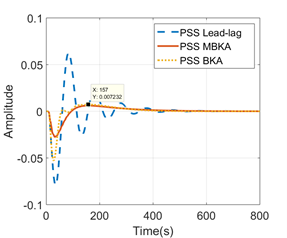
This article presents a Modified Method for tuning the parameters of a power system stabilizer (PSS). This article suggests a different approach that modifies the Black Kite Algorithm (BKA). The Black Kite (BKA) method is inspired by the migratory and predatory habits of the black kite. BKA combines the Leader and Cauchy mutation strategies to improve the algorithm's capacity for global search and convergence rate. This article includes comparative simulations of the PSS objective function and transient response to verify the effectiveness of the suggested strategy. The study validates the proposed method through comparison with both conventional techniques and the original BKA. Simulation results demonstrate that, when benchmarked against competing algorithms, the proposed method consistently yields optimal performance and exhibits faster convergence in certain scenarios. Notably, it reduces undershoot and overshoot by an average of 65% and 90.22%, respectively, compared to the PSS-Lead Lag method. Furthermore, the proposed approach not only minimizes overshoot and undershoot but also achieves a significantly faster settling time.
References
S. Shahzad and E. Jasińska, “Renewable revolution: a review of strategic flexibility in future power systems,” Sustainability, vol. 16, no. 13, p. 5454, 2024, https://doi.org/10.3390/su16135454.
Y. Zahraoui et al., “AI applications to enhance resilience in power systems and microgrids—A review,” Sustainability, vol. 16, no. 12, p. 4959, 2024, https://doi.org/10.3390/su16124959.
N. Tatipatri and S. L. Arun, “A comprehensive review on cyber-attacks in power systems: Impact analysis, detection, and cyber security,” IEEE Access, vol. 12, pp. 18147–18167, 2024, https://doi.org/10.1109/ACCESS.2024.3361039.
A. R. Jordehi, S. A. Mansouri, M. Tostado-Véliz, A. Iqbal, M. Marzband, and F. Jurado, “Industrial energy hubs with electric, thermal and hydrogen demands for resilience enhancement of mobile storage-integrated power systems,” Int. J. Hydrogen Energy, vol. 50, pp. 77–91, 2024, https://doi.org/10.1016/j.ijhydene.2023.07.205.
B. D. Rosalin, “Energy Monitoring in Wave Power Plant Based on Node-Red and ESP 8266,” Vokasi Unesa Bull. Eng. Technol. Appl. Sci., vol. 1, no. 3, pp. 9–15, 2024, https://doi.org/10.26740/vubeta.v1i3.35456.
P. Rani, V. Parkash, and N. K. Sharma, “Technological aspects, utilization and impact on power system for distributed generation: A comprehensive survey,” Renew. Sustain. Energy Rev., vol. 192, p. 114257, 2024, https://doi.org/10.1016/j.rser.2023.114257.
L. Aththanayake, N. Hosseinzadeh, A. Gargoom, and H. H. Alhelou, “Power system reduction techniques for planning and stability studies: A review,” Electr. Power Syst. Res., vol. 227, p. 109917, 2024, https://doi.org/10.1016/j.epsr.2023.109917.
A. Nawawi, A. Hermawan, and A. Wardani, “Performance of LoRa SX1278 Using Yagi Antenna,” Vokasi Unesa Bull. Eng. Technol. Appl. Sci., pp. 47–58, 2024, https://doi.org/10.26740/vubeta.v1i1.34348.
M. Amir and K. Singh, “Frequency regulation strategies in renewable energy-dominated power systems: Issues, challenges, innovations, and future trends,” in Advanced Frequency Regulation Strategies in Renewable-Dominated Power Systems, pp. 367–381, 2024, https://doi.org/10.1016/B978-0-323-95054-1.00001-9.
W. Aribowo, B. Suprianto, and J. Joko, “Improving neural network using a sine tree-seed algorithm for tuning motor DC,” Int. J. Power Electron. Drive Syst., vol. 12, no. 2, p. 1196, 2021, https://doi.org/10.11591/ijpeds.v12.i2.pp1196-1204.
Y. Li et al., “Artificial intelligence-based methods for renewable power system operation,” Nat. Rev. Electr. Eng., vol. 1, no. 3, pp. 163–179, 2024, https://doi.org/10.1038/s44287-024-00018-9.
A. Kumar, A. K. Chandel, and S. Tiwari, “Transient Stability Improvement of Multi-Machine System by using STATCOM with Power System Stabilizer,” in 2024 IEEE International Students’ Conference on Electrical, Electronics and Computer Science (SCEECS), pp. 1–5, 2024, https://doi.org/10.1109/SCEECS61402.2024.10482178.
P. P. Kasaraneni, Y. V. P. Kumar, and R. Kannan, “Data-driven analytics for power system stability assessment,” in Intelligent Data-Driven Modelling and Optimization in Power and Energy Applications, pp. 39–71, 2024, https://doi.org/10.1201/9781003470274.
M. F. Ma’arif, “Design Lighting System Based on PID Control and Node-RED,” Vokasi Unesa Bull. Eng. Technol. Appl. Sci., vol. 1, no. 3, pp. 1–8, 2024, https://doi.org/10.26740/vubeta.v1i3.35454.
M. S. Massaoudi, H. Abu-Rub, and A. Ghrayeb, “Navigating the Landscape of Deep Reinforcement Learning for Power System Stability Control: A Review,” IEEE Access, vol. 11, pp. 134298–134317, 2023, https://doi.org/10.1109/ACCESS.2023.3337118.
M. Khan, W. Wu, and L. Li, “Grid‐forming control for inverter‐based resources in power systems: A review on its operation, system stability, and prospective,” IET Renew. Power Gener., vol. 18, no. 6, pp. 887–907, 2024, https://doi.org/10.1049/rpg2.12991.
L. Ge et al., “A review of hydrogen generation, storage, and applications in power system,” J. Energy Storage, vol. 75, p. 109307, 2024, https://doi.org/10.1016/j.est.2023.109307.
A. M. Obais and A. A. Mukheef, “Design of a 120V, 5A SEPIC DC-DC Converter for Unipolar 120V DC Microgrid,” Vokasi Unesa Bull. Eng. Technol. Appl. Sci., vol. 2, no. 3, pp. 655–665, 2025, https://doi.org/10.26740/vubeta.v2i3.44140.
A. G. Abo-Khalil, “Digital twin real-time hybrid simulation platform for power system stability,” Case Stud. Therm. Eng., vol. 49, p. 103237, 2023, https://doi.org/10.1016/j.csite.2023.103237.
T. Meridji, G. Joós, and J. Restrepo, “A power system stability assessment framework using machine-learning,” Electr. Power Syst. Res., vol. 216, p. 108981, 2023, https://doi.org/10.1016/j.epsr.2022.108981.
N. Mira-Gebauer, C. Rahmann, R. Álvarez-Malebrán, and V. Vittal, “Review of wide-area controllers for supporting power system stability,” IEEE Access, vol. 11, pp. 8073–8095, 2023, https://doi.org/10.1109/ACCESS.2023.3237576.
H. Wang, Z. Xie, Y. Chen, W. Wu, Z. Zhu, and J. Gao, “Stability enhancement control strategy for grid-connected wind power system based on composite feedforward damping,” Int. J. Electr. Power Energy Syst., vol. 158, p. 109908, 2024, https://doi.org/10.1016/j.ijepes.2024.109908.
D. Butti, S. K. Mangipudi, and S. Rayapudi, “Model order reduction based power system stabilizer design using improved whale optimization algorithm,” IETE J. Res., vol. 69, no. 4, pp. 2144–2163, 2023, https://doi.org/10.1080/03772063.2021.1886875.
V. Snášel, R. M. Rizk-Allah, D. Izci, and S. Ekinci, “Weighted mean of vectors optimization algorithm and its application in designing the power system stabilizer,” Appl. Soft Comput., vol. 136, p. 110085, 2023, https://doi.org/10.1016/j.asoc.2023.110085.
W. Aribowo, M. Rohman, F. Baskoro, R. Harimurti, Y. Yamasari, and W. Yustanti, “A Novel Hybrid Prairie Dog Optimization Algorithm-Marine Predator Algorithm for Tuning Parameters Power System Stabilizer,” J. Robot. Control, vol. 4, no. 5, pp. 686–695, 2023, https://doi.org/10.18196/jrc.v4i5.19521.
W. Aribowo, S. Muslim, Munoto, B. Suprianto, U. T. Kartini, and I. G. P. Asto Buditjahjanto, “Tuning of Power System Stabilizer Using Cascade Forward Backpropagation,” in Proceeding - 2020 3rd International Conference on Vocational Education and Electrical Engineering: Strengthening the framework of Society 5.0 through Innovations in Education, Electrical, Engineering and Informatics Engineering, ICVEE 2020, 2020, https://doi.org/10.1109/ICVEE50212.2020.9243204.
B. Mushtaq and M. Mufti, “Coordinated operation of fuzzy‐based TCSC and SMES for low‐frequency oscillation damping in interconnected power systems,” Int. J. Circuit Theory Appl., vol. 51, no. 6, pp. 2912–2941, 2023, https://doi.org/10.1002/cta.3543.
D. U. Sarkar and T. Prakash, "A Recent Review on Approaches to Design Power System Stabilizers: Status, Challenges and Future Scope," in IEEE Access, vol. 11, pp. 34044-34061, 2023, https://doi.org/10.1109/ACCESS.2023.3244687.
I. I. Addaviqi and A. Prapanca, “Metabharata Game Based on Javanese Wayang Art Using Unity,” Vokasi Unesa Bull. Eng. Technol. Appl. Sci., pp. 38–45, 2024, https://doi.org/10.26740/vubeta.v1i1.34034.
M. I. Faruqi, “Monitoring of Public Street Lighting Equipment Using Passive Infrared Receiver (PIR) Sensors and Node-red,” Vokasi Unesa Bull. Eng. Technol. Appl. Sci., vol. 1, no. 2, pp. 33–40, 2024, https://doi.org/10.26740/vubeta.v1i2.35411.
W. J. Ramadhan, A. Amirullah, and A. S. Wardhana, “Telegram Application to Monitor and Control of Automatic Railway Crossing Prototype Using Automatic Transfer Switch,” Vokasi Unesa Bull. Eng. Technol. Appl. Sci., vol. 1, no. 2, pp. 54–63, 2024, https://doi.org/10.26740/vubeta.v1i2.35391.
W. ARİBOWO, “Comparison Study on Economic Load Dispatch Using Metaheuristic Algorithm,” Gazi Univ. J. Sci., vol. 35, no. 1, p. 1, 2022, https://doi.org/10.35378/gujs.820805.
Z. Z. A. Thaariq, “Internet of Educational Things (IoET): An Overview,” Vokasi Unesa Bull. Eng. Technol. Appl. Sci., vol. 1, no. 2, pp. 81–92, 2024, https://doi.org/10.26740/vubeta.v1i2.35886.
M. Hemeida, D. Osheba, S. Alkhalaf, A. Fawzy, M. Ahmed, and M. Roshdy, “Optimized PID controller using Archimedes optimization algorithm for transient stability enhancement,” Ain Shams Eng. J., vol. 14, no. 10, p. 102174, 2023, https://doi.org/10.1016/j.asej.2023.102174.
M. A. El-Dabah, M. H. Hassan, S. Kamel, M. A. Abido, and H. M. Zawbaa, “Optimal Tuning of Power System Stabilizers for a Multi-Machine Power Systems Using Hybrid Gorilla Troops and Gradient-Based Optimizers,” IEEE Access, vol. 11, pp. 27168–27188, 2023, https://doi.org/10.1109/ACCESS.2023.3250384.
Y. Wu, S. Fan, P. Liu, J. Sun, T. Lei, and S. Li, “On Optimization of Multi-machine PSS Parameters Tuning Based on SCSO Algorithm,” in 2023 International Conference on Neuromorphic Computing (ICNC), pp. 435–440, 2023, https://doi.org/10.1109/ICNC59488.2023.10462750.
Z. Sun, Y. Cao, Z. Wen, Y. Song, and Z. Sun, “A Grey Wolf Optimizer algorithm based fuzzy logic power system stabilizer for single machine infinite bus system,” Energy Reports, vol. 9, pp. 847–853, 2023, https://doi.org/10.1016/j.egyr.2023.04.365.
J. Wang, W. Wang, X. Hu, L. Qiu, and H. Zang, “Black-winged kite algorithm: a nature-inspired meta-heuristic for solving benchmark functions and engineering problems,” Artif. Intell. Rev., vol. 57, no. 4, pp. 1–53, 2024, https://doi.org/10.1007/s10462-024-10723-4.
D. Chitara, P. K. Singhal, S. L. Surana, G. Sharma, and R. C. Bansal, “Robust multi-machine power system stabilizer design using bio-inspired optimization techniques and their comparison,” Int. J. Electr. Power Energy Syst., vol. 155, p. 109615, 2024, https://doi.org/10.1016/j.ijepes.2023.109615.
P. Dey et al., “Small signal stability enhancement of large interconnected power system using grasshopper optimization algorithm tuned power system stabilizer,” in Advances in Computers, vol. 135, pp. 99-125, 2024, https://doi.org/10.1016/bs.adcom.2023.11.004.
Published
How to Cite
Issue
Section
License
Copyright (c) 2025 Widi Aribowo, Laith Abualigah, Diego Oliva, Nur Vidia Laksmi B, Fithrotul Irda Amaliah, As’ad Shidqy Aziz, Hewa Majeed Zangana

This work is licensed under a Creative Commons Attribution-ShareAlike 4.0 International License.
Authors who publish with this journal agree to the following terms:
- Authors retain copyright and grant the journal right of first publication with the work simultaneously licensed under a Creative Commons Attribution License that allows others to share the work with an acknowledgment of the work's authorship and initial publication in this journal.
- Authors are able to enter into separate, additional contractual arrangements for the non-exclusive distribution of the journal's published version of the work (e.g., post it to an institutional repository or publish it in a book), with an acknowledgment of its initial publication in this journal.
- Authors are permitted and encouraged to post their work online (e.g., in institutional repositories or on their website) prior to and during the submission process, as it can lead to productive exchanges, as well as earlier and greater citation of published work (See The Effect of Open Access).

This journal is licensed under a Creative Commons Attribution-ShareAlike 4.0 International License.