Motorcycle Parking Availability Monitoring Using YOLOv5 and Mobile-Based Systems
DOI:
https://doi.org/10.12928/biste.v8i3.16087Keywords:
Motorcycle Parking Detection, YOLOv5, Smart Parking in Developing CountriesAbstract
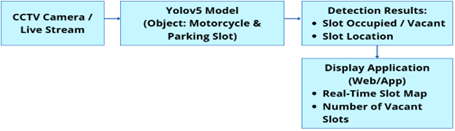
The increasing number of motorcycles in developing countries has intensified parking management challenges, particularly in high-density environments with irregular vehicle arrangements. This study proposes a motorcycle parking availability detection system using the YOLOv5 object detection algorithm to address limitations of conventional parking methods. The research contribution is the development of a context-aware detection framework using a locally collected dataset and the evaluation of its performance under real-world parking conditions.The dataset consists of 1,200 images collected from campus parking areas and is divided into training, validation, and testing sets. The images were annotated into occupied and vacant classes and trained using YOLOv5 with 100 epochs. Model performance was evaluated using precision, recall, F1-score, and mean Average Precision (mAP@0.5) on a held-out test set.The results show that the model achieves an F1-score of 0.57 and mAP@0.5 of 0.566, indicating moderate detection performance in dense and occluded environments. Although a precision of 1.00 is obtained at a confidence threshold of 0.978, this condition significantly reduces recall, highlighting a trade-off between detection accuracy and coverage. The confusion matrix and recall–confidence analysis reveal that errors are primarily caused by occlusion, shadow effects, and background interference. Compared to previous studies focusing on car parking detection, this system demonstrates comparable performance while addressing the unique complexity of motorcycle parking. However, the relatively small dataset size and environmental variability limit generalization.In conclusion, the proposed system provides a feasible initial approach for motorcycle parking detection, but further improvements in dataset diversity, annotation quality, and model robustness are required to achieve reliable large-scale deployment.
References
G. Yaldi, I. M. Nur, Apwiddhal, and Momon, “Analysing Young Motorcyclist Trip and Parking Behaviours: A Strategy to Reduce Motorcycle Accident Numbers,” Int. J. Adv. Sci. Eng. Inf. Technol., vol. 13, no. 2, pp. 477–486, 2023, https://doi.org/10.18517/ijaseit.13.2.16407.
J. E, M. Noerrachman, and A. Saripudin, “Review of: Design of a Smart Motorcycle Parking System based on Wireless Sensor Network (WSN) in a Multilevel Building at Universitas Pendidikan Indonesia,” Qeios, no. 207, pp. 1–16, 2024, https://doi.org/10.32388/4jpba0.
W. Sulistyarso, “Motorcycle Parking Capacity Analysis Around Unikom Campus, Jalan Dipatiukur, Bandung City,” J. Dev. Integr. Eng., vol. 3, no. 2, pp. 95–106, 2023, https://doi.org/10.17509/jodie.v3i2.55741.
E. F. Wicaksono, E. Hidayah, and C. A. Fildzah, “Bioretention Design Simulation for Efficient Urban Stormwater Reduction,” J. Civ. Eng. Forum, vol. 11, no. 1, pp. 69–78, 2025, https://doi.org/10.22146/jcef.12806.
P. J. Romadhona, R. Liu, and C. Balijepalli, “The effect of motorcycle park-and-ride on the performance of Transit-Oriented Development and transit ridership: a case study of Greater Jakarta,” Travel Behav. Soc., vol. 41, no. September 2024, p. 101092, 2025, https://doi.org/10.1016/j.tbs.2025.101092.
N. M. Zafri, A. Khan, S. Jamal, and B. M. Alam, “Impact of COVID-19 pandemic on motorcycle purchase in Dhaka, Bangladesh,” Frontiers in future transportation, vol. 2, p. 646664, 2021, https://doi.org/10.3389/ffutr.2021.646664.
A. Ahad and F. A. Kidwai, “Comprehensive Analysis Of Urban Vehicle Parking Challenges: A Comprehensive Survey Of Delhi,” Int. J. Creat. Res. Thoughts, vol. 11, no. 12, pp. 649–657, 2023, https://ijcrt.org/papers/IJCRT2312302.pdf
W. Chen, Y. Tian, Y. Wang, H. Yan, and Y. Wang, “Cause Identification and Coupling Relationship Analysis of Urban Problems: A Case Study of Poor Parking Convenience,” Buildings, vol. 14, no. 2, 2024, https://doi.org/10.3390/buildings14020516.
M. Uche-Soria, B. Tabuenca, G. Halcón-Gibert, and Y. Núñez-Guerrero, “Quantifying and Forecasting Emission Reductions in Urban Mobility: An IoT-Driven Bike-Sharing Analysis,” Sensors, vol. 25, no. 7, pp. 1–24, 2025, https://doi.org/10.3390/s25072163.
J. S. Olmos Medina, J. G. Maradey Lázaro, A. Rassõlkin, and H. González Acuña, An Overview of Autonomous Parking Systems: Strategies, Challenges, and Future Directions, vol. 25, no. 14. 2025. https://doi.org/10.3390/s25144328.
D. L. Nguyen, X. T. Vo, A. Priadana, and K. H. Jo, “YOLO5PKLot: A Parking Lot Detection Network Based on Improved YOLOv5 for Smart Parking Management System,” Commun. Comput. Inf. Sci., vol. 1857, pp. 95–106, 2023, https://doi.org/10.1007/978-981-99-4914-4_8.
J. Bhowmik, M. F. Monir, S. A. Al Naiyem, M. A. Rahman, B. Bhowmik, and T. Ahmed, “Design and Development of a Low-Cost Automated Parking System for Developing Countries,” EUROCON 2023 - 20th Int. Conf. Smart Technol. Proc., no. July, pp. 30–35, 2023, https://doi.org/10.1109/EUROCON56442.2023.10198976.
S. Yan, N. E. OConnor, and M. Liu, “U-Park: A User-Centric Smart Parking Recommendation System for Electric Shared Micromobility Services,” IEEE Trans. Artif. Intell., vol. 5, no. 10, pp. 5179–5193, 2024, https://doi.org/10.1109/TAI.2024.3428513.
S. H. Lee, S. H. Oh, and J. G. Kim, “YOLOv5-Based Electric Scooter Crackdown Platform,” Appl. Sci., vol. 15, no. 6, 2025, https://doi.org/10.3390/app15063112.
Z. Chen, X. Wang, W. Zhang, G. Yao, D. Li, and L. Zeng, “Autonomous Parking Space Detection for Electric Vehicles Based on Improved YOLOV5-OBB Algorithm,” World Electr. Veh. J., vol. 14, no. 10, 2023, https://doi.org/10.3390/wevj14100276.
M. Hussain, “YOLOv5, YOLOv8 and YOLOv10: The Go-To Detectors for Real-time Vision,” arXiv preprint arXiv:2407.02988, 2024, https://doi.org/10.48550/arXiv.2407.02988.
N. Bachir and Q. A. Memon, “Benchmarking YOLOv5 models for improved human detection in search and rescue missions,” J. Electron. Sci. Technol., vol. 22, no. 1, p. 100243, 2024, https://doi.org/10.1016/j.jnlest.2024.100243.
C. Zhang, “Car detection algorithm in urban based on YOLOv5,” Appl. Comput. Eng., vol. 88, no. 1, pp. 245–251, 2024, https://doi.org/10.54254/2755-2721/88/20241768.
A. S. Geetha, “Comparing YOLOv5 Variants for Vehicle Detection: A Performance Analysis,” arXiv preprint arXiv:2408.12550, pp. 1–18, 2024, https://doi.org/10.48550/arXiv.2408.12550.
J. Cao, X. Zheng, Y. Lyu, J. Wang, R. Xu, and L. Wang, “Chasing Day and Night: Towards Robust and Efficient All-Day Object Detection Guided by an Event Camera,” Proc. - IEEE Int. Conf. Robot. Autom., pp. 9026–9032, 2024, https://doi.org/10.1109/ICRA57147.2024.10611705.
B. G. Mesfin, Z. Li, D. Sun, D. Chen, and Y. Xi, “Urban traffic-parking system dynamics model with macroscopic properties: a comparative study between Shanghai and Zurich,” Humanit. Soc. Sci. Commun., vol. 11, no. 1, pp. 1–13, 2024, https://doi.org/10.1057/s41599-024-02959-w.
M. J. Alam et al., “An Optimized YOLOv5 Based Approach For Real-time Vehicle Detection At Road Intersections Using Fisheye Cameras,” arXiv preprint arXiv:2502.04566, 2025, https://doi.org/10.48550/arXiv.2502.04566.
A. N. Faturrohman, S. H. Suryawan, and A. Rahim, “Development of a Classification Model for Vehicles Entering and Leaving Parking Areas Using the YOLOv8 Algorithm,” Technique, vol. 13, no. 3, pp. 370–379, 2024, https://doi.org/10.34148/teknika.v13i3.992.
C. Wei, Z. Tan, Q. Qing, R. Zeng, and G. Wen, “Fast Helmet and License Plate Detection Based on Lightweight YOLOv5,” Sensors, vol. 23, no. 9, pp. 1–21, 2023, https://doi.org/10.3390/s23094335.
G. Manju and V. A. Binson, “Automated Disease Detection in Silkworms Using Machine Learning Techniques,” Adv. Sustain. Sci. Eng. Technol., vol. 6, no. 4, pp. 1–10, 2024, https://doi.org/10.26877/asset.v6i4.965.
L. H. Aguswandi, B. K. Triwijoyo, and G. H. Martono, “Smart Parking Space Detection Using Advanced Deep Learning Techniques,” J. Artif. Intell. Softw. Eng., vol. 5, no. 1, p. 198, 2025, https://doi.org/10.30811/jaise.v5i1.6473.
A. Sukaca, D. H. U. Ningsih, and E. Zuliarso, “Smart Parking System Optimization Using the YOLO Method and A* Algorithm,” Progress. Sci. J. Comput. Sci., vol. 20, no. 2, p. 852, 2024, https://doi.org/10.35889/progresif.v20i2.2113.
R. Setiyana, H. Nasbey, and H. Suhendar, “Object Detection-Based Vehicle Counting Using the Yolov4-Tiny Algorithm,” Proc. Natl. Phys. Semin., vol. XIII, pp. 102–107, 2024. https://doi.org/10.21009/03.1301.FA14.
Haerudin, A. R. Hudjimartsu, S. A. and Hermawan. E. “Deteksi Pelanggaran Lalu Lintas Kendaraan Bermotor Roda Dua Menggunakan Metode Convolutional Neural Network Wilayah Kota Bogor,” JATI, vol. 9, no. 3, pp. 4304–4309, 2025. https://doi.org/10.36040/jati.v9i3.13654.
A. Bochkovskiy, C.-Y. Wang, and H.-Y. M. Liao, “YOLOv4: Optimal Speed and Accuracy of Object Detection,” arXiv preprint arXiv:2004.10934, 2020, https://doi.org/10.48550/arXiv.2004.10934.
C. Y. Wang, A. Bochkovskiy, and H. Y. M. Liao, “Scaled-yolov4: Scaling cross stage partial network,” Proc. IEEE Comput. Soc. Conf. Comput. Vis. Pattern Recognit., pp. 13024–13033, 2021, https://doi.org/10.1109/CVPR46437.2021.01283.
G. P. C. P. da Luz, G. M. Sato, L. F. G. Gonzalez, and J. F. Borin, “Smart Parking with Pixel-Wise ROI Selection for Vehicle Detection Using YOLOv8, YOLOv9, YOLOv10, and YOLOv11,” Internet of Things, p. 101858, 2025, https://doi.org/10.48550/arXiv.2412.01983.
A. Susanti et al., “Application of the Orangutan Optimization Algorithm for Solving Vehicle Routing Problems in Sustainable Transportation Systems,” Eng. Technol. Appl. Sci. Res., vol. 15, no. 3, pp. 22915–22922, 2025, https://doi.org/10.48084/etasr.10545.
Y. Wang et al., “Lightweight Vehicle Detection Based on Improved YOLOv5s,” Sensors, vol. 24, no. 4, 2024, https://doi.org/10.3390/s24041182.
B. Benjdira, A. Koubaa, W. Boulila, and A. Ammar, “Parking Analytics Framework using Deep Learning,” Proc. - 2022 2nd Int. Conf. Smart Syst. Emerg. Technol. SMARTTECH 2022, pp. 200–205, 2022, https://doi.org/10.1109/SMARTTECH54121.2022.00051.
S. K. Jaiswal and R. Agrawal, “A Comprehensive Review of YOLOv5: Advances in Real-Time Object Detection,” Int. J. Innov. Res. Comput. Sci. Technol., vol. 12, no. 3, pp. 75–80, 2024, https://doi.org/10.55524/ijircst.2024.12.3.12.
R. Khanam and M. Hussain, “What is YOLOv5: A deep look into the internal features of the popular object detector,” arXiv preprint arXiv:2407.20892, 2024, http://arxiv.org/abs/2407.20892
A. O. Elfaki, W. Messoudi, A. Bushnag, S. Abuzneid, and T. Alhmiedat, “A Smart Real-Time Parking Control and Monitoring System,” Sensors, vol. 23, no. 24, 2023, https://doi.org/10.3390/s23249741.
D. L. Nguyen, X. T. Vo, A. Priadana, and K. H. Jo, “Car Detection for Smart Parking Systems Based on Improved YOLOv5,” Vietnam J. Comput. Sci., vol. 11, no. 2, pp. 195–209, 2024, https://doi.org/10.1142/S2196888823500185.
H. Feng, G. Mu, S. Zhong, P. Zhang, and T. Yuan, “Benchmark Analysis of YOLO Performance on Edge Intelligence Devices,” Cryptography, vol. 6, no. 2, pp. 1–16, 2022, https://doi.org/10.3390/cryptography6020016.
A. Hidayah, S. Zuhriyah, B. E. W. Asrul, Yuyun, and E. Prakasa, “Integration of YOLOv5 Algorithm and OpenCV in Innovative Smart Parking Management Approach,” RESTI J., vol. 8, no. 3, pp. 413–422, 2024, https://doi.org/10.29207/resti.v8i3.5728.
M. Makara, H. Min, “YOLO Object Detection for Real-Time Fabric Defect Inspection in the Textile Industry: A Review of YOLOv1 to YOLOv11,” Sensors, vol. 25, no. 7, p. 2270, 2025, https://doi.org/10.3990/s25072270.
Z. Lei, M. Bingya, D. Yanyan, Y. Zhewen and L. Fan, “DCFE-YOLO: A novel fabric defect detection method” PLOS ONE, vol. 20, no. 1, p. e0314525, 2025, https://doi.org/10.1371/journal.pone.0314525.
M. T. Nguyen, et al., “Integrated Approach for Vehicle Detection, Tracking, and Counting in Urban Traffic Videos Utilizing YOLOv11 and DeepSORT Algorithms,” In International Conference on Engineering Research and Applications, pp. 200-207, 2025, https://doi.org/10.1007/978-3-032-15836-9_21.
Z. Tianxiao, L. Bo, S. Ajay and W. Guanghui, “Dynamic Label Assignment for Object detection by Combining Predicted IoUs and Anchor IoUs” Journal of Imaging, vol. 8, no. 7, p. 193, 2022, https://doi.org/10.3390/jimaging8070193.
D. K. Alqahtani, M. A. Cheema, and A. N. Toosi, “Benchmarking Deep Learning Models for Object Detection on Edge Computing Devices,” Lect. Notes Comput. Sci. (including Subser. Lect. Notes Artif. Intell. Lect. Notes Bioinformatics) , vol. 15404 LNCS, pp. 142–150, 2025, https://doi.org/10.1007/978-981-96-0805-8_11
X. Lin and Z. Zhu, “Vehicle detection in complex scenarios based on YOLOv5,” Appl. Comput. Eng., vol. 52, no. 1, pp. 157–163, 2024, https://doi.org/10.54254/2755-2721/52/20241500.
L. Yu and S. Liu, “A Single-Stage Deep Learning-based Approach for Real-Time License Plate Recognition in Smart Parking System,” Int. J. Adv. Comput. Sci. Appl., vol. 14, no. 9, pp. 1142–1150, 2023, https://doi.org/10.14569/IJACSA.2023.01409119.
L. Kuhyun, H. Jihoon, K. Beom-seok, S. Yuna and L. Dong-hee, “Cost-Stability Evaluation Framework for Reliable Deployment of Object Detectors in Industrial Applications” IEEE Access, 2025, https://doi.org/10.1109/ACCESS.2025.3637545
D. Tianmin, L. Xujui and L. Wang, “Occlued Vehicle Detection via multi-Scale Hybrid Attention Mechanism in the Road Scene” electronics, 2022, https://doi.org/10.3390/electronics11172709.
Q. Jiyang et. al., “Occlued Video Instance Segmentation: A Benchmark,” International Journal Of Computer Vision, vol. 130, no. 8, pp. 2022-2039, 2022, https://doi.org/10.1007/s11263-022-01629-1.
C. Ziang et. al., “Towards Real-World Visual Tracking With Temporal Contexts,” IEEE Transactions on pattern Analysis and Machine Intelligence, vol. 45, no. 12, pp. 15834-15849 2023, https://doi.org/10.1109/TPAMI.2023.3307174.
Published
How to Cite
Issue
Section
License
Copyright (c) 2026 R. Endro Wibisono, Anita Susanti, Kusuma Refa Haratama, Widi Aribowo, Karin Nur Fitria Ariyanti, Diego Oliva, Hisham A. Shehadeh, Abubakar Umar

This work is licensed under a Creative Commons Attribution-ShareAlike 4.0 International License.
Authors who publish with this journal agree to the following terms:
- Authors retain copyright and grant the journal right of first publication with the work simultaneously licensed under a Creative Commons Attribution License that allows others to share the work with an acknowledgment of the work's authorship and initial publication in this journal.
- Authors are able to enter into separate, additional contractual arrangements for the non-exclusive distribution of the journal's published version of the work (e.g., post it to an institutional repository or publish it in a book), with an acknowledgment of its initial publication in this journal.
- Authors are permitted and encouraged to post their work online (e.g., in institutional repositories or on their website) prior to and during the submission process, as it can lead to productive exchanges, as well as earlier and greater citation of published work (See The Effect of Open Access).

This journal is licensed under a Creative Commons Attribution-ShareAlike 4.0 International License.