Adaptive Feature Selection using Fisher-Based Supervised Hill Climbing for Dysgraphia Handwriting Classification
DOI:
https://doi.org/10.12928/biste.v8i2.14983Keywords:
Feature Selection, Hill Climbing, Fisher’s Criterion, Dysgraphia, Online HandwritingAbstract
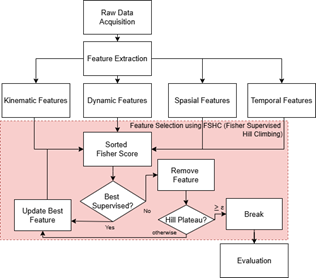
Dysgraphia features selection remains a challenge. Fisher’s criterion excels at highlighting the discriminative features of dysgraphia but lacks guidance for choosing the optimal number of features. Whereas Hill Climbing shows robust feature selection but often gets trapped in local optima. This study aims to avoid the Hill Climbing trap in local optima when selecting the best dysgraphia feature. Thus, the Fisher-Based Supervised Hill Climbing (FSHC) method is introduced. The contribution of this study is an optimized machine-learning-guided hill-climbing method that uses a classifier on a validation set as the objective function. A plateau mechanism also guided Hill Climbing exploration, not by a single Fisher point but by the neighboring subsets. The dataset used contains the graphomotor slant line task from 119 children aged 8-15 years (47.5% diagnosed with dysgraphia), with 10000 to 50000 data points per user. It is organized into kinematic, spatial, dynamic, and temporal features, yielding 117 sub-features. A stratified 5-fold cross-validation is set for training and testing, reaching 21 features. Comparative test—Linear SVM, SVM RBF, Sigmoid SVM, Polynomial SVM, Random Forest, AdaBoost, KNN, Decision Tree, Gradient Boosting, Gaussian Naive Bayes, and Gaussian Classifier—showed that linear SVM achieves the best performance with a weighted average precision, recall, and F1 score of 0.93. Linear SVM also outperformed the three approaches: no feature selection, the traditional Fisher, and machine-learning-based feature selection (weighted KNN and SVM). It can be concluded that the proposed method is more robust than the state of the art by highlighting key points for avoiding overfitting.
References
S. L. Frierson, “Chapter 25 - Specific learning disabilities,” In Capute and Accardo's Neurodevelopmental Disabilities in Infancy and Childhood, pp. 521-535, 2025, https://doi.org/10.1016/B978-0-12-824060-1.00040-7.
R. B. Mohemad, N. F. A. Mamat, N. M. M. Noor, A. C. Alhadi, N. M. Mohamad Noor, and A. C. Che Alhadi, “ONT-SLD: A domain ontology for learning disability,” Indian Journal of Computer Science and Engineering, vol. 11, no. 5, pp. 568–581, 2020, https://doi.org/10.21817/indjcse/2020/v11i5/201105187.
P. Drotár, J. Mekyska, I. Rektorová, L. Masárová, Z. Smékal, and M. Faundez-Zanuy, “Evaluation of handwriting kinematics and pressure for differential diagnosis of Parkinson’s disease,” Artif. Intell. Med., vol. 67, pp. 39–46, 2016, https://doi.org/10.1016/j.artmed.2016.01.004.
Z. Galaz et al., “Advanced Parametrization of Graphomotor Difficulties in School-Aged Children,” IEEE Access, vol. 8, pp. 112883–112897, 2020, https://doi.org/10.1109/ACCESS.2020.3003214.
T. B. T, U. Goel, V. U. MS, V. Kulkarni and K. Sooda, "Automated Detection of Dysgraphia Symptoms In Primary and Middle School Children," 2024 International Conference on Emerging Smart Computing and Informatics (ESCI), pp. 1-5, 2024, https://doi.org/10.1109/ESCI59607.2024.10497397.
S. A. Ramlan, I. S. B. Isa, M. K. Osman, A. P. Ismail, Z. H. C. Che Soh, and Z. H. C. Soh, “Comparing CNN-based Architectures for Dysgraphia Handwriting Classification Performance,” Pertanika J. Sci. Technol., vol. 32, no. 5, pp. 2013–2032, 2024, https://doi.org/10.47836/pjst.32.5.05.
I. Baixauli-Fortea, B. Roselló, C. Berenguer, and A. Miranda-Casas, “Profiles of reading comprehension and written composition of children with high functioning autism,” Medicina (Buenos Aires), vol. 80, pp. 37–40, 2020, https://pubmed.ncbi.nlm.nih.gov/32150711/.
Md. A. A. Islam, Md. Z. Z. Hasan Majumder, Md. A. A. Hussein, K. M. Hossain, and Md. S. S. Miah, “A review of machine learning and deep learning algorithms for Parkinson’s disease detection using handwriting and voice datasets,” Heliyon, vol. 10, no. 3, p. e25469, 2024, https://doi.org/https://doi.org/10.1016/j.heliyon.2024.e25469.
S. D. Mayes, S. L. Calhoun, R. Kallus, R. Baweja, and D. A. Waschbusch, “Cognitive Disengagement Syndrome (Formerly Sluggish Cognitive Tempo) and Comorbid Symptoms in Child Autism, ADHD, and Elementary School Samples,” J. Psychopathol. Behav. Assess., vol. 46, no. 3, pp. 857–865, 2024, https://doi.org/10.1007/s10862-024-10145-0.
R. Wulanningrum, A. Nur Handayani, H. Wahyu Herwanto, and K. Arai, “Optimized Yolov8 to identify people with disabilities,” International Journal of Advances in Intelligent Informatics, vol. 11, no. 4, pp. 756–767, 2025, https://doi.org/10.26555/ijain.v11i4.1977.
S. A. Habeb, I. H. Obed, and A. Khaleel, “The infection of child with (Dysgraphia dyspraxia problems related to language, perception and thought, and affect fine motor activities, such as pen-holdingdisease related to language, perception and thought, and affect fine kinetic activities,” Indian J. Public Health Res. Dev., vol. 10, no. 10, pp. 3052–3056, 2019, https://doi.org/10.5958/0976-5506.2019.03344.8.
E. Crosse and J. Roberts, “Navigating Academic Research as a Neurodivergent Individual: Insights, Challenges, and a Call to Action,” International Journal of Evidence Based Coaching and Mentoring, pp. 30–40, 2025, https://doi.org/10.24384/rbe3-k236.
T. P. Kalashnikova, M. O. Satyukova, G. V Anisimov, and Y. V Karakulova, “Genetic background of dyslexia and dysgraphy in children,” Zhurnal Nevrologii i Psihiatrii imeni S.S. Korsakova, vol. 123, no. 5, pp. 48–52, 2023, https://doi.org/10.17116/jnevro202312305148.
S. Rangasrinivasan, M. S. Sumi Suresh, A. Olszewski, S. R. Setlur, B. Jayaraman, and V. Govindaraju, “AI-Enhanced Child Handwriting Analysis: A Framework for the Early Screening of Dyslexia and Dysgraphia,” SN Comput. Sci., vol. 6, no. 5, 2025, https://doi.org/10.1007/s42979-025-03927-0.
S. Sreekumar, A. Lijiya, and R. K. Ravindren, “Bridging the Gap: Cognitive Science Perspectives and Artificial Intelligence for Prediction and Detection of Specific Learning Disabilities,” IEEE Trans. Cogn. Dev. Syst., vol. 17, no. 4, pp. 711–726, 2025, https://doi.org/10.1109/TCDS.2025.3562665.
Komarudin, B. B. Wiyono, N. Eva, I. Hitipeuw, and H. S. Tortop, “The Influence of Grit and Social Support on University Students’ Psychological Well-Being: The Mediating Role of Problem-Focused Coping,” Open Education Studies, vol. 8, no. 1, pp. 1–17, 2026, https://doi.org/10.1515/edu-2025-0119.
L. C. Irani, N. Hidayah, M. Ramli, and N. Eva, “Mothers of children with disabilities: harnessing cognitive flexibility to promote parental mental health,” Journal of Public Health (United Kingdom), vol. 46, no. 1, pp. E157–E158, 2024, https://doi.org/10.1093/pubmed/fdad129.
B. Agarwal et al., “Early and Automated Diagnosis of Dysgraphia Using Machine Learning Approach,” SN Comput. Sci., vol. 4, no. 5, 2023, https://doi.org/10.1007/s42979-023-01884-0.
L. Deschamps et al., “Development of a Pre-Diagnosis Tool Based on Machine Learning Algorithms on the BHK Test to Improve the Diagnosis of Dysgraphia,” Advances in Artificial Intelligence and Machine Learning, vol. 1, no. 2, pp. 114–135, 2021, https://doi.org/10.54364/AAIML.2021.1108.
M. Ikermane and A. El Mouatasim, “Digital handwriting characteristics for dysgraphia detection using artificial neural network,” Bulletin of Electrical Engineering and Informatics, vol. 12, no. 3, pp. 1693–1699, 2023, https://doi.org/10.11591/eei.v12i3.4571.
K. Zvončáková, J. Mekyska, and V. Zvoncak, “Developmental Dysgraphia: A New Approach to Diagnosis,” International Journal of Assessment and Evaluation, vol. 28, no. 1, pp. 143–160, 2021, https://doi.org/10.18848/2327-7920/CGP/V28I01/143-160.
N. Rahim, N. M. Mat Diah, and N. M. Diah, “Enhancing Handwriting Proficiency in Dysgraphic Students: Development and Validation of a Technology-Assisted Model,” International Journal of Information and Education Technology, vol. 15, no. 8, pp. 1563–1572, 2025, https://doi.org/10.18178/ijiet.2025.15.8.2358.
X. Wang et al., “LSTM-CNN: An efficient diagnostic network for Parkinson’s disease utilizing dynamic handwriting analysis,” Comput. Methods Programs Biomed., vol. 247, 2024, https://doi.org/10.1016/j.cmpb.2024.108066.
H. Singh, R. K. Sharma, V. P. Singh, and M. Kumar, “Recognition of online handwritten Gurmukhi characters using recurrent neural network classifier,” Soft comput., vol. 25, no. 8, pp. 6329–6338, 2021, https://doi.org/10.1007/s00500-021-05620-9.
M. Bublin et al., “Handwriting Evaluation Using Deep Learning with SensoGrip,” Sensors, vol. 23, no. 11, pp. 1–14, 2023, https://doi.org/10.3390/s23115215.
P. Odya, A. Czyżewski, A. Grabkowska, and M. Grabkowski, “Smart Pen - new multimodal computer control tool for graphomotorical therapy,” Intelligent Decision Technologies, vol. 4, no. 3, p. 197, 2010, https://doi.org/10.3233/IDT-2010-0080.
T. Asselborn et al., “Automated human-level diagnosis of dysgraphia using a consumer tablet,” NPJ Digit. Med., vol. 1, no. 1, 2018, https://doi.org/10.1038/s41746-018-0049-x.
C. Rémi, C. Frèlicot, P. Courtelleḿont, C. Frélicot, and P. Courtellemont, “Automatic analysis of the structuring of children’s drawings and writing,” Pattern Recognit., vol. 35, no. 5, pp. 1059–1069, 2002, https://doi.org/10.1016/S0031-3203(01)00094-2.
J. Mekyska et al., “Graphomotor and Handwriting Disabilities Rating Scale (GHDRS): towards complex and objective assessment,” Aust. J. Learn. Diffic., vol. 29, no. 1, pp. 1–34, 2024, https://doi.org/10.1080/19404158.2024.2326686.
S. A. Ramlan, I. S. B. Isa, A. P. Ismail, M. K. Osman, and Z. H. Che Soh, “Development of potential dysgraphia handwriting dataset,” Data Brief, vol. 54, 2024, https://doi.org/10.1016/j.dib.2024.110534.
B. Manimekala, D. Umamaheswari, J. Rozario, M. Kannan, and P. M. Savitha, “Dysgraphia Disorder Detection and Classification Using Deep Learning Technique,” SN Comput. Sci., vol. 6, no. 3, 2025, https://doi.org/10.1007/s42979-025-03825-5.
J. Kunhoth et al., “Grading of Developmental Dysgraphia Severity in Children: Multimodal Dataset and Classifier Fusion,” IEEE Trans. Cogn. Dev. Syst., pp. 1–15, 2025, https://doi.org/10.1109/TCDS.2025.3597742.
R. Lafitte et al., “Writing and drawing tilts after right hemisphere stroke are signs of a wrong verticality representation,” Ann. Phys. Rehabil. Med., vol. 68, no. 4, 2025, https://doi.org/10.1016/j.rehab.2024.101923.
L. Devillaine et al., “Analysis of graphomotor tests with machine learning algorithms for an early and universal pre-diagnosis of dysgraphia,” Sensors, vol. 21, no. 21, 2021, https://doi.org/10.3390/s21217026.
R. Bouhamoum, M. Masmoud, Y. Lyousfi, H. Baazaoui, and D. Mehrotra, “Towards an Intelligent Model for Dysgraphia Evolution Tracking,” Procedia Comput. Sci., vol. 246, pp. 3713–3722, 2024, https://doi.org/10.1016/j.procs.2024.09.185.
J. Kunhoth et al., “CNN feature and classifier fusion on novel transformed image dataset for dysgraphia diagnosis in children,” Expert Syst. Appl., vol. 231, p. 120740, 2023, https://doi.org/10.1016/j.eswa.2023.120740.
J. Škunda et al., “Method for Dysgraphia Disorder Detection using Convolutional Neural Network,” Computer Science Research Notes, vol. 2022, no. 2022, pp. 152–157, 2022, https://doi.org/10.24132/CSRN.3201.19.
P. Drotár and M. Dobeš, “Dysgraphia detection through machine learning,” Sci. Rep., vol. 10, no. 1, 2020, https://doi.org/10.1038/s41598-020-78611-9.
Z. Galaz et al., “Comparison of CNN-Learned vs. Handcrafted Features for Detection of Parkinson’s Disease Dysgraphia in a Multilingual Dataset,” Front. Neuroinform., vol. 16, pp. 1–18, 2022, https://doi.org/10.3389/fninf.2022.877139.
M. A. Amini et al., “The impact of in-air features on the diagnosis of developmental dysgraphia,” Journal of Intelligent and Fuzzy Systems, vol. 44, no. 1, pp. 1413–1424, 2023, https://doi.org/10.3233/JIFS-221708.
L. Cornei, E. Croitoru, and H. Luchian, “Unsupervised text feature selection using NSGA II with Hill Climbing local search,” Procedia Comput. Sci., vol. 225, pp. 1201–1210, 2023, https://doi.org/10.1016/j.procs.2023.10.108.
A. Naskar, R. Pramanik, S. K. S. Hossain, S. Mirjalili, and R. Sarkar, “Late acceptance hill climbing aided chaotic harmony search for feature selection: An empirical analysis on medical data,” Expert Syst. Appl., vol. 221, 2023, https://doi.org/10.1016/j.eswa.2023.119745.
S. Tari, M. Basseur, and A. Goëffon, “Expansion-based Hill-climbing,” Inf. Sci. (N Y)., vol. 649, p. 119635, 2023, https://doi.org/10.1016/j.ins.2023.119635.
V. Hénaux, A. Goëffon, and F. Saubion, “Evolution of Deterministic Hill-climbers,” in 2020 IEEE 32nd International Conference on Tools with Artificial Intelligence (ICTAI), pp. 564–571, 2020, https://doi.org/10.1109/ICTAI50040.2020.00093.
A. Ibtissame, K. Ghizlane, M. Mrabti, I. Aouraghe, G. Khaissidi, and M. Mrabti, “A literature review of online handwriting analysis to detect Parkinson’s disease at an early stage,” Multimed. Tools Appl., vol. 82, no. 8, pp. 11923–11948, 2023, https://doi.org/10.1007/s11042-022-13759-2.
M. Moetesum, I. Siddiqi, N. Vincent, and F. Cloppet, “Assessing visual attributes of handwriting for prediction of neurological disorders—A case study on Parkinson’s disease,” Pattern Recognit. Lett., vol. 121, pp. 19–27, 2019, https://doi.org/10.1016/j.patrec.2018.04.008.
K. Sarin et al., “A three-stage fuzzy classifier method for Parkinson’s disease diagnosis using dynamic handwriting analysis,” Decision Analytics Journal, vol. 8, p. 100274, 2023, https://doi.org/https://doi.org/10.1016/j.dajour.2023.100274.
J. A. Nolazco Flores et al., “Exploiting Spectral and Cepstral Handwriting Features on Diagnosing Parkinson’s Disease,” IEEE Access, vol. 9, pp. 141599–141610, 2021, https://doi.org/10.1109/ACCESS.2021.3119035.
J. Kunhoth, S. Al Maadeed, M. Saleh, and Y. Akbari, “Exploration and analysis of On-Surface and In-Air handwriting attributes to improve dysgraphia disorder diagnosis in children based on machine learning methods,” Biomed. Signal Process. Control, vol. 83, p. 104715, 2023, https://doi.org/10.1016/j.bspc.2023.104715.
K. S. Franz, G. Reszetnik, and T. Chau, “On the Need for Accurate Brushstroke Segmentation of Tablet-Acquired Kinematic and Pressure Data: The Case of Unconstrained Tracing,” Algorithms, vol. 17, no. 3, 2024, https://doi.org/10.3390/a17030128.
A. Takaiwa, S. Tsuneto, H. Abe, S. Terai, and K. Tagawa, “A case of representational dysgraphia and object representational disorder with unilateral spatial neglect,” Brain and Nerve, vol. 67, no. 3, pp. 323–327, 2015, https://doi.org/10.11477/mf.1416200140.
F. Brescia, B. E. A. Santana, M. Diaz, G. Vessio, M. A. Ferrer, and G. Castellano, “Integrating robotic kinematics and dynamics with online handwriting features for dysgraphia classification,” Biomed. Signal Process. Control, vol. 112, p. 108560, 2026, https://doi.org/10.1016/j.bspc.2025.108560.
P. Sharma et al., “Vision transformer-based model for early detection of dysgraphia among school students,” Microsystem Technologies, vol. 31, no. 3, pp. 775–785, 2025, https://doi.org/10.1007/s00542-024-05741-9.
A. M. Al-Shatnawi, F. Al-Saqqar, and A. Souri, “Arabic Handwritten Word Recognition Based on Stationary Wavelet Transform Technique using Machine Learning,” ACM Transactions on Asian and Low-Resource Language Information Processing, vol. 21, no. 3, 2022, https://doi.org/10.1145/3474391.
S. W. Sihwi, K. Fikri, and A. Aziz, “Dysgraphia Identification from Handwriting with Support Vector Machine Method Dysgraphia Identification from Handwriting with Support Vector Machine Method,” vol. 1201, no. 1, p. 012050, 2019, https://doi.org/10.1088/1742-6596/1201/1/012050.
S. A. Francis and M. Sangeetha, “A comparison study on optical character recognition models in mathematical equations and in any language,” Results in Control and Optimization, vol. 18, p. 100532, 2025, https://doi.org/10.1016/j.rico.2025.100532.
M. Gavenciak et al., “Computer-Aided Diagnosis of Graphomotor Difficulties Utilizing Direction-Based Fractional Order Derivatives,” Cognit. Comput., vol. 17, no. 1, 2025, https://doi.org/10.1007/s12559-024-10360-7.
K. C. Kirana, S. Abdullah, K. Abdulrahmana, and K. Abdulrahman, “Random Multi-Augmentation to Improve TensorFlow-Based Vehicle Plate Detection,” Buletin Ilmiah Sarjana Teknik Elektro, vol. 6, no. 2, pp. 113–125, 2024, https://doi.org/10.12928/biste.v6i2.10542.
L. N. Hayati, A. N. Handayani, W. S. G. Irianto, R. A. Asmara, D. Indra, and N. S. Damanhuri, “Improving Indonesian Sign Alphabet Recognition for Assistive Learning Robots Using Gamma-Corrected MobileNetV2,” Buletin Ilmiah Sarjana Teknik Elektro, vol. 7, no. 3, pp. 350–361, 2025, https://doi.org/10.12928/biste.v7i3.13300.
G. Dimauro, V. Bevilacqua, L. Colizzi, and D. Di Pierro, “TestGraphia, a software system for the early diagnosis of dysgraphia,” IEEE Access, vol. 8, pp. 19564–19575, 2020, https://doi.org/10.1109/ACCESS.2020.2968367.
B. Manimekala, D. Umamaheswari, J. Rozario, M. Kannan, and P. M. Savitha, “Dysgraphia Disorder Detection and Classification Using Deep Learning Technique,” SN Comput. Sci., vol. 6, no. 3, 2025, https://doi.org/10.1007/s42979-025-03825-5.
F. Masood, W. U. Khan, K. Ullah, A. Khan, F. H. Alghamedy, and H. Aljuaid, “A Hybrid CNN-LSTM Random Forest Model for Dysgraphia Classification from Hand-Written Characters with Uniform/Normal Distribution,” Applied Sciences (Switzerland), vol. 13, no. 7, 2023, https://doi.org/10.3390/app13074275.
M. A. D. Widyadara, A. N. Handayani, H. W. Herwanto, and T. Yu, “A Generalized Deep Learning Approach for Multi Braille Character (MBC) Recognition,” Buletin Ilmiah Sarjana Teknik Elektro, vol. 7, no. 3, pp. 434–449, 2025, https://doi.org/10.12928/biste.v7i3.13891.
L. N. Hayati, A. N. Handayani, W. S. G. Irianto, R. A. Asmara, D. Indra, and N. S. Damanhuri, “Optimizing YOLO-Based Algorithms for Real-Time BISINDO Alphabet Detection Under Varied Lighting and Background Conditions in Computer Vision Systems,” International Journal of Engineering, Science and Information Technology, vol. 5, no. 3, pp. 285–294, 2025, https://doi.org/10.52088/ijesty.v5i3.948.
W. Ma, M. Fan, Y. Shi, and P. Kowalska, “Adapting to Diverse Special Needs: A Scoping Review of Participatory Design Involving Children with Learning Disabilities,” Int. J. Hum. Comput. Interact., vol. 42, no. 5, pp. 3012-3043, 2025, https://doi.org/10.1080/10447318.2025.2531269.
Published
How to Cite
Issue
Section
License
Copyright (c) 2026 Kartika Candra Kirana, Anik Nur Handayani, Nur Eva, Aji Prasetya Wibawa, Wahyu Nur Hidayat, Kohei Arai

This work is licensed under a Creative Commons Attribution-ShareAlike 4.0 International License.
Authors who publish with this journal agree to the following terms:
- Authors retain copyright and grant the journal right of first publication with the work simultaneously licensed under a Creative Commons Attribution License that allows others to share the work with an acknowledgment of the work's authorship and initial publication in this journal.
- Authors are able to enter into separate, additional contractual arrangements for the non-exclusive distribution of the journal's published version of the work (e.g., post it to an institutional repository or publish it in a book), with an acknowledgment of its initial publication in this journal.
- Authors are permitted and encouraged to post their work online (e.g., in institutional repositories or on their website) prior to and during the submission process, as it can lead to productive exchanges, as well as earlier and greater citation of published work (See The Effect of Open Access).

This journal is licensed under a Creative Commons Attribution-ShareAlike 4.0 International License.