A Generalized Deep Learning Approach for Multi Braille Character (MBC) Recognition
DOI:
https://doi.org/10.12928/biste.v7i3.13891Keywords:
Braille Recognition, Convolutional Neural Network (CNN), Comparing Architectures, Multi Braille Character Classification, Assistive TechnologyAbstract
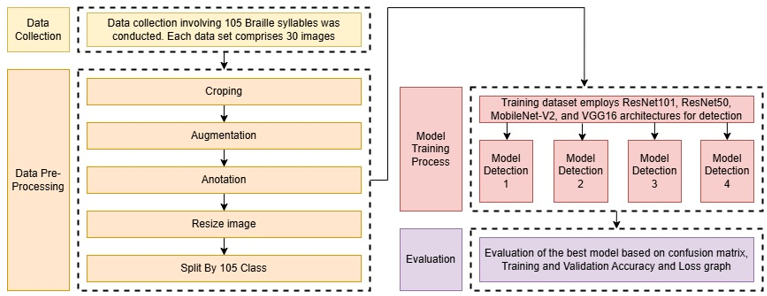
Automated visual recognition of Multi Braille Characters (MBC) poses significant challenges for assistive reading technologies for the visually impaired. The intricate dot configurations and compact layouts of Braille complicate MBC classification. This study introduces a deep learning approach utilizing Convolutional Neural Networks (CNN) and compares four leading architectures: ResNet-50, ResNet-101, MobileNetV2, and VGG-16. A dataset comprising 105 MBC classes was developed from printed Braille materials and underwent preprocessing that included image cropping, brightness enhancement, character position labeling, and resizing to 89×89 pixels. A 70:20:10 data partitioning strategy was applied for training and evaluation, with variations in batch sizes (8–128) and epochs (50–500). The results demonstrate that ResNet-101 achieved superior performance, attaining an accuracy of 91.46%, an F1-score of 89.48%, and a minimum error rate of 8.5%. ResNet-50 and MobileNetV2 performed competitively under specific conditions, whereas VGG-16 consistently exhibited lower accuracy and training stability. Standard deviation assessments corroborated the stability of residual architectures throughout the training process. These results endorse ResNet-101 as the most effective architecture for Multi Braille Character classification, highlighting its potential for incorporation into automated Braille reading systems, a tool for translating braille into text or sound for future needs.
References
T. Kausar, S. Manzoor, A. Kausar, Y. Lu, M. Wasif, and M. Adnan Ashraf, “Deep Learning Strategy for Braille Character Recognition,” IEEE Access, vol. 9, pp. 169357–169371, 2021, https://doi.org/10.1109/ACCESS.2021.3138240.
E.-G. Kim, S.-H. Park, S.-D. Cho, and J.-Y. Oh, “Braille Learning Helper for the Visually Impaired, Jumjarang,” Journal of the Korea Institute of Information and Communication Engineering, vol. 28, no. 12, pp. 1493–1500, 2024, https://doi.org/10.6109/jkiice.2024.28.12.1493.
S. Shokat, R. Riaz, S. S. Rizvi, I. Khan, and A. Paul, “Characterization of English Braille Patterns Using Automated Tools and RICA Based Feature Extraction Methods,” Sensors, vol. 22, no. 5, p. 1836, 2022, https://doi.org/10.3390/s22051836.
R. Lupetina, “The Braille System: The Writing And Reading System That Brings Independence To The Blind Person,” European Journal of Special Education Research, vol. 8, no. 3, 2022, https://doi.org/10.46827/ejse.v8i3.4288.
L. Lu, D. Wu, J. Xiong, Z. Liang, and F. Huang, “Anchor-Free Braille Character Detection Based on Edge Feature in Natural Scene Images,” Comput Intell Neurosci, vol. 2022, pp. 1–11, 2022, https://doi.org/10.1155/2022/7201775.
K. Doi, T. Nishimura, M. Takei, S. Sakaguchi, and H. Fujimoto, “Braille learning materials for Braille reading novices: experimental determination of dot code printing area for a pen-type interface read aloud function,” Univers Access Inf Soc, vol. 20, no. 1, pp. 45–56, 2021, https://doi.org/10.1007/s10209-020-00709-8.
Z. H. M. Jawasreh, N. Sahari Ashaari, and D. P. Dahnil, “The Acceptance of Braille Self-Learning Device,” Int J Adv Sci Eng Inf Technol, vol. 10, no. 1, pp. 246–252, 2020, https://doi.org/10.18517/ijaseit.10.1.10263.
N. Elaraby, S. Barakat, and A. Rezk, “A generalized ensemble approach based on transfer learning for Braille character recognition,” Inf Process Manag, vol. 61, no. 1, p. 103545, 2024, https://doi.org/10.1016/j.ipm.2023.103545.
P. Bhuse, B. Singh, and P. Raut, “Effect of Data Augmentation on the Accuracy of Convolutional Neural Networks,” In Information and Communication Technology for Competitive Strategies (ICTCS 2020) ICT: Applications and Social Interfaces, pp. 337–348, 2022, https://doi.org/10.1007/978-981-16-0739-4_33.
A. AlSalman, A. Gumaei, A. AlSalman, and S. Al-Hadhrami, “A Deep Learning-Based Recognition Approach for the Conversion of Multilingual Braille Images,” Computers, Materials and Continua, vol. 67, no. 3, pp. 3847–3864, 2021, https://doi.org/10.32604/cmc.2021.015614.
B.-M. Hsu, “Braille Recognition for Reducing Asymmetric Communication between the Blind and Non-Blind,” Symmetry (Basel), vol. 12, no. 7, p. 1069, 2020, https://doi.org/10.3390/sym12071069.
H. Wang, C. Zhu, and L. Bian, “Image-free multi-character recognition,” Opt Lett, vol. 6, no. 6, pp. 1343–1346, 2021, https://doi.org/10.1364/OL.451777.
M. M. González and D. M. Hardison, “Assistive design for English phonetic tools (ADEPT) in language learning,” Language Learning & Technology, vol. 26, no. 1, pp. 1-23, 2022, https://doi.org/10.64152/10125/73493.
T. Okamoto, T. Shimono, Y. Tsuboi, M. Izumi and Y. Takano, "Braille Block Recognition Using Convolutional Neural Network and Guide for Visually Impaired People," 2020 IEEE 29th International Symposium on Industrial Electronics (ISIE), pp. 487-492, 2020, https://doi.org/10.1109/ISIE45063.2020.9152576.
D. R. Lim Roque, J. T. Marcelo Mateo, N. B. Linsangan, R. A. Juanatas, and I. Villamor, “Assistive Technology for Braille Reading using Optical Braille Recognition and Text-to-Speech,” in 2022 IEEE 14th International Conference on Humanoid, Nanotechnology, Information Technology, Communication and Control, Environment, and Management (HNICEM), pp. 1–6, 2022, https://doi.org/10.1109/HNICEM57413.2022.10109516.
V. P. Revelli, G. Sharma, and S.Kiruthika devi, “Automate extraction of braille text to speech from an image,” Advances in Engineering Software, vol. 172, p. 103180, 2022, https://doi.org/10.1016/j.advengsoft.2022.103180.
R. Kumari, A. Dev, and A. Kumar, “An Efficient Syllable-Based Speech Segmentation Model Using Fuzzy and Threshold-Based Boundary Detection,” Int J Comput Intell Appl, vol. 21, no. 02, 2022, https://doi.org/10.1142/S1469026822500079.
A. Al-Salman and A. AlSalman, “Fly-LeNet: A deep learning-based framework for converting multilingual braille images,” Heliyon, vol. 10, no. 4, p. e26155, 2024, https://doi.org/10.1016/j.heliyon.2024.e26155.
A. AlSalman, A. Gumaei, A. AlSalman, and S. Al-Hadhrami, “A Deep Learning-Based Recognition Approach for the Conversion of Multilingual Braille Images,” Computers, Materials & Continua, vol. 67, no. 3, pp. 3847–3864, 2021, https://doi.org/10.32604/cmc.2021.015614.
V. Venkatesh Murthy and M. Hanumanthappa, “VGG16 CNN based Braille Cell classifier model for Translation of Braille to Text,” Specialusis Ugdymas, vol. 1, no. 43, pp. 4388-4396, 2022, http://www.sumc.lt/index.php/se/article/view/527.
V. Venkatesh Murthy and N. B. S, “Conversion of Braille Document to Regular English Document using VGG16 BC-CNN Model,” Grenze International Journal of Engineering & Technology (GIJET), vol. 10, 2024, https://openurl.ebsco.com/EPDB%3Agcd%3A10%3A35621418/detailv2?sid=ebsco%3Aplink%3Ascholar&id=ebsco%3Agcd%3A181690643&crl=c&link_origin=scholar.google.com.
B.-S. Park et al., “Visual and tactile perception techniques for braille recognition,” Micro and Nano Systems Letters, vol. 11, no. 1, p. 23, 2023, https://doi.org/10.1186/s40486-023-00191-w.
C. Li and W. Yan, “Braille Recognition Using Deep Learning,” in 2021 4th International Conference on Control and Computer Vision, pp. 30–35, 2021, https://doi.org/10.1145/3484274.3484280.
M. Almasi, “Deep Learning and Neural Networks: Methods and Applications,” in Cutting-Edge Technologies in Innovations in Computer Science and Engineering, 2023, https://doi.org/10.59646/csebookc8/004.
V. A. Golovko, A. A. Kroshchanka, and E. V. Mikhno, “Deep Neural Networks: Selected Aspects of Learning and Application,” Pattern Recognition and Image Analysis, vol. 31, no. 1, pp. 132–143, 2021, https://doi.org/10.1134/S1054661821010090.
A. Khan, A. Sohail, U. Zahoora, and A. S. Qureshi, “A survey of the recent architectures of deep convolutional neural networks,” Artif Intell Rev, vol. 53, no. 8, pp. 5455–5516, 2020, https://doi.org/10.1007/s10462-020-09825-6.
S. P and R. R, “A Review of Convolutional Neural Networks, its Variants and Applications,” in 2023 International Conference on Intelligent Systems for Communication, IoT and Security (ICISCoIS), pp. 31–36, 2023, https://doi.org/10.1109/ICISCoIS56541.2023.10100412.
S. Alufaisan, W. Albur, S. Alsedrah, and G. Latif, “Arabic Braille Numeral Recognition Using Convolutional Neural Networks,” In International Conference on Communication, Computing and Electronics Systems: Proceedings of ICCCES 2020, pp. 87–101, 2021, https://doi.org/10.1007/978-981-33-4909-4_7.
P. Purwono, A. Ma’arif, W. Rahmaniar, H. I. K. Fathurrahman, A. Z. K. Frisky, and Q. M. ul Haq, “Understanding of Convolutional Neural Network (CNN): A Review,” International Journal of Robotics and Control Systems, vol. 2, no. 4, pp. 739–748, 2023, https://doi.org/10.31763/ijrcs.v2i4.888.
B. P. Sowmya and M. C. Supriya, “Convolutional Neural Network (CNN) Fundamental Operational Survey,” In International Conference on Innovative Computing and Cutting-edge Technologies, pp. 245–258, 2021, https://doi.org/10.1007/978-3-030-65407-8_21.
M. Sandler, A. Howard, M. Zhu, A. Zhmoginov, and L.-C. Chen, “MobileNetV2: Inverted Residuals and Linear Bottlenecks,” In Proceedings of the IEEE conference on computer vision and pattern recognition, pp. 4510-4520, 2019, https://doi.org/10.1109/CVPR.2018.00474.
R. Scheps, “Geometry and the Life of Forms,” in Mathematics in the Visual Arts, pp. 29–52, 2021, https://doi.org/10.1002/9781119801801.ch2.
E. O. Pedersen, “The Beauty of Mathematical Order A Study of the Role of Mathematics in Greek Philosophy and the Modern Art Works of Piet Hein and Inger Christensen,” Journal of Somaesthetics, vol. 6, no. 1, pp. 36-52, 2020, https://doi.org/10.5278/ojs.jos.v6i1.3667.
A. Stone, “Measurement as a tool for painting,” Journal of Mathematics and the Arts, vol. 14, no. 1–2, pp. 154–156, 2020, https://doi.org/10.1080/17513472.2020.1732786.
S. Srimamilla, “Image Classification Using Convolutional Neural Networks,” Int J Res Appl Sci Eng Technol, vol. 10, no. 12, pp. 586–591, 2022, https://doi.org/10.22214/ijraset.2022.47085.
J. Miao, S. Xu, B. Zou, and Y. Qiao, “ResNet based on feature-inspired gating strategy,” Multimed Tools Appl, vol. 81, no. 14, pp. 19283–19300, 2022, https://doi.org/10.1007/s11042-021-10802-6.
S. K. Sahu and R. N. Yadav, “Performance Analysis of ResNet in Facial Emotion Recognition,” n International Conference on Machine Intelligence and Signal Processing, pp. 639–648, 2023, https://doi.org/10.1007/978-981-99-0047-3_54.
J. Lin, W. Liu, X. Li, S. Xiao, and Z. Yu, “An Asynchronous Convolution Process Engine forVGG-16 Neural Network,” in 2020 IEEE International Conference on Integrated Circuits, Technologies and Applications (ICTA), pp. 73–74, 2020, https://doi.org/10.1109/ICTA50426.2020.9332010.
M. Ye et al., “A Lightweight Model of VGG-16 for Remote Sensing Image Classification,” IEEE J Sel Top Appl Earth Obs Remote Sens, vol. 14, pp. 6916–6922, 2021, https://doi.org/10.1109/JSTARS.2021.3090085.
P. Xiao, Y. Pang, H. Feng, and Y. Hao, “Optimized MobileNetV2 Based on Model Pruning for Image Classification,” in 2022 IEEE International Conference on Visual Communications and Image Processing (VCIP), pp. 1–5, 2022, https://doi.org/10.1109/VCIP56404.2022.10008829.
L. Zhao, L. Wang, Y. Jia, and Y. Cui, “A lightweight deep neural network with higher accuracy,” PLoS One, vol. 17, no. 8, p. e0271225, 2022, https://doi.org/10.1371/journal.pone.0271225.
W. Jiang, H. Yu, and Y. Ha, “A High-Throughput Full-Dataflow MobileNetv2 Accelerator on Edge FPGA,” IEEE Transactions on Computer-Aided Design of Integrated Circuits and Systems, vol. 42, no. 5, pp. 1532–1545, 2023, https://doi.org/10.1109/TCAD.2022.3198246.
V. Chang, M. A. Ganatra, K. Hall, L. Golightly, and Q. A. Xu, “An assessment of machine learning models and algorithms for early prediction and diagnosis of diabetes using health indicators,” Healthcare Analytics, vol. 2, p. 100118, 2022, https://doi.org/10.1016/j.health.2022.100118.
A. Al Bataineh, D. Kaur, M. Al-khassaweneh, and E. Al-sharoa, “Automated CNN Architectural Design: A Simple and Efficient Methodology for Computer Vision Tasks,” Mathematics, vol. 11, no. 5, p. 1141, 2023, https://doi.org/10.3390/math11051141.
K. M. Ang et al., “Optimal Design of Convolutional Neural Network Architectures Using Teaching–Learning-Based Optimization for Image Classification,” Symmetry (Basel), vol. 14, no. 11, p. 2323, 2022, https://doi.org/10.3390/sym14112323.
Published
How to Cite
Issue
Section
License
Copyright (c) 2025 Made Ayu Dusea Widyadara, Anik Nur Handayani, Heru Wahyu Herwanto, Tony Yu

This work is licensed under a Creative Commons Attribution-ShareAlike 4.0 International License.
Authors who publish with this journal agree to the following terms:
- Authors retain copyright and grant the journal right of first publication with the work simultaneously licensed under a Creative Commons Attribution License that allows others to share the work with an acknowledgment of the work's authorship and initial publication in this journal.
- Authors are able to enter into separate, additional contractual arrangements for the non-exclusive distribution of the journal's published version of the work (e.g., post it to an institutional repository or publish it in a book), with an acknowledgment of its initial publication in this journal.
- Authors are permitted and encouraged to post their work online (e.g., in institutional repositories or on their website) prior to and during the submission process, as it can lead to productive exchanges, as well as earlier and greater citation of published work (See The Effect of Open Access).

This journal is licensed under a Creative Commons Attribution-ShareAlike 4.0 International License.