Deep Learning-based Channel State Estimation for V2V OFDM Communication: A Comparative Study of LSTM, BiLSTM, and GRU Networks
DOI:
https://doi.org/10.12928/biste.v7i4.14064Keywords:
OFDM, Deep Learning, Channel State Estimation, V2V, LSTM, BiLSTM, GRUAbstract
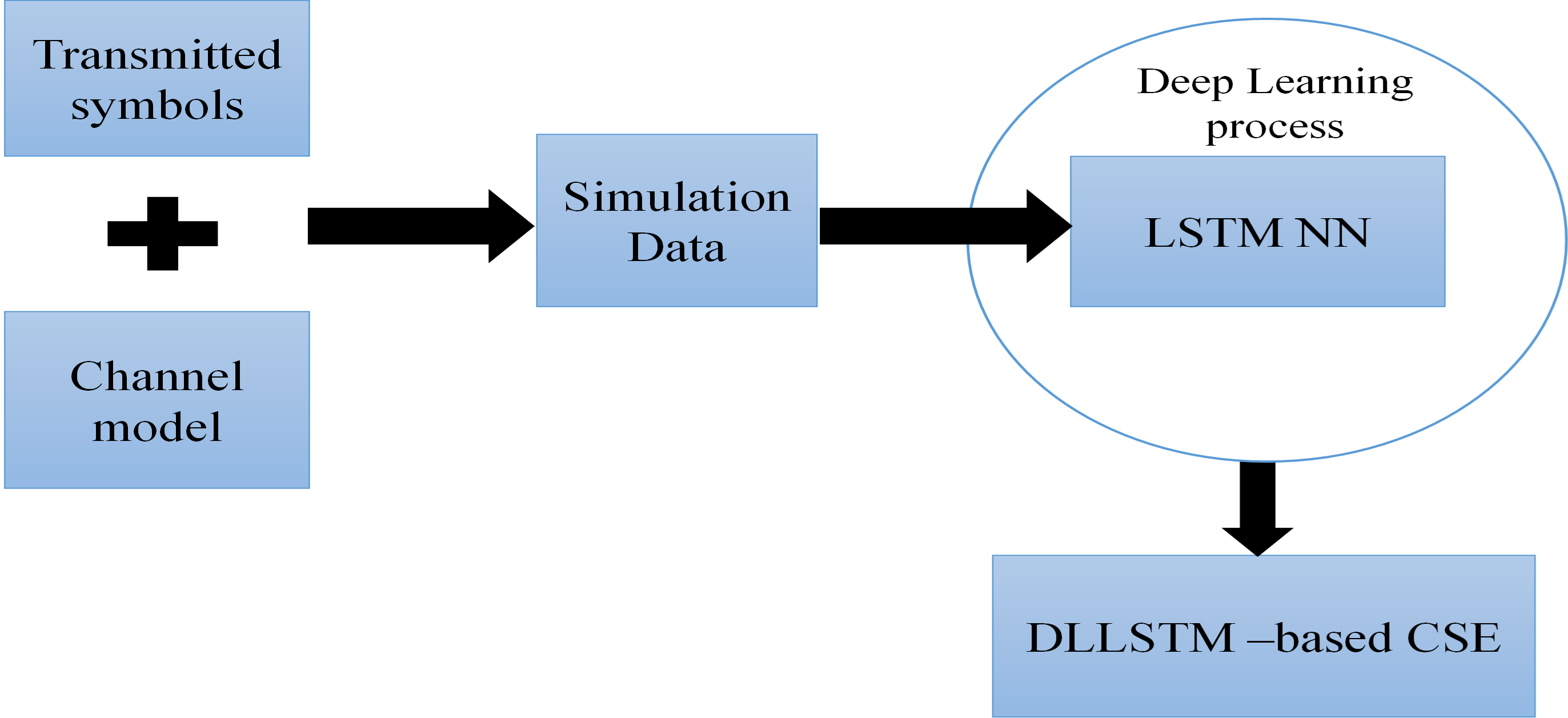
CSE is crucial for OFDM systems to handle multipath fading in wireless channels. While CS techniques like SOMP are computationally efficient, their performance is limited by basis mismatch and noise sensitivity. This paper presents a comprehensive comparison between SOMP and DL approaches using LSTM, BiLSTM, and GRU networks for CSE in V2V communication. The performance of the proposed DL models is rigorously evaluated in a realistic V2V communication scenario utilizing the 3GPP standard vehicular channel model within an OFDM system, with estimation accuracy assessed based on MSE. Experimental results demonstrate that the DL architectures significantly outperform SOMP, achieving a reduction in MSE by up to 15 dB and a reduction in BER by up to three orders of magnitude at high SNRs while maintaining robust performance in high-mobility highway environments. The study establishes DL, particularly the efficient GRU model, as a superior paradigm for accurate and adaptive channel estimation in modern wireless communication systems, thereby contributing to safer and more reliable V2V communication essential for next-generation intelligent transportation systems. The proposed models are trained to accurately estimate the CSI, which is subsequently utilized for the final detection of the transmitted data.
References
W. Fendzi et al., “Policy-driven expansion of renewable energy in Cameroon : A technical and sustainability-centered analysis of growth trends and cross-sectoral impacts ( 2015 – 2024 ),” Energy Strateg. Rev., vol. 62, p. 101912, 2025, https://doi.org/10.1016/j.esr.2025.101912.
H. Abdelfattah, I. Elzein, M. M. Mahmoud, M. I. Mosaad, W. Fendzi Mbasso, and N. F. Ibrahim, “Supporting the reactivity of nuclear power plants using an optimized FOPID controller with arithmetic algorithm: Toward an environmentally sustainable energy system,” Energy Explor. Exploit., 2025, https://doi.org/10.1177/01445987251357362.
S. Nadweh and M. M. M. , I. M. Elzein, Daniel Eutyche Mbadjoun Wapet, “Optimizing control of single- ended primary inductor converter integrated with microinverter for PV systems : Imperialist competitive algorithm,” Energy Explor. Exploit., 2025, https://doi.org/10.1177/01445987251382002.
A. Gao, Z. Zhu, J. Zhang, W. Liang, and Y. Hu, “Matching Combined Heterogeneous Multi-Agent Reinforcement Learning for Resource Allocation in NOMA-V2X Networks,” IEEE Trans. Veh. Technol., vol. 73, no. 10, pp. 15109–15124, 2024, https://doi.org/10.1109/TVT.2024.3409048.
A. Hysa, S. Sefa, I. M. Elzein, A. Ma, M. M. Mahmoud, and E. Touti, “Advanced Modeling and Comparative Error Analysis of Photovoltaic Cells Using Multi-Diode Models and EQE Characterization,” J. Robot. Control, vol. 6, no. 5, pp. 2308–2321, 2025, https://doi.org/10.18196/jrc.v6i5.27539.
W. Feng and B. Wang, “Stability analysis and delayed feedback control for platoon of connected automated vehicles with V2X and V2V infrastructure,” Phys. A Stat. Mech. its Appl., vol. 658, 2025, https://doi.org/10.1016/j.physa.2024.130258.
M. Awad et al., “A review of water electrolysis for green hydrogen generation considering PV/wind/hybrid/hydropower/geothermal/tidal and wave/biogas energy systems, economic analysis, and its application,” Alexandria Eng. J., vol. 87, pp. 213–239, 2024, https://doi.org/10.1016/j.aej.2023.12.032.
E. A. Rahim, M. H. Essai, and E. K. I. Hamad, “Artificial neural network-based sparse channel estimation for V2V communication systems,” J. Electr. Eng., vol. 75, no. 4, pp. 285–296, 2024, https://doi.org/10.2478/jee-2024-0035.
M. S. Priyadarshini et al., “Microcontroller-based Prototype Model of a Solar Wireless Electric Vehicle-to-Vehicle Charging System with Real-Time Battery Voltage Monitoring,” Bul. Ilm. Sarj. Tek. Elektro, vol. 7, no. 3, pp. 527–540, 2025, https://doi.org/10.12928/biste.v7i3.13232.
B. S. d. C. da Silva, V. D. P. Souto, R. D. Souza, and L. L. Mendes, “A Survey of PAPR Techniques Based on Machine Learning,” Sensors, vol. 24, no. 6. 2024. https://doi.org/10.3390/s24061918.
T. Hwang, C. Yang, G. Wu, S. Li, and G. Y. Li, “OFDM and its wireless applications: A survey,” IEEE Trans. Veh. Technol., vol. 58, no. 4, pp. 1673–1694, 2009, https://doi.org/10.1109/TVT.2008.2004555.
D. Cui et al., “Enhancing Short-Term Electricity Forecasting with Advanced Machine Learning Techniques,” J. Electr. Eng. Technol., 2025, https://doi.org/10.1007/s42835-025-02430-z.
P. Sinha et al., “Classifying Power Quality Issues in Railway Electrification Systems Using a Nonsubsampled Contourlet Transform Approach,” Eng. Reports, vol. 7, no. 8, 2025, https://doi.org/10.1002/eng2.70301.
N. V. A. Ravikumar et al., “Design and real-time simulations of robust controllers for uncertain multi-input wind turbine,” Energy Explor. Exploit., p. 01445987251373101, 2025, https://doi.org/10.1177/01445987251373101.
Q. Hu, F. Gao, H. Zhang, S. Jin, and G. Y. Li, “Deep Learning for Channel Estimation: Interpretation, Performance, and Comparison,” IEEE Trans. Wirel. Commun., vol. 20, no. 4, pp. 2398–2412, 2021, https://doi.org/10.1109/TWC.2020.3042074.
H. Senol, A. R. Bin Tahir, and A. Özmen, “Artificial neural network based estimation of sparse multipath channels in OFDM systems,” Telecommun. Syst., vol. 77, no. 1, pp. 231–240, 2021, https://doi.org/10.1007/s11235-021-00754-5.
L. V. Nguyen, D. H. N. Nguyen, and A. L. Swindlehurst, “Deep Learning for Estimation and Pilot Signal Design in Few-Bit Massive MIMO Systems,” IEEE Trans. Wirel. Commun., vol. 22, no. 1, pp. 379–392, 2023, https://doi.org/10.1109/TWC.2022.3193885.
N. H. Hussein, C. T. Yaw, S. P. Koh, S. K. Tiong, and K. H. Chong, “A Comprehensive Survey on Vehicular Networking: Communications, Applications, Challenges, and Upcoming Research Directions,” IEEE Access, vol. 10. pp. 86127–86180, 2022. https://doi.org/10.1109/ACCESS.2022.3198656.
M. S. Priyadarshini, S. A. E. M. Ardjoun, A. Hysa, M. M. Mahmoud, U. Sur, and N. Anwer, “Time-domain Simulation and Stability Analysis of a Photovoltaic Cell Using the Fourth-order Runge-Kutta Method and Lyapunov Stability Analysis,” Bul. Ilm. Sarj. Tek. Elektro, vol. 7, no. 2, pp. 214–230, 2025, https://doi.org/10.12928/biste.v7i2.13233.
Y. Jing, X. Dan, J. Yu, K. Fu, and S. M. Sharkh, “Simultaneous Wireless Power and Multi-Channel Data Transmission Based on OFDM,” IEEE Trans. Power Electron., vol. 39, no. 7, pp. 8894–8903, 2024, https://doi.org/10.1109/TPEL.2024.3377260.
Y. Maamar et al., “A Comparative Analysis of Recent MPPT Algorithms ( P & O INC FLC ) for PV Systems,” J. Robot. Control, vol. 6, no. 4, pp. 1581–1588, 2025, https://doi.org/10.18196/jrc.v6i4.25814.
A. Kakkavas, H. Wymeersch, G. Seco-Granados, M. H. C. Garcia, R. A. Stirling-Gallacher, and J. A. Nossek, “Power allocation and parameter estimation for multipath-based 5G positioning,” IEEE Trans. Wirel. Commun., vol. 20, no. 11, pp. 7302–7316, 2021, https://doi.org/10.1109/TWC.2021.3082581.
R. Bousseksou et al., “Utilizing Short-Time Fourier Transform for the Diagnosis of Rotor Bar Faults in Induction Motors Under Direct Torque Control,” Int. J. Robot. Control Syst., vol. 5, no. 2, pp. 1441–1457, 2025, https://doi.org/10.31763/ijrcs.v5i2.1886.
M. F. Duarte and Y. C. Eldar, “Structured compressed sensing: From theory to applications,” IEEE Trans. Signal Process., vol. 59, no. 9, pp. 4053–4085, 2011, https://doi.org/10.1109/TSP.2011.2161982.
A. K. Ranjan and P. Kumar, “A survey on blockchain-based privacy preserving techniques for edge internet of things,” International Journal of Computers and Applications, vol. 47, no. 6. pp. 497–508, 2025. https://doi.org/10.1080/1206212X.2025.2498687.
H. Huang et al., “Deep learning for physical-layer 5g wireless techniques: Opportunities, challenges and solutions,” IEEE Wirel. Commun., vol. 27, no. 1, pp. 214–222, 2020, https://doi.org/10.1109/MWC.2019.1900027.
S. Basu et al., “Applications of Snow Ablation Optimizer for Sustainable Dynamic Dispatch of Power and Natural Gas Assimilating Multiple Clean Energy Sources,” Eng. Reports, vol. 7, no. 6, pp. 1–12, 2025, https://doi.org/10.1002/eng2.70211.
X. Chen, W. Zhu, Y. Shi, and Y. Zhong, “Wireless communication channel modeling based on ML,” Appl. Comput. Eng., vol. 78, no. 1, pp. 169–175, 2024, https://doi.org/10.54254/2755-2721/78/20240462.
J. Kumar, A. Gupta, S. Tanwar, and M. K. Khan, “A review on 5G and beyond wireless communication channel models: Applications and challenges,” Physical Communication, vol. 67. 2024. https://doi.org/10.1016/j.phycom.2024.102488.
W. Liu, Z. Wang, X. Liu, N. Zeng, Y. Liu, and F. E. Alsaadi, “A survey of deep neural network architectures and their applications,” Neurocomputing, vol. 234, pp. 11–26, 2017, https://doi.org/10.1016/j.neucom.2016.12.038.
C. Zhang, P. Patras, and H. Haddadi, “Deep Learning in Mobile and Wireless Networking: A Survey,” IEEE Commun. Surv. Tutorials, vol. 21, no. 3, pp. 2224–2287, 2019, https://doi.org/10.1109/COMST.2019.2904897.
K. Wang, T. Cao, X. Li, H. Li, M. Li, and M. Zhou, “A Survey on Trajectory Planning and Resource Allocation in Unmanned Aerial Vehicle-assisted Edge Computing Networks,” Dianzi Yu Xinxi Xuebao/Journal Electron. Inf. Technol., vol. 47, no. 5, pp. 1266–1281, 2025, https://doi.org/10.11999/JEIT241071.
A. Alkuhayli, U. Khaled, and M. M. Mahmoud, “A Novel Hybrid Harris Hawk Optimization – Sine Cosine Transmission Network,” Energies, Mdpi, vol. 17, no. 19, p. 4985, 2024, https://doi.org/10.3390/en17194985.
C. Ji, J. Dai, X. Q. Jiang, and W. Xu, “Auxiliary Bayesian Learning Approach for Joint Channel Estimation and Data Detection with RIS-Assisted OFDM Systems,” IEEE Trans. Wirel. Commun., 2025, https://doi.org/10.1109/TWC.2025.3605521.
S. Damith, T. Riihonen, C. Baquero Barneto, and M. Valkama, “Joint MIMO Communications and Sensing With Hybrid Beamforming Architecture and OFDM Waveform Optimization,” IEEE Trans. Wirel. Commun., vol. 23, no. 2, pp. 1565–1580, 2024, https://doi.org/10.1109/TWC.2023.3290326.
I. M. Elzein, Y. Maamar, M. M. Mahmoud, M. I. Mosaad, and S. A. Shaaban, “The Utilization of a TSR-MPPT-Based Backstepping Controller and Speed Estimator Across Varying Intensities of Wind Speed Turbulence,” Int. J. Robot. Control Syst., vol. 5, no. 2, pp. 1315–1330, 2025, https://doi.org/10.31763/ijrcs.v5i2.1793.
Z. Mohades and V. Tabataba Vakili, “Deep Neural Network for Compressive Sensing and Application to Massive MIMO Channel Estimation,” Circuits, Syst. Signal Process., vol. 40, no. 9, pp. 4474–4489, 2021, https://doi.org/10.1007/s00034-021-01675-z.
H. A. Hassan, M. A. Mohamed, M. H. Essai, H. Esmaiel, A. S. Mubarak, and O. A. Omer, “Effective deep learning-based channel state estimation and signal detection for OFDM wireless systems,” J. Electr. Eng., vol. 74, no. 3, pp. 167–176, 2023, https://doi.org/10.2478/jee-2023-0022.
A. Fayz et al., “Optimal Controller Design of Crowbar System for DFIG-based WT : Applications of Gravitational Search Algorithm,” Bul. Ilm. Sarj. Tek. Elektro, vol. 7, no. 2, pp. 122–136, 2025, https://doi.org/10.12928/biste.v7i2.13027.
H. A. Hassan, M. A. Mohamed, M. N. Shaaban, M. H. E. Ali, and O. A. Omer, “An efficient deep neural network channel state estimator for OFDM wireless systems,” Wirel. Networks, vol. 30, no. 3, pp. 1441–1451, 2024, https://doi.org/10.1007/s11276-023-03585-1.
S. Heroual, B. Belabbas, and N. B. Elzein I M, Yasser Diab, Alfian Ma’arif, Mohamed Metwally Mahmoud, Tayeb Allaoui, “Enhancement of Transient Stability and Power Quality in Grid- Connected PV Systems Using SMES,” Int. J. Robot. Control Syst., vol. 5, no. 2, pp. 990–1005, 2025, https://doi.org/10.31763/ijrcs.v5i2.1760.
M. H. Essai Ali, “Deep learning-based pilot-assisted channel state estimator for OFDM systems,” IET Commun., vol. 15, no. 2, pp. 257–264, 2021, https://doi.org/10.1049/cmu2.12051.
S. Wang, R. Yao, T. A. Tsiftsis, N. I. Miridakis, and N. Qi, “Signal Detection in Uplink Time-Varying OFDM Systems Using RNN with Bidirectional LSTM,” IEEE Wirel. Commun. Lett., vol. 9, no. 11, pp. 1947–1951, 2020, https://doi.org/10.1109/LWC.2020.3009170.
P. L. Seabe, C. R. B. Moutsinga, and E. Pindza, “Forecasting Cryptocurrency Prices Using LSTM, GRU, and Bi-Directional LSTM: A Deep Learning Approach,” Fractal Fract., vol. 7, no. 2, 2023, https://doi.org/10.3390/fractalfract7020203.
M. M. Lawal and A. Abdulrauf, “Fake News Detection Using Bi-LSTM Architecture: A Deep Learning Approach on the ISOT Dataset,” J. Comput. Theor. Appl., vol. 3, no. 2, pp. 104–114, 2025, https://doi.org/10.62411/jcta.14235.
A. K. Nair and V. Menon, “Joint Channel Estimation and Symbol Detection in MIMO-OFDM Systems: A Deep Learning Approach using Bi-LSTM,” in 2022 14th International Conference on COMmunication Systems and NETworkS, COMSNETS 2022, 2022, pp. 406–411. https://doi.org/10.1109/COMSNETS53615.2022.9668456.
M. H. E. Ali and I. I. B. M. Taha, “Channel state information estimation for 5G wireless communication systems: recurrent neural networks approach,” PeerJ Comput. Sci., vol. 7, pp. 1–23, 2021, https://doi.org/10.7717/peerj-cs.682.
A. T. Tran and K. H. Tran, “Advances in Artificial Intelligence for Next-Generation Wireless Transmission,” J. Comput. Electron. Inf. Manag., vol. 17, no. 1, pp. 25–32, 2025, https://doi.org/10.54097/3fkgwa24.
A. Hysa, M. M. Mahmoud, and A. Ewais, “An Investigation of the Output Characteristics of Photovoltaic Cells Using Iterative Techniques and MATLAB ® 2024a Software,” Control Syst. Optim. Lett., vol. 3, no. 1, pp. 46–52, 2025, https://doi.org/10.59247/csol.v3i1.174.
S. Monga, N. Saluja, R. Garg, A. F. M. S. Shah, J. Ekoru, and M. Madahana, “Innovative Channel Estimation Methods for Massive MIMO Using GAN Architectures,” IET Commun., vol. 19, no. 1, 2025, https://doi.org/10.1049/cmu2.70066.
M. Bakulin, T. Ben Rejeb, V. Kreyndelin, D. Pankratov, and A. Smirnov, “Multi-User MIMO Downlink Precoding with Dynamic User Selection for Limited Feedback,” Sensors, vol. 25, no. 3, 2025, https://doi.org/10.3390/s25030866.
S. Heroual, B. Belabbas, Y. Diab, M. M. Mahmoud, T. Allaoui, and N. Benabdallah, “Optimizing Power Flow in Photovoltaic-Hybrid Energy Storage Systems: A PSO and DPSO Approach for PI Controller Tuning,” Int. Trans. Electr. Energy Syst., vol. 2025, no. 1, 2025, https://doi.org/10.1155/etep/9958218.
M. M. Mahmoud, H. S. Salama, M. M. Aly, and A. M. M. Abdel-Rahim, “Design and implementation of FLC system for fault ride-through capability enhancement in PMSG-wind systems,” Wind Eng., vol. 45, no. 5, pp. 1361–1373, 2021, https://doi.org/10.1177/0309524X20981773.
H. Alizadegan, B. Rashidi Malki, A. Radmehr, H. Karimi, and M. A. Ilani, “Comparative study of long short-term memory (LSTM), bidirectional LSTM, and traditional machine learning approaches for energy consumption prediction,” Energy Explor. Exploit., vol. 43, no. 1, pp. 281–301, 2025, https://doi.org/10.1177/01445987241269496.
G. Van Houdt, C. Mosquera, and G. Nápoles, “A review on the long short-term memory model,” Artif. Intell. Rev., vol. 53, no. 8, pp. 5929–5955, 2020, https://doi.org/10.1007/s10462-020-09838-1.
P. Sinha et al., “Efficient automated detection of power quality disturbances using nonsubsampled contourlet transform & PCA-SVM,” Energy Explor. Exploit., vol. 00, no. 00, 2025, https://doi.org/10.1177/01445987241312755.
A. M. E. Abhishek Raj, Chandra Sekhar Mishra, S Ramana Kumar Joga, I. M. Elzein, Asit Mohanty, Snehalika, Mohamed Metwally Mahmoud, “Wavelet Analysis- Singular Value Decomposition Based Method for Precise Fault Localization in Power Distribution Networks Using k-NN Classifier,” Int. J. Robot. Control Syst., vol. 5, no. 1, pp. 530–554, 2025, https://doi.org/10.31763/ijrcs.v5i1.1543.
M. M. Mahmoud, M. K. Ratib, M. M. Aly, and A. M. M. Abdel–Rahim, “Application of Whale Optimization Technique for Evaluating the Performance of Wind-Driven PMSG Under Harsh Operating Events,” Process Integr. Optim. Sustain., 2022, https://doi.org/10.1007/s41660-022-00224-8.
D. S. Rodriguez, “Gated Recurrent Units - Enhancements and Applications: Studying Enhancements to Gated Recurrent Unit (GRU) Architectures and Their Applications in Sequential Modeling Tasks,” Adv. Deep Learn. Tech., vol. 3, no. 1, pp. 16–30, 2023, https://www.thesciencebrigade.org/adlt/article/view/113.
M. Ravanelli, P. Brakel, M. Omologo, and Y. Bengio, “Light Gated Recurrent Units for Speech Recognition,” IEEE Trans. Emerg. Top. Comput. Intell., vol. 2, no. 2, pp. 92–102, 2018, https://doi.org/10.1109/TETCI.2017.2762739.
M. M. Hussein, T. H. Mohamed, M. M. Mahmoud, M. Aljohania, M. I. Mosaad, and A. M. Hassan, “Regulation of multi-area power system load frequency in presence of V2G scheme,” PLoS One, vol. 18, no. 9, p. e0291463, 2023, https://doi.org/10.1371/journal.pone.0291463.
F. Menzri, T. Boutabba, I. Benlaloui, H. Bawayan, M. I. Mosaad, and M. M. Mahmoud, “Applications of hybrid SMC and FLC for augmentation of MPPT method in a wind-PV-battery configuration,” Wind Eng., 2024, https://doi.org/10.1177/0309524X241254364.
O. M. Lamine et al., “A Combination of INC and Fuzzy Logic-Based Variable Step Size for Enhancing MPPT of PV Systems,” Int. J. Robot. Control Syst., vol. 4, no. 2, pp. 877–892, 2024, https://doi.org/10.31763/ijrcs.v4i2.1428.
N. Benalia et al., “Enhancing electric vehicle charging performance through series-series topology resonance-coupled wireless power transfer,” PLoS One, vol. 19, no. 3, 2024, https://doi.org/10.1371/journal.pone.0300550.
B. S. Atia et al., “Applications of Kepler Algorithm-Based Controller for DC Chopper: Towards Stabilizing Wind Driven PMSGs under Nonstandard Voltages,” Sustain. , vol. 16, no. 7, 2024, https://doi.org/10.3390/su16072952.
A. T. Hassan, et al., “Adaptive Load Frequency Control in Microgrids Considering PV Sources and EVs Impacts: Applications of Hybrid Sine Cosine Optimizer and Balloon Effect Identifier Algorithms,” Int. J. Robot. Control Syst., vol. 4, no. 2, pp. 941–957, 2024, https://doi.org/10.31763/ijrcs.v4i2.1448.
M. S. Priyadarshini, D. Krishna, M. Bhaskara Reddy, A. Bhatt, M. Bajaj, and M. M. Mahmoud, “Continuous Wavelet Transform based Visualization of Transient and Short Duration Voltage Variations,” in 2023 4th IEEE Global Conference for Advancement in Technology, GCAT 2023, 2023. https://doi.org/10.1109/GCAT59970.2023.10353457.
A. M et al., “Prediction of Optimum Operating Parameters to Enhance the Performance of PEMFC Using Machine Learning Algorithms,” Energy Explor. Exploit., 2024, https://doi.org/10.1177/01445987241290535.
B. Krishna Ponukumati et al., “Evolving fault diagnosis scheme for unbalanced distribution network using fast normalized cross-correlation technique,” PLoS One, vol. 19, no. 10, pp. 1–23, 2024, https://doi.org/10.1371/journal.pone.0305407.
I. K. M. Jais, A. R. Ismail, and S. Q. Nisa, “Adam Optimization Algorithm for Wide and Deep Neural Network,” Knowl. Eng. Data Sci., vol. 2, no. 1, p. 41, 2019, https://doi.org/10.17977/um018v2i12019p41-46.
Published
How to Cite
Issue
Section
License
Copyright (c) 2025 Eman Rashedy, Mohamed Metwally Mahmoud, Alfian Ma'arif, Mohamed Hassan Essai, Kuruva Raju, Ehab K. I. Hamad

This work is licensed under a Creative Commons Attribution-ShareAlike 4.0 International License.
Authors who publish with this journal agree to the following terms:
- Authors retain copyright and grant the journal right of first publication with the work simultaneously licensed under a Creative Commons Attribution License that allows others to share the work with an acknowledgment of the work's authorship and initial publication in this journal.
- Authors are able to enter into separate, additional contractual arrangements for the non-exclusive distribution of the journal's published version of the work (e.g., post it to an institutional repository or publish it in a book), with an acknowledgment of its initial publication in this journal.
- Authors are permitted and encouraged to post their work online (e.g., in institutional repositories or on their website) prior to and during the submission process, as it can lead to productive exchanges, as well as earlier and greater citation of published work (See The Effect of Open Access).

This journal is licensed under a Creative Commons Attribution-ShareAlike 4.0 International License.