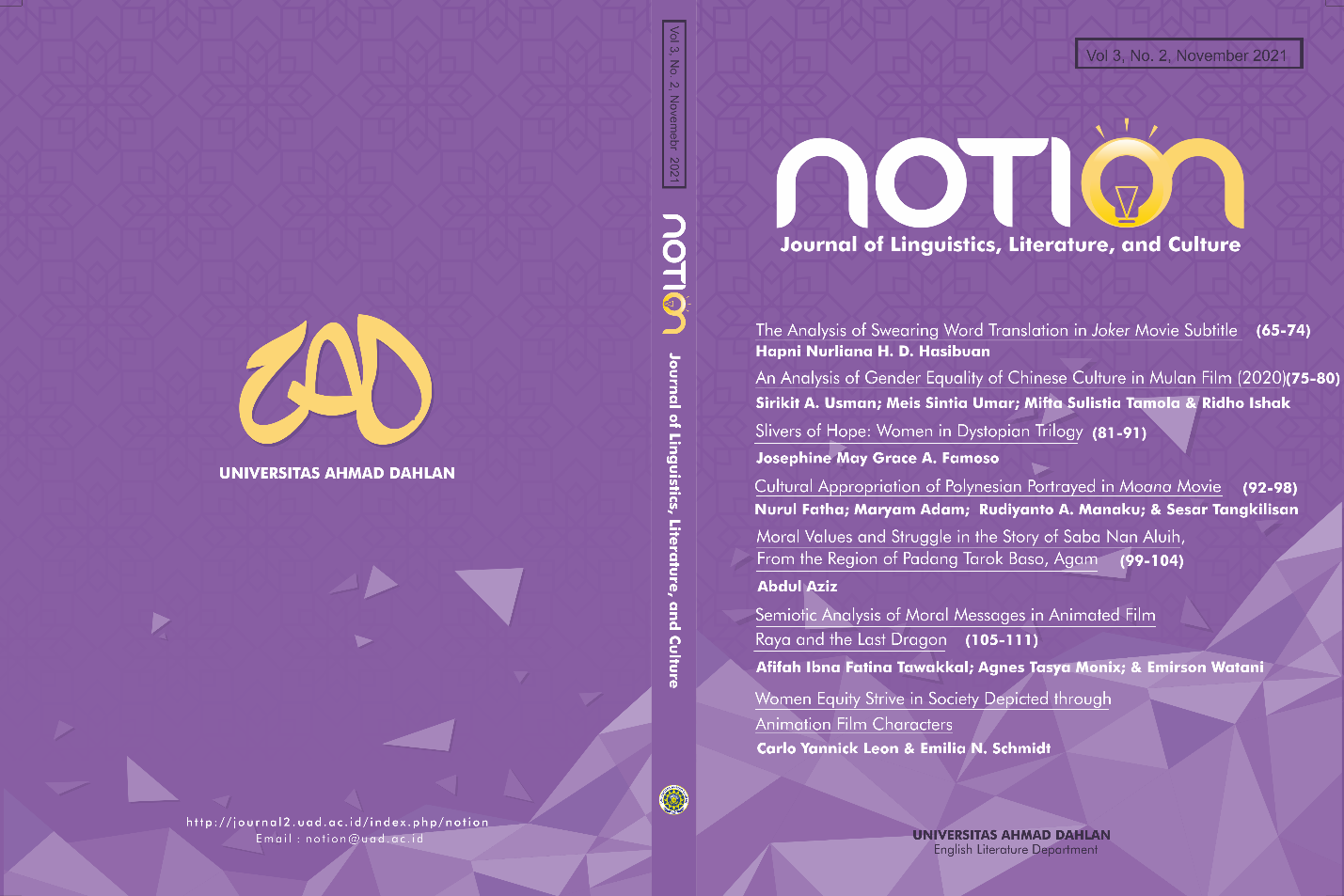
An Analysis of Gender Equality of Chinese Culture in Mulan Film (2020)
DOI:
https://doi.org/10.12928/notion.v3i2.4886Keywords:
gender equality, Chinese culture, discriminationAbstract
Mulan film (2020) raises gender issues and is still related to the laws of norms and traditions. Mulan has a strong and patriarchal nature while Chinese cultural traditions are not unilateral with Mulan figures. The study aims to promote justice for women with regard to Chinese culture and traditions, as well as whether it has the opportunity to promote equal treatment without discrimination. Gender equality is commonplace to raise and talk about. Each gender is formed in a complex culture of each gender either in their respective positions or positions. Gender equality is linked to feminist, masculine and also includes sexism. Women and men can change roles like women can be wise leaders and men can do the skills that women have such as cooking. This study uses qualitative descriptive methods to analyze the social circumstances associated with the scene. Researchers use the technique of observing the film, interpreting each situation in the film, then collecting data, seeking information on gender equality or activities through observation and sensing that are still related to gender equality in culture, After that give a view on the object to be observed. Thus the research of Mulan film (2020) is intended to find a new mindset or an idea and a new understanding. This method uses observation and sensing and then provides a new interpretation.
References
Asruchin, D. M. (2018). Konfusianisme: sumber peradaban China. The First International Seminar & Roundtable Meeting “Professional Chinese Teaching” in Southeast Asia, 75–84. https://china.uai.ac.id/wp-content/uploads/2019/02/July-2018-UAI-PBM-International-Seminar-Proceeding.pdf#page=82
Budaya, D., & Kuno, C. (1997). In Irwan Abdullah, “Dari Domestik ke Publik: Jalan Panjang Pencarian Identitas Perempuan”, dalam Irwan Abdullah (ed.), Sangkan Paran Gender, p. 311-314. Yogyakarta: Pustaka Pelajar.
Indrastuti, N. S. K. (2018). Representasi Unsur Budaya dalam Cerita Rakyat Indonesia: Kajian Terhadap Status Sosial dan Kebudayaan Masyarakat. Malaysian Journal of Social Sciences and Humanities (MJ - SSH), 3(3), p. 192. https://msocialsciences.com/index.php/mjssh/article/view/124
Manurung, D. (2013). Analisis unsur feminisme dalam kumpulan cerpen perempuan berlipstik kapur karya esti nuryanti kasam. Journal UMRAH. https://jurnal.umrah.ac.id/archives/688
Korompot S. N. (2017). Representasi seksisme dalam fim Her. Thesis, p. 97. https://core.ac.uk/display/89564717
Sulistia, R. (2016). Female masculinity of Fa Mulan and its impact towards her relationship with male characters in disney movie Mulan. Litera~Kultura, 4(3), 12–19. https://core.ac.uk/download/pdf/230653305.pdf
Moleong, L. J. (2001). Metode penelitian kualitatif. Bandung: PT Penerbit Remaja Rosdakarya.
Downloads
Published
How to Cite
Issue
Section
License
Copyright (c) 2021 Sirikit A. Usman, Meis Sintia Umar, Mifta Sulistia Tamola, Ridho Ishak

This work is licensed under a Creative Commons Attribution 4.0 International License.
By publishing your research with NOTION: Journal of Linguistics, Literature, and Culture, you agree to a collaborative and open approach to copyright:
-
You Keep the Rights: You retain full copyright of your manuscript. You simply grant our journal the right of first publication. To maximize the reach of your research, your work will be licensed under a Creative Commons Attribution 4.0 International License (CC BY 4.0). This empowers the global community to read and share your work freely, provided they give proper credit to your authorship and acknowledge NOTION as the original publisher.
-
Freedom to Distribute: You are completely free to enter into separate, non-exclusive agreements to distribute the published version of your article. Whether you wish to archive it in your university's institutional repository or include it as a chapter in a future book, you may do so as long as its initial publication in this journal is properly cited.
-
Boost Your Impact: We actively encourage you to share your pre-publication manuscript online such as on your personal website or an academic repository even before or during the submission process. Proactive sharing fosters valuable scholarly discussions and significantly increases the early visibility and citation potential of your work.