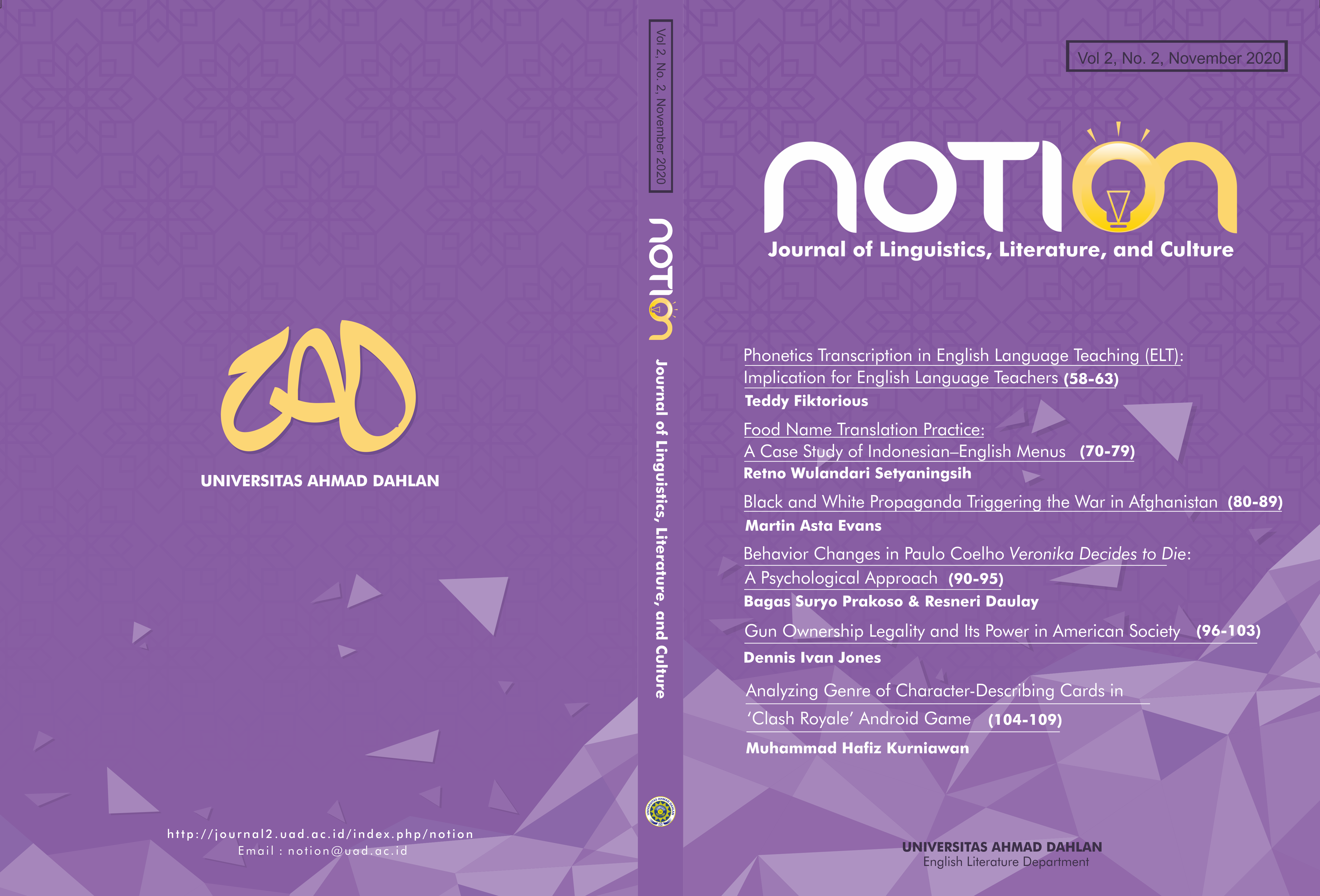
Phonetics Transcription in English Language Teaching (ELT): Implications for English Language Teachers
DOI:
https://doi.org/10.12928/notion.v2i2.2068Keywords:
phonetic transcription, International Phonetic Alphabet, EFL, literacy instructionAbstract
This paper is written through descriptive method or library research to discuss the use of phonetic transcription in the teaching of English as a foreign language (EFL) using the International Phonetic Alphabet (IPA). The first part describes the theoretical framework of the transcription basics. Then, the next part discusses the advantages of the phonetic transcription. This is followed by an illustration of understanding basic speech sounds. Some ideas of preparing classroom materials using the IPA are addressed in the next section. Finally, some solutions as well as recommendations are proposed and justification of the researcher’s position toward the use of phonics as an EFL literacy instruction in ELT is presented.
References
Olugbeko, S. O. 2016. “Phonic Method: A Strategy Towards Enhancing Learning Retention in Basic Literacy Programme of Ondo State, Nigeria”. International Journal of Education and Research, 4(6): 143-152.
Pennington, M. C. & Revell, P.R. 2019. English Pronunciation Teaching and Research Contemporary Perspectives. London: Palgrave Macmillan.
Hosseinzadeh, N. M., Kambuziya, A. K. Z. & Shariati, M. 2015. “British and American Phonetic Varieties”. Journal of Language Teaching and Research, 6(3): 647-655.
Tench, P. 2011. Transcribing the Sound of English: A Phonetics Workbook for Words and Discourse. Cambridge: Cambridge University Press.
Wells, J. C. 2016. Sounds Fascinating: Further Observations on English Phonetics and Phonology. Cambridge: Cambridge University Press.
Fromkin, V., Rodman, R., & Hyams, N. 2011. An Introduction to Language. Wadsworth: Cengage Learning.
Stabler, E. 2012. Introduction to Linguistics. Campbell.
Thaen-nga, A. & Leenam, W. 2016. “The Use of Phonics Instruction to Enhance Students’ Reading Ability: A Case Study of Grade 3 Students at Nam Yuen School, Nam Yuen District, Ubon Ratchathani Province”. International Journal of Research-Granthaalayah, 4(10): 65-71.
Gilakjani, A. P. 2011. “A Study on the Situation of Pronunciation Instruction in ESL/EFL classrooms”. Journal of Studies in Education, 1(1): 1-15.
Downloads
Published
How to Cite
Issue
Section
License
Copyright (c) 2020 Teddy Fiktorius

This work is licensed under a Creative Commons Attribution-ShareAlike 4.0 International License.
By publishing your research with NOTION: Journal of Linguistics, Literature, and Culture, you agree to a collaborative and open approach to copyright:
-
You Keep the Rights: You retain full copyright of your manuscript. You simply grant our journal the right of first publication. To maximize the reach of your research, your work will be licensed under a Creative Commons Attribution 4.0 International License (CC BY 4.0). This empowers the global community to read and share your work freely, provided they give proper credit to your authorship and acknowledge NOTION as the original publisher.
-
Freedom to Distribute: You are completely free to enter into separate, non-exclusive agreements to distribute the published version of your article. Whether you wish to archive it in your university's institutional repository or include it as a chapter in a future book, you may do so as long as its initial publication in this journal is properly cited.
-
Boost Your Impact: We actively encourage you to share your pre-publication manuscript online such as on your personal website or an academic repository even before or during the submission process. Proactive sharing fosters valuable scholarly discussions and significantly increases the early visibility and citation potential of your work.