Development of an e-comic media assisted by QuiverVision for integrated literacy learning
DOI:
https://doi.org/10.12928/ijei.v7i3.17188Keywords:
augmented reality, e-comic, integrated literacy, QuiverVision, reading and writing literacyAbstract
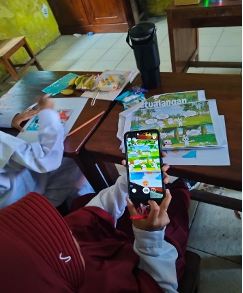
This study was motivated by the low reading and writing literacy of third-grade students at SDS Terpadu Bani Rauf Gowa, Indonesia, shown by students’ limited ability to comprehend texts, identify main ideas, interpret information, and organize ideas coherently in writing. Learning that still relies on lecturing and conventional media has resulted in low student interest, motivation, and involvement in literacy activities. This study aimed to (1) describe the need for QuiverVision-assisted e-comic media, (2) develop the media based on an integrated literacy learning approach, (3) determine the validity of the media, (4) determine the practicality of the media, and (5) determine the effectiveness of the media in improving the reading and writing literacy of third-grade students. This research employed a research and development (R&D) method using the ADDIE model, consisting of the analysis, design, development, implementation, and evaluation stages. The participants were one classroom teacher and 30 third-grade students of SDS Terpadu Bani Rauf Gowa. Data were collected through observation, needs-analysis questionnaires, expert validation sheets, teacher and student response questionnaires, and reading-writing literacy tests (pretest and posttest), and were analyzed descriptively and quantitatively. The results show that the QuiverVision-assisted e-comic media was successfully developed according to the identified learning needs. We successfully developed an e-comic that stimulates students’ reading and writing literacy through several integrated activities, including reading illustrated stories, identifying characters and main ideas, answering comprehension questions, observing augmented-reality visualizations, and rewriting the story in their own words. Expert validation produced scores of 91% from the material expert, 88% from the media expert, and 84% from the language expert, indicating that the media was valid to strongly valid. Teacher and student response scores reached 90.00% and 79.88%, respectively, with an average practicality score of 84.94%, categorized as very practical. The effectiveness test showed an increase in students’ mean score from 35.87 on the pretest to 82.67 on the posttest, a statistically significant paired-sample t-test result, and an N-Gain value of 0.64 in the moderate category. These findings indicate that the developed media is valid, very practical, and effective for use in Indonesian language learning to improve elementary students’ reading and writing literacy. This study contributes to the advancement of language education by providing an innovative and alternative literacy learning medium that integrates digital storytelling, visual interaction, and augmented reality technology in a single instructional process, thereby supporting more engaging and meaningful reading and writing learning activities for elementary school students.
References
Alfian, A. N., Putra, M. Y., Rafsanjani, R., & Witjaksono, A. P. (2022). User acceptance test terhadap aplikasi augmented reality Quivervision 3D sebagai media pembelajaran mewarnai. Informatics For Educators and Professional: Journal of Informatics, 6(2), 197-206.
Azuma, R. (2021). A survey of augmented reality. Presence: Teleoperators and Virtual Environments, 6(4), 355-385. https://doi.org/10.1162/pres.1997.6.4.355
Borg, W. R., & Gall, M. D. (1983). Educational research: An introduction. Longman.
Branch, R. M. (2009). Instructional design: The ADDIE approach. Springer. https://doi.org/10.1007/978-0-387-09506-6
Eisner, W. (1990). Comics and Sequential Art. Poorhouse Press.
Graham, S., & Hebert, M. (2021). Writing to read: Evidence for how writing can improve reading. Carnegie Corporation. https://carnegie.org/publication/writing-to-read-evidence-for-how-writing-can-improve-reading
Guthrie, J. T., & Wigfield, A. (2000). Engagement and motivation in reading. In M. L. Kamil, P. B. Mosenthal, P. D. Pearson, & R. Barr (Eds.), Handbook of reading research (vol. 3, pp. 403–422). Lawrence Erlbaum Associates Publishers.
Nadda, N. Q. (2025). Membangun Fondasi pendidikan: solusi atas minimnya kemampuan membaca dan berhitung di sekolah dasar Indonesia. Publikasi Ilmu Pendidikan Bahasa dan Matematika, 3(5), 206-215.
Khotimah, S., Ratnawuri, T., & Pritandhari, M. (2021). Pengembangan e-comic berbasis android sebagai media pembelajaran kelas Xl SMA Paramarta 1 Seputih Banyak Lampung Tengah. Jurnal Ilmiah Pendidikan Ekonomi, 2(1), 49-58. https://doi.org/10.24127/edunomia.v2i1.1630
Kloss, J. (2022). Augmented reality in education: Immersive learning and instructional design. Routledge.
Mahayani, L. D., Wibawa, I. M. C., & Paramartha, W. E. (2024). Media e-komik berbasis kontekstual untuk meningkatkan keterampilan literasi pada siswa kelas VI sekolah dasar. International Journal of Natural Science and Engineering, 8(2), 105–120. https://doi.org/10.23887/ijnse.v8i2.95771
Malpique, A., Limpo, T., & Alves, R. A. (2022). Reading-writing connections in elementary education. Journal of Educational Psychology, 114(4), 845-860. https://doi.org/10.1037/edu0000689
Maritim, E. (2023). The essence and curriculum of learning Indonesian language in elementary schools. International Journal of Education and Literature, 2(1), 49-57.
Mayer, R. E. (2021). Multimedia learning. Cambridge University Press.
McCloud, S. (2020). Understanding comics. HarperCollins.
Nurchurifiani, E., & Zulianti , H. . (2021). Use of problem-based digital comics in the era of disruption as an increasing effort critical thinking skills and learning achievement. Journal Corner of Education, Linguistics, and Literature, 1(1), 1–7. https://doi.org/10.54012/jcell.v1i1.5
Widianto, P. C., Fadhilawati, D., Sutanti, N., & Supriyono, S. (2024). Examining Quizalize's impact on students' reading comprehension mastery English. Jurnal Pendidikan: Riset dan Konseptual, 8(2), 338-349.
Yulaichah, S., Mariana, N., & Wirayanto. (2024). The use of e-comics based on a realistic mathematical approach to improve critical and creative thinking skills of elementary school students. International Journal of Recent Educational Research, 5(1), 90-105. https://doi.org/10.46245/ijorer.v5i1.497
Downloads
Published
How to Cite
Issue
Section
License
Copyright (c) 2026 Asri Pratiwi, Sulfasyah Sulfasyah, Tasrif Akib

This work is licensed under a Creative Commons Attribution-ShareAlike 4.0 International License.
Authors who publish with this journal agree to the following terms:
- Authors retain copyright with the work simultaneously licensed under a Creative Commons Attribution License that allows others to share the work with an acknowledgement of the work's authorship and initial publication in this journal.
- Authors are able to enter into separate, additional contractual arrangements for the non-exclusive distribution of the journal's published version of the work (e.g., post it to an institutional repository or publish it in a book), with an acknowledgement of its initial publication in this journal.
- Authors are permitted and encouraged to post their work online (e.g., in institutional repositories or on their website) prior to and during the submission process, as it can lead to productive exchanges, as well as earlier and greater citation of published work (See The Effect of Open Access).