Developing Wordwall-based Pancasila education learning game to improve the students’ responsibility character and learning outcomes
DOI:
https://doi.org/10.12928/ijei.v7i3.17123Keywords:
learning outcomes, Pancasila education, responsibility character, Wordwall-based learning gameAbstract
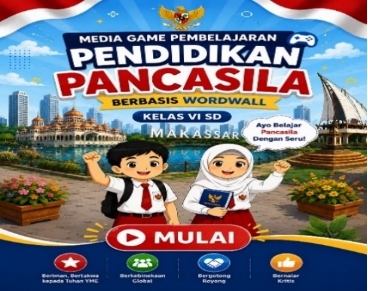
Development of innovative learning media is essential for strengthening students' responsibility character and improving learning outcomes in Pancasila Education. This study aimed to (1) develop Wordwall-based game learning media, (2) examine its validity, (3) evaluate its practicality, and (4) determine its effectiveness in improving the responsibility character and learning outcomes of sixth-grade elementary school students. This study employed a Research and Development (R&D) approach using the ADDIE model and involved 28 sixth-grade students at UPT SPF SD Negeri Kakatua, a public elementary school in Makassar, South Sulawesi, Indonesia. The developed learning media consisted of four curriculum-based learning topics, four interactive Wordwall game activities, student worksheets, and media usage instructions integrated into a comprehensive instructional package. The interactive learning activities were designed to encourage active participation, independent learning, and the development of students' responsibility character through meaningful game-based learning experiences. The results indicated that the developed media met the criteria of validity, practicality, and effectiveness. Expert validation confirmed that the media was highly feasible for classroom implementation. Teacher and student responses demonstrated excellent practicality, while students' responsibility character and learning outcomes improved after using the media. The paired-samples t-test revealed a statistically significant difference between pretest and posttest scores, and the N-gain analysis indicated meaningful learning improvement. These findings demonstrate that the developed Wordwall-based learning media effectively enhances both students' responsibility character and learning outcomes. Therefore, it can serve as an innovative instructional alternative to support meaningful learning and character education in elementary Pancasila education.
References
Abuhassna, H., Alnawajha, S., Awae, F., Adnan, M. A. B. M., & Edwards, B. I. (2024). Synthesizing technology integration within the ADDIE model for instructional design: A comprehensive systematic literature review. Journal of Autonomous Intelligence, 7(5), 1546–1574. https://doi.org/10.32629/jai.v7i5.1546
Branch, R. M. (2009). Instructional design: The ADDIE approach. Springer. https://doi.org/10.1007/978-0-387-09506-6
Bureau, J. S., Howard, J. L., Chong, J. X., & Guay, F. (2022). Pathways to student motivation: A meta-analysis of antecedents of autonomous and controlled motivation. Review of Educational Research, 92(1), 46–72. https://doi.org/10.3102/00346543211042426
Celik, F., & Baturay, M. H. (2024). Technology and innovation in shaping the future of education. Smart Learning Environments, 11(1), Article 54. https://doi.org/10.1186/s40561-024-00339-0
Clark, R. C., & Mayer, R. E. (2016). E-learning and the science of instruction: Proven guidelines for consumers and designers of multimedia learning (4th ed.). Wiley. https://doi.org/10.1002/9781119239086
Deterding, S., Dixon, D., Khaled, R., & Nacke, L. (2011). From game design elements to gamefulness: Defining gamification. In Proceedings of the 15th International Academic MindTrek Conference (pp. 9–15). ACM. https://doi.org/10.1145/2181037.2181040
Dewi, R. S., & Setiawan, S. (2022). Digital comic media: The relevance of Pancasila in everyday life. Mimbar PGSD Undiksha, 10(2), 183–189. https://doi.org/10.23887/jjpgsd.v10i2.41811
Fariza, A. A., Nawir, M., & Azis, A. (2026). Developing Pancasila education e-module using Panrita Lopi context and Wordwall media to foster the fifth graders’ learning motivation and national character. International Journal on Education Insight, 7(2), 159–176. https://doi.org/10.12928/ijei.v7i2.15976
Firdaus, A. A., Cahyanto, B., & Dina, L. N. A. B. (2025). Pengembangan elektronik modul (e-module) berbasis kearifan lokal pada mata pelajaran pendidikan Pancasila di sekolah dasar. JPMI: Jurnal Pendidikan Madrasah Ibtidaiyah, 7(3), 116–127.
Husna, D. A., & Kusumadewi, R. F. (2025). Pengaruh media pembelajaran Wordwall terhadap motivasi belajar pendidikan Pancasila di kelas IV SD Negeri Sembungharjo 01. Pendas: Jurnal Ilmiah Pendidikan Dasar, 10(2), 447–457. file:///Users/yasirmarzuqi/Downloads/341.+Dina+Amalia+Husna.pdf
Indriani, P., Zuhria, A. F., Hidayat, G. F., Jaja, J., & Kurnia, M. D. (2024). Wordwall educational games-based digital assessment development: An innovative approach to Indonesian language learning in junior high schools. Jurnal Kependidikan, 11(3). https://doi.org/10.33394/jk.v11i3.16626
Khoiriyah, N. N. M., Dharma, I. M. A., & Sudewiputri, M. P. (2025). Pengaruh media interaktif berbantuan Wordwall setting model open ended terhadap motivasi belajar siswa SD kelas IV. Jurnal BELAINDIKA: Pembelajaran dan Inovasi Pendidikan, 7(2), 294–300. https://doi.org/10.52005/belaindika.v7i2.375
Lisandra, R., Pramudani, S. L., Widodo, S. T., & Nuraeni, R. (2025). Optimalisasi media Wordwall untuk peningkatan motivasi, hasil belajar, dan kemampuan berpikir kritis dalam pembelajaran PKn di SD. Mutiara: Multidisciplinary Scientific Journal, 3(1), 104–105. file:///Users/yasirmarzuqi/Downloads/317.+71-76%20(1).pdf
Mayer, R. E. (2008). Applying the science of learning: Evidence-based principles for the design of multimedia instruction. American Psychologist, 63(8), 760–769. https://doi.org/10.1037/0003-066X.63.8.760
Mayer, R. E. (2024). The past, present, and future of the cognitive theory of multimedia learning. Educational Psychology Review, 36(1), 8. https://doi.org/10.1007/s10648-023-09842-1
Mayer, R. E., & Fiorella, L. (Eds.). (2021). The Cambridge Handbook of Multimedia Learning (3rd ed.). Cambridge University Press. https://doi.org/10.1017/9781108894333
Milanti, A. A., Lasambouw, C. M., & Maulana, M. Y. (2023). Validation of mobile learning-based e-modules in civic education learning. Journal of Education Research, 4(4), 1543–1552. https://doi.org/10.37985/jer.v4i4.482
Parhan, M., & Sukaenah, S. (2020). Contextual approach in improving Pancasila and civic education learning. Jurnal Civics: Media Kajian Kewarganegaraan, 17(2), 188–197. https://journal2.um.ac.id/index.php/jppk/article/view/10035
Podsakoff, P. M., MacKenzie, S. B., Lee, J. Y., & Podsakoff, N. P. (2003). Common method biases in behavioral research: A critical review of the literature and recommended remedies. Journal of Applied Psychology, 88(5), 879–903. https://doi.org/10.1037/0021-9010.88.5.879
Prensky, M. (2001). Digital game-based learning. McGraw-Hill. https://www.marcprensky.com/writing/Prensky%20-%20Digital%20Game-Based%20Learning.pdf
Rahmawati, N., & Suryani, I. (2022). The use of Wordwall in increasing student activity in online learning. Journal of Educational Technology, 10(2), 123–135. https://doi.org/10.26858/pjss.v2i3.62298
Safitri, D., Awalia, S., Sekaringtyas, T., Nuraini, S., Lestari, I., Suntari, Y., & Sudrajat, A. (2022). Improvement of student motivation through Wordwall-based digital games. International Journal of Interactive Mobile Technologies, 16(6), 189–205. https://doi.org/10.3991/ijim.v16i06.25729
Saputra, B. D., Murdiono, M., & Tohani, E. (2023). Nationalism education in primary school. International Journal of Evaluation and Research in Education, 12(2), 739–749. https://doi.org/10.11591/ijere.v12i2.24609
Siregar, I. N., Siagian, P. T., Dasuha, R. J. D., & Ria, R. R. (2024). Menumbuhkan karakter, etika, dan moral melalui proyek penguatan profil pelajar Pancasila (P5) di SD. Jurnal Pendidikan Guru Sekolah Dasar, 1(3), 1–8. https://doi.org/10.47134/pgsd.v1i3.436
Susanti, & Prahastiwi, E. D. (2025). Optimalisasi pendampingan orang tua terhadap kedisiplinan belajar anak. Al-Athfal: Jurnal Pendidikan Anak, 6(1), 49–58. https://doi.org/10.46773/alathfal.v6i1.1663
Usmi, R., & Samsuri, S. (2022). Urgensi pendidikan kewarganegaraan global dalam kurikulum pendidikan Pancasila dan kewarganegaraan di abad ke-21. Jurnal Ilmiah Pendidikan Pancasila dan Kewarganegaraan, 7(1), 149–160. https://doi.org/10.17977/um019v7i1p149-160
Waruwu, M. (2024). Research and development (R&D) methods: Concepts, types, stages, and advantages. Journal of Educational Professions, 9(2), 1220–1230. 10.29303/jipp.v9i2.2141
Downloads
Published
How to Cite
Issue
Section
License
Copyright (c) 2026 St Rosmi R, Suardi Suardi, Muhajir Muhajir

This work is licensed under a Creative Commons Attribution-ShareAlike 4.0 International License.
Authors who publish with this journal agree to the following terms:
- Authors retain copyright with the work simultaneously licensed under a Creative Commons Attribution License that allows others to share the work with an acknowledgement of the work's authorship and initial publication in this journal.
- Authors are able to enter into separate, additional contractual arrangements for the non-exclusive distribution of the journal's published version of the work (e.g., post it to an institutional repository or publish it in a book), with an acknowledgement of its initial publication in this journal.
- Authors are permitted and encouraged to post their work online (e.g., in institutional repositories or on their website) prior to and during the submission process, as it can lead to productive exchanges, as well as earlier and greater citation of published work (See The Effect of Open Access).