Career guidance and workforce readiness in TVET: Lessons from Germany, Japan, and Indonesia
DOI:
https://doi.org/10.12928/ijei.v7i3.16094Keywords:
career guidance, comparative study, employability, TVET, workforce readinessAbstract
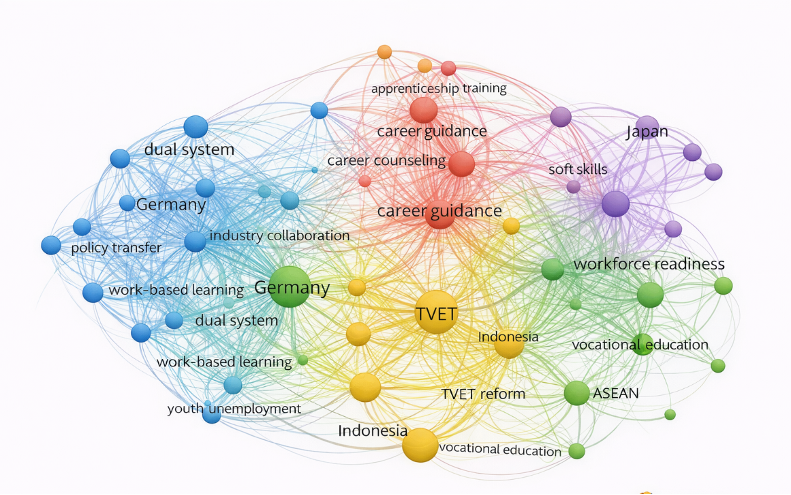
This study examines the role of career guidance systems in enhancing workforce readiness within Technical and Vocational Education and Training (TVET). Increasing global challenges such as skills mismatch, youth unemployment, and rapid digital transformation have intensified the need for effective career guidance as a bridge between education and labor market demands. However, significant disparities remain across countries in how career guidance is structured and implemented. This study addresses the research question on how career guidance systems in Germany, Japan, and Indonesia contribute to workforce readiness, and what best practices can be identified. This study contributes to the literature by offering a comparative and integrative perspective on career guidance systems, moving beyond fragmented approaches that focus solely on employability or training systems. It proposes a novel framework that integrates institutional, cultural, and guidance dimensions to explain workforce readiness in TVET. A systematic literature review (SLR) was conducted following the PRISMA framework, analyzing 32 peer-reviewed articles sourced from Scopus, Web of Science, and ScienceDirect (2020–2025). The study employed bibliometric analysis using VOSviewer and thematic comparative analysis to identify key patterns across the selected countries. The findings reveal three dominant models: a system-driven approach in Germany characterized by strong industry integration, a culture-driven approach in Japan shaped by organizational values, and an emerging, fragmented system in Indonesia. Career guidance is identified as a critical intermediary mechanism linking education systems and labor market outcomes. The study concludes that workforce readiness is shaped by the interaction of institutional structures, cultural contexts, and career guidance systems. It highlights the need for integrated, industry-aligned, and data-driven career guidance frameworks, particularly in developing countries, to improve employability and reduce skills mismatch.
References
Agiannidou, C., & Bozhkova, R. (2021). Intercultural education amidst financial crisis in Greece. Economics & Law, 3(1), 1–17. https://doi.org/10.37708/el.swu.v3i1.1
Ahmad, S. R., Isa, N., Liaw, A., Nazari, M. L., Abdullah, N. P., Rani, M. H., Ahmad, A., Rahman, A. Q. A., & Lokman, A. M. (2023). Enhancing employability and empowerment: Unveiling factors within PERDA-TECH for sustainable development. Journal of Technical Education and Training, 15(3). https://doi.org/10.30880/jtet.2023.15.03.021
Akgündüz, D., & Mesutoğlu, C. (2021). STEM education for Industry 4.0 in technical and vocational high schools: Investigation of teacher professional development. Science Education International, 32(2), 172–181. https://doi.org/10.33828/sei.v32.i2.11
Alicon Auf, T., & Arinaitwe, J. (2022). Guidelines, frameworks and practices of school guidance and counselling: A comparison between Uganda and Germany. East African Journal of Education and Social Sciences, 3(2). https://doi.org/10.46606/eajess2022v03i02.0159
Amaliah, R., & Irfan, D. (2022). The effect of the teaching factory learning model on the work readiness of Class XII students of SMKN 1 Sinunukan. Aksara Jurnal Ilmu Pendidikan Nonformal, 8(3), 1759. https://doi.org/10.37905/aksara.8.3.1759-1768.2022
Andresen, M. (2021). When at home, do as they do at home? Valuation of self-initiated repatriates’ competences in French and German management career structures. International Journal of Human Resource Management, 32(4). https://doi.org/10.1080/09585192.2018.1511612
Behle, H. (2021). Taking stock: Employability as an outcome of higher education. Evaluating developments in the German higher education system. Higher Education Quarterly, 75(4), 562–574. https://doi.org/10.1111/hequ.12318
Bilqis, A., Manaloe, S. E., Febriyanti, A., Yuniarni, D. R., Safrina, R., & Yurnaidi, Z. (2024). Empowering ASEAN’s education for RE jobs: A readiness assessment. IOP Conference Series Earth and Environmental Science, 1395(1), 012044. https://doi.org/10.1088/1755-1315/1395/1/012044
Bonaiuto, M., Placidi, V., Cataldi, S., Faggioli, S., Geb, M., Kulinska, A., Pinello, G., Sande, G. V. S., & Thorstensen, L. O. (2022). Career ToolVip24 effectiveness in enhancing self-efficacy, self-esteem, attitude toward enterprise and entrecomp dimensions in students from different european countries. Ricerche Di Psicologia, (3). https://doi.org/10.3280/rip2022oa15199
Chookaew, S., Howimanporn, S., Hutamarn, S., & Thongkerd, T. (2021). Perceptions of vocational education and training teachers with regard to an industrial robot training. Tem Journal, 1149–1154. https://doi.org/10.18421/tem103-19
Čubela, D., Rossner, A., & Neis, P. (2023). Using problem-based learning and gamification as a catalyst for student engagement in data-driven engineering education: A report. Education Sciences, 13(12). https://doi.org/10.3390/educsci13121223
Dahmen, S. (2021). Constructing the “competent” pupil: Optimizing human futures through testing? Social Inclusion, 9(3). https://doi.org/10.17645/si.v9i3.4354
Fassbender, U. (2022). Collective skill formation regimes in times of Covid-19: A governance-focused analysis of the german dual training system. International Journal for Research in Vocational Education and Training, 9(2), 167–194. https://doi.org/10.13152/ijrvet.9.2.2
Findeisen, S., & Wild, S. (2022). General digital competences of beginning trainees in commercial vocational education and training. Empirical Research in Vocational Education and Training, 14(1). https://doi.org/10.1186/s40461-022-00130-w
Fontdevila, C., Valiente, Ó., & Schneider, S. (2022). An organized anarchy? Understanding the role of german cooperation in the construction and export of the dual training model. International Journal of Training and Development, 26(4), 585–605. https://doi.org/10.1111/ijtd.12274
Fuchs, M., Westermeyer, J., Finken, L., & Pilz, M. (2021). Training activities in subsidiaries of foreign multinational companies: Local embeddedness in Germany? International Journal of Training and Development, 25(4), 414–432. https://doi.org/10.1111/ijtd.12244
Gessler, M., Bohlinger, S., & Zlatkin‐Troitschanskaia, O. (2021). International vocational education and training research: An introduction to the special issue. International Journal for Research in Vocational Education and Training, 8(4), 1–15. https://doi.org/10.13152/ijrvet.8.4.1
Göbel, S., Rotter, E., Brabänder, W. F., Maier, A., & Ziegler, B. (2024). Serious games for vocational training. European Conference on Games Based Learning, 18(1), 297–303. https://doi.org/10.34190/ecgbl.18.1.2710
Graf, L., & Lohse, A. P. (2021). Conditions for cross-border policy transfer and cooperation: analysing differences between higher education and vocational training. Research in Comparative and International Education, 16(4), 361–383. https://doi.org/10.1177/17454999211057747
Gunnes, M., Thaulow, K., Kaspersen, S. L., Jensen, C. A., & Ose, S. O. (2025). Young adults not in education, employment, or training (NEET): A global scoping review. BMC Public Health, 25(1). https://doi.org/10.1186/s12889-025-24781-y
Heulingn, L., & Wild, S. (2021). How student characteristics affect economy students’ digital competences: A latent profile study. Nordic Journal of Vocational Education and Training, 44–70. https://doi.org/10.3384/njvet.2242-458x.2111144
Hilman, H., Wahyudin, D., & Rusman, R. (2020). A study of multi entry and multi exit education system in increasing vocational high school graduates skills. Applied Science and Innovative Research, 4(2), p70. https://doi.org/10.22158/asir.v4n2p70
Imai, A., Maebara, K., & Yaeda, J. (2023). Efforts and effectiveness in improving knowledge and skills of vocational assessment for teachers supporting career decisions of students with intellectual disabilities. Journal of Intellectual Disability-Diagnosis and Treatment, 11(4). https://doi.org/10.6000/2292-2598.2023.11.04.1
Klein, J., Driesel‐lange, K., & Ohlemann, S. (2022). Are adolescents in one‐parent families a previously unnoticed group in inclusive career guidance? Social Inclusion, 10(2). https://doi.org/10.17645/si.v10i2.5085
Kushida, O., Iida, A., Arai, Y., Koyama, T., Tanaka, K., Morooka, A., Isobe, S., Okamoto, R., & Yoshita, K. (2023). Individual learning needs of japanese public health dietitians by years of experience in health promotion. Healthcare (Switzerland), 11(12). https://doi.org/10.3390/healthcare11121765
Kusuma, H. A., & Yoto, Y. (2024). Collaboration skills in vocational schools in the information and communication technology (ICT) sector. Briliant Jurnal Riset Dan Konseptual, 9(1), 158. https://doi.org/10.28926/briliant.v9i1.1674
Lee, S. S., & Nahm, J. (2024). From segmentalist to liberal skill formation system: A comparative analysis of labour market activation policies in Japan and South Korea. Journal of International and Comparative Social Policy, 40(1), 42–56. https://doi.org/10.1017/ics.2024.6
Liu, S., Behrens, S. C., Besteher, B., Bilek, E., Chae, W. R., Clemens, V., Korn, C., Pflug, V., Richter, A., Selle, J., O’Sullivan, J. L., von Brachel, R., Totzeck, C., & Brandhorst, I. (2024). Structures, aims and needs of early career scientists at the German Center for Mental Health. Nervenarzt, 95(5). https://doi.org/10.1007/s00115-024-01631-7
Luesia, J. F., Plaza, J. F., Benítez, I., & Sánchez-Martín, M. (2023). Desarrollo y validación del test de competencia ortográfica (TCORT) en estudiantes universitarios de nuevo ingreso. Revista Española De Pedagogía, 81(286). https://doi.org/10.22550/rep81-3-2023-08
Luo, X., & Yao, H. (2023). Research on the cultivation of craftsmanship spirit among higher vocational college students and integration of industry and education. World Journal of Educational Research, 10(6), p33. https://doi.org/10.22158/wjer.v10n6p33
Martínez-Izquierdo, L., & Sánchez, M. T. (2022). Dual vocational education and training systems’ governance model and policy transfer: The role of the european union in its diffusion. Social Sciences, 11(9), 403. https://doi.org/10.3390/socsci11090403
Mitchell, B., & Buntic, C. G. (2022). Successfully implementing technical and vocational education and training programmes in secondary schools. World Journal of Vocational Education and Training, 4(1), 36–45. https://doi.org/10.18488/119.v4i1.3219
Moon, H., & Choi, J. (2024). Toward an analysis of employer engagement in the TVET system for 10 ASEAN member states. European Journal of Training and Development, 49(1/2), 224–239. https://doi.org/10.1108/ejtd-07-2023-0109
Musa, S. F. P. D. (2022). Preparing the youth for the future of work through apprenticeship programme in Brunei. Higher Education Skills and Work-Based Learning, 13(1), 113–130. https://doi.org/10.1108/heswbl-06-2022-0133
Mynbayeva, A., Zhou, M., Minazheva, G., & Seiitnur, Z. (2025). Specifics of population psychodiagnostics on the example of Kazakhstan, China, and Japan: A comparative analysis. International Journal of Evaluation and Research in Education, 14(1). https://doi.org/10.11591/ijere.v14i1.30363
Nagai, S., Ogata, Y., Yamamoto, T., Fedyk, M., & Bell, J. F. (2023). A longitudinal study of the impact of personal and professional resources on nurses’ work engagement: A comparison of early-career and mid-later-career nurses. Healthcare (Switzerland), 11(1). https://doi.org/10.3390/healthcare11010076
Nakagomi, K., & Hayashi, Y. (2023). Attitudes of pharmacy graduates at the early career stage: A pilot survey at a private university in Japan. Pharmacy Education, 23(1). https://doi.org/10.46542/pe.2023.231.6777
Noda, A. (2023). Exploring the possibilities and challenges in developing the japanese qualifications framework. Higher Education Evaluation and Development, 17(2), 82–95. https://doi.org/10.1108/heed-05-2022-0019
Otaki, J., Taketomi, K., Shibahara, M., Watanabe, Y., Nagata-Kobayashi, S., Harada, Y., & Mitoma, H. (2022). Factors that hinder medical career aspirations: A nationwide questionnaire survey of teachers in charge of career guidance in Japanese high schools. PLoS ONE, 17(6 June). https://doi.org/10.1371/journal.pone.0270477
Pan, W., Chen, L., & Zhan, W. (2021). Positioning construction workers’ vocational training of guangdong in the global political-economic spectrum of skill formation. Engineering Construction & Architectural Management, 28(9), 2489–2515. https://doi.org/10.1108/ecam-11-2019-0641
Paudel, P. K., & Eberhardt, C. (2023). Approaching apprenticeship in Nepal: Lessons from dual-VET of Germany. Journal of Technical and Vocational Education and Training, 17(1), 1–18. https://doi.org/10.3126/tvet.v17i1.52405
Pradipta, B. Q., Hirawan, F. B., & Ragamustari, S. K. (2021). Evaluation of policy in the vocational education system revitalization in Indonesia: Examining the teaching factory readiness of the industry. Jurnal Pendidikan Vokasi, 11(1). https://doi.org/10.21831/jpv.v11i1.37693
Putra, F. A. (2023). Reducing youth unemployment in Indonesia: Identifying financial strategy for technical and vocational education and training. Jejak, 16(1). https://doi.org/10.15294/jejak.v16i1.40633
Ramadhani, Mgs. A., & Rahayu, E. (2021). A shift in corporate social responsibility program to support vocational education in Indonesia. Jurnal Pendidikan Teknologi dan Kejuruan, 27(1), 26–36. https://doi.org/10.21831/jptk.v27i1.32981
Saitoh, A., Shimoda, K., Kawabata, A., Oku, H., & Horiuchi, S. (2022). Evaluation of the first Accelerated Bachelor of Science in Nursing program as a second career in Japan. Nurse Education Today, 111. https://doi.org/10.1016/j.nedt.2022.105275
Sariwulan, T., Widodo, W., Perdana, N. S., Fajarini, & Agung, I. (2020). The influence of absorption graduates vocational education: A case study. Academic Journal of Interdisciplinary Studies, 9(2), 55. https://doi.org/10.36941/ajis-2020-0023
Shvindina, H., Котенко, С., Воронцова, А., Gordienko, V., Petrushenko, Y., & Jha, D. (2021). Reforming the education system to prevent labor migration. Knowledge and Performance Management, 4(1), 52–66. https://doi.org/10.21511/kpm.04(1).2020.05
Sloane, P. F. E. (2022). Re-reading Kerschensteiner today: Doing VET in German vocational schools—A search for traces. Journal of Philosophy of Education, 56(3), 408–424. https://doi.org/10.1111/1467-9752.12674
Sudan, F. K. (2021). Fourth industrial revolution and future of work in Asia. Global Economics Science, 98–111. https://doi.org/10.37256/ges.222021783
Sudan, F. K. (2023). Leveraging youth employment through human resource practices and vocational education in Asia. Global Economics Science, 11–25. https://doi.org/10.37256/ges.4320231572
Takanuma, R. (2025). Exploring skills, knowledge and competencies in multicultural and social justice career consulting in Japan. Impact, 2025(2). https://doi.org/10.21820/23987073.2025.2.26
Torggler, C., Miesera, S., & Nerdel, C. (2023). From TPACK to N-TPACK framework for vocational education and training with a focus on nutritional science and home economics. International Journal for Research in Vocational Education and Training, 10(2), 168–190. https://doi.org/10.13152/ijrvet.10.2.2
Ueno, K. (2022). Labor immobility, stability discourse, and LGBQ young adults’ career plans in Japan. Social Currents, 10(1), 41–59. https://doi.org/10.1177/23294965221105662
Umar, A. A., Cletus, H. E., Mohammad, A. M., Alasan, I. I., Adamu, U., & Umar, M. (2020). Nurturing the contemporary entrepreneur: A tactical solution to the outrageous unemployment and poverty rate in Nigeria. The International Journal of Business and Management, 8(2). https://doi.org/10.24940/theijbm/2020/v8/i2/bm2002-058
Usman, M., Sawaya, A., Igarashi, M., Gayman, J. J., & Dixit, R. (2021). Strained agricultural farming under the stress of youths’ career selection tendencies: A case study from Hokkaido (Japan). Humanities and Social Sciences Communications, 8(1). https://doi.org/10.1057/s41599-020-00688-4
Virginia, G. A. (2023). A comparative study of stakeholder engagement in the dual education system: A case of Germany, the United States and Kazakhstan. Journal of Technical Education and Training, 15(3). https://doi.org/10.30880/jtet.2023.15.03.014
Wang, K., Li, L., Li, J., Chen, H., He, B., & Li, L. (2022). An exploration of students’ attitudes toward employment services in private schools: The case of the sanya institute of technology. Sage Open, 12(3). https://doi.org/10.1177/21582440221109590
Watabe, Y. (2021). Delivery and staffing challenges in supporting the careers of international students. Bulletin of Nagasaki Institute of Applied Science, 61(1).
Weber, P. (2024). Competence development for counselling practitioners – The Masters programme M.A. bob in Germany. Journal of the National Institute for Career Education and Counselling, 25(1). https://doi.org/10.20856/jnicec.2510
Werdiningsih, D., Zuhairi, A., Arief, N. F., & Osman, Z. (2021). Integrated solution model to support competitiveness and relevance of vocational education in the era of technological disruption. International Journal of Research in Business and Social Science (2147-4478), 10(7), 319–329. https://doi.org/10.20525/ijrbs.v10i7.1468
Wibowo, R. A., Myau-Lyau, N., Christy, N. N. A., & Albert. (2022). The challenges for Indonesia to integrate dual vocational education and training system. Journal of Technical Education and Training, 14(2). https://doi.org/10.30880/jtet.2022.14.02.008
Wismansyah, A. R., Kadir, A. R., Baja, S., & Amar, M. Y. (2024). Sustainable vocational education models for industrial revolution role in development of job market absorption in Tangerang City, Indonesia. Journal of Infrastructure Policy and Development, 8(6), 3958. https://doi.org/10.24294/jipd.v8i6.3958
Yanindah, A. (2022). An insight into youth unemployment in Indonesia. Proceedings of the International Conference on Data Science and Official Statistics, 2021(1), 666–682. https://doi.org/10.34123/icdsos.v2021i1.229
Yusop, S. R. M., Rasul, M. S., Yasin, R. M., Hashim, H. U., & Jalaludin, N. A. (2022). An assessment approaches and learning outcomes in technical and vocational education: A systematic review using PRISMA. Sustainability, 14(9), 5225. https://doi.org/10.3390/su14095225
Zhang, H. (2021). An institutional dilemma in China’s skills-development system: Evidence from two apprenticeship reforms. The China Quarterly, 248(1), 1103–1128. https://doi.org/10.1017/s030574102100059x
Zhichun, W., Tang, B., Xiao-long, F. U., & Wang, Y. (2021). A comparative study on student career education in China and Japan development, practice and breakthrough. Frontiers in Educational Research, 4(3). https://doi.org/10.25236/fer.2021.040306
Downloads
Published
How to Cite
Issue
Section
License
Copyright (c) 2026 Muhammad Idris Effendi, Tuwoso Tuwoso, Fadliyanti Firdausia

This work is licensed under a Creative Commons Attribution-ShareAlike 4.0 International License.
Authors who publish with this journal agree to the following terms:
- Authors retain copyright with the work simultaneously licensed under a Creative Commons Attribution License that allows others to share the work with an acknowledgement of the work's authorship and initial publication in this journal.
- Authors are able to enter into separate, additional contractual arrangements for the non-exclusive distribution of the journal's published version of the work (e.g., post it to an institutional repository or publish it in a book), with an acknowledgement of its initial publication in this journal.
- Authors are permitted and encouraged to post their work online (e.g., in institutional repositories or on their website) prior to and during the submission process, as it can lead to productive exchanges, as well as earlier and greater citation of published work (See The Effect of Open Access).