How PBL and CTL instructional models differ in affecting mathematical problem-solving skills
DOI:
https://doi.org/10.12928/ijei.v7i3.16091Keywords:
contextual teaching and learning, learning interest, problem-based learning, problem-solving skillsAbstract
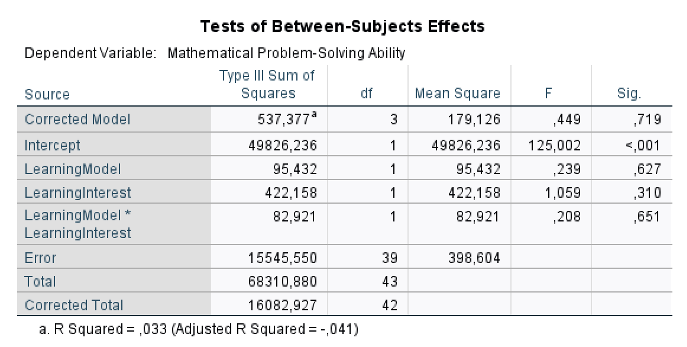
This research aimed to analyze the impact of the PBL and CTL instructional models on students’ mathematical problem-solving skills, taking into consideration their learning interest levels. A quantitative experimental method with a 3 × 2 factorial design was applied. The study involved 43 eleventh-grade students from SMK Muhammadiyah 1 Yogyakarta, who were selected through random sampling and assigned into two groups. The first group consisted of 26 students taught using the PBL model, whereas the second group consisted of 17 students instructed through the CTL model. Data were obtained through two research instruments: a mathematical problem-solving test and a learning interest questionnaire. Before conducting hypothesis testing, the data satisfied the assumptions of normality and homogeneity and were analyzed using a two-way ANOVA. The analysis showed no significant effect of the instructional model on students’ mathematical problem-solving ability (Sig. = 0.627 > 0.05). Likewise, learning interest was not found to significantly affect students’ performance (Sig. = 0.310 > 0.05). Furthermore, no significant interaction effect was detected between instructional model and learning interest (Sig. = 0.651 > 0.05). The analysis demonstrated that students’ learning interest did not interact with the instructional models in determining their mathematical problem-solving ability. These results imply that the influence of instructional models on problem-solving ability remains relatively stable across different levels of learning interest. Hence, future studies are recommended to explore additional variables that may affect students’ mathematical problem-solving performance.
References
Al-Jannah, S., & Aly, H. N. (2022). Kurikulum sebagai pilar pengembangan individual siswa SMA: Pendekatan holistik untuk masa depan yang berkilau. Jurnal Pendidikan dan Konseling, 5(4), 540–548.
Andika, C. J., & Manurung, S. L. (2023). Perbedaan peningkatan kemampuan pemecahan masalah matematika siswa menggunakan model problem based learning dan model kooperatif tipe STAD SMA Negeri 1 Perbaungan. In D. Septiana, D. Kartika, N. Maulida Subrakti, N. Afianti Nasution, & A. Perdana (Eds.), Prosiding Seminar Nasional Jurusan Matematika 2023 (pp. 427–434). Lembaga Penerbitan dan Publikasi UNIMED Publisher. https://publisher.unimed.ac.id
Anggraini, V., Delyana, H., & Sari, I. K. (2022). Analisis kemampuan pemecahan masalah matematis ditinjau dari minat belajar siswa. AKSIOMA: Jurnal Program Studi Pendidikan Matematika, 11(2), 1231. https://doi.org/10.24127/ajpm.v11i2.5034
Anjiani, M. M., & Hasanudin, C. (2023). Jurnalistik sebagai sumber data untuk karya ilmiah. Prosiding Seminar Nasional Daring Peran Guru dalam Pembelajaran Matematika di Sekolah, 1171–1176.
Annisa Rahman, S., & Suwignyo Prayogo, M. (2025). Implementasi model discovery learning untuk meningkatkan pemahaman konsep sistem pernapasan manusia di sekolah dasar. JPIM: Jurnal Penelitian Ilmiah Multidisipliner, 2(3), 2435–2441.
Arikunto, S. (2010). Prosedur Penelitian Suatu Pendekatan Praktik. Rineka Cipta.
Artinta, S. V., & Fauziyah, H. N. (2021). Faktor yang mempengaruhi rasa ingin tahu dan kemampuan memecahkan masalah siswa pada mata pelajaran IPA SMP. Jurnal Tadris IPA Indonesia, 1(2), 210–218. https://doi.org/10.21154/jtii.v1i2.153
Asih, & Ihsan Imami, A. (2021). Analisis minat belajar siswa SMP pada pembelajaran matematika. Jurnal Pembelajaran Matematika Inovatif, 4(4), 799–808. https://doi.org/10.22460/jpmi.v4i4.799-808
Aulia, S., Amelia, S., & Qudsi, R. (2021). Analisis minat belajar matematika siswa dalam menggunakan aplikasi scratch pada materi trigonometri. Journal for Research in Mathematics Learning) p, 4(3), 205–214.
Aulia, S. S., & Hermansah. (2024). Efektivitas model pembelajaran contextual teaching and learning terhadap kemampuan pemecahan masalah matematis siswa. AB-JME: Al-Bahjah Journal of Mathematics Education, 2(1), 108–120. https://doi.org/10.61553/abjme.v2i1.78
Delita, Bachtiar, Y., & Rizali, I. (2026). Pengaruh model contextual teaching and learning terhadap kemampuan pemecahan masalah matematis sekolah dasar. Caxra: Jurnal Pendidikan Sekolah Dasar, 6(1), 197–205.
Djamarah, S. B. (2011). Psikologi Belajar (Edisi Revisi). Rineka Cipta.
Ermayanti, Arifin, S., & Nurdayani, A. (2025). Efektivitas pendekatan contextual teaching and learning dalam mengembangkan kemampuan pemecahan masalah matematis. Indiktika: Jurnal Inovasi Pendidikan Matematika, 7(2), 336–349. https://doi.org/10.31851/indiktika.v7i2.17095
Gr. Voskoglou, M. (2021). Problem solving and mathematical modelling. American Journal of Educational Research, 9(2), 85–90. https://doi.org/10.12691/education-9-2-6
Harianja, W. J., & Panjaitan, A. (2022). Peningkatan kemampuan pemecahan masalah matematis siswa kelas VIII SMP Parulian 1 Medan melalui model pembelajaran interaktif setting kooperatif. Jurnal Fibonaci, 03(1), 42–51. https://doi.org/10.24114/jfi.v2i1
Hendriana, H., Rohaeti, E. E., & Sumarmo, U. (2017). Hard Skills dan Soft Skills Matematik Siswa. PT Refika Aditama.
Hermawan, R. M., Yuspriyati, D. N., & Purwasih, R. (2022). Analisis minat belajar siswa SMP Kelas VIII pada materi pokok bangun ruang sisi datar berbantuan aplikasi geogebra. PRISMA, 11(1), 203–209. https://doi.org/10.35194/jp.v11i1.1982
Jaenudin, S., Aminah, M., & Yusuf, Y. (2025). Analysis of students’ mathematical problem-solving abilities. Jurnal Cendekia: Jurnal Pendidikan Matematika, 9(1), 195–202. https://doi.org/10.31004/cendekia.v9i1.3743
Kamuntuan, E., Langi, B., & Pangemanan, M. (2026). Implementasi metode pembelajaran kontekstual (contextual teaching and learning/CTL) pada program pendidikan yang berfokus terhadap peserta didik. Esawaya, 2(2), 17–23. https://journal.gknpublisher.net/index.php/esawaya
Mailani, E., Rarastika, N., Anastasya Purba, D., Novita Padang, I., & Romayanti Br Ginting, J. (2025). Analisis penerapan deep learning dalam pemecahan masalah matematika siswa sekolah dasar. Jurnal Motivasi Pendidikan Dan Bahasa Harapan, 3(4), 1–14.
Maulina, V., Harun, L., & PGRI Semarang, U. (2022). Pengaruh minat belajar dan resiliensi matematis terhadap kemampuan pemecahan masalah matematis siswa. Imajiner: Jurnal Matematika Dan Pendidikan Matematika , 4(4), 347–354.
Mawardi, K., Turmuzi, M., & Azmi, S. (2022). Analisis kemampuan pemecahan masalah matematika pada siswa SMP dalam menyelesaikan soal cerita ditinjau dari tahapan Polya. Journal of Mathematics Education and Application, 2(4), 1031–1048. https://mathjournal.unram.ac.id/index.php/Griya/indexGriya
M.Ramli, & Mardhiyatirrahmah, L. (2025). Model discovery learning dan model inquiry learning. AL-MANBA, Jurnal Ilmiah Keislaman Dan Kemasyarakatan , 10(2), 41–49.
Muhidin, & Suparman. (2025). Penerapan model pembelajaran problem based learning (PBL) untuk meningkatkan aktivitas dan hasil belajar fisika siswa kelas XI SMA. Jurnal Pendidikan MIPA, 15(2), 871–877. https://doi.org/10.37630/jpm.v15i2.3097
Muslihah, N. N., & Suryaningrat, E. F. (2021). Model pembelajaran contextual teaching and learning terhadap kemampuan pemecahan masalah matematis. Plusminus: Jurnal Pendidikan Matematika, 1(3), 553–564.
Mystakidis, S., Berki, E., & Valtanen, J. P. (2021). Deep and meaningful e-learning with social virtual reality environments in higher education: A systematic literature review. Applied Sciences (Switzerland), 11(5), 1–25. https://doi.org/10.3390/app11052412
Nasution, A. G. J. (2022). Pengaruh model discovery learning terhadap kemampuan pemecahan masalah matematika peserta didik kelas IV MIS Istiqomah Islamic Fullday School Kec. Sunggal Kab. Deli Serdang. Nizhamiyah, 12(1), 65–87.
NCTM. (2000). Principles and Standards for School Mathematics. The National Council of Teachers of Mathematics, inc.
Ndemo, Z., & Mtetwa, D. K. J. (2022). Student teachers’ conceptualizations of mathematical problem solving and the nature of their warrants. JRAMathEdu (Journal of Research and Advances in Mathematics Education), 7(4). https://doi.org/10.23917/jramathedu.v7i4.15303
Nurhamidah, S., & Nurachadijat, K. (2023). Project based learning dalam meningkatkan kemandirian belajar siswa. Jurnal Inovasi, Evaluasi, Dan Pengembangan Pembelajaran (JIEPP), 3(2), 42–50. http://journal.ainarapress.org/index.php/jiepp
Putri, Y. P., & Adirakasiwi, A. G. (2021). Analisis minat belajar siswa kelas X SMA At-Taubah pada materi SLPTV dengan metode pembelajaran daring. Jurnal Cendekia: Jurnal Pendidikan Matematika, 05(03), 2934–2940.
Rachmawati, N. Y., & Rosy, B. (2021). Pengaruh model pembelajaran problem based learning (PBL) terhadap kemampuan berpikir kritis dan pemecahan masalah pada mata pelajaran administrasi umum kelas X OTKP di SMK Negeri 10 Surabaya. Jurnal Pendidikan Administrasi Perkantoran (JPAP), 9(2), 246–259. https://journal.unesa.ac.id/index.php/jpap
Rahayu, R., Iskandar, S., & Abidin, Y. (2022). Inovasi pembelajaran abad 21 dan penerapannya di Indonesia. Jurnal Basicedu, 6(2), 2099–2104. https://doi.org/10.31004/basicedu.v6i2.2082
Rakhmawati, D., Hendracipta, N., Adya Pribadi, R., & Nurhasanah, A. (2024). Peran guru dalam mengoptimalkan model-model pembelajaran berorientasi pada keterampilan abad 21. Jurnal Pendidikan Dasar Flobamorata, 5(1), 75–85. https://e-journal.unmuhkupang.ac.id/index.php/jpdf
Sandi, N. R., Nisa, S., & Suriani, A. (2024). Penggunaan model pembelajaran problem based learning dalam meningkatkan minat belajar siswa. Dewantara: Jurnal Pendidikan Sosial Humaniora, 3(2), 294–303. https://doi.org/10.30640/dewantara.v3i2.2654
Sembiring, G. A., Siagian, K. A., Rajagukguk, N. A., Arwita, W., & Nasution, A. (2025). Pengaruh model problem based learning terhadap peningkatan aktivitas dan minat belajar siswa pada materi komponen ekosistem dan interaksinya di kelas X SMA Negeri 7 Medan. JURNAL MEDIA AKADEMIK (JMA), 3(4), 1–22. https://doi.org/10.62281
Setiawan, M., Pujiastuti, E., & Susilo, B. E. (2021). Pengaruh kecemasan matematika terhadap kemampuan pemecahan masalah siswa. QALAMUNA: Jurnal Pendidikan, Sosial, Dan Agama, 13(2), 239–256. https://doi.org/10.37680/qalamuna.v13i2.870
Siswanto, E., & Meiliasari. (2024). Kemampuan pemecahan masalah pada pembelajaran matematika: systematic literature review. Jurnal Riset Pembelajaran Matematika Sekolah, 8(1), 45–59.
Siswanto, E., Rahayu, W., & Meiliasari. (2025). Optimalisasi kemampuan pemecahan masalah matematika melalui implementasi pembelajaran problem based learning (PBL): systematic literature review. SJME (Supremum Journal of Mathematics Education), 09(01), 181–195.
Sucipto, M. F., & Firmansyah, D. (2021). Analisis minat belajar siswa SMP pada pembelajaran matematika. MAJU: Jurnal Ilmiah Pendidikan Matematika, 8(2), 376–380.
Sumaji, S., Widianingrum, E., Wanabuliandari, S., & Premprayoon, K. (2025). The effectiveness of problem-based learning assisted with the ethnomathematics-based Geocube e-module on problem-solving skills. JRAMathEdu (Journal of Research and Advances in Mathematics Education), 135–145. https://doi.org/10.23917/jramathedu.v10i3.3228
Syah, I., latifa Latif, N., & Kasma. (2024). Model pembelajaran kooperatif dalam pendidikan agama islam untuk meningkatkan kerjasama siswa. JUPENJI: Jurnal Pendidikan Jompa Indonesia, 3(4). https://jurnal.jomparnd.com/index.php/jupenji
Thornhill-Miller, B., Camarda, A., Mercier, M., Burkhardt, J. M., Morisseau, T., Bourgeois-Bougrine, S., Vinchon, F., El Hayek, S., Augereau-Landais, M., Mourey, F., Feybesse, C., Sundquist, D., & Lubart, T. (2023). Creativity, critical thinking, communication, and collaboration: assessment, certification, and promotion of 21st century skills for the future of work and education. Journal of Intelligence, 11(3), 1–32. https://doi.org/10.3390/jintelligence11030054
Wahyudi, A., Dwi Ariyani, Y., Rochaendi, E., & Apriyanti. (2021). Posisi keterampilan berpikir kritis dan keterampilan berpikir kreatif dalam pendidikan sains. Jurnal Zarah, 9(1), 8–14.
Yuliati, I. (2021). Kemampuan pemecahan masalah matematika ditinjau dari minat belajar peserta didik. Jurnal Cendekia: Jurnal Pendidikan Matematika, 5(2), 1159–1168.
Zahroh, F. L., & Hilmiyati, F. (2024). Indikator keberhasilan dalam evaluasi program pendidikan. Edu Cendikia: Jurnal Ilmiah Kependidikan, 4(03), 1052–1062. https://doi.org/10.47709/educendikia.v4i03.5049
Zuliyanti, P., & Pujiastuti, H. (2020). Model contextual teaching learning (CTL) untuk meningkatkan kemampuan pemecahan masalah matematis siswa SMP. PRISMA, 9(1), 98–107. https://jurnal.unsur.ac.id/prisma
Zulkarnain, I. (2023). Pengaruh model pembelajaran problem based learning terhadap kemampuan pemecahan masalah matematika. PTK: Jurnal Tindakan Kelas, 4(1), 149–157. https://doi.org/10.53624/ptk.v4i1.298
Downloads
Published
How to Cite
Issue
Section
License
Copyright (c) 2026 Afifah Putri Ardirani; Uswatun Khasanah

This work is licensed under a Creative Commons Attribution-ShareAlike 4.0 International License.
Authors who publish with this journal agree to the following terms:
- Authors retain copyright with the work simultaneously licensed under a Creative Commons Attribution License that allows others to share the work with an acknowledgement of the work's authorship and initial publication in this journal.
- Authors are able to enter into separate, additional contractual arrangements for the non-exclusive distribution of the journal's published version of the work (e.g., post it to an institutional repository or publish it in a book), with an acknowledgement of its initial publication in this journal.
- Authors are permitted and encouraged to post their work online (e.g., in institutional repositories or on their website) prior to and during the submission process, as it can lead to productive exchanges, as well as earlier and greater citation of published work (See The Effect of Open Access).