Integrating STEM project into mathematics learning design to improve the students’ mathematical literacy
DOI:
https://doi.org/10.12928/ijei.v7i2.15963Keywords:
lines and angles, mathematical literacy, STEM integrated project learning modelAbstract
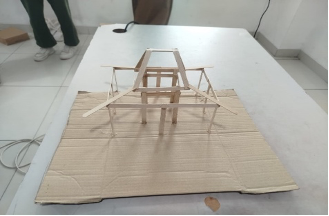
Students need to develop sufficient mathematical literacy. In reality, however, not all students demonstrate good mathematical literacy. The project-based learning (PjBL) model is a recommended teaching model, then STEM is a broad approach. This echo produces a STEM-integrated project learning model. Based on this description, researchers designed and developed Local Instructional Theory (LIT) in the form of mathematics learning with a STEM-integrated project learning model on the topic of lines and angles. This study uses a design research method, which includes three research stages: preliminary, teaching experiment, retrospective analysis. The research subjects were students taking Geometry courses. Data collection techniques used were interviews, documentation, field notes, and written tests that were collected and analyzed to improve HLT. This study was designed in three activities: creating a Joglo house project with maximum STEM-based enlightenment, identifying the concept of lines and angles and measuring angle sizes, then categorizing the types of angles and understanding the relationships between angles. From the results of all the activities that have been carried out, the learning trajectory provides students with activities that are enthusiastic in learning, creative in creating, active in discussions, and group learning to complete an assigned project. The use of LIT produces a design that has a strong theoretical basis because each learning syntax is compiled based on a synthesis of various theories and empirical research results, then validated through research and development stages.
References
Ahmad, D., Suherman, S., & Maulana, H. (2018). Teacher mathematical literacy: case study of junior high school teachers in Pasaman. IOP Conference Series: Materials Science and Engineering, 335(1). https://doi.org/10.1088/1757-899X/335/1/012109
Budi, M. (2015). Tantangan pembelajaran matematika era global. Prosiding Seminar Nasional Matematika dan Pendidikan Matematika UMS, 810(3), 28–47. https://publikasiilmiah.ums.ac.id/bitstream/handle/11617/6005/28_47 PROF BUDI M.pdf
Creswell, J. W. (2007). Qualitative Inquiry and Research Design Choosing Among Five Approaches. Sage.
English, L. (2018). Disruption and learning innovation across STEM. International STEM in Education Conference. https://eprints.qut.edu.au/129471/
English, L. D. (2023). Ways of thinking in STEM-based problem solving. ZDM-Mathematics Education, 55(7), 1219–1230. https://doi.org/10.1007/s11858-023-01474-7
Goldman, S., & Zielezinski, M. B. (2016). Teaching with design thinking: developing new vision and approaches to twenty-first century learning BT-Connecting science and engineering education practices in meaningful ways: building bridges (L. A. Annetta & J. Minogue (eds.); pp. 237–262). Springer International Publishing. https://doi.org/10.1007/978-3-319-16399-4_10
Kadir, & Masi, L. (2014). Penggunaan konteks dan pengetahuan awal matematika dalam pembelajaran keterampilan berpikir kreatif siswa using context and mathematical prior knowledge in learning students’ creativity thinking skills. Jurnal Pendidikan Matematika, 5(1), 52–66. DOI: 10.36709/jpm.v5i1.2041
Kolar, V. M., & Hodnik, T. (2021). Mathematical literacy from the perspective of solving contextual problems. European Journal of Educational Research, 10(1), 467–483. https://doi.org/10.12973/EU-JER.10.1.467
Maass, K., Geiger, V., Ariza, M. R., & Goos, M. (2019). The role of mathematics in interdisciplinary STEM education. ZDM, 51(6), 869–884. https://doi.org/10.1007/s11858-019-01100-5
Mevarech, Z. R., & Fan, L. (2018). Cognition, metacognition, and mathematics literacy BT - cognition, metacognition, and culture in stem education: learning, teaching and assessment (Y. J. Dori, Z. R. Mevarech, & D. R. Baker (eds.); pp. 261–278). Springer International Publishing. https://doi.org/10.1007/978-3-319-66659-4_12
OECD (2014), PISA 2012 Results: What Students Know and Can Do-Student Performance in Mathematics, Reading and Science (Volume I, Revised edition, February 2014), PISA, OECD Publishing. http://dx.doi.org/10.1787/9789264208780-en
Ojose, B. (2011). Mathematics literacy : are we able to put the mathematics we learn into everyday use?. Journal of Mathematics Education, 4(1), 89–100. https://journalofmathed.scholasticahq.com/article/90403-mathematics-literacy-are-we-able-to-put-the-mathematics-we-learn-into-everyday-use
Roberts, T., Maiorca, C., Jackson, C., & Mohr-Schroeder, M. (2022). Integrated STEM as problem-Solving practices. Investigations in Mathematics Learning, 14(1), 1–13. https://doi.org/10.1080/19477503.2021.2024721
Sari, R. H. N., & Wijaya, A. (2017). Mathematical literacy of senior high school students in Yogyakarta. Jurnal Riset Pendidikan Matematika, 4(1), 100–107. https://doi.org/10.21831/jrpm.v4i1.10649
Supianti, I. I., Yaniawati, P., Osman, S. Z. M., Al-Tamar, J., & Lestari, N. (2022). Development of teaching materials for e-learning-based statistics materials oriented towards the mathematical literacy ability of vocational high school students. Infinity Journal, 11(2), 237–254. https://doi.org/10.22460/infinity.v11i2.p237-254
Tutkun, O. F., & Erdogan, D. G. (2014). Levels of visual mathematics literacy self-efficacy perception of the secondary school students. Middle Eastern & African Journal of Educational Research, 8, 19–27.
Yavuz, G., Gunhan, B. C., Ersoy, E., & Narli, S. (2013). Self-efficacy beliefs of prospective primary mathematics teachers about mathematical literacy. Journal of College Teaching & Learning (TLC), 10(4), 279–288. https://doi.org/10.19030/tlc.v10i4.8124
Downloads
Published
How to Cite
Issue
Section
License
Copyright (c) 2026 Nita Hidayati, Attin Warmi, Hanifah Hanifah, Latifah Darojat, Shahrun Niza Sofian, Epin Hidayat

This work is licensed under a Creative Commons Attribution-ShareAlike 4.0 International License.
Authors who publish with this journal agree to the following terms:
- Authors retain copyright with the work simultaneously licensed under a Creative Commons Attribution License that allows others to share the work with an acknowledgement of the work's authorship and initial publication in this journal.
- Authors are able to enter into separate, additional contractual arrangements for the non-exclusive distribution of the journal's published version of the work (e.g., post it to an institutional repository or publish it in a book), with an acknowledgement of its initial publication in this journal.
- Authors are permitted and encouraged to post their work online (e.g., in institutional repositories or on their website) prior to and during the submission process, as it can lead to productive exchanges, as well as earlier and greater citation of published work (See The Effect of Open Access).