Implementation STEAM project-based learning to improve the students’ critical thinking skills
DOI:
https://doi.org/10.12928/ijei.v7i2.15894Keywords:
critical thinking skills, project-based learning, STEAMAbstract
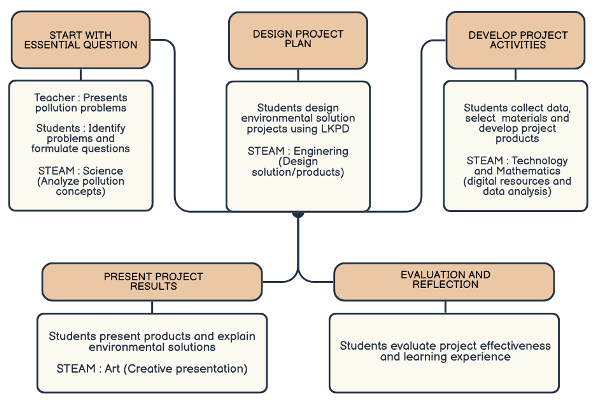
The lack of students’ critical thinking skills has been widely reported, particularly in biology learning, which often emphasizes memorization rather than higher-order thinking processes. Although various instructional approaches have been proposed, limited studies have specifically examined the integration of STEAM-based project-based learning (PjBL) to address this issue. This gap indicates the need for empirical evidence on how such an approach can effectively enhance students’ critical thinking skills. The purpose of this study was to describe the implementation of STEAM-based PjBL to improve students' critical thinking skills on the topic of environmental pollution. It also aimed to capture the significant difference in students' critical thinking skills before and after the application of STEAM-based PjBL, and the ignificant difference in students' critical thinking skills between students who learn using STEAM-based PjBL and students who learn using conventional learning. It was an experiment with the population was all 10th-grade students at SMA Negeri Peusangan, a public senior high school in Aceh, Indonesia. From the population, we purposively selected 140 students as the sample. The differences in critical thinking skills of the experimental class and the control class were analyzed using the independent sample t-test. The results show that the average N-gain for the experimental class of 72.03. The critical thinking skill gain was 0.93. of the paired sample t-test analysis in the experimental class showed a significance value of ρ < .001, indicating that Ha was accepted. This result demonstrates that there was a significant difference in students' critical thinking skills before and after the implementation of the STEAM-based PjBL in the 10th-grade of SMA Negeri Peusangan on the topic of environmental pollution, which means the students’ critical thinking was significantly improved.
References
Ananda, U. (2018). Penerapan model project based learning untuk meningkatkan kreativitas siswa pada pembelajaran IPA Kelas IV MIN 6 Aceh Selatan. Skripsi. UIN Ar-Raniry Banda Aceh.
Basri, H. (2019). Investigating critical thinking skill of junior high school in solving mathematical problem. International Journal of Instruction, 12(3), 745-758. https://doi.org/10.29333/iji.2019.12345a
Beers, S. Z. (2011). 21st Century Skills: Preparing for Their Future. ASD Author.
Daniel, F. (2017). Kemampuan berpikir kritis siswa pada implementasi project based learning (PJBL) berpendekatan saintifik. JPMI (Jurnal Pendidikan Matematika Indonesia), 1(1), 7-13. http://dx.doi.org/10.26737/jpmi.v1i1.76
Diana, H. A., & Saputri, V. (2021). Model project based learning terintegrasi STEAM terhadap kecerdasan emosional dan kemampuan berpikir kritis siswa berbasis soal numerasi. Numeracy, 8(2), 113-127. https://doi.org/10.46244/numeracy.v8i2.1609
Fatmah, H. (2021). Kreativitas peserta didik dalam pembelajaran bioteknologi dengan pjbl berbasis steam. Pedagonal: Jurnal Ilmiah Pendidikan, 5(1), 7–14. https://doi.org/10.33751/pedagonal.v5i1.2574
Fidela, W., & Fadilah, M. (2024). Literature review: penerapan model project based learning (PjBL) untuk meningkatkan hasil belajar dan kemampuan berpikir kreatif siswa SMA. Jurnal Pendidikan dan Pembelajaran Indonesia (JPPI), 4(4), 1498-1511. https://doi.org/10.53299/jppi.v4i4.745
Jauhariyyah, F. R., Suwono, H., & Ibrohim. (2017). Science, technology, engineering and mathematics project based learning (STEM-PjBL) pada pembelajaran sains. Prosiding Seminar Pendidikan IPA Pascasarjana UM (vol. 2). Universitas Negeri Malang.
Kardoyo, Nurkhin, A., Muhsin, & Pramusinto, H. (2020). Problem based learning strategy: its impact on students’ critical and creative thinking skills. European Journal of Educational Research, 9(3), 1141-1150. https://doi.org/10.12973/eu-jer.9.3.1141
Made, A. M., Ambiyar, A., Riyanda, A. R., Sagala, M. K., & Adi, N. H. (2022). Implementasi model project based learning (PjBL) dalam upaya meningkatkan hasil belajar mahasiswa teknik mesin. Edukatif: Jurnal Ilmu Pendidikan, 4(4), 5162-5169. https://doi.org/10.31004/edukatif.v4i4.3128
Marshall, J. A & Jason R. H. (2018). Making learners: a framework for evaluating making in STEM education. Interdisciplinary Journal of Problem-Based Learning, 12(2), 1-13. https://doi.org/10.7771/1541-5015.1749
Motimona, P. D., & Maryatun, I. B. (2023). Implementasi metode pembelajaran STEAM pada kurikulum merdeka pada PAUD. Jurnal Obsesi: Jurnal Pendidikan Anak Usia Dini, 7(6), 6493-6504. https://doi.org/10.31004/obsesi.v7i6.4682
Nasrah, N. (2021). Efektivitas model pembelajaran STEAM (Science, Technology, Engineering, Art, and Mathematics) pada siswa kelas IV SD. JKPD (Jurnal Kajian Pendidikan Dasar), 6(1), 1-13. https://journal.unismuh.ac.id/index.php/jkpd/id/article/view/4166
Nurhasanah, A., Hermawan, W., Mandang, T., Unadi, A., Budiharti, U., Suparlan, Susanto, H., Amalia, A. F., Widodo, T. W., Budiastuti, M. J. T., Nitamiwati, N. P. D., Sagita, D., Hidayat, M., & Samudiantono, A. (2023). Engineering properties of sorghum bioguma-variety for designing appropriate thresher and chopper machine. AIMS Agriculture & Food, 8(3), 720-735. https://doi.org/10.3934/agrfood.2023039
Oktaya, I., & Panggabean, E. M. (2022). Ketepatan dan efektivitas penggunaan teori belajar dalam pembelajaran matematika dengan model project based learning pada kurikulum merdeka belajar. Journal of Mathematics in Teaching and Learning, 1(1), 10–14. https://jurnal.stain-madina.ac.id/index.php/matematika/article/view/1044
Pebriana, R., & Disman. (2017). Effect of problem based learning to critical thinking skills. Journal of Elementary Education, 1(1), 109-118. https://doi.org/10.22460/pej.v1i1.487
Permanasari, A. (2016). STEM Education: Inovasi dalam Pembelajaran Sains. Prosiding Seminar Nasional Pendidikan Sains, 23-34.
Prihatini, E. (2017). Pengaruh model problem based learning (PBL) dan project based learning (PjBL) terhadap hasil belajar biologi pada materi pencemaran lingkungan peserta didik sekolah menengah atas. Jurnal Pendidikan Biologi, 6(2), 304-311. https://doi.org/10.24114/jpb.v6i2.6550
Sholeh, M. I., Tasya, D. A., Syafi’i, A., Rosyidi, H., Arifin, Z., & Abd Rahman, S. F. (2024). Penerapan pembelajaran berbasis proyek (PjBL) dalam meningkatkan kemampuan berpikir kritis siswa. Jurnal Tinta, 6(2), 158-176. https://doi.org/10.35897/jurnaltinta.v6i2.1484
Ulfa, M. F., Asikin, M., & Dwidayati, N. K. (2019). Membangun kemampuan berpikir kreatif matematis siswa dengan pembelajaran PjBL terintegrasi pendekatan STEM. Prosiding Seminar Nasional Pascasarjana, 2(1), 612-617. https://garuda.kemdiktisaintek.go.id/documents/detail/3492758
Zulmaulida, R., Wahyudin, & Jarnawi, A. D. (2018). Watson-Glaser’s critical thinking skills. Journal of Physics: Conference Series, 1028 (2018) 012094. https://doi.org/10.1088/1742-6596/1028/1/012094
Downloads
Published
How to Cite
Issue
Section
License
Copyright (c) 2026 Zainatul Hasanah, Erlia Hanum, Cut Roswita, Rahmawati Rahmawati

This work is licensed under a Creative Commons Attribution-ShareAlike 4.0 International License.
Authors who publish with this journal agree to the following terms:
- Authors retain copyright with the work simultaneously licensed under a Creative Commons Attribution License that allows others to share the work with an acknowledgement of the work's authorship and initial publication in this journal.
- Authors are able to enter into separate, additional contractual arrangements for the non-exclusive distribution of the journal's published version of the work (e.g., post it to an institutional repository or publish it in a book), with an acknowledgement of its initial publication in this journal.
- Authors are permitted and encouraged to post their work online (e.g., in institutional repositories or on their website) prior to and during the submission process, as it can lead to productive exchanges, as well as earlier and greater citation of published work (See The Effect of Open Access).