Vocational high school students mathematical problem-solving skills in PBL on composite functions
DOI:
https://doi.org/10.12928/ijei.v7i1.15623Keywords:
composite function, PBL, problem-solving skills, students’ worksheet, vocational high schoolAbstract
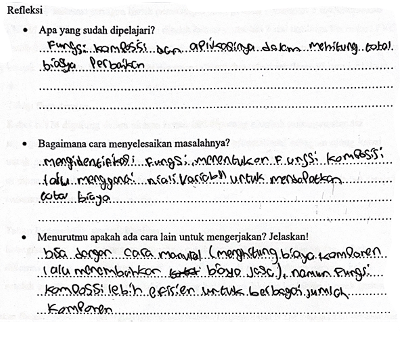
Mathematical problem-solving skills remains a critical concern in Indonesian education. PISA 2022 results showing that Indonesian students’ mathematical performance is significantly below the OECD average. This issue is particularly important in vocational high schools, where mathematics is closely related to technical and workplace applications. Although Problem Based Learning (PBL) has been widely reported as effective in improving students’ problem-solving skills, most previous studies were conducted in general senior high schools and primarily focused on learning outcomes rather than examining students’ problem-solving processes in depth. Research specifically analyzing vocational students’ problem-solving characteristics at each stage of Polya’s framework within PBL, particularly on composite functions, remains limited. This study aims to fill this gap by qualitatively analyzing Grade XI vocational students’ mathematical problem-solving characteristics at each stage of Polya’s framework within PBL instruction on composite functions. A qualitative descriptive approach was employed involving 34 students. Data were collected through validated essay tests, observations, and interviews. Data analysis was conducted using data reduction, data display, and conclusion drawing techniques. The findings indicate that most students were categorized at a moderate level (83.33%), demonstrating adequate procedural ability but weaknesses in the planning and reflection stages. The study highlights an imbalance between procedural and metacognitive development and suggests the need for explicit scaffolding in planning and reflection to strengthen vocational students’ systematic problem-solving skills.
References
Al Kayyis, A., Tohir, M., & Muhasshanah, M. (2024). The urgency of Polya model problem-solving on students mathematical ability in facing the Industrial Revolution 5.0. Alifmatika: Jurnal Pendidikan dan Pembelajaran Matematika, 6(2), 218–231. https://doi.org/10.35316/alifmatika.2024.v6i2.218-231
Darsono, Hali, F., & Tahir. (2021). The effectiveness of the power of two method on mathematical problem solving ability of Class XI MA Attarbiah Islamiah Kolaka students. Arus Jurnal Pendidikan, 1(2), 1–9. https://doi.org/10.57250/ajup.v1i2.1
Fadilah, N. S., & Hakim, D. L. (2022). Analisis kemampuan pemecahan masalah matematis siswa SMA pada Materi Fungsi. Jurnal THEOREMS (The Original Research of Mathematics), 7(1), 64-73.
Febriani, P., Widada, W., & Herawaty, D. (2019). Pengaruh pembelajaran matematika realistik berbasis etnomatematika terhadap kemampuan pemahaman konsep matematika siswa SMA Kota Bengkulu. Jurnal Pendidikan Matematika Raflesia, 4(2), 120-135. https://doi.org/10.33369/jpmr.v4i2.9761
Gyanthi, N. M. W., Agustiana, I. G. A. T., & Firstia, D. G. (2023). Laps-Heuristic learning model improves mathematical problem-solving ability. International Journal of Elementary Education, 7(1), 169-177. https://doi.org/10.23887/ijee.v7i1.58407
Hasan, H., & Nindiasari, H. (2023). Efektivitas problem based learning (PBL) untuk meningkatkan kemampuan berpikir kritis siswa di SMK Negeri 2 Pandeglang. NOTASI: Jurnal Pendidikan Matematika, 1(2), 52-58. https://doi.org/10.70115/notasi.v1i2.99
Kementerian Pendidikan Dasar dan Menengah. (2025). Ringkasan Peraturan Menteri Pendidikan Dasar dan Menengah Nomor 13 Tahun 2025 tentang Perubahan atas Peraturan Menteri Pendidikan Kebudayaan Riset dan Teknologi Nomor 12 Tahun 2024 tentang Kurikulum pada Pendidikan Anak Usia Dini, Jenjang Pendidikan Dasar, dan Jenjang Pendidikan Menengah. Kementerian Pendidikan Dasar dan Menengah.
Lestari, I. D., & Juandi, D. (2023). Students’ mathematical problem solving ability reviewed from adversity quotient: Systematic literature review. Journal of Mathematics and Mathematics Education, 13(1), 56-75. https://doi.org/10.20961/jmme.v13i1.73997
Marchy, F., Murni, A., Kartini, K., & Muhammad, I. (2022). The effectiveness of using problem-based learning (PBL) in mathematics problem-solving ability for junior high school students. AlphaMath: Journal of Mathematics Education, 8(2), 185-198. https://doi.org/10.30595/alphamath.v8i2.15047
Miles, M. B., Hubermann, A. M. (1994). Qualitative Data Analysis: An Expanded Sourcebook. Sage Publications.
Mukminin, D. S. (2021). Model problem-based learning untuk meningkatkan hasil belajar peserta didik SMK Muhammadiyah Semin. Jurnal Pendidikan Vokasi Otomotif, 4(1), 47-56.. https://doi.org/10.21831/jpvo.v4i1.45569
OECD. (2023). PISA 2022 Results (Volume I): The State of Learning and Equity in Education. OECD Publishing.
Polya, G. (1978). How to solve it: A new aspect of mathematical method second edition. In The Mathematical Gazette (vol. 30, p. 181). https://www.jstor.org/stable/3609122?origin=crossref
Pratidiana, D., & Muhayatun, N. (2021). Analisis kelancaran prosedural matematis siswa dalam menyelesaikan soal program linear. UNION: Jurnal Ilmiah Pendidikan Matematika, 9(2), 189-201. http://doi.org/10.30738/union.v9i2.9369
Pratiwi, R., & Hidayati, N. (2022). Kemampuan pemecahan masalah matematis siswa kelas XI SMK berdasarkan tahapan polya. Jurnal Educatio FKIP UNMA, 8(1), 256-263. https://doi.org/10.31949/educatio.v8i1.1978
Putri, F. A., & Erita, S. (2024). Analisis kemampuan pemecahan masalah matematis siswa pada materi fungsi komposisi. Konstanta: Jurnal Matematika dan Ilmu Pengetahuan Alam, 2(1), 32-39. https://doi.org/10.59581/konstanta-widyakarya.v2i1.1897
Rahmadani, A., Wandini, R. R., Dewi, A., Zairima, E., & Putri, T. D. (2022). Upaya meningkatkan berpikir kritis dan mengefektifkan pendekatan kontekstual dalam pembelajaran matematika. Edu Society: Jurnal Pendidikan, Ilmu Sosial dan Pengabdian Kepada Masyarakat, 2(1), 427-433. https://doi.org/10.56832/edu.v2i1.167
Rambe, A. Y. F., & Afri, L. D. (2020). Analisis kemampuan pemecahan masalah matematis siswa dalam menyelesaikan soal materi baris dan deret. AXIOM: Jurnal Pendidikan dan Matematika, 9(2), 175-187. https://doi.org/10.30821/axiom.v9i2.8069
Santi, I., Hutapea, N. M., & Murni, A. (2022). Pengembangan perangkat pembelajaran matematika model Problem based learning (PBL) untuk memfasilitasi kemampuan pemecahan masalah matematis peserta didik kelas x jurusan otomotif SMK. Jurnal Cendekia: Jurnal Pendidikan Matematika, 6(2), 1584-1602. https://doi.org/10.31004/cendekia.v6i2.1178
Setyawan, N. D., & Suparman, S. (2023). Pengembangan e-LKPD berbasis PBL terintegrasi kemampuan pemecahan masalah matematika peserta didik. Jurnal Pendidikan Matematika RAFA, 9(1), 35-48.. https://doi.org/10.19109/jpmrafa.v9i1.13306
Veronika, T., Ninawati, N., Fransiska, L., Rabiatul, A., & Yusawinur, B. (2024). Menggali potensi problem based learning: Definisi, sintaks, dan contoh nyata. SOSIAL: Jurnal Ilmiah Pendidikan dan Ilmu Pendidikan Sosial, 2(2), 121-128. https://doi.org/10.62383/sosial.v2i2.153
Yustiana, Y., Kusmayadi, T. A., & Fitriana, L. (2021). Mathematical problem solving ability of vocational high school students based on adversity quotient. Journal of Physics: Conference Series, 1806(1), 012092. https://doi.org/10.1088/1742-6596/1806/1/012092
Downloads
Published
How to Cite
Issue
Section
License
Copyright (c) 2026 Dhiantika Aulia Hasna, Dwi Astuti

This work is licensed under a Creative Commons Attribution-ShareAlike 4.0 International License.
Authors who publish with this journal agree to the following terms:
- Authors retain copyright with the work simultaneously licensed under a Creative Commons Attribution License that allows others to share the work with an acknowledgement of the work's authorship and initial publication in this journal.
- Authors are able to enter into separate, additional contractual arrangements for the non-exclusive distribution of the journal's published version of the work (e.g., post it to an institutional repository or publish it in a book), with an acknowledgement of its initial publication in this journal.
- Authors are permitted and encouraged to post their work online (e.g., in institutional repositories or on their website) prior to and during the submission process, as it can lead to productive exchanges, as well as earlier and greater citation of published work (See The Effect of Open Access).