From misconceptions to machine models: A decade review of conceptual and technological advances in probability and combinatorics learning
DOI:
https://doi.org/10.12928/ijei.v7i2.15483Keywords:
artificial intelligence, combinatorics, misconceptions, multiple representations, probabilityAbstract
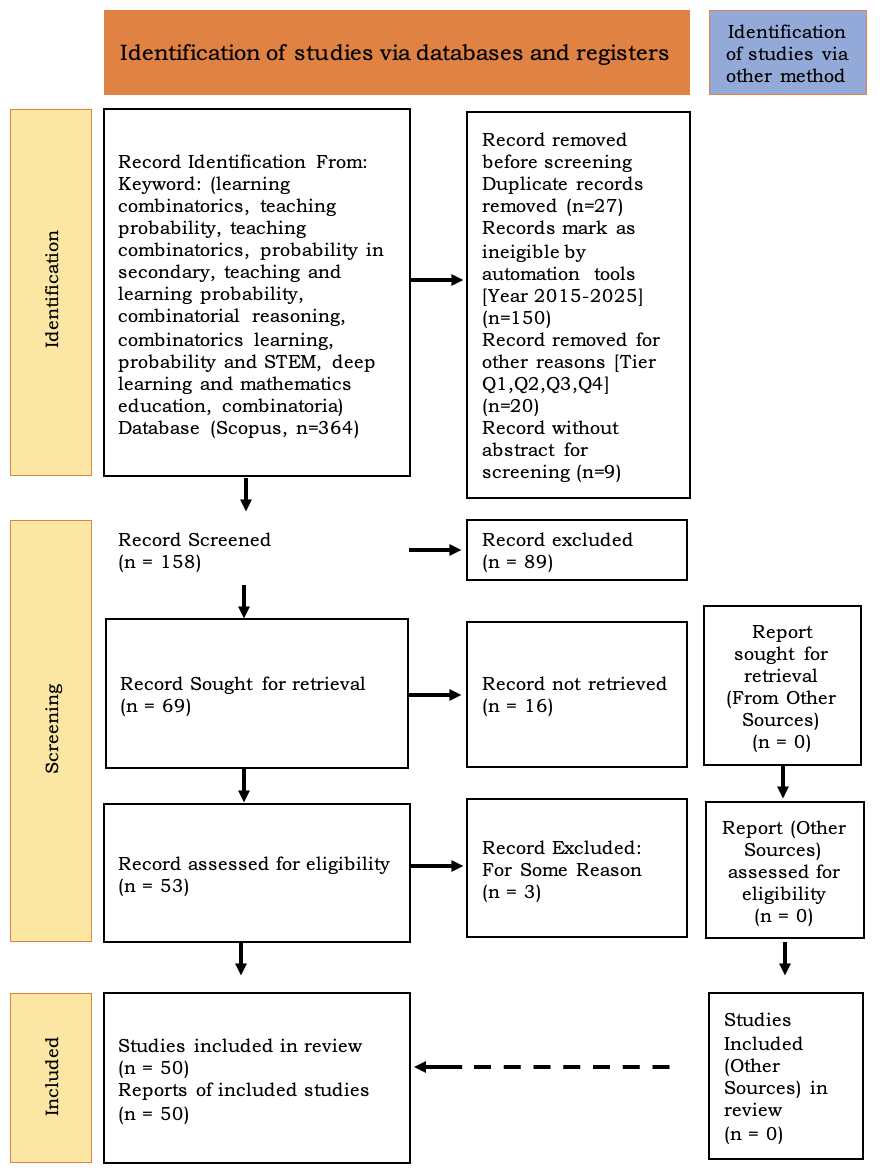
Abstract concept in probability and combinatorics often conflict with students’ intuitive reasoning, creating persistent challenges in teaching and learning. To investigate these challenges a systematic literature review (SLR) following the PRISMA framework was conducted of 50 peer-reviewed articles published between 2015 and 2025. The articles were retrieved through WATASE UAKE, an academic literature discovery platform that provide access to a curated collection of open access educational research published in Scopus Indexed journals across quartile Q1-Q4. This study identified three key findings. First, probability dominates 84% of the literature, yet instruction remains largely mechanistic, with modern approaches such as Bayesian reasoning underutilized especially in primary education. In addition, human-centered strategies such as multiple representations, contextual modeling, and game-based learning have proven effective in addressing misconceptions but are rarely systematized in curricula. Second, while 26% of studies involved technology (CAI, GeoGebra, AI), only 10% used modern AI, and none developed systems that diagnostically adapt to student misconceptions such as equiprobability bias. Third, because curricula treat probability's classical, frequentist, and subjective perspectives as disconnected, future research should pursue cross-cultural, design-based studies that adapt effective pedagogical strategies to local curricula, alongside teacher education programs that build diagnostic competence rather than content mastery alone. This reveals a critical gap: the absence of AI-based learning materials that address the cognitive structures behind errors. This review contributes to mathematics education research by mapping the disconnect between cognitive-pedagogical strategies and AI-based innovation, an integration that remains largely absent from existing research frameworks. It also proposes a cognition-aware AI model as a novel direction for future instructional design. The study calls for curricula that integrate classical, frequentist, and subjective perspectives, and teacher education programs that strengthen epistemological understanding of uncertainty.
References
Abramovich, S., & Nikitin, Y. Y. (2017). Teaching classic probability problems with modern digital tools. Computers in the Schools, 34(4), 318–336. https://doi.org/10.1080/07380569.2017.1384687
Açar, Abdullah & Ercan, Bahar & Altun, Sertel. (2019). Teaching Probability through Understanding by Design: An Examination on Students’ Achievement, Attitude and Views. Education Ans Science. 44(198). 155-147. https://doi.org/10.15390/EB.2019.7168
Başaran, M., Özalp, G., Kalender, İ., & Alacaci, C. (2015). Mathematical Knowledge and Skills Expected by Higher Education in Engineering and the Social Sciences: Implications for High School Mathematics Curriculum. EURASIA Journal of Mathematics, Science and Technology Education. 11(2), 405-420 https://doi.org/10.12973/eurasia.2015.1357a
Batanero, C., & Álvarez-Arroyo, R. (2024). Teaching and learning of probability. ZDM – Mathematics Education, 56(1), 5–17. https://doi.org/10.1007/s11858-023-01511-5
Becerra-Rozas, M., Crawford, B., Soto, R., Talbi, E.-G., & Gómez-Pulido, J. M. (2024). Challenging the Limits of Binarization: A New Scheme Selection Policy Using Reinforcement Learning Techniques for Binary Combinatorial Problem Solving. Biomimetics, 9(2), 89. https://doi.org/10.3390/biomimetics9020089
Braun, V., & Clarke, V. (2006). Using thematic analysis in psychology. Qualitative Research in Psychology, 3(2), 77–101. https://doi.org/10.1191/1478088706qp063oa
Dayal, H. C., & Sharma, S. (2020). Investigating Probability Concepts of Secondary Pre-service Teachers in a Game Context. Australian Journal of Teacher Education, 45(5). https://doi.org/10.14221/ajte.2020v45n5.6
Ding, J. (2023). A practical study on integrating ecological education in university mathematics education in the context of deep learning. Applied Mathematics and Nonlinear Sciences, 9(1), 1–15. https://doi.org/10.2478/amns.2023.2.00901
Eckert, A., Nilsson, P. (2015). Introducing a symbolic interactionist approach on teaching mathematics: the case of revoicing as an interactional strategy in the teaching of probability. J Math Teacher Educ 20, 31–48. https://doi.org/10.1007/s10857-015-9313-z
Erickson, S.A., Lockwood, E. (2021). Investigating Combinatorial Provers’ Reasoning about Multiplication. Int. J. Res. Undergrad. Math. Ed. 7, 77–106. https://doi.org/10.1007/s40753-020-00123-8
Flavio Guiñez, F., Vásquez, C., Brito, C., & Martínez, S. (2021). ALICE IN RANDOMLAND: A RESOURCE FOR IMPROVING ATTITUDES TOWARDS PROBABILITY AND ITS TEACHING. STATISTICS EDUCATION RESEARCH JOURNAL, 20(2), 14. https://doi.org/10.52041/serj.v20i2.410
Gürbüz, R., Dede, Y., & Doğan, M. F. (2018). The Role of Computer-Assisted Instruction in the Teaching of Probability. Hacettepe University Journal of Education, 1–18. https://doi.org/10.16986/HUJE.2018036943
Iversen, K., & Nilsson, P. (2019). Lower secondary school students’ reasoning about compound probability in spinner tasks. The Journal of Mathematical Behavior, 56, 100723. https://doi.org/10.1016/j.jmathb.2019.100723
Izagirre, A., Anasagasti, J., & Berciano, A. (2025). Determinants of secondary school teachers' attitudes towards probability and its teaching. Statistics Education Research Journal. 24(2),2. https://doi.org/10.52041/serj.v24i2.751
Jahodova Berkova, A., & Nemec, R. (2020). Teaching Theory of Probability and Statistics during the Covid-19 Emergency. Symmetry, 12(9), 1577. https://doi.org/10.3390/sym12091577
Kazak, S., & Pratt, D. (2021). Developing the role of modelling in the teaching and learning of probability. Research in Mathematics Education, 23(2), 113–133. https://doi.org/10.1080/14794802.2020.1802328
Kingsley A. Reeves, Jr., Victor Hernandez-Gantes, Grisselle Centeno, Carolina Gushi Nurnberg (2021) Game—Constructivist Exercises to Enhance Teaching of Probability and Statistics for Engineers. INFORMS Transactions on Education, 22(1): 55-64. https://doi.org/10.1287/ited.2021.0246
Kitchenham, B., & Charters, S. (2007). Guidelines for performing systematic literature reviews in software engineering (EBSE Technical Report EBSE-2007-01). Keele University and Durham University. https://www.cs.usask.ca/~cduchesn/docs/kitchenham2007guidelines.pdf
Latifi, M., Eseghir, A., Elmaroufi, A., Hattaf, K., & Achtaich, N. (2022). Modeling with Differential Equations and Geogebra in High School Mathematics Education. Journal of Educational and Social Research, 12(3), 47. https://doi.org/10.36941/jesr-2022-0065
Lima, E.T.D., & Borba, R.E.D.S.R. (2020). Investigating Relationships Between Combinatorial and Probabilistic Reasonings in Youth and Adult Education. Acta Scientiae. 22(2),134-148. https://doi.org/10.17648/acta.scientiae.5383
Liu, B., Han, T., Qi, L., & Ji, F. (2023). Incorporating multidimensional data analysis methods for probability theory and mathematical statistics teaching reform and practical exploration. Applied Mathematics and Nonlinear Sciences, 9(1), 1–19. https://doi.org/10.2478/amns.2023.2.01310
Lyford, A., & Czekanski, M. (2020). Teaching student to estimate complex probabilities of board game events through simulation. Teaching Statistics, 42:3, 117-125. https://doi.org/10.1111/test.12235
Lockwood, E., De Chenne, A. (2019). Enriching Students’ Combinatorial Reasoning through the Use of Loops and Conditional Statements in Python. Int. J. Res. Undergrad. Math. Ed. 6, 303–346. https://doi.org/10.1007/s40753-019-00108-2
Martin-Cudero, D. (2025). Balanced Incomplete Block Designs For Teaching Combinatorics: Construction And Applications. The Teaching of Mathematics. 27(1) pp 42-73. DOI: 10.57016/TM-NOQK3870
Martin, V., Thibault, M. & Homier, M. (2022). Convergence and Divergence in Probability Teaching in Elementary and Secondary School in Québec: a Closer Look at Eight Teachers’ Self-reported Practices. Can. J. Sci. Math. Techn. Educ. 22, 659–678. https://doi.org/10.1007/s42330-022-00241-2
Ma, J., Liu, Q., Zhang, Z., & Gu, P. (2024). Research on personalized recommendation of teaching resources based on joint probability matrix decomposition model and CNN improvement algorithm. Applied Mathematics and Nonlinear Sciences, 9(1), 20240543. https://doi.org/10.2478/amns-2024-0543
Medová, J., Bulková, K. O., & Čeretková, S. (2020). Relations between Generalization, Reasoning and Combinatorial Thinking in Solving Mathematical Open-Ended Problems within Mathematical Contest. Mathematics, 8(12), 2257. https://doi.org/10.3390/math8122257
Nguyen, Q. A., Dao, N. H., Hoa, T. A., & Nguyen, N.-G. (2025). Teaching conditional probability in grade 12 using realistic mathematics education theory. Journal on Mathematics Education, 16(2), 603–632. https://doi.org/10.22342/jme.v16i2.pp603-632
Nopriana, T., Herman, T., & Martadiputra, B. A. P. (2023). Digital Didactical Design: The Role of Learning Obstacles in Designing Combinatorics Digital Module for Vocational Students. International Journal of Interactive Mobile Technologies (iJIM), 17(02), pp. 4–23. https://doi.org/10.3991/ijim.v17i02.34293
Ollerton, R. L. (2015). A unifying framework for teaching probability event types. International Journal of Mathematical Education in Science and Technology, 46(5), 790–794. https://doi.org/10.1080/0020739X.2015.1005702
Pérez, K.M., Delgadillo, E.M. (2022). The Mathematical Work of Chilean Secondary Teachers in the Domain of Probability. Can. J. Sci. Math. Techn. Educ. 22, 558–575. https://doi.org/10.1007/s42330-022-00235-0
Pinto, A., & Cooper, J. (2023). “But this is not mathematics!”: Mathematicians and secondary teachers explore the affordances of tertiary mathematics for teaching secondary probability. ZDM – Mathematics Education, 55, 883–896. https://doi.org/10.1007/s11858-023-01506-2
Post, M., & Prediger, S. (2024). Teaching practices for unfolding information and connecting multiple representations: The case of conditional probability information. Mathematics Education Research Journal, 36(1), 97–129. https://doi.org/10.1007/s13394-022-00431-z
Qu G, Hu W, Jiao W and Jin J. (2021). Application of Deep Learning-Based Integrated Trial-Error + Science, Technology, Reading/Writing, Engineer, Arts, Mathematics Teaching Mode in College Entrepreneurship Education. Front. Psychol. 12:739362. doi: 10.3389/fpsyg.2021.739362
Rico, N., & Ruiz-Hidalgo, J. F. (2022). Errors concerning Statistics and Probability in Spanish Secondary School Textbooks. Applied Sciences, 12(24), 12719. https://doi.org/10.3390/app122412719
Sari, A. D., Suryadi, D., & Dasari, D. (2024). Learning obstacle of probability learning based on the probabilistic thinking level. Journal on Mathematics Education, 15(1), 207–226. https://doi.org/10.22342/jme.v15i1.pp207-226
Satake, E., & Vashlishan Murray, A. (2015). An alternative teaching method of conditional probabilities and Bayes’ rule: An application of the truth table. Teaching Statistics, 37(3), 89–95. https://doi.org/10.1111/test.12080
Schoen, R. C., LaVenia, M., Chicken, E., Razzouk, R., & Kisa, Z. (2019). Increasing secondary-level teachers’ knowledge in statistics and probability: Results from a randomized controlled trial of a professional development program. Cogent Education, 6(1). https://doi.org/10.1080/2331186X.2019.1613799
Sharma, S. (2015). Teaching probability: A socio‐constructivist perspective. Teaching Statistics, 37(3), pp 78–84. https://doi.org/10.1111/test.12075
Sheikh W. (2019). An intuitive, application-based, simulation-driven approach to teaching probability and random processes. International Journal of Electrical Engineering & Education.61(1):17-57. doi:10.1177/0020720919866405
Supratman, Budayasa, I. K., & Rahaju, E. B. (2025). Probability problem-solving: the role of probabilistic thinking of undergraduate mathematics education students with feminine female gender and field-independent cognitive style. Perspektivy nauki i obrazovania = Perspectives of Science and Education, (2), 228–242. https://doi.org/10.32744/pse.2025.1.15
Supratman, Budayasa, I.K., & Rahaju, E.B. (2025). Probabilistic Thinking Process in Probability Problem-Solving Prospective Mathematics Teacher with Field-Independent based on Polya's Three Stages. Educational Process International Journal. 17(1). https://doi.org/10.22521/edupij.2025.17.333
Susiswo, Darmawan, P., Murtafiah, W., & Osman, S. (2024). Exploring default-interventionist interaction of thinking activity types on probability problem-solving. Journal on Mathematics Education, 15(1), 295–316. https://doi.org/10.22342/jme.v15i1.pp295-316
Targosz, O., & Strycharz-Szemberg, B. (2022). On the peer-to-peer instruction in high school mathematics education, a case study. Annales Universitatis Paedagogicae Cracoviensis | Studia Ad Didacticam Mathematicae Pertinentia, 14, 103–117. https://doi.org/10.24917/20809751.14.6
Tillema, E. S., Hackenberg, A. J., Gatza, A. M., & Pinheiro, W. A. (2024). Combinatorial and quantitative reasoning: Stage 3 high school students reason about combinatorics problems and their representation as 3-D arrays. The Journal of Mathematical Behavior, 73, 101125. https://doi.org/10.1016/j.jmathb.2024.101125
Totis, P., Davis, J., De Raedt, L., & Kimmig, A. (2023). Lifted reasoning for combinatorial counting. Journal of Artificial Intelligence Research, 76, 1-58. https://doi.org/10.1613/jair.1.14062
Tranfield, D., Denyer, D., & Smart, P. (2003). Towards a methodology for developing evidence-informed management knowledge by means of systematic review. British Journal of Management, 14(3), 207–222. https://doi.org/10.1111/1467-8551.00375
Vásquez, C., & Alsina, Á. (2021). Analysing Probability Teaching Practices in Primary Education: What Tasks Do Teachers Implement? Mathematics, 9(19), 2493. https://doi.org/10.3390/math9192493
Voit, W., & Bathke, A. (2015). Statistics and Probability at Secondary Schools in the Federal State of Salzburg: An Empirical Study. Austrian Journal of Statistics, 44(1), 17-24. https://doi.org/10.17713/ajs.v44i1.12
Wathne, U., & Carlsen, M. (2024). Third grade students’ multimodal mathematical reasoning when collaboratively solving combinatorial problems in small groups, Mathematical Thinking and Learning, 26:3, 258-277, DOI: 10.1080/10986065.2022.2099611
Wu, H., Saleh, A.R. & Molnár, G. (2022). Inductive and combinatorial reasoning in international educational context: assessment, measurement invariance, and latent mean differences. Asia Pacific Educ. Rev. 23, 297–310. https://doi.org/10.1007/s12564-022-09750-z
Xuan, Son Ha, Nguyen, Anh Tuan, Nguyen, Thau, Nguyen, Ly, Nguyen, Hung, Pham, Nghiem, Phung, Trinh, Ngo, Bang, Nguyen, Vinh, Nguyen, Minh, Tran, Thuan, Le, Tung, Nguyen, Kha, FNU, Pratima. (2025). Evaluating the Impact of Generative AI in Mathematics Education: A Comparative Study in Vietnamese High Schools, Human Behavior and Emerging Technologies, 8886206, 23 pages, 2025. https://doi.org/10.1155/hbe2/8886206
Yang, D. C., & Sianturi, I. A. J. (2019). The earliest teaching and learning of probability in Singapore, the US, and Indonesia from the perspectives of textbooks analysis. Irish Educational Studies, 38(4), 535–559. https://doi.org/10.1080/03323315.2019.1664313
Downloads
Published
How to Cite
Issue
Section
License
Copyright (c) 2026 Siti Nur Baiti, Farida Nurhasanah, Triyanto Triyanto

This work is licensed under a Creative Commons Attribution-ShareAlike 4.0 International License.
Authors who publish with this journal agree to the following terms:
- Authors retain copyright with the work simultaneously licensed under a Creative Commons Attribution License that allows others to share the work with an acknowledgement of the work's authorship and initial publication in this journal.
- Authors are able to enter into separate, additional contractual arrangements for the non-exclusive distribution of the journal's published version of the work (e.g., post it to an institutional repository or publish it in a book), with an acknowledgement of its initial publication in this journal.
- Authors are permitted and encouraged to post their work online (e.g., in institutional repositories or on their website) prior to and during the submission process, as it can lead to productive exchanges, as well as earlier and greater citation of published work (See The Effect of Open Access).