Digital equity in mathematics education: Technology use in academic and vocational tracks
DOI:
https://doi.org/10.12928/ijei.v7i2.15478Keywords:
academic track, digital equity, educational technology, mathematics education, vocational trackAbstract
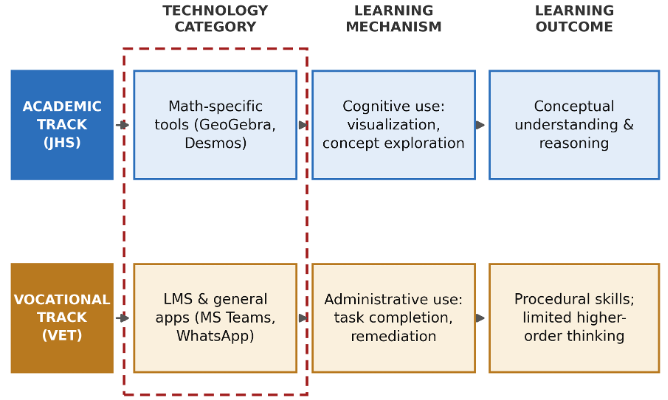
Digital equity in mathematics education is shaped not only by the availability of devices but also by the quality and purposes of technology use in learning. This study maps how technology is used in mathematics learning across academic and vocational tracks and examines its implications for digital equity. A systematic literature review was conducted following PRISMA 2020 guidelines using the Scopus database, covering publications from 2015 to 2025. A total of 44 selected articles were analyzed through descriptive mapping and thematic analysis to identify technology categories and patterns of use in both tracks. The findings show a clear divide: in the academic track, technology is more often used as cognitive tools to support visualization, conceptual exploration, and higherorder learning. In contrast, in the vocational track, technology is more commonly used for communication, learning management, and strengthening basic skills or remediation. In addition, the evidence base is concentrated in developed countries, while studies focusing on vocational tracks and developingcountry contexts, including Indonesia, remain limited. These results highlight a gap that may reduce vocational students’ learning opportunities. Future research should expand evidence from vocational settings and developing countries, while policy should strengthen pedagogical support so that technology use in vocational education also promotes conceptual understanding and mathematical reasoning.
References
Alabdulaziz, M. S. (2021). COVID19 and the use of digital technology in mathematics education. Education and Information Technologies, 26, 7609–7633. https://doi.org/10.1007/s10639021106023
Arcavi, A. (2003). The role of visual representations in the learning of mathematics. Educational Studies in Mathematics, 52(3), 215–241. https://doi.org/10.1023/A:1024312321077
Braun, V., & Clarke, V. (2006). Using thematic analysis in psychology. Qualitative Research in Psychology, 3(2), 77–101. https://doi.org/10.1191/1478088706qp063oa
Bray, A., & Tangney, B. (2017). Technology usage in mathematics education research – A systematic review of recent trends. Computers & Education, 114, 255–273. https://doi.org/10.1016/j.compedu.2017.07.004
Erdener, K., Perkmen, S., Shelley, M., & Kandemir, M. A. (2022). Measuring perceived attributes of the interactive whiteboard for the mathematics class. Computers in the Schools, 39(1), 1–15. https://doi.org/10.1080/07380569.2022.2037294
Gough, D., Oliver, S., & Thomas, J. (2017). An introduction to systematic reviews (2nd ed.). SAGE Publications. https://doi.org/10.4135/9781036234942.n1
Govender, R., & Amevor, G. (2025). Instructionalbased learning of cyclic quadrilateral theorems: Making geometric thinking visible and enhancing learners' spatial and geometry cognitions. Pythagoras, 46(1), a812. https://doi.org/10.4102/pythagoras.v46i1.812
Haleem, A., Javaid, M., Qadri, M. A., & Suman, R. (2022). Understanding the role of digital technologies in education: A review. Sustainable Operations and Computers, 3, 275–285. https://doi.org/10.1016/j.susoc.2022.05.004 ScienceDirect
Hong, Q. N., Fàbregues, S., Bartlett, G., Boardman, F., Cargo, M., Dagenais, P., Gagnon, M.P., Griffiths, F., Nicolau, B., O’Cathain, A., Rousseau, M.C., Vedel, I., & Pluye, P. (2018). The Mixed Methods Appraisal Tool (MMAT) version 2018 for information professionals and researchers. Education for Information, 34(4), 285–291. https://doi.org/10.3233/EFI180221
Letchumanan, M., Husain, S. K. S., & Ayub, A. F. M. (2024). Selfregulated learning in mathematics online learning environment: A systematic review. The Journal of Educators Online, 21(4). https://doi.org/10.9743/JEO.2024.21.4.6
López, F., Contreras, M., Nussbaum, M., Paredes, R., Gelerstein, D., Alvares, D., & Chiuminatto, P. (2023). Developing critical thinking in technical and vocational education and training. Education Sciences, 13(6), 590. https://doi.org/10.3390/educsci13060590
Nagar, G. G., Hegedus, S., & Orrill, C. H. (2022). Teachers’ understanding of draggable geometric objects: Variance and invariance in a dynamic geometry environment. Digital Experiences in Mathematics Education, 8(3), 259–286. https://doi.org/10.1007/s40751022001061
National Digital Inclusion Alliance. (n.d.). Definitions. https://www.digitalinclusion.org/definitions/
Page, M. J., McKenzie, J. E., Bossuyt, P. M., Boutron, I., Hoffmann, T. C., Mulrow, C. D., … Moher, D. (2021). The PRISMA 2020 statement: An updated guideline for reporting systematic reviews. BMJ, 372, n71. https://doi.org/10.1136/bmj.n71
Paul, J., Lim, W. M., O’Cass, A., Hao, A. W., & Bresciani, S. (2021). Scientific procedures and rationales for systematic literature reviews (SPAR4SLR). International Journal of Consumer Studies, 45(4), O1–O16. https://doi.org/10.1111/ijcs.12695
Rodriguez Segura, D. (2021). EdTech in developing countries: A review of the evidence. The World Bank Research Observer. https://doi.org/10.1093/wbro/lkab011
Salami, I. A., & Spangenberg, E. (2024). Integration of GeoGebra software into mathematics instruction. Studies in Learning and Teaching, 5(1), 118–126. https://doi.org/10.46627/silet.v5i1.343
Segal, R., & Biton, Y. (2024). Teaching and learning highschool mathematics via WhatsApp: Teachers’ perspectives. Learning Environments Research. Advance online publication. https://doi.org/10.1007/s10984-024-09508-x
Taranto, E., Jablonski, S., Recio, T., Mercat, C., Cunha, E., Lázaro, C., Ludwig, M., & Mammana, M. F. (2022). Professional development in mathematics education—Evaluation of a MOOC on outdoor mathematics. Mathematics, 9(22), 2975. https://doi.org/10.3390/math9222975
UNESCO. (2023). Global education monitoring report 2023: Technology in education: A tool on whose terms? UNESCO. https://doi.org/10.54676/UZQV8501
Wahyudi, L. (2024). Watase Uake: Research collaboration tools [Computer software]. https://www.watase.web.id/
Walkington, C. (2025). The implications of generative artificial intelligence for mathematics education. School Science and Mathematics. School Science and Mathematics, 126(4), 356-365. https://doi.org/10.1111/ssm.18356
Warschauer, M., & Matuchniak, T. (2010). New technology and digital worlds: Analyzing evidence of equity in access, use, and outcomes. Review of Research in Education, 34(1), 179–225. https://doi.org/10.3102/0091732X09349791
Wilder, S., & Berry, L. (2016). Emporium model: The key to content retention in secondary math courses. Journal of Educators Online, 13(2). https://doi.org/10.9743/JEO.2016.2.5
Downloads
Published
How to Cite
Issue
Section
License
Copyright (c) 2026 Hesty Ummi Wulandari, Farida Nurhasanah, Dhidhi Pambudi

This work is licensed under a Creative Commons Attribution-ShareAlike 4.0 International License.
Authors who publish with this journal agree to the following terms:
- Authors retain copyright with the work simultaneously licensed under a Creative Commons Attribution License that allows others to share the work with an acknowledgement of the work's authorship and initial publication in this journal.
- Authors are able to enter into separate, additional contractual arrangements for the non-exclusive distribution of the journal's published version of the work (e.g., post it to an institutional repository or publish it in a book), with an acknowledgement of its initial publication in this journal.
- Authors are permitted and encouraged to post their work online (e.g., in institutional repositories or on their website) prior to and during the submission process, as it can lead to productive exchanges, as well as earlier and greater citation of published work (See The Effect of Open Access).