The role of engineering-related attitude and learning interest on mechanical reasoning: A structural equation modeling study
DOI:
https://doi.org/10.12928/ijei.v7i1.15300Keywords:
engineering-related attitude, interest in learning, mechanical reasoning, structural equation modelingAbstract
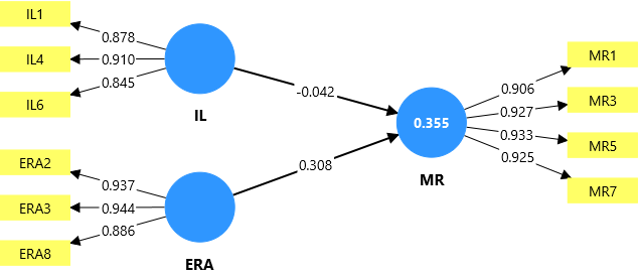
The results of previous research have not revealed the factors that influence mechanical reasoning, as a preparatory step to improve the mechanical reasoning abilities of engineering students. Based on this, the purpose of this study is to determine a factor model of engineering-related attitude and interest in learning in influencing mechanical reasoning. This study used a cross-sectional study design. The sampling technique used was purposive sampling, involving 30 mechanical engineering students and 72 civil engineering students from the Faculty of Engineering at Universitas Islam Ogan Komering Ilir Kayuagung. The study was conducted using a questionnaire with four Likert-type scale options. The questionnaire consisting of 13 items on mechanical reasoning, 8 items on engineering-related attitudes, and 8 items on interest in learning. The research data were analyzed using Structural Equation Modeling (SEM) using the SmartPLS4 application. SEM analysis involves two stages: measurement model testing and structural model evaluation. Overall, the results of the PLS-SEM model evaluation show that all indicators have met convergent validity and reliability, the independent variables do not experience multicollinearity, 42.1% of the variation in the mechanical reasoning variable can be explained by the relationship between the indicators that form the construct, and both engineering-related attitudes and learning interests are important and significant factors in influencing mechanical reasoning ability. This study contributes to the existing literature in mechanical reasoning by providing an empirically validated structural model that clarifies the significant roles of engineering-related attitudes and learning interest in explaining variations in students’ mechanical reasoning ability.
References
Allen, K. R., Smith, K. A., & Tenenbaum, J. B. (2020). Rapid trial-and-error learning with simulation supports flexible tool use and physical reasoning. PNAS, 117(47), 29302–29310. https://doi.org/10.1073/pnas.1912341117/-/DCSupplemental.y
Andriyanto, Y. D. (2024). Relationship between learning interest and learning outcomes of Catholic religious education students in Grade III of St. Don Bosco Catholic Elementary School Palangkaraya. Journal of Childhood Development, 4(2), 459-469. https://doi.org/10.25217/jcd.v4i2.5104
Dewaters, J., Moosbrugger, J. C., & Sharma, P. (2017). Development and application of a questionnaire to measure student attitudes toward and understanding of engineering. ASEE Annual Conference and Exposition (vol. 2017-June). https://doi.org/10.18260/1-2--28153
Firdaus, E., Andrikasmi, S., Hermita, N., & Wijaya, T. T. (2025). Investigating factors influencing bullying behavior reduction and gender differences in higher education: A structural equation modeling approach. Acta Psychologica, 253(1), 1–11. https://doi.org/10.1016/j.actpsy.2025.104747
Fithri, P., Hasan, A., Syafrizal, S., & Games, D. (2024). Validation studies a questionnaire developed to measure incubator business technology performance using PLS-SEM Approach. Andalasian International Journal of Applied Science, Engineering and Technology, 4(1), 64–78. https://doi.org/10.25077/aijaset.v4i1.132
Grondin, M. M., & Fu, K. (2023). How does students’ use of speech ground and embody their mechanical reasoning during engineering discourse? ASEE Annual Conference and Exposition (vol. 2023-June, pp. 1–20). https://doi.org/10.18260/1-2--43365
Hačatrjana, L., & Namsone, D. (2024). Breaking down the concept of students’ thinking and reasoning skills for implementation in the classroom. Journal of Intelligence, 12(11), 109. https://doi.org/10.3390/jintelligence12110109
Hair, J., & Alamer, A. (2022). Partial Least Squares Structural Equation Modeling (PLS-SEM) in second language and education research: Guidelines using an applied example. Research Methods in Applied Linguistics, 1(3), 1–16. https://doi.org/10.1016/j.rmal.2022.100027
Hair, J., Hult, G., Ringle, C., Sarstedt, M., Danks, N., & Ray, S. (2021). Partial Least Squares Structural Equation Modeling (PLS-SEM) using R. Springer Nature. https://doi.org/10.1007/978-3-030-80519-7
Hidayat, R., & Patricia Wulandari. (2022). Structural Equation Modelling (SEM) in research: Narrative literature review. Open Access Indonesia Journal of Social Sciences, 5(6), 852–858. https://doi.org/10.37275/oaijss.v5i6.141
Izzaty, R. E., Setiawati, F. A., & Istikomah, F. (2024). The effect of educational levels and gender on students’ reasoning ability and mechanical aptitude. Cypriot Journal of Educational Sciences, 19(4), 309–325. https://doi.org/10.18844/cjes.v19i4.8953
Kock, N. (2015). Common method bias in PLS-SEM: A full collinearity assessment approach. International Journal of E-Collaboration, 11(4), 1–10. https://doi.org/10.4018/ijec.2015100101
Kőycű, Ü., & de Vries, M. J. (2016). What preconceptions and attitudes about engineering are prevalent amongst upper secondary school pupils? An international study. International Journal of Technology and Design Education, 26(2), 243–258. https://doi.org/10.1007/s10798-015-9305-4
Laguador, J. M., & Dotong, C. I. (2020). Engineering students’ challenging learning experiences and their changing attitude towards academic performance. European Journal of Educational Research, 9(3), 1127–1140. https://doi.org/10.12973/EU-JER.9.3.1127
Mackellar, C. (2015). Mechanical, Spatial & Abstract Reasoning. Vivid Publishing.
Mia, M. M., Zayed, N. M., Islam, K. M. A., Nitsenko, V., Matusevych, T., & Mordous, I. (2022). The strategy of factors influencing learning satisfaction explored by first and second-order Structural Equation Modeling (SEM). Inventions, 7(3), 59. https://doi.org/10.3390/inventions7030059
Miah, M. S., Singh, J. S. K., & Rahman, M. A. (2023). Factors influencing technology adoption in online learning among private university students in Bangladesh post COVID-19 pandemic. Sustainability, 15(4), 3543. https://doi.org/10.3390/su15043543
Mohamed, Z., Hasbiah Ubaidullah, N., & Ilyana Mohd Yusof, S. (2018). An evaluation of structural model for independent learning through connectivism theory and Web 2.0 towards students’ achievement. In International Conference on Applied Science and Engineering (ICASE 2018) (pp. 1-5). Atlantis Press.
MS, F., & Saud, E. (2024). Engineering aptitude-mechanical reasoning of engineering students: Rasch analysis. Edutainment: Jurnal Ilmu Pendidikan dan Kependidikan, 12(2), 56–64. https://doi.org/10.35438/e.v12i2.927
Purwanto, A., & Sudargini, Y. (2021). Partial Least Squares Structural Squation Modeling (PLS-SEM) analysis for social and management research: A literature review. Journal of Industrial Engineering & Management Research, 2(4), 114–123. https://doi.org/10.7777/jiemar.v2i4
Putu Gede Subhaktiyasa. (2024). PLS-SEM for multivariate analysis: A practical guide to educational research using SmartPLS. EduLine: Journal of Education and Learning Innovation, 4(3), 353–365. https://doi.org/10.35877/454ri.eduline2861
Radzi, N. A. M., & Sulaiman, S. (2018). Measuring students’ interest towards engineering in technical school: A case study. Journal of Technology and Science Education, 8(4), 231–237. https://doi.org/10.3926/jotse.369
Reynolds, B., Mehalik, M. M., Lovell, M. R., & Schunn, C. D. (2019). Increasing student awareness of and interest in engineering as a career option through design-based learning. International Journal of Engineering Education, 25(4), 788–798.
Robinson, B., Tretter, T., Lewis, J. E., & Hawkins, N. (2021). Measuring First-Year Engineering Majors Interest in Engineering. In 2021 ASEE Virtual Annual Conference Content Access. https://doi.org/10.18260/1-2--37493
Schuberth, F., Hubona, G., Roemer, E., Zaza, S., Schamberger, T., Chuah, F., Cepeda-Carrión, G., & Henseler, J. (2023). The choice of structural equation modeling technique matters: A commentary on Dash and Paul (2021). Technological Forecasting and Social Change, 194, 122665. https://doi.org/10.1016/j.techfore.2023.122665
Setiawan, H., & Raharjo, F. (2019). Knowledge, skills and attitudes of civil engineers in Indonesia. IOP Conference Series: Materials Science and Engineering, 615(1), 012030. https://doi.org/10.1088/1757-899X/615/1/012030
Sholihah, U., & Listanti, A. (2022). Analyzing students’ mathematical reasoning from the perspective of learning interest. Beta: Jurnal Tadris Matematika, 15(2), 157-166. https://doi.org/10.20414/betajtm.v15i2.535
Sulfiani, B., Nurhayati, N., Abdullah, E., Takwa, E. S., Fitriani, F., & Nesti, V. A. (2024). Increasing student learning interest through cooperative learning. Journal La Edusci, 5(3), 162–168. https://doi.org/10.37899/journallaedusci.v5i3.1354
Sun, H., Gao, Q., Lyu, H., Luo, D., Li, Y., & Deng, H. (2025). Probing Mechanical Reasoning in Large Vision Language Models. Arxiv Preprint. http://arxiv.org/abs/2410.00318
Xu, S. R., & Zhou, S. N. (2022). The effect of students’ attitude towards science, technology, engineering, and mathematics on 21st century learning skills: A structural equation model. Journal of Baltic Science Education, 21(4), 706–719. https://doi.org/10.33225/jbse/22.21.706
Downloads
Published
How to Cite
Issue
Section
License
Copyright (c) 2026 Firdaus MS, Deliansyah Pasayu

This work is licensed under a Creative Commons Attribution-ShareAlike 4.0 International License.
Authors who publish with this journal agree to the following terms:
- Authors retain copyright with the work simultaneously licensed under a Creative Commons Attribution License that allows others to share the work with an acknowledgement of the work's authorship and initial publication in this journal.
- Authors are able to enter into separate, additional contractual arrangements for the non-exclusive distribution of the journal's published version of the work (e.g., post it to an institutional repository or publish it in a book), with an acknowledgement of its initial publication in this journal.
- Authors are permitted and encouraged to post their work online (e.g., in institutional repositories or on their website) prior to and during the submission process, as it can lead to productive exchanges, as well as earlier and greater citation of published work (See The Effect of Open Access).