Describing the effect of worksheet-assisted PBL on the students’ critical thinking, numeracy, and responsibility
DOI:
https://doi.org/10.12928/ijei.v7i1.13708Keywords:
critical thinking skills, numeracy, problem-based learning, responsibilityAbstract
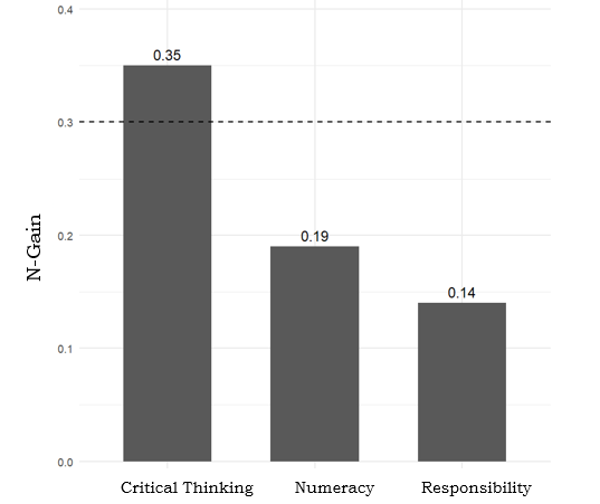
This study aims to describe the effect of the problem-based learning model on students' critical thinking skills, numeracy, and sense of responsibility. The research employed a quantitative approach using a one-group pretest-posttest design. The research subjects were seventh-grade students at SMP Negeri 4 Banguntapan, selected randomly. The instruments used included a critical thinking test, a numeracy test, and a responsibility questionnaire. Data were analyzed both descriptively and inferentially using the paired t-test and N-Gain calculations. The results showed p-values ≤ 0.05, indicating significant differences between pretest and posttest scores in critical thinking, numeracy, and responsibility following the intervention. Therefore, it can be concluded that the problem-based learning model assisted by student worksheets positively influences students’ critical thinking skills, numeracy, and sense of responsibility. The improvements in these three aspects fell into the moderate to high categories. These findings indicate that the problem-based learning model is effective in fostering active student engagement, enhancing higher-order thinking processes, and developing positive attitudes toward mathematics learning.
References
Afifah, E. P., Wahyudi, W., & Setiawan, Y. (2019). Efektivitas problem based learning dan problem solving terhadap kemampuan berpikir kritis siswa kelas V dalam pembelajaran matematika. MUST: Journal of Mathematics Education, Science and Technology, 4(1), 95. https://doi.org/10.30651/must.v4i1.2822
Andini, F., & Siregar, M. A. P. (2024). Improving mathematical literacy: How does PBL affect the students’ performance? Bulletin of Applied Mathematics and Mathematics Education, 4(1), 51-60
Cohen, J. (1988). Statistical Power Analysis for the Behavioral Science. Lawrence Erlbaum Associates.
Eka, Y. R., Purwanto, & Swida, M. (2020). Pengaruh model pembelajaran kooperatif tipe Student Team Achievement Divisions (STAD) berbasis mind mapping terhadap kemampuan pemahaman konsep matematis peserta didik di SMP Negeri 232 Jakarta. Jurnal Riset Pendidikan Matematika Jakarta, 2(2), 50–58. https://doi.org/10.21009/jrpmj.v2i1.14860
Fajriyah, E. (2022). Kemampuan literasi numerasi siswa pada pembelajaran matematika di abad 21. In Prosiding Seminar Nasional Pendidikan (vol. 4, pp. 403-409). Universitas Majalengka. https://prosiding.unma.ac.id/index.php/semnasfkip/article/view/824
Fakhriyah, F. (2014). Penerapan problem based learning dalam upaya mengembangkan kemampuan berpikir kritis mahasiswa. Jurnal Pendidikan IPA Indonesia, 3(1), 95–101. https://doi.org/10.15294/jpii.v3i1.2906
Fauziyah, N. Z., Salsabila, E., & Meidianingsih, Q. (2025). Pengaruh model pembelajaran PBL dengan bantuan LKPD berbasis masalah kontekstual terhadap kemampuan literasi numerasi. Jurnal Riset Pembelajaran Matematika Sekolah, 9(1), 18–27. https://doi.org/10.21009/jrpms.091.03
Fraenkel, J. R., & Wallen, N. E. (1990). How to Design and Evaluate Research in Education. McGraw Hill Publishing.
Hake, R. R. (1998). Interactive-engagement versus traditional methods: A six-thousand-student survey of mechanics test data for introductory physics courses. American Journal of Physics, 66(1), 64–74. https://doi.org/10.1119/1.18809
Hayati, N., & Nuriyah, T. S. (2023). Pengembangan LKPD model PBL (Problem Based Learning) dalam melatihkan keterampilan berpikir kritis peserta didik. Jurnal Binomial, 6(2), 172-184. https://doi.org/10.46918/bn.v6i2.1901
Hermawan, V., Anggiana, A. D., & Rahman, T. (2023). Peningkatan kemampuan pemahaman konsep siswa SMA melalui model discovery learning berbantuan Geogebra. Symmetry: Pasundan Journal of Research in Mathematics Learning and Education, 8(1), 128–137. https://doi.org/10.23969/symmetry.v8i1.9451
Hmelo-Silver, C. E. (2004). Problem-based learning: What and how do students learn? Educational Psychology Review, 16(3), 235–266. https://doi.org/10.1023/B:EDPR.0000034022.16470.f3
Husnul, F., & Khairul, A. (2024). Studi literatur: Peran pembelajaran matematika dalam pembentukan karakter siswa. Jurnal Riset Rumpun Ilmu Pendidikan, 3(1), 163–175. https://doi.org/10.55606/jurripen.v3i1.2802
Janah, S. R., Suyitno, H., & Rosyida, I. (2019). Pentingnya literasi matematika dan berpikir kritis matematis dalam menghadapi abad ke-21. In PRISMA Prosiding Seminar Nasional Matematika (vol. 2, pp. 905-910). Universitas Negeri Semarang. https://journal.unnes.ac.id/sju/index.php/prisma/article/view/29305
Karadimitriou, S., & Marshall, E. (2011). Paired t-test in R. http://openvpn.net/index.php/open-source/245-community-open-source-software-overview.html
Koh, K., & Chapman, O. (2019). Problem-based learning, assessment literacy, mathematics knowledge, and competencies in teacher education. Papers on Postsecondary Learning and Teaching, 3, 74–80.
Lubis, M. S. (2022). Strategi penerapan pendidikan karakter dalam pembelajaran matematika pada siswa SMP. Jurnal Pengembangan Pembelajaran Matematika, 4(1), 87–98.
Muahor, M., & Yulianto, D. (2023). Pengaruh model problem based learning (PBL) terhadap kemampuan berpikir kritis matematis siswa. Geomath, 2(2), 65. https://doi.org/10.55171/geomath.v2i2.868
Nasution, M. L., Yerizon, Y., & Gusmiyanti, R. (2018). Students’ mathematical problem-solving abilities through the application of learning models problem based learning. IOP Conference Series: Materials Science and Engineering, 335(1), 012117. https://doi.org/10.1088/1757-899X/335/1/012117
Ningsih, E., Anggraini, R. D., & Kartini, K. (2023). Penerapan model problem based learning untuk meningkatkan kemampuan pemecahan masalah matematis siswa kelas VII-E SMP Negeri 23 Pekanbaru. Jurnal Cendekia: Jurnal Pendidikan Matematika, 7(3), 2250–2260. https://doi.org/10.31004/cendekia.v7i3.2647
Novalina, S., & Sembiring, B. (2025). Pengembangan instrumen tes HOTS untuk meningkatkan kemampuan berpikir kritis matematis siswa melalui model pembelajaran problem based learning. PHI: Jurnal Pendidikan Matematika, 9(1), 200–210. http://dx.doi.org/10.33087/phi.v9i1.473
OECD. (2025). Unlocking High‑Quality Teaching. OECD Publishing. https://doi.org/10.1787/f5b82176-en
OECD. (2023). PISA 2022 Results (Volume I and Volume II) Country Notes Indonesia. https://www.oecd.org/en/publications/pisa-2022-results-volume-i-and-ii-country-notes_ed6fbcc5-en/indonesia_c2e1ae0e-en.html
Padmakrisya, M. R., & Meiliasari, M. (2023). Studi literatur: Keterampilan berpikir kritis dalam matematika. Jurnal Basicedu, 7(6), 3702–3710. https://doi.org/10.31004/basicedu.v7i6.6327
Paillin, B., Prastiti, T. D., & Ramdhani, S. (2024). Pengembangkan keterampilan berpikir kritis dan solusi masalah matematika melalui problem based learning. Jurnal Cendekia: Jurnal Pendidikan Matematika, 8(2), 1225–1242. https://doi.org/10.31004/cendekia.v8i2.3199
Pasani, C. F., & Basil, M. (2014). Mengembangkan karakter tanggung jawab siswa melalui pembelajaran matematika dengan model kooperatif tipe TAI di kelas VIII SMPN. EDU-MAT: Jurnal Pendidikan Matematika, 2(2), 219–229. https://doi.org/10.20527/edumat.v2i2.616
Pratama, B. A., & Mardiani, D. (2022). Kemampuan berpikir kritis matematis antara siswa yang mendapat model problem-based learning dan discovery learning. Jurnal Inovasi Pembelajaran Matematika: PowerMathEdu, 1(1), 83–92. https://doi.org/10.31980/pme.v1i1.1368
Purwati, N., & Prasetyowati, D. (2024). Efektivitas model problem based learning berbantu E-LKPD untuk meningkatkan kemampuan numerasi siswa. Jurnal Inovasi Pendidikan Matematika (JIPM), 6(2), 72–81. https://doi.org/10.37729/jipm.v6i2.5258
Rifai, R., Pratidiana, D., & Arifiyanti, S. D. (2019). Penerapan model problem based learning untuk meningkatkan kemampuan pemecahan masalah matematis siswa. JKPM (Jurnal Kajian Pendidikan Matematika), 5(1), 109. https://doi.org/10.30998/jkpm.v5i1.5179
Rosmana, P. S., Ruswan, A., Lesmana, A. R. D., Andini, I. F., Yuliani, I. P., Ramanda, N., Nurfitria, R., & Citra, W. R. (2024). Penerapan LKPD terhadap efektivitas pembelajaran peserta didik di sekolah dasar. Jurnal Pendidikan Tambusai, 8(1), 3082–3088. https://doi.org/10.31004/jptam.v8i1.12851
Salsabila, N. H., Sripatmi, S., Tyaningsih, R. Y., Novitasari, D., & Triutami, T. W. (2024). LKPD berbasis model problem based learning berorientasi pada kemampuan numerasi: Bagaimana respon siswa? Media Pendidikan Matematika, 12(1), 30-36.
Saputra, R. W., & Sumardi, S. (2024). Pembiasaan karakter berpikir kritis pembelajaran matematika kelas VIII SMP N 4 Banjarnegara. Jurnal Cendekia: Jurnal Pendidikan Matematika, 8(2), 1488–1498. https://doi.org/10.31004/cendekia.v8i2.2373
Savery, J. (2006). Overview of problem-based learning: Definition and distinction. Interdisciplinary Journal Problem-Based Learning, 1(1), 9–20. https://doi.org/10.7771/1541-5015.1002
Sianturi, A., Sipayung, T. N., & Simorangkir, F. M. A. (2018). Pengaruh model problem based learning (PBL) terhadap kemampuan berpikir kritis matematis siswa SMPN 5 Sumbul. UNION: Jurnal Ilmiah Pendidikan Matematika, 6(1). https://doi.org/10.30738/.v6i1.2082
Supit, V. S., Syawaluddin, A., & Syahruddin, A. (2022). Penerapan model problem based learning dalam peningkatan tanggung jawab dan hasil belajar siswa kelas III SD Negeri 65 Bua. Pinisi Journal Pendidikan Guru Sekolah Dasar, 2(3), 922–936. https://doi.org/10.70713/pjp.v2i3.30528
Torchiano, M. (2020). Effsize: Efficient effect size computation (R package). CRAN Respository. https://cran.r-project.org/package=effsize
Tshering, K., Dorji, P., & Jatsho, S. (2024). Enhancing students’ behavioural and cognitive engagement through active learning strategies in Physics. International Journal of Didactical Studies, 5(1), 1–10. https://doi.org/10.33902/ijods.202423328
Wahyuni, D., & Septiati, E. (2024). Pengaruh model PBL (Problem Based Learning) terhadap kemampuan literasi numerasi peserta didik SMP melalui soal cerita. Jurnal Cendekia: Jurnal Pendidikan Matematika, 8(2), 1579–1589. https://doi.org/10.31004/cendekia.v8i2.2721
Yanti, A. D., Kertayasa, I. K., Hariani, N. M. M., & Sentana, S. T. A. H. S. D. (2022). Efektivitas lembar kerja peserta didik (LKPD) pada mata pelajaran matematika berbasis metode penemuan terbimbing di SD Kelas V. Jurnal Widya Genitri, 13(3), 185-196.
Yew, E. H. J., & Goh, K. (2016). Problem-based learning: An overview of its process and impact on learning. Health Professions Education, 2(2), 75–79. https://doi.org/10.1016/j.hpe.2016.01.004
Yohannes, Juandi, D., & Tamur, M. (2021). The effect of problem-based learning model on mathematical critical thinking skills of junior high school students: A meta-analysis study. Jurnal Pengukuran Psikologi dan Pendidikan Indonesia, 10(2), 142–157. https://doi.org/10.15408/jp3i.v10i2.17893
Zulyadaini, Z. (2017). Perbandingan hasil belajar matematika model pembelajaran kooperatif tipe coop-coop dengan konvensional. Jurnal Ilmiah Universitas Batanghari Jambi, 16(1), 153-158.
Downloads
Published
How to Cite
Issue
Section
License
Copyright (c) 2026 Afifah Sausan Rahmawati, Nur Anisa Fatonah

This work is licensed under a Creative Commons Attribution-ShareAlike 4.0 International License.
Authors who publish with this journal agree to the following terms:
- Authors retain copyright with the work simultaneously licensed under a Creative Commons Attribution License that allows others to share the work with an acknowledgement of the work's authorship and initial publication in this journal.
- Authors are able to enter into separate, additional contractual arrangements for the non-exclusive distribution of the journal's published version of the work (e.g., post it to an institutional repository or publish it in a book), with an acknowledgement of its initial publication in this journal.
- Authors are permitted and encouraged to post their work online (e.g., in institutional repositories or on their website) prior to and during the submission process, as it can lead to productive exchanges, as well as earlier and greater citation of published work (See The Effect of Open Access).