Islamic contextualized HOTS problems in linear algebra
DOI:
https://doi.org/10.12928/ijei.v5i2.13681Keywords:
HOTS, Islamic context, linear algebraAbstract
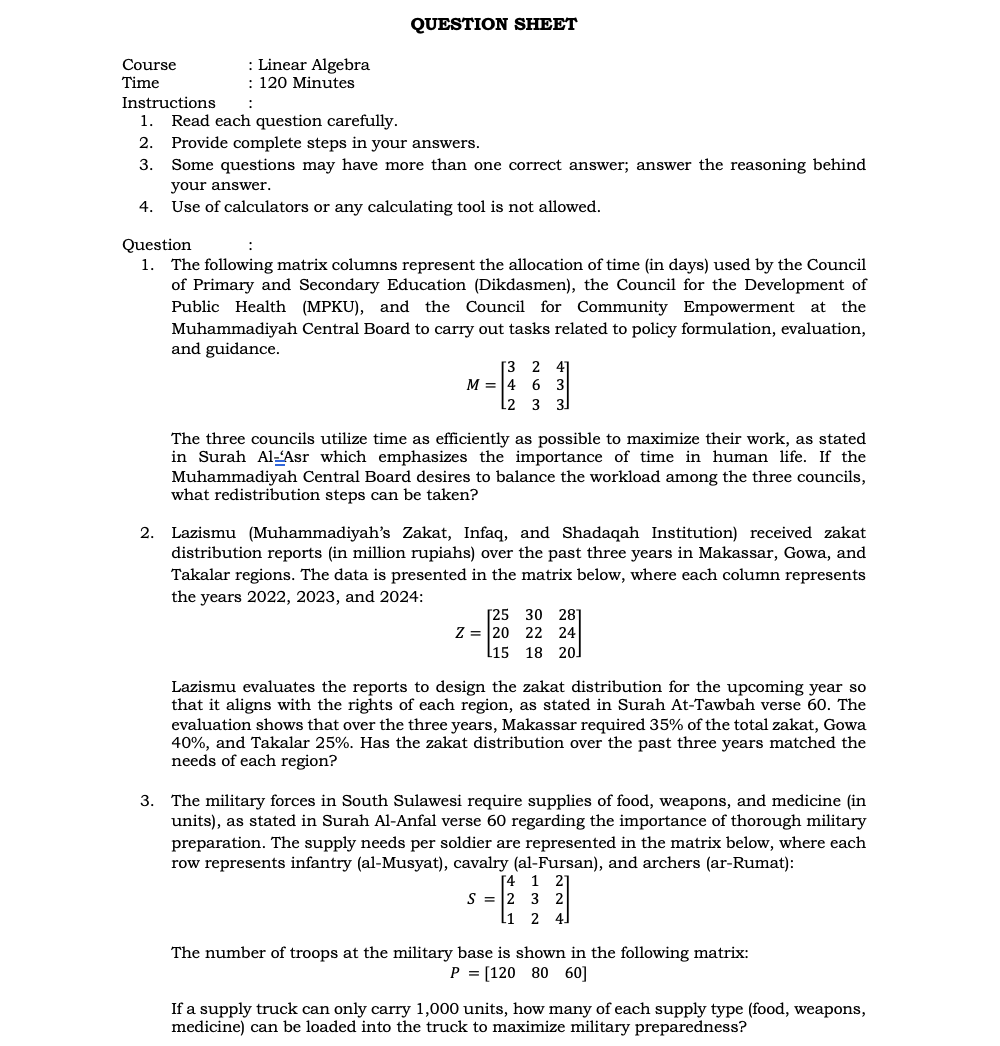
This study aims to develop higher order thinking skills (HOTS) problem on linear algebra with an Islamic context. This study was conducted because undergraduate students are unable to solve HOTS questions, so they need practice and questions for training. The question development process uses the Tessmer development model, which consists of preliminary, self-evaluation, prototyping (expert review, one-to-one, and small group), and field test stages. However, the field test stage was not implemented due to time constraints that prevented the researcher from conducting a comprehensive field test. The research subjects were undergraduate mathematics education students divided into three groups based on high, medium, and low ability levels. The validity of the questions was measured using CVR and CVI. The analysis results showed that the 12 developed questions had a CVI score of 1.00, categorized as highly valid. These questions not only measure undergraduate students' higher-order thinking skills but also provide stimulation in the form of Islamic values. Further research is expected to proceed to the field test stage.
References
Acesta, A. (2020). Analisis kemampuan higher order thingking skills (HOTS) siswa materi IPA di sekolah dasar. Quangga: Jurnal Pendidikan Dan Biologi, 12(2), 170–175. https://doi.org/10.25134/quagga.v12i2.2831.
Anderson, L. W., & Krathwohl, D. R. (2001). A Taxonomy for Learning, Teaching, and Assesing: A Revision of Bloom’s Taxonomy of Educational Objectives. Longman.
Arigawati, N. H., & Kusnandi. (2023). Berpikir kritis siswa ditinjau dari gender dan gaya kognitif field dependent dan field independent. JIIP - Jurnal Ilmiah Ilmu Pendidikan, 6(8), 6125–6133. https://doi.org/10.54371/jiip.v6i8.2408
Astuti, Y. D., & Sabon, Z. A. K. W. (2020). Analisis kemampuan literasi matematika mahasiswa dalam penyelesaian soal higher order thinking skills (HOTS) ditinjau pada level 5 PISA. Asimtot: Jurnal Kependidikan Matematika, 2(2).
Aviola, N., Hayati, S., Pebria, W., Annisa, & Imamuddin, M. (2023). Pengaruh pembelajaran matematika terintegrasi islam terhadap pembentukan karakter siswa. KOLONI: Jurnal Multidisiplin Ilmu, 2(2), 195–204.
Bashooir, K., & Supahar. (2018). Validitas dan reliabilitas instrumen asesmen kinerja literasi sains pelajaran fisika berbasis STEM. Jurnal Penelitian dan Evaluasi Pendidikan, 22(2), 168–181. https://doi.org/10.21831/pep.v22i2.20270
Fahrurrozi, M. (2021). Urgensi Penguatan keterampilan berfikir kritis pada mata pelajaran qur’an hadist. Jurnal Penelitian Keislaman, 17(1), 39–40.
Faizah, N., Febriani, P. I., Saputri, N. E., & Imamuddin, M. (2023). Implementasi pendidikan karakter dalam pembelajaran matematika yang berorientasi pada nilai-nilai moral. KOLONI, 2(2), 234-241.
Hadi, A., & Ramadhana, R. (2022). Efektivitas model pembelajaran berbasis proyek (Project Based Learning) terhadap kemampuan berpikir tingkat tinggi kelas VIII-A MTs Negeri 2 Makassar. EQUALS: Jurnal Ilmiah Pendidikan Matematika, 5(1), 46–54. https://doi.org/10.46918/equals.v5i1.1228
Hendryadi, H. (2017). Validitas Isi: Tahap awal pengembangan kuesioner. Jurnal Riset Manajemen dan Bisnis (JRMB) Fakultas Ekonomi UNIAT, 2(2), 169–178. https://doi.org/10.36226/jrmb.v2i2.47
Idris, M. (2022). Pendidikan Islam dan era Society 5.0: Peluang dan tantangan bagi mahasiswa PAI menjadi guru berkarakter. Belajea: Jurnal Pendidikan Islam, 7(1), 61–86. https://doi.org/10.29240/belajea.v7i1.4159
Imamuddin, M., & Isnaniah. (2023). Peranan integrasi nilai-nilai Islam dalam pembelajaran matematika. Kaunia : Integration and Interconnection of Islam and Science Journal, 19(1), 15–21.
Kristiani, K. D., Mayasari, T., & Kurniadi, E. (2017). Pengaruh pembelajaran STEM-PjBL terhadap keterampilan berpikir kreatif. Prosiding SNPF (Seminar Nasional Pendidikan Fisika), 21, 266–274. http://e-journal.unipma.ac.id/index.php/snpf/article/view/1719
Musyafak, & Subhi, M. R. (2023). Strategi pembelajaran pendidikan agama Islam dalam menghadapi tantangan di era Revolusi Industri 5.0. Asian Journal of Islamic Studies and Da’wah, 1(2), 373–398.
Mutalib, K. A., Yahaya, A. S., Kamaluddin, R. A., Dawi, A. H. M., & Harun, S. (2023). Penguasaan kompetensi global 6C guru-guru pelatih dalam pelaksanaan kapasiti pedagogi pembelajaran bermakna. International Journal of Education: Islamic Studies and Social Sciences Research, 8(1), 1–7. https://myjms.mohe.gov.my/index.php/IJEISR
OECD. (2023a). PISA 2022 Results (Volume I): The State of Learning and Equity in Education (Vol. I). OECD Publishing. https://doi.org/10.31244/9783830998488
OECD. (2023b). Program for International Student Assessment (PISA) 2022 Analytical Framework. Organisation for Economic Co-operation and Development Publishing. https://www.oecd-ilibrary.org/education/pisa-2022-assessment-and-analytical-framework_dfe0bf9c-en
Polya, G. (1973). How to Solve it (2nd ed.). Princeton Unversity Press.
Putri, J., & Ferianto. (2023). Kemajuan peradaban Islam di era Society 5.0. Jurnal Wahana Karya Ilmiah Pendidikan, 7(1). https://doi.org/10.35706/wkip.v7i01.9241
Rahayuningsih, S., & Jayani, R. (2019). High order thinking skills (HOTS) mahasiswa program studi pendidikan matematika dalam menyelesaikan masalah grup. Majamath, 2(2), 87–93.
Tessmer, M. (1993). Planning and Conducting Formative Evaluations. Konan Page Limited. http://books.google.com/books?id=aroefdSRc8AC&pgis=1
Yuliany, N., Halimah, A., Manzila, F., & Ichiana, N. N. (2021). Analisis kemampuan penalaran matematis pada mata kuliah aljabar linear elementer mahasiswa Pendidikan Matematika Fakultas Tarbiyah dan Keguruan UIN Alauddin Makassar. Al Asma: Journal of Islamic Education, 3(2), 275–286.
Yusup, R. M. (2022). Implementasi Penggunaan Aljabar Linear dalam Bidang Genetika Pada Tanaman. Universitas Nusa Putra.
Zamsir, Kodirun, Busnawir, Bey, A., & Arapu, L. (2020). Kompetensi guru matematika smp dalam membuat soal higher order thinking skills. Jurnal Pendidikan Matematika, 13(2), 147–155. https://doi.org/10.36709/jpm.v13i2.10
Downloads
Published
How to Cite
Issue
Section
License
Copyright (c) 2024 Nurfidhea Dwidelia, Sukmawati Sukmawati, Sitti Fithriani Saleh

This work is licensed under a Creative Commons Attribution-ShareAlike 4.0 International License.
Authors who publish with this journal agree to the following terms:
- Authors retain copyright with the work simultaneously licensed under a Creative Commons Attribution License that allows others to share the work with an acknowledgement of the work's authorship and initial publication in this journal.
- Authors are able to enter into separate, additional contractual arrangements for the non-exclusive distribution of the journal's published version of the work (e.g., post it to an institutional repository or publish it in a book), with an acknowledgement of its initial publication in this journal.
- Authors are permitted and encouraged to post their work online (e.g., in institutional repositories or on their website) prior to and during the submission process, as it can lead to productive exchanges, as well as earlier and greater citation of published work (See The Effect of Open Access).