Creative teacher’s products: Identifying innovation in physical education learning
DOI:
https://doi.org/10.12928/ijei.v6i2.13568Keywords:
innovation product, physical education, teachers’ creativityAbstract
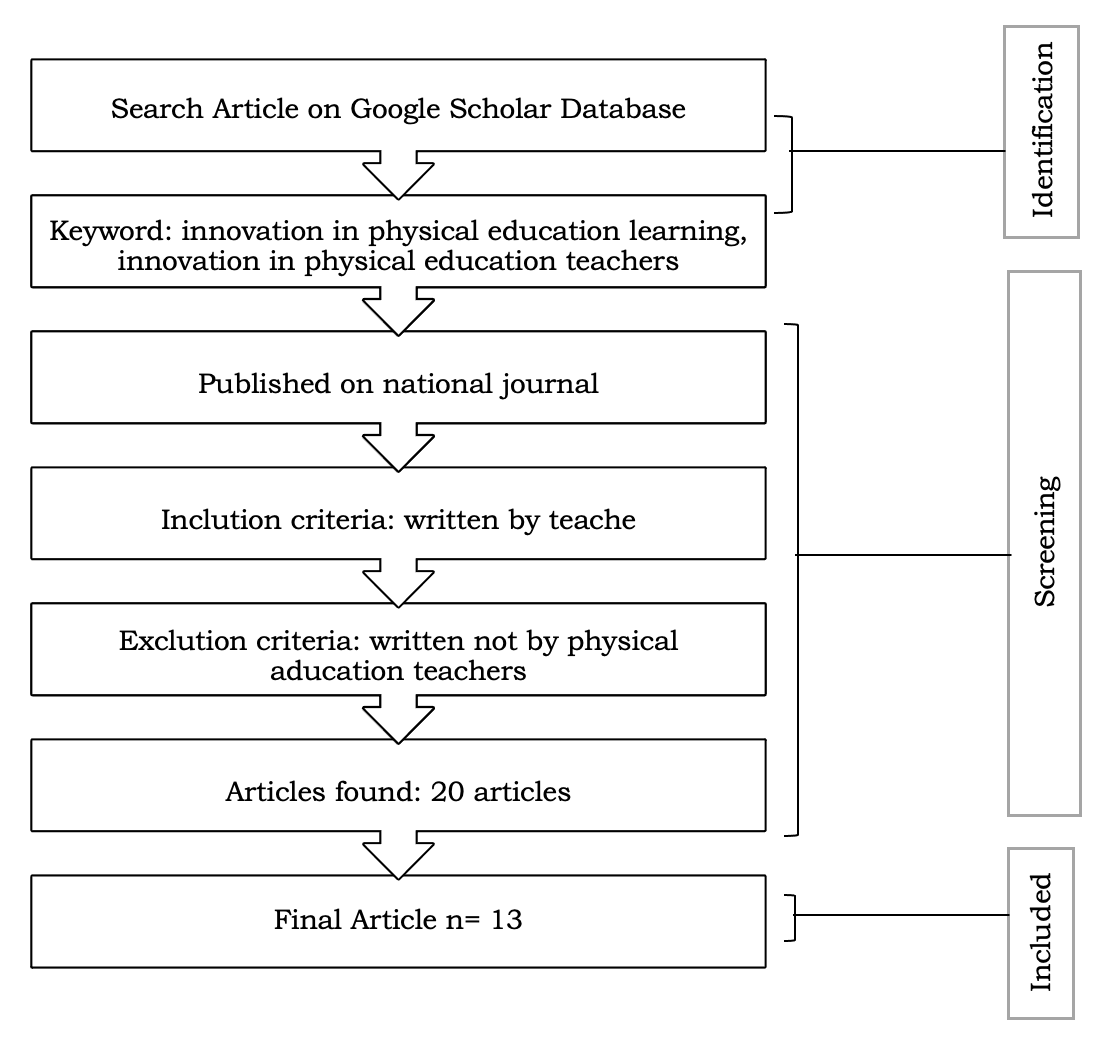
This study aims to identify innovations in physical education (PE) learning carried out by teachers. This study is a systematic review on the Google Scholar database. We set inclusion criteria, namely articles published in the last 5 years, the author is a teacher, and the searching keyword for the article is ‘innovation in physical education learning’. Therefore, any article wriiten by non-PE teachers was excluded, as it can be seen from the authors’ affiliation. The results of the study refer to the analysis of 13 articles that match the criteria, indicating that teachers have made innovations in physical education learning. The innovations include learning media, models, and methods. The Innovations were carried out to improve students’ learning outcomes in the cognitive, affective, and psychomotor domains, as well as to increase the students’ learning motivation. The learning environment designed by the teacher will affect the learning process and student learning outcomes. Finally, we suggest PE teachers to continuously make innovations, not only to improve learning outcomes, but also to provide memorable learning experiences at every meeting.
References
Al-fathi, Z. S., Maksum, A., Christina, S., Hartati, Y., Kristiyandaru, A., & Sumarsono, A. (2024). Peningkatan gerak dasar melalui permainan kasti pendahuluan. Jurnal Porkes, 7(2), 943–954. https://doi.org/10.29408/porkes.v7i2.26292
Almusawi, H. A., & Durugbo, C. M. (2024). Linking task-technology fit, innovativeness, and teacher readiness using structural equation modelling. Education and Information Technologies, 29(12), 14899–14928. https://doi.org/10.1007/s10639-023-12440-x
Ardinnata, M. Y., & Mashud, M. (2023). Integrasi model pembelajaran project-based learning dengan gaya mengajar inklusi dalam pembelajaran keterampilan bola voli. Multilateral : Jurnal Pendidikan Jasmani Dan Olahraga, 22(4), 128. https://doi.org/10.20527/multilateral.v22i4.16399
Da’i, M., & Apriyanto, R. (2025). Integrating digital comics into physical education: a new model for enhancing elementary athletic learning. Edu Sportivo, 6(1), 77–92.
Dupri, Suherman, A., Budiana, D., & Juliantine, T. (2024). The influence of thinking styles and gender on students’ creative thinking abilities in physical education. Edu Sportivo: Indonesian Journal of Physical Education, 5(2), 198–206.
Eswara, N. K. (2023). Role of new technologies innovation on sports achievement. International Journal of Physiology, Exercise and Physical Education, 5(1), 14–16. https://doi.org/10.33545/26647249.2023.v5.i1a.57
Fan, D. (2022). Research on the concept and practice of poverty reduction in China. Research on the Concept and Practice of Poverty Reduction in China, Icssem, 1–178. https://doi.org/10.1007/9789811695193
Fjortoft, N., Gettig, J., & Verdone, M. (2018). Teaching Innovation and Creativity, or Teaching to the Test? American Journal of Pharmaceutical Education, 82(10). https://doi.org/10.5688/ajpe7423
Hakim, R., & Basuki, S. (2023). Pemanfaatan audio visual dalam pembelajaran ketrampilan bola basket. Multilateral : Jurnal Pendidikan Jasmani Dan Olahraga, 22(4), 107. https://doi.org/10.20527/multilateral.v22i4.16454
Khastini, R. O., Rohmah, W. S., & Putriana, T. (2022). Development of Monopoly Digestive Media Based on Educational Games as Student Learning Resources on Food Digestive System Concept. International Journal of Biology Education Towards Sustainable Development, 2(2), 53–62. https://doi.org/10.53889/ijbetsd.v2i2.150
Kurniawan, M. F., Ihsan, N., Irawan, R., & Putra, A. N. (2023). Development of android-based self-assessment applications basic pencak silat techniques SMAN 1 Bengkalis. Jorpres, 19(2), 165–177.
Lusiantri, L., & Mashud, M. (2023). Integrasi model pembelajaran PjBL dengan inklusi dalam pembelajaran lompat jauh. Multilateral : Jurnal Pendidikan Jasmani dan Olahraga, 22(4), 45. https://doi.org/10.20527/multilateral.v22i4.16318
Mahardika, I. M. S. (2018). Perencanaan dan Inovasi pembelajaran pendidikan jasmani olahraga dan kesehatan (PJOK). Prosiding Seminar Nasional IPTEK Olahraga (SENALOG), 1(1), 1–9.
Margiyani, M. (2021). Pemanfaatan blended learning untuk meningkatkan kemampuan gerak dasar bermain bola basket pada masa pandemi Covid-19. Ideguru: Jurnal Karya Ilmiah Guru, 6(2), 153–160. https://doi.org/10.51169/ideguru.v6i2.250
Novita, E. (2022). Praktik pembelajaran inovatif guru penggerak di SDN Inpres Tenga. Jurnal Pendidikan dan Pembelajaran Indonesia (JPPI), 2(2), 110–121. https://doi.org/10.53299/jppi.v2i2.225
Pahlawani, K. A., & Nining, N. (2023). teacher creativity and innovation influence the quality of learning, which impacts learning achievement in physical education. Sustainability (Switzerland), 11(4), 330–338.
Pakpahan, B. A. ., Ariawan, S., Naibaho, D., Napitupulu, T. M., Simanjuntak, H., & Manalu, P. J. . (2021). Improving Teacher Creativity and Innovation Through The Supervision of The Principal. International Research Journal on Advanced Science Hub, 3(9), 202–209. https://doi.org/10.47392/irjash.2021.238
Pangestu, U., & Karwan, D. H. (2021). The role of the principal to increase teacher innovation and creativity during the pandemic. Nidhomul Haq: Jurnal Manajemen Pendidikan Islam, 6(2), 251–266. https://doi.org/10.31538/ndh.v6i2.1432
Polevoy, G., Ouergui, I., Padulo, J., & Ardigò, L. P. (2024). The outdoor game “catch-up” is a tool to support the development of coordination abilities in children. Annals of Applied Sport Science, 12(2). https://doi.org/10.61186/aassjournal.1264
Raaiyatini, M. A., & Arifin, S. (2023). Penerapan model PjBL dalam pembelajaran pasing bawah bola voli. Multilateral : Jurnal Pendidikan Jasmani dan Olahraga, 22(4), 62–68.
Saputra, S. Y., Kobandaha, F., Annas, A. N., & Fantiro, F. A. (2024). Inovasi dalam pembelajaran pendidikan jasmani di sekolah dasar : tinjauan terhadap literatur. INNOVATIVE: Journal of Social Science Research, 4(5), 8487–8497.
Silviyani, S. D., Sonjaya, A. R., Permadi, A. A., & Hidayat, H. (2023). Efektivitas penerapan model pembelajaran peer teaching terhadap proses pembelajaran PJOK. Jurnal Porkes, 6(1), 152–176. https://doi.org/10.29408/porkes.v6i1.17480
Soemaryoto, S. (2022). Peningkatan motivasi belajar kebugaran jasmani melalui model circuit training berbantuan video pembelajaran. Ideguru: Jurnal Karya Ilmiah Guru, 8(1), 112–119. https://doi.org/10.51169/ideguru.v8i1.389
Sungkari, F. M., Santi, E. V., & Fauziah, M. (2024). Permainan tradisional egrang pada pembelajaran PJOK SD Kelas 1. JLEB: Journal of Law, Education and Business, 2(1), 591–599. https://doi.org/10.57235/jleb.v2i1.1942
Susanto, R., Fafa, M. N., Afandi, A., Indah, L., & Wahyuni, N. (2024). Development of a beginner level flexibility training model in learning archery. Jurnal Porkes, 7(2), 992–1001. https://doi.org/10.29408/porkes.v7i2.26485
Susila, I. G. (2022). Penerapan model pembelajaran kooperatif tipe think-pair-share untuk meningkatkan prestasi belajar PJOK. Indonesian Journal of Educational Development, 3(1), 104–112. https://doi.org/10.5281/zenodo.6570031
Victoria, A., Mustafa, P. S., & Ardiyanto, D. (2021). Pembelajaran pendidikan jasmani dan olahraga berbasis blended learning di sekolah menengah pertama. Jurnal Ilmiah Wahana Pendidikan, 7(2), 170–183. https://doi.org/10.5281/zenodo.4659619
Wei, W. (2019). Research on the cultivation of students’ enthusiasm in physical education teaching. Agro Food Industry Hi-Tech, 369, 693–695.
Xing, Z., & Qi, Y. (2023). Development of creativity in physical education teachers using interactive technologies: involvement and collaboration. Education and Information Technologies, 28(5), 5763–5777. https://doi.org/10.1007/s10639-022-11422-9
Downloads
Published
How to Cite
Issue
Section
License
Copyright (c) 2025 Sri Wicahyani, Suroto Suroto, Vega Candra Dinata, Gema Fitriady, Febri Wasono Aji, Sigit Ansori, Ghulam Zaky Ismail, Bobby Ade Setiawan, Rizky Prayuda Putra

This work is licensed under a Creative Commons Attribution-ShareAlike 4.0 International License.
Authors who publish with this journal agree to the following terms:
- Authors retain copyright with the work simultaneously licensed under a Creative Commons Attribution License that allows others to share the work with an acknowledgement of the work's authorship and initial publication in this journal.
- Authors are able to enter into separate, additional contractual arrangements for the non-exclusive distribution of the journal's published version of the work (e.g., post it to an institutional repository or publish it in a book), with an acknowledgement of its initial publication in this journal.
- Authors are permitted and encouraged to post their work online (e.g., in institutional repositories or on their website) prior to and during the submission process, as it can lead to productive exchanges, as well as earlier and greater citation of published work (See The Effect of Open Access).