Developing Google Sites-assisted collaborative learning materials to learn quadratic function
DOI:
https://doi.org/10.12928/ijei.v5i2.13363Keywords:
collaborative approach, Google Sites, quadratic function, teaching materialsAbstract
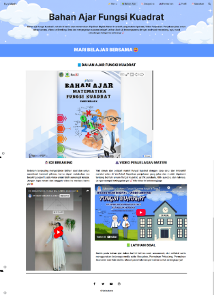
This study was motivated by the need for teaching materials obtained from the results of questionnaire analysis, namely 69 out of 70 students stated that they needed interactive and fun website-based teaching materials. Students also experience difficulties in learning mathematics with the methods applied by teachers and material that is considered difficult, namely the quadratic function with a percentage of 70%. This study aims to develop website-based interactive teaching materials with a collaborative approach assisted by Google Sites that are valid and practical. The research used the ADDIE development model (Analysis, Design, Development, Implementation, Evaluation). The research subjects were students of class X-5 and X-3 SMA Negeri 1 Kasihan, while the research object was Funmath Quadratic Function website. Data were collected through interviews, observations, material and media expert validation questionnaires, and student response questionnaires in small and large class trials. The results showed that the Funmath Quadratic Function website teaching materials developed were very valid with a percentage of 86% according to material experts and 86.5% according to media experts. In addition, this teaching material is also very practical with a score of 88.6% in the small class trial and 95.18% in the large class trial. The results showed that this teaching material is very valid and practical, so it can help the process of learning mathematics on quadratic function material that is more interactive and fun. In this study, it is recommended to add a variety of content and interactive activities for better understanding of the quadratic function. In addition, training for teachers and students needs to be provided so that the use of the website is maximized. Periodic evaluation is also important to maintain the quality and relevance of teaching materials.
References
Alfiansyah, M., Khoirunnisa, D., Nurjanah, E., & Suraya, G. (2025). Transformasi Digital: Inovasi untuk Pendidikan Berkelanjutan, 7(2), 10458-10466.
Amadi, A. S. M. (2023). Pendidikan di era global: Persiapan siswa untuk menghadapi dunia yang semakin kompetitif. Educatio, 17(2), 153–164. https://doi.org/10.29408/edc.v17i2.9439
Aulia, H., Nurhalimah, A., Mandailina, V., Mahsup, M., Syaharuddin, S., Abdillah, A., & Zaenudin, Z. (2023). Efektifitas Metode Pembelajaran Kolaboratif dalam Meningkatkan Kemampuan Berpikir Kritis Siswa. In Seminar Nasional Paedagoria (Vol. 3, pp. 314-320).
Handayani, R., & Sulistiawati, E. W. (2019). Penerapan pembelajaran kolaboratif pada mata pelajaran matematika di SMK N 1 Kotabumi. Eksponen, 9(1), 35–41. https://doi.org/10.47637/eksponen.v9i1.131
Hapsari, I. I., & Fatimah, M. (2021). Inovasi pembelajaran sebagai strategi peningkatan kualitas guru di SD N 2 Setu Kulon. Standarisasi Pendidikan Sekolah Dasar Menuju Era Human Society 5.0, 187–194.
Harefa, E. P., Waruwu, D. P., Hulu, A. H., & Bawamenewi, A. (2023). Pengembangan media pembelajaran bahasa indonesia berbasis website dengan menggunakan model ADDIE. Journal on Education, 6(1), 4405–4410.
Hidayat, F., & Nizar, M. (2021). Model ADDIE (Analysis, Design, Development, Implementation and Evaluation) dalam pembelajaran Pendidikan Agama Islam. Jurnal UIN, 1(1), 28–37.
Hodiyanto, H., Darma, Y., & Putra, S. R. S. (2020). Pengembangan media pembelajaran berbasis macromedia flash bermuatan problem posing terhadap kemampuan pemecahan masalah matematis. Mosharafa: Jurnal Pendidikan Matematika, 9(2), 323–334. https://doi.org/10.31980/mosharafa.v9i2.652
Islam, M. S., & Fahmi, S. (2019). Pengembangan media pembelajaran interaktif matematika dengan menggunakan macromedia flash 8 pada materi aritmatika sosial untuk siswa SMP kelas VII semester genap. In Seminar Nasional Pendidikan Matematika Ahmad Dahlan (Vol. 6, pp. 626-627).
Salsabila, S., Anriani, N., & Santosa, C. A. H. F. (2023). Pengembangan E-modul pada android menggunakan kodular untuk meningkatkan kemampuan representasi matematis siswa. Teorema: Teori dan Riset Matematika, 8(1), 1. https://doi.org/10.25157/teorema.v8i1.8704
Susanto, D., Kurniawan, T., Sihombing, S. K., Salim, E., Radjawane, M. M., Salmah, U., & Wardani, A. K. (2021). Buku Siswa Matematika SMA/SMK Kelas X. Kementerian Pendidikan dan Kebudayaan.
Sutisna, E. (2020). Modul matematika umum Kelas X. In Paper Knowledge . Toward a Media History of Documents (Vol. 3, April, pp. 49–58).
Yuzar. (2022). Fungsi Kuadrat. In Studio Belajar (hal. 1–7). https://www.studiobelajar.com/fungsi-kuadrat/
Downloads
Published
How to Cite
Issue
Section
License
Copyright (c) 2024 Fatimah Nur Muhlishoh, Syariful Fahmi

This work is licensed under a Creative Commons Attribution-ShareAlike 4.0 International License.
Authors who publish with this journal agree to the following terms:
- Authors retain copyright with the work simultaneously licensed under a Creative Commons Attribution License that allows others to share the work with an acknowledgement of the work's authorship and initial publication in this journal.
- Authors are able to enter into separate, additional contractual arrangements for the non-exclusive distribution of the journal's published version of the work (e.g., post it to an institutional repository or publish it in a book), with an acknowledgement of its initial publication in this journal.
- Authors are permitted and encouraged to post their work online (e.g., in institutional repositories or on their website) prior to and during the submission process, as it can lead to productive exchanges, as well as earlier and greater citation of published work (See The Effect of Open Access).