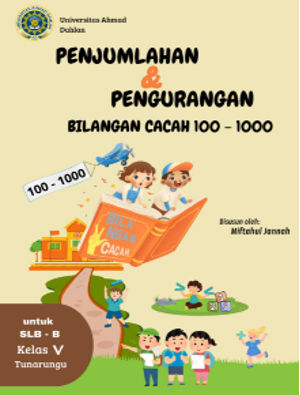
Developing an e-module to learn addition and substraction using Genially for students with special needs
DOI:
https://doi.org/10.12928/ijei.v5i2.13235Keywords:
deaf children, e-module, Genially platform, students with special needsAbstract
Deaf children have auditory limitations and therefore rely more heavily on visual cues in their daily lives. For this reason, there is a need for media that can visualize mathematical concepts or materials. The aim of this study is to develop a learning modul for addition and subtraction topics and to assess the validity and practicality of the developed electronic module. We used the ADDIE R&D model which consists of five stages—analysis, design, development, implementation, and evaluation. We developed the e-module using Genially platform. The validity of the module was assessed by experts in mathematics education and inclusive education. Then, we tried out the module to seven fifth-grade deaf students at SLB Negeri 2 Bantul—a public school for students with special needs. The result of the validation by content experts got an average score of 4.2 (good), the validation by media expert got an average score of 4.16 (good), and the validation by teacher got an average score of 4.38 (very good). Moreover, the practicality testing got the average score of the students’ response at 4.2 (small group) and 4.33 (field testing), which means the module is practical.
References
Ambarsari, M. A. (2022). Mengenal ABK (Anak Berkebutuhan Khusus). Human Persona Indonesia.
Dalimunthe, M. A. (2024). Faktor-faktor Yang Mempengaruhi Status Gizi pada Anak Berkebutuhan Khusus di SLB Kecamatan Medan Johor. Doctoral Dissertation. UIN Sumatera Utara.
Juliyanti, A., & Pujiastuti, H. (2020). Pengaruh kecemasan matematis dan konsep diri terhadap hasil belajar matematika siswa. Prima: Jurnal Pendidikan Matematika, 4(2), 75-83.
Leton, S. I. (2018). Kemampuan koneksi dan pemecahan masalah matematis serta kegemaran belajar matematika siswa tunarungu Kelas VIII. Doctoral Dissertation. Universitas Pendidikan Indonesia.
Leton, I., Lakapu, M., Djong, K. D., Jagom, Y. O., Uskono, I. V., & Dosinaeng, W. B. N. (2021). Pengembangan Bahan Ajar Berbasis Visual dan Realistik bagi Siswa Tunarungu. JNPM (Jurnal Nasional Pendidikan Matematika), 5(1), 23-36. https://doi.org/10.33603/jnpm.v5i1.4614
Maftuhin, A. (2016). Mengikat makna diskriminasi: Penyandang cacat, difabel, dan Penyandang disabilitas. INKLUSI Journal of Disability Studies, 3(2), 139-162.
Muslimah, A. (2024). Peningkatan kemampuan menulis kalimat sederhana dengan metode concept sentence berbantuan media permainan tradisional ulgara saka rangka (Ular Tangga Aksara Sambung Kata Rangkai Kalimat) pada siswa kelas II SDIT Harapan Ummat Kabupaten Ngawi tahun pelajaran 2023/2024. Doctoral Dissertation. Universitas PGRI Madiun.
Mursalat, M., Siregar, E., & Tarjiah, I. (2023). Pengembangan video pembelajaran desain grafis untuk buku digital interaktif bagi siswa Tunarungu. Jurnal Paedagogy, 10(2), 589-597.
Mustofa, A. F. (2021). Pengembangan media pembelajaran matematika pada materi bilangan untuk meningkatkan pemahaman siswa di SMP Negeri 2 Andong. Doctoral Dissertation. Universitas Muhammadiyah Surakarta.
Nurhanifah, R. L., & Utami, W. B. (2021). Analisis kesulitan belajar matematika pada anak tunarungu. Jurnal Inovasi Pendidikan Matematika (JIPM), 3(1), 9-19.
Pangestuti, A. (2023). Pengembangan e-book kalor dan perpindahan berbasis multirepresentasi dinamis untuk meningkatkan keterampilan berpikir kritis siswa SMP Kelas VII.
Putra, I. K. A. A. J., Suarsana, I. M., & Suharta, I. G. P. (2020). Pengembangan bahan ajar interaktif materi pecahan untuk siswa SMPLB Tunarungu dengan pendekatan multi representasi. Jurnal Nasional Pendidikan Teknik Informatika: JANAPATI, 9(2), 158-170.
Rahmawati, F. (2024). Alat peraga matematika manipulatif geometri siswa tunarungu. Teorema: Teori dan Riset Matematika, 9(1), 133-142.
Rezieka, D. G., Putro, K. Z., & Fitri, M. (2021). Faktor penyebab anak berkebutuhan khusus dan klasifikasi ABK. Bunayya: Jurnal Pendidikan Anak, 7(2), 40-53.
Safira, N. A. (2018). Pengembangan bahan ajar berbantuan augmented reality software dan smartphone untuk pencapaian kompetensi dasar matematis tunarungu. Doctoral Dissertation. Universitas Pendidikan Indonesia.
Saputro, H. B., & Febriani, O. R. (2023). Pengaruh penggunaan modul digital interaktif terhadap minat dan hasil belajar materi pecahan Kelas IV SDN 2 Klesem. Jurnal Lebesgue: Jurnal Ilmiah Pendidikan Matematika, Matematika dan Statistika, 4(1), 130-139.
Siregar, N. R. (2017). Persepsi siswa pada pelajaran matematika: studi pendahuluan pada siswa yang menyenangi game. Prosiding Temu Ilmiah Nasional X Ikatan Psikologi Perkembangan Indonesia, 1.
Syafarina, S., Supriadi, U., & Fakhruddin, A. (2024). Penggunaan multimedia dalam pembelajaran Pendidikan Agama Islam bagi anak tunarungu di Sekolah Luar Biasa. Murhum: Jurnal Pendidikan Anak Usia Dini, 5(1), 521-535.
Syafrudin, T., & Sujarwo, S. (2019). Pengembangan bahan ajar untuk pembelajaran matematika bagi siswa tunarungu. Suska Journal of Mathematics Education, 5(2), 87-94.
Widinarsih, D. (2019). Penyandang disabilitas di Indonesia: Perkembangan istilah dan definisi. Jurnal Ilmu Kesejahteraan Sosial, 20(2), 127-142.
Yuniarsih, I. (2022) Pengembangan multimedia interaktif berbasis android untuk meningkatkan penguasaan kosakata siswa tunarungu di SLB BC Dharma Wanita 03 Malang. Thesis. Universitas Negeri Malang.
Downloads
Published
How to Cite
Issue
Section
License
Copyright (c) 2024 Miftahul Jannah, Afit Istiandaru

This work is licensed under a Creative Commons Attribution-ShareAlike 4.0 International License.
Authors who publish with this journal agree to the following terms:
- Authors retain copyright with the work simultaneously licensed under a Creative Commons Attribution License that allows others to share the work with an acknowledgement of the work's authorship and initial publication in this journal.
- Authors are able to enter into separate, additional contractual arrangements for the non-exclusive distribution of the journal's published version of the work (e.g., post it to an institutional repository or publish it in a book), with an acknowledgement of its initial publication in this journal.
- Authors are permitted and encouraged to post their work online (e.g., in institutional repositories or on their website) prior to and during the submission process, as it can lead to productive exchanges, as well as earlier and greater citation of published work (See The Effect of Open Access).