About the Journal


Journal title COMMICAST
Initials Commicast
Abbreviation J. Commun.
Frequency 3 Issues per year
DOI Prefix 10.12928
ISSN 2723-7672 (online)  
Editor-in-chief Professor Zhou Huiquan | SCOPUS ID: 55551412900
Managing Editor Dani Fadillah, Ph.D. | SCOPUS ID: 85079170928
Publisher Prodi Ilmu Komunikasi Universitas Ahmad Dahlan
Citation Analysis Google Scholar |Dimensions | Portal Garuda | SINTA 3 | Scopus (Secondary Document)

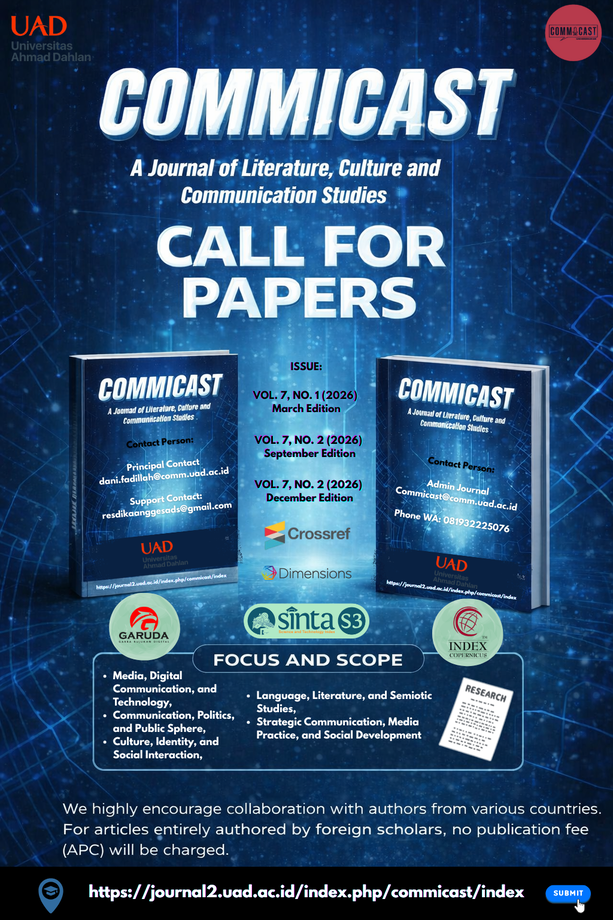
Commicast is a multimedia online academic journal that adheres to the highest standards of peer review and engages with established and emerging scholars from around the world. It is published three times a year: March, September, and December. Commicast aims to serve as a platform for publishing reviews, original articles, research findings, and case studies. This interdisciplinary journal focuses on communication, literature, and culture. It welcomes contributions from a wide range of disciplines and approaches that intersect at the intersection of the social sciences. Commicast’s topics include: Media, Digital Communication, and Technology, Communication, Politics, and Public Sphere, Culture, Identity, and Social Interaction, Language, Literature, and Semiotic Studies, Strategic Communication, Media Practice, and Social Development.
 
These topics are addressed in full-length academic articles, critical statements on current issues, development practices, and literary and cultural-based book reviews. The journal provides an innovative platform for researchers, students, practitioners, and educators to learn and contribute to the field. All articles undergo initial screening by the Editor and then a rigorous double-masked peer-review process before publication.
 
Submitted manuscripts will be evaluated through an Initial Review by the Editor-in-Chief/Managing Editor. If the article meets the journal’s requirements for scope, originality, novelty, adequacy of experimental data, and format, at least two (2) peer reviewers will be assigned to review the manuscript using a Double-Blind Peer Review Process. After the review process is complete, the assigned Editor will decide on the article. If the article requires revision, the manuscript will be returned to the author for revision. The Editor-in-Chief will then make the final decision (acceptance or rejection). Each manuscript submitted for peer review will be assessed based on both substantive and technical aspects.
 
Before submission,
You must ensure that your manuscript is prepared using the COMMICAST Journal Template and carefully read the Author Guidelines. Starting in 2022, submit your manuscript in English ONLY. If you encounter any issues with this journal, please get in touch with us at: commicast@comm.uad.ac.id (Journal Admin) or resdikaanggesads@gmail.com (Managing Technical Editor).

Announcements

Current Issue

Vol. 7 No. 1 (2026): March
					View Vol. 7 No. 1 (2026): March

Country of Authors : INDONESIA

COMMICAST is an interdisciplinary journal, although centered on Literature, Culture, and Communication, it is open and welcomes contributions from a wide range of disciplines and approaches that meet at the intersection of Literature, Culture, and Communication Sciences.

The editorial board is pleased to present Volume 7, Issue 1 (March 2026), which brings together a collection of scholarly articles focusing on contemporary issues in media, communication, and cultural studies. This edition highlights the dynamic interplay between digital media, consumer behavior, and socio-cultural representations within the Indonesian context.

All contributions in this issue are authored by researchers from Indonesia, offering a rich and contextualized understanding of local phenomena while engaging with broader theoretical and global discussions. The articles collectively reflect the evolving landscape of communication practices in the digital era, particularly in relation to social media platforms, digital marketing, and audience engagement.

Several studies in this issue examine audience perceptions and experiences, including paid news subscriptions, social commerce environments, and consumer responses to brand campaigns such as eco-friendly marketing initiatives. These works provide valuable insights into how trust, perceived quality, and digital interaction shape consumer decision-making processes.

In addition, this issue explores the representation of identity and cultural norms in various media forms. From literary analysis of family norms in contemporary short stories to examinations of masculinity in Gen Z TikTok content and lifestyle representation in cosmetic advertising, the articles offer critical perspectives on how media constructs and reflects societal values.

The prominence of platforms such as Instagram and TikTok within these studies further underscores the significance of social media as a central space for communication, identity formation, and commercial activity in today’s digital society.

The editorial board extends its sincere appreciation to all authors and reviewers for their valuable contributions. It is hoped that this issue will enrich academic discourse, provide meaningful insights for researchers and practitioners, and encourage further exploration in the fields of media and communication studies.

Published: 2026-03-30
View All Issues