Advances in Brain-Computer Interfaces for Taste Perception: Current Insights and Future Directions
DOI:
https://doi.org/10.12928/biste.v8i1.14718Keywords:
Brain-Computer Interface (BCI), Taste Perception, Electroencephalography (EEG), Sensory Neuroscience, Neuroengineering ApplicationsAbstract
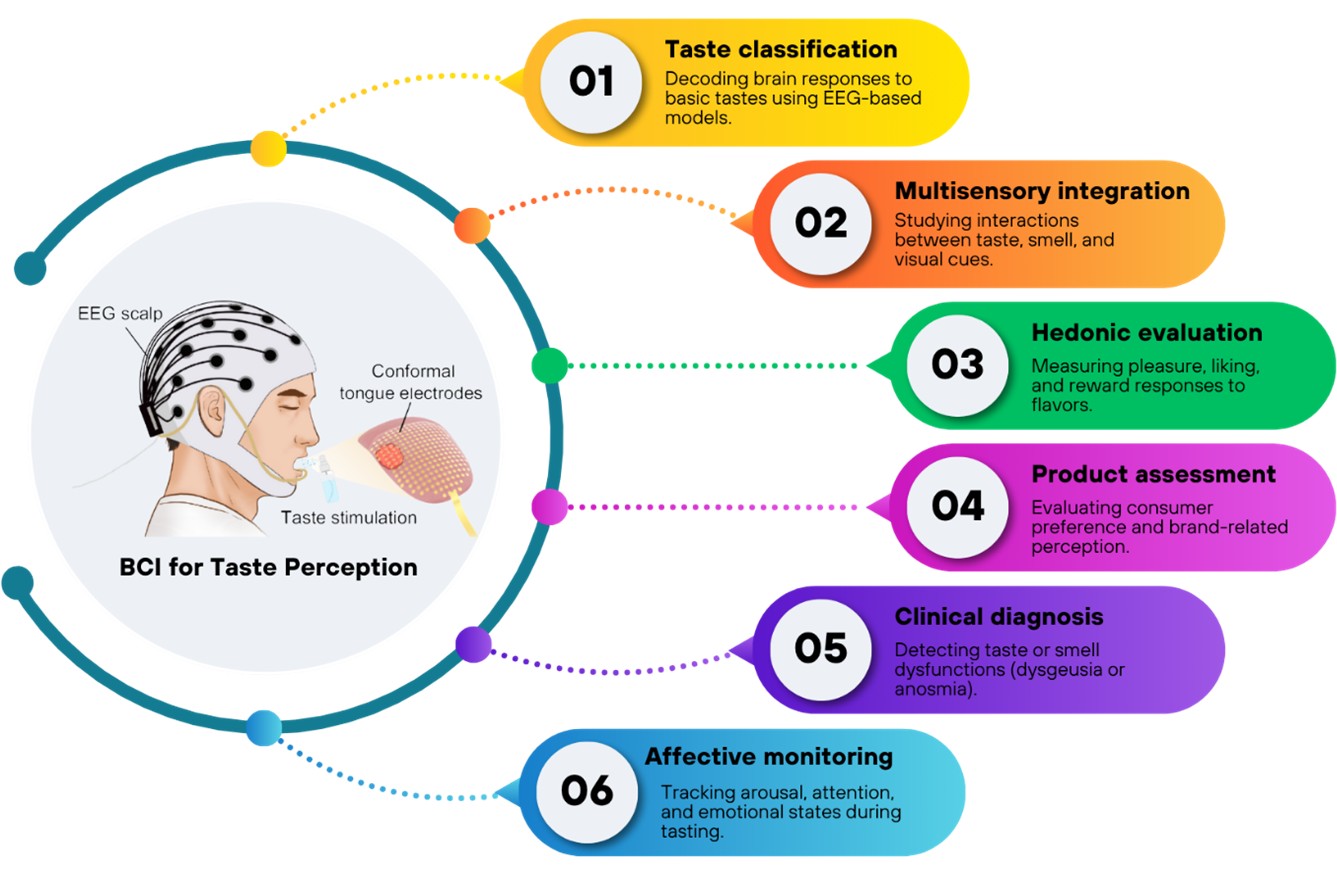
Human taste perception is a complex multisensory process that integrates chemical, emotional, and cognitive responses within the brain. Traditional methods for evaluating taste rely on subjective reporting, which limits reproducibility and accuracy. Brain-Computer Interface (BCI) technology provides an objective solution by decoding neural activity associated with taste perception using non-invasive techniques such as EEG and fNIRS. The research contribution aims to deliver an extensive overview of the latest advancements in BCI-oriented taste research, emphasizing various applications, methodological frameworks, and potential future pathways that connect the domains of neuroscience and sensory technology. This review examines the use of EEG and fNIRS modalities for signal acquisition, preprocessing, feature extraction, and classification across 36 studies conducted between 2020 and 2025. These works employ both traditional algorithms and deep learning models, including SVM, CNNs, and Transformer-based frameworks, to decode neural signatures of basic tastes and multisensory interactions. Results show that BCIs have successfully identified distinct brain responses for sweet, sour, salty, bitter, and umami stimuli. They have also been applied in multisensory integration, hedonic evaluation, consumer behavior analysis, clinical diagnosis of taste disorders, and affective monitoring. However, challenges remain in signal noise, dataset standardization, and model interpretability. In conclusion, BCIs represent a promising and interdisciplinary approach for objectively studying and enhancing human taste perception through the integration of neuroscience, engineering, and artificial intelligence.
References
B. Chen, X. Lin, Z. Liang, X. Chang, Z. Wang, M. Huang, and X.-A. Zeng, “Advances in food flavor analysis and sensory evaluation techniques and applications: Traditional vs emerging,” Food Chemistry, vol. 494, p. 146235, 2025, https://doi.org/10.1016/j.foodchem.2025.146235.
J. Wang et al., “From Traditional to Intelligent, A Review of Application and Progress of Sensory Analysis in Alcoholic Beverage Industry,” Food Chemistry X, vol. 23, pp. 101542–101542, 2024, https://doi.org/10.1016/j.fochx.2024.101542.
Y. Shu, H. Gao, Y. Wang, and Y. Wei, “Food Emotional Perception and Eating Willingness Under Different Lighting Colors: A Preliminary Study Based on Consumer Facial Expression Analysis,” Foods, vol. 14, no. 19, p. 3440, 2025, https://doi.org/10.3390/foods14193440.
G. Wang, X. Wang, H. Cheng, H. Li, Z. Qin, F. Zheng, X. Ye, and B. Sun, “Application of electroencephalogram (EEG) in the study of the influence of different contents of alcohol and Baijiu on brain perception,” Food Chemistry, vol. 462, pp. 140969–140969, 2024, https://doi.org/10.1016/j.foodchem.2024.140969.
L. Pallante et al., “On the human taste perception: Molecular-level understanding empowered by computational methods,” Trends in Food Science & Technology, vol. 116, pp. 445–459, 2021, https://doi.org/10.1016/j.tifs.2021.07.013.
J. Peksa and D. Mamchur, “State-of-the-Art on Brain-Computer Interface Technology,” Sensors, vol. 23, no. 13, p. 6001, 2023, https://doi.org/10.3390/s23136001.
S. G. H. Meyerding, X. He, and A. Bauer, “Neuronal correlates of basic taste perception and hedonic evaluation using functional Near-Infrared Spectroscopy (fNIRS),” Applied Food Research, vol. 4, no. 2, p. 100477, 2024, https://doi.org/10.1016/j.afres.2024.100477.
A. Byrne, E. Bonfiglio, C. Rigby, and N. Edelstyn, “A systematic review of the prediction of consumer preference using EEG measures and machine-learning in neuromarketing research,” Brain Informatics, vol. 9, no. 1, 2022, https://doi.org/10.1186/s40708-022-00175-3.
X. Xia, Y. Yang, Y. Shi, W. Zheng, and H. Men, “Decoding human taste perception by reconstructing and mining temporal-spatial features of taste-related EEGs,” Applied Intelligence, vol. 54, no. 5, pp. 3902–3917, 2024, https://doi.org/10.1007/s10489-024-05374-5.
J. Mai, S. Li, Z. Wei, and Y. Sun, “Implicit Measurement of Sweetness Intensity and Affective Value Based on fNIRS,” Chemosensors, vol. 13, no. 2, pp. 36–36, 2025, https://doi.org/10.3390/chemosensors13020036.
H. Ahuja, S. Badhwar, H. Edgell, M. Litoiu, and L. E. Sergio, “Machine learning algorithms for detection of visuomotor neural control differences in individuals with PASC and ME,” Frontiers in Human Neuroscience, vol. 18, 2024, https://doi.org/10.3389/fnhum.2024.1359162.
Y. Gao, N. Lewis, V. D. Calhoun, and R. L. Miller, “Interpretable LSTM model reveals transiently-realized patterns of dynamic brain connectivity that predict patient deterioration or recovery from very mild cognitive impairment,” vol. 161, pp. 107005–107005, 2023, https://doi.org/10.1016/j.compbiomed.2023.107005.
A. D. Wibawa, N. Fatih, Y. Pamungkas, M. Pratiwi, P. A. Ramadhani and Suwadi, "Time and Frequency Domain Feature Selection Using Mutual Information for EEG-based Emotion Recognition," 2022 9th International Conference on Electrical Engineering, Computer Science and Informatics (EECSI), pp. 19-24, 2022, https://doi.org/10.23919/EECSI56542.2022.9946522.
H. Zhang, L. Jiao, S. Yang, H. Li, X. Jiang, J. Feng, S. Zou, Q. Xu, J. Gu, X. Wang, and B. Wei, “Brain-computer interfaces: The innovative key to unlocking neurological conditions,” International Journal of Surgery, vol. 110, no. 9, 2024, https://doi.org/10.1097/js9.0000000000002022.
X.-Y. Liu et al., “Recent applications of EEG-based brain-computer-interface in the medical field,” Military Medical Research, vol. 12, no. 1, 2025, https://doi.org/10.1186/s40779-025-00598-z.
C. Spence, “The tongue map and the spatial modulation of taste perception,” Current Research in Food Science, vol. 5, pp. 598–610, 2022, https://doi.org/10.1016/j.crfs.2022.02.004.
M. L.-Jiménez et al., “On the Cranial Nerves,” NeuroSci, vol. 5, no. 1, pp. 8–38, 2024, https://doi.org/10.3390/neurosci5010002.
V. Tereshenko et al., “Axonal mapping of the motor cranial nerves,” Frontiers in Neuroanatomy, vol. 17, Jun. 2023, https://doi.org/10.3389/fnana.2023.1198042.
M. M. Ottaviani and V. G. Macefield, “Structure and Functions of the Vagus Nerve in Mammals,” Comprehensive physiology, vol. 12, no. 4, pp. 3989–4037, 2022, https://doi.org/10.1002/j.2040-4603.2022.tb00237.x.
J. Forstenpointner, A. M. S. Maallo, I. Elman, S. Holmes, R. Freeman, R. Baron, and D. Borsook, “The solitary nucleus connectivity to key autonomic regions in humans,” European Journal of Neuroscience, vol. 56, no. 2, pp. 3938–3966, 2022, https://doi.org/10.1111/ejn.15691.
E. R. Delay and S. D. Roper, “Umami Taste Signaling from the Taste Bud to Cortex,” Food and Health, pp. 43–71, 2023, https://doi.org/10.1007/978-3-031-32692-9_3.
K. Jezierska, A. C.-Płoska, J. Zaleska, and W. Podraza, “Gustatory-Visual Interaction in Human Brain Cortex: fNIRS Study,” Brain Sciences, vol. 15, no. 1, pp. 92–92, 2025, https://doi.org/10.3390/brainsci15010092.
J. A. Avery, A. G. Liu, J. E. Ingeholm, C. D. Riddell, S. J. Gotts, and A. Martin, “Taste Quality Representation in the Human Brain,” The Journal of Neuroscience, vol. 40, no. 5, pp. 1042–1052, 2019, https://doi.org/10.1523/jneurosci.1751-19.2019.
P. Han, M. Mohebbi, H.-S. Seo, and T. Hummel, “Sensitivity to sweetness correlates to elevated reward brain responses to sweet and high-fat food odors in young healthy volunteers,” NeuroImage, vol. 208, p. 116413, 2020, https://doi.org/10.1016/j.neuroimage.2019.116413.
J. D. Boughter and M. Fletcher, “Rethinking the role of taste processing in insular cortex and forebrain circuits,” Current Opinion in Physiology, vol. 20, pp. 52–56, 2021, https://doi.org/10.1016/j.cophys.2020.12.009.
A. Rosa, F. Loy, I. Pinna, and C. Masala, “Role of Aromatic Herbs and Spices in Salty Perception of Patients with Hyposmia,” Nutrients, vol. 14, no. 23, pp. 4976–4976, 2022, https://doi.org/10.3390/nu14234976.
S. D. Roper, “Encoding Taste: From Receptors to Perception,” Handbook of experimental pharmacology, vol. 275, pp. 53–90, 2022, https://doi.org/10.1007/164_2021_559.
M. Andrade, “The senses 3: exploring the interrelated senses of smell and taste,” Nursing Times, vol. 21, 2022, https://www.nursingtimes.net/neurology/the-senses-3-exploring-the-interrelated-senses-of-smell-and-taste-21-11-2022/.
C.-L. Shen et al., “P50, N100, and P200 Auditory Sensory Gating Deficits in Schizophrenia Patients,” Frontiers in Psychiatry, vol. 11, 2020, https://doi.org/10.3389/fpsyt.2020.00868.
G. R.-Bermúdez, B. Naret, and A. R. Teixeira, “Analysis of P300 Evoked Potentials to Determine Pilot Cognitive States,” Sensors, vol. 25, no. 19, p. 6201, 2025, https://doi.org/10.3390/s25196201.
C. Guida, M. J. B. Kim, O. A. Stibolt, A. Lompado, and J. E. Hoffman, “The N400 component reflecting semantic and repetition priming of visual scenes is suppressed during the attentional blink,” Attention, perception & psychophysics, vol. 87, no. 4, pp. 1199–1218, 2025, https://doi.org/10.3758/s13414-024-02997-1.
J. Gallina, G. Marsicano, V. Romei, and C. Bertini, “Electrophysiological and Behavioral Effects of Alpha-Band Sensory Entrainment: Neural Mechanisms and Clinical Applications,” Biomedicines, vol. 11, no. 5, p. 1399, May 2023, https://doi.org/10.3390/biomedicines11051399.
J. Chmiel and A. Malinowska, “The Neural Correlates of Chewing Gum—A Neuroimaging Review of Its Effects on Brain Activity,” Brain Sciences, vol. 15, no. 6, p. 657, 2025, https://doi.org/10.3390/brainsci15060657.
M. Maram, M. A. Khalil and K. George, "Analysis of Consumer Coffee Brand Preferences Using Brain-Computer Interface and Deep Learning," 2023 IEEE 7th International Conference on Information Technology, Information Systems and Electrical Engineering (ICITISEE), pp. 227-232, 2023, https://doi.org/10.1109/ICITISEE58992.2023.10404368.
S. Y. Ki and Y. T. Jeong, “Neural circuits for taste sensation,” Molecules and Cells, vol. 47, no. 7, pp. 100078–100078, 2024, https://doi.org/10.1016/j.mocell.2024.100078.
E. T. Rolls, “Emotion, motivation, decision-making, the Orbitofrontal cortex, Anterior Cingulate cortex, and the Amygdala,” Brain Structure and Function, vol. 228, no. 5, 2023, https://doi.org/10.1007/s00429-023-02644-9.
C. A. Zimmerman et al., “A neural mechanism for learning from delayed postingestive feedback,” Nature, pp. 1–10, 2025, https://doi.org/10.1038/s41586-025-08828-z.
M. E. Doyle, H. U. Premathilake, Q. Yao, C. H. Mazucanti, and J. M. Egan, “Physiology of the tongue with emphasis on taste transduction,” Physiological Reviews, vol. 103, no. 2, pp. 1193–1246, 2023, https://doi.org/10.1152/physrev.00012.2022.
A. K.-Sterniuk, N. Browarska, A. Al-Bakri, M. Pelc, J. Zygarlicki, M. Sidikova, R. Martinek, and E. J. Gorzelanczyk, “Summary of over Fifty Years with Brain-Computer Interfaces—A Review,” Brain Sciences, vol. 11, no. 1, p. 43, 2021, https://doi.org/10.3390/brainsci11010043.
Y. Guo, X. Xia, Y. Shi, Y. Ying, and H. Men, “Olfactory EEG induced by odor: Used for food identification and pleasure analysis,” Food Chemistry, vol. 455, pp. 139816–139816, 2024, https://doi.org/10.1016/j.foodchem.2024.139816.
A. Tonin, M. Semprini, P. Kiper, and D. Mantini, “Brain-Computer Interfaces for Stroke Motor Rehabilitation,” Bioengineering, vol. 12, no. 8, pp. 820–820, 2025, https://doi.org/10.3390/bioengineering12080820.
T. Yang et al., “Exploring the neural correlates of fat taste perception and discrimination: Insights from electroencephalogram analysis,” Food Chemistry, vol. 450, p. 139353, 2024, https://doi.org/10.1016/j.foodchem.2024.139353.
E. Boot et al., “fNIRS a novel neuroimaging tool to investigate olfaction, olfactory imagery, and crossmodal interactions: a systematic review,” Frontiers in Neuroscience, vol. 18, 2024, https://doi.org/10.3389/fnins.2024.1266664.
A. M. Dietsch, R. M. Westemeyer, and D. H. Schultz, “Brain activity associated with taste stimulation: A mechanism for neuroplastic change?,” Brain and Behavior, vol. 13, no. 4, p. e2928, 2023, https://doi.org/10.1002/brb3.2928.
A. Farizal, A. D. Wibawa, D. P. Wulandari and Y. Pamungkas, "Investigation of Human Brain Waves (EEG) to Recognize Familiar and Unfamiliar Objects Based on Power Spectral Density Features," 2023 International Seminar on Intelligent Technology and Its Applications (ISITIA), pp. 77-82, 2023, https://doi.org/10.1109/ISITIA59021.2023.10221052.
N. Huidobro, R. M.-Andrade, I. M.-Balbuena, C. Trenado, M. T. Bello, and E. T. Rodríguez, “Electroencephalographic Biomarkers for Neuropsychiatric Diseases: The State of the Art,” Bioengineering, vol. 12, no. 3, p. 295, 2025, https://doi.org/10.3390/bioengineering12030295.
R. Aziza, E. Alessandrini, C. Matthews, S. R. Ranmal, Z. Zhou, E. H. Davies, and C. Tuleu, “Using facial reaction analysis and machine learning to objectively assess the taste of medicines in children,” PLOS Digital Health, vol. 3, no. 11, pp. e0000340–e0000340, 2024, https://doi.org/10.1371/journal.pdig.0000340.
S. R. M.-Castelblanco, M. A. V.-Guerrero, and M. C.-Cuervo, “Artificial Intelligence Approaches for EEG Signal Acquisition and Processing in Lower-Limb Motor Imagery: A Systematic Review,” Sensors, vol. 25, no. 16, pp. 5030–5030, 2025, https://doi.org/10.3390/s25165030.
Y. Pamungkas and U. W. Astuti, "Comparison of Human Emotion Classification on Single-Channel and Multi-Channel EEG using Gate Recurrent Unit Algorithm," 2023 International Conference on Computer Science, Information Technology and Engineering (ICCoSITE), pp. 1-6, 2023, https://doi.org/10.1109/ICCoSITE57641.2023.10127686.
A. Jovic, N. Frid, K. Brkic, and M. Cifrek, “Interpretability and accuracy of machine learning algorithms for biomedical time series analysis – a scoping review,” Biomedical Signal Processing and Control, vol. 110, p. 108153, 2025, https://doi.org/10.1016/j.bspc.2025.108153.
T. Mouillot et al., “Differential Cerebral Gustatory Responses to Sucrose, Aspartame, and Stevia Using Gustatory Evoked Potentials in Humans,” Nutrients, vol. 12, no. 2, p. 322, 2020, https://doi.org/10.3390/nu12020322.
Y. Chen, A. X. Huang, I. Faber, G. Makransky, and F. J. A. P.-Cueto, “Assessing the Influence of Visual-Taste Congruency on Perceived Sweetness and Product Liking in Immersive VR,” Foods, vol. 9, no. 4, p. 465, 2020, https://doi.org/10.3390/foods9040465.
L. Alvino, R. van der Lubbe, R. A. M. Joosten, and E. Constantinides, “Which wine do you prefer? An analysis on consumer behaviour and brain activity during a wine tasting experience,” Asia Pacific Journal of Marketing and Logistics, vol. 32, no. 5, pp. 1149–1170, 2019, https://doi.org/10.1108/apjml-04-2019-0240.
A. HajiHosseini and C. A. Hutcherson, “Alpha oscillations and event-related potentials reflect distinct dynamics of attribute construction and evidence accumulation in dietary decision making,” eLife, vol. 10, 2021, https://doi.org/10.7554/elife.60874.
Y. Huang, B. W. Kakusa, A. Feng, S. Gattas, R. S. Shivacharan, E. B. Lee, J. J. Parker, F. M. Kuijper, D. A. N. Barbosa, C. J. Keller, C. Bohon, A. Mikhail, and C. H. Halpern, “The insulo-opercular cortex encodes food-specific content under controlled and naturalistic conditions,” Nature Communications, vol. 12, no. 1, 2021, https://doi.org/10.1038/s41467-021-23885-4.
C. Sinding, H. Thibault, T. Hummel, and T. T.-Danguin, “Odor-Induced Saltiness Enhancement: Insights Into The Brain Chronometry Of Flavor Perception,” Neuroscience, vol. 452, pp. 126–137, 2021, https://doi.org/10.1016/j.neuroscience.2020.10.029.
S. Franco, A. M. Abreu, R. Biscaia, and S. Gama, “Sports ingroup love does not make me like the sponsor’s beverage but gets me buying it,” PLOS ONE, vol. 16, no. 7, p. e0254940, 2021, https://doi.org/10.1371/journal.pone.0254940.
M. Hong, H. Jang, S. Bo, M. Kim, P. Deepa, J. Park, K. Sowndhararajan, and S. Kim, “Changes in Human Electroencephalographic Activity in Response to Agastache rugosa Essential Oil Exposure,” Behavioral sciences, vol. 12, no. 7, pp. 238–238, 2022, https://doi.org/10.3390/bs12070238.
G. Voltani, H. Arteaga, A. Rodrigues, N. F. Ortega, J. Xavier, and A. Carolina, “The convolutional neural network as a tool to classify electroencephalography data resulting from the consumption of juice sweetened with caloric or non-caloric sweeteners,” Frontiers in Nutrition, vol. 9, 2022, https://doi.org/10.3389/fnut.2022.901333.
B. Wu, X. Zhou, I. Blank, and Y. Liu, “Investigating the influence of monosodium L-glutamate on brain responses via scalp-electroencephalogram (scalp-EEG),” Food Science and Human Wellness, vol. 11, no. 5, pp. 1233–1239, 2022, https://doi.org/10.1016/j.fshw.2022.04.019.
E. R.-Arroyo, J. Soria, M. Mora, F. Laport, A. M.-F.-de-Leceta, and L. V.-Araújo, “Exploratory Research on Sweetness Perception: Decision Trees to Study Electroencephalographic Data and Its Relationship with the Explicit Response to Sweet Odor, Taste, and Flavor,” Sensors, vol. 22, no. 18, pp. 6787–6787, 2022, https://doi.org/10.3390/s22186787.
C. Çelik, H. Güler, and M. Pehlivan, “Medicolegal aspect of loss of smell and olfactory event-related potentials,” Egyptian Journal of Forensic Sciences, vol. 12, no. 1, 2022, https://doi.org/10.1186/s41935-022-00306-1.
I. V. Stuldreher, D. Kaneko, H. Hiraguchi, J. B. F. van Erp, and A.-M. Brouwer, “EEG measures of attention toward food-related stimuli vary with food neophobia,” Food Quality and Preference, vol. 106, p. 104805, 2023, https://doi.org/10.1016/j.foodqual.2022.104805.
T. Hosang, S. Laborde, A. Löw, M. Sprengel, N. Baum, and T. Jacobsen, “How Attention Changes in Response to Carbohydrate Mouth Rinsing,” Nutrients, vol. 15, no. 13, pp. 3053–3053, 2023, https://doi.org/10.3390/nu15133053.
A. Naser and Ö. Aydemir, “Enhancing EEG Signal Classification With a Novel Random Subset Channel Selection Approach: Applications in Taste, Odor, and Motor Imagery Analysis,” IEEE Access, vol. 12, pp. 145608–145618, 2024, https://doi.org/10.1109/access.2024.3473810.
Y. Jing, Z. Xu, Y. Pang, X. Liu, J. Zhao, and Y. Liu, “The Neural Correlates of Food Preference among Music Kinds,” Foods, vol. 13, no. 7, pp. 1127–1127, 2024, https://doi.org/10.3390/foods13071127.
A. Ullah, F. Zhang, Z. Song, Y. Wang, S. Zhao, W. Riaz, and G. Li, “Surface Electromyography-Based Recognition of Electronic Taste Sensations,” Biosensors, vol. 14, no. 8, pp. 396–396, 2024, https://doi.org/10.3390/bios14080396.
M. Mastinu, L. S. Grzeschuchna, C. Mignot, C. Guducu, V. Bogdanov, and T. Hummel, “Time–frequency analysis of gustatory event related potentials (gERP) in taste disorders,” Scientific Reports, vol. 14, no. 1, 2024, https://doi.org/10.1038/s41598-024-52986-5.
X. Xia, Q. Wang, H. Wang, C. Liu, P. Li, Y. Shi, and H. Men, “Optimizing Food Taste Sensory Evaluation Through Neural Network-Based Taste Electroencephalogram Channel Selection,” IEEE Transactions on Instrumentation and Measurement, vol. 74, pp. 1–9, 2025, https://doi.org/10.1109/tim.2025.3551994.
H. Li, S. Li, K. Matsuo, and T. Okamoto, “Brain activity during a cognitive task after consuming food of varying palatability,” Frontiers in Psychology, vol. 16, 2025, https://doi.org/10.3389/fpsyg.2025.1522812.
L. Stickel, K. G. Grunert, and L. Lähteenmäki, “Implicit and explicit liking of a snack with health- versus taste-related information,” Food Quality and Preference, vol. 122, p. 105293, 2025, https://doi.org/10.1016/j.foodqual.2024.105293.
X. Xia, Y. Cheng, Z. Zhang, Z. Hua, Q. Wang, Y. Shi, and H. Men, “Advancing research on odor-induced sweetness enhancement: A EEG local-global fusion transformer network for sweetness quantification combined with EEG technology,” Food Chemistry, vol. 463, p. 141533, 2025, https://doi.org/10.1016/j.foodchem.2024.141533.
S. Albayrak, B. Aydin, G. Özen, F. Yalçin, M. Balık, H. Yanık, B. A. Urgen, and M. G. Veldhuizen, “Transcutaneous Vagus Nerve Stimulation Effects on Flavor‐Evoked Electroencephalogram and Eye‐Blink Rate,” Brain and Behavior, vol. 15, no. 3, 2025, https://doi.org/10.1002/brb3.70355.
Q. Zhao, P. Yang, X. Wang, Z. Ye, Z. Xu, J. Chen, S. Chen, X. Ye, and H. Cheng, “Unveiling brain response mechanisms of citrus flavor perception: An EEG-based study on sensory and cognitive responses,” Food Research International, vol. 206, pp. 116096–116096, 2025, https://doi.org/10.1016/j.foodres.2025.116096.
J. Liu, Y. Xu, X. Lian, T. Liu, H. Ning, X. Jiang, S. Yu, S. Liu, L. Huang, X. Sun, J. Li, and D. Xu, “A comprehensive framework for decoding salty taste information from electroencephalography signals: distinguishing brain reactions to saltiness of comparable intensity,” Food Science and Human Wellness, vol. 14, no. 4, p. 9250099, 2025, https://doi.org/10.26599/fshw.2024.9250099.
L. Stickel, S. Poggesi, K. G. Grunert, L. Lähteenmäki, and J. Hort, “Do you remember? Consumer reactions to health-related information on snacks in repeated exposure,” Food Quality and Preference, pp. 105431–105431, 2025, https://doi.org/10.1016/j.foodqual.2025.105431.
X. Wang, G. Wang, and D. Liu, “EEG-Based Analysis of Neural Responses to Sweeteners: Effects of Type and Concentration,” Foods, vol. 14, no. 14, pp. 2460–2460, 2025, https://doi.org/10.3390/foods14142460.
S. De, P. Mukherjee, and A. H. Roy, “TasteNet: A novel deep learning approach for EEG-based basic taste perception recognition using CEEMDAN domain entropy features,” Journal of Neuroscience Methods, vol. 419, p. 110463, 2025, https://doi.org/10.1016/j.jneumeth.2025.110463.
G. Wang, X. Wang, T. Zhang, Z. Qin, F. Zheng, X. Ye, B. Sun, and H. Cheng, “Advancing flavor perception research with EEG microstate analysis: A dynamic approach to understanding brain responses to alcoholic stimuli,” Food Chemistry, pp. 144218–144218, 2025, https://doi.org/10.1016/j.foodchem.2025.144218.
Q. Wang et al., “Mechanistic study of saltiness enhancement induced by three characteristic volatiles identified in Jinhua dry-cured ham using electroencephalography (EEG),” Food Chemistry, pp. 144180–144180, 2025, https://doi.org/10.1016/j.foodchem.2025.144180.
H. Park et al., “Elucidation of chemosensory and neurophysiological approaches of rice (Oryza sativa L.) bran foods with sugar substitutes through permutation and machine learning-assisted screening methods,” Food Bioscience, vol. 71, p. 107090, 2025, https://doi.org/10.1016/j.fbio.2025.107090.
J. Yang, J. Zhang, J. Xu, Q. Ke, X. Kou, and X. Huang, “SensoryGAN: AI-driven design of low-toxicity dairy flavor alternatives with integrated neurosensory and cellular safety validation,” Food Research International, vol. 218, pp. 116785–116785, 2025, https://doi.org/10.1016/j.foodres.2025.116785.
D. R. Pereira, H. R. Pereira, M. L. Silva, P. Pereira, and H. A. Ferreira, “Impact of five basic tastes perception on neurophysiological response: Results from brain activity,” Food Quality and Preference, vol. 131, p. 105572, 2025, https://doi.org/10.1016/j.foodqual.2025.105572.
P. Chen et al., “Electroencephalography (EEG) design for flavor perception of Baijiu: An investigation into the influence of full-bodied mouthfeel on brain rhythms,” Food Chemistry, pp. 145864–145864, 2025, https://doi.org/10.1016/j.foodchem.2025.145864.
Y. Fu et al., “Neurophysiological and multimodal sensory evaluation of baijiu and food pairing liking,” Food Research International, pp. 117451–117451, 2025, https://doi.org/10.1016/j.foodres.2025.117451.
X. Wang and L. Guoce, “TEDNet: Cascaded CNN-Transformer with Dual Attentions for Taste EEG Decoding,” Journal of Neuroscience Methods, vol. 424, pp. 110594–110594, 2025, https://doi.org/10.1016/j.jneumeth.2025.110594.
Published
How to Cite
Issue
Section
License
Copyright (c) 2025 Yuri Pamungkas, Abdul Karim, Gao Yulan, Muhammad Nur Afnan Uda, Uda Hashim

This work is licensed under a Creative Commons Attribution-ShareAlike 4.0 International License.
Authors who publish with this journal agree to the following terms:
- Authors retain copyright and grant the journal right of first publication with the work simultaneously licensed under a Creative Commons Attribution License that allows others to share the work with an acknowledgment of the work's authorship and initial publication in this journal.
- Authors are able to enter into separate, additional contractual arrangements for the non-exclusive distribution of the journal's published version of the work (e.g., post it to an institutional repository or publish it in a book), with an acknowledgment of its initial publication in this journal.
- Authors are permitted and encouraged to post their work online (e.g., in institutional repositories or on their website) prior to and during the submission process, as it can lead to productive exchanges, as well as earlier and greater citation of published work (See The Effect of Open Access).

This journal is licensed under a Creative Commons Attribution-ShareAlike 4.0 International License.