Feasibility Study of Snake Fruit Chips Business as a Value-Added Transformation for Strengthening Sustainable Agroindustry
DOI:
https://doi.org/10.12928/jafost.v7i1.15797Keywords:
Added value, Agroindustry, Business feasibility, Snake fruit chips, Sustainable innovationAbstract
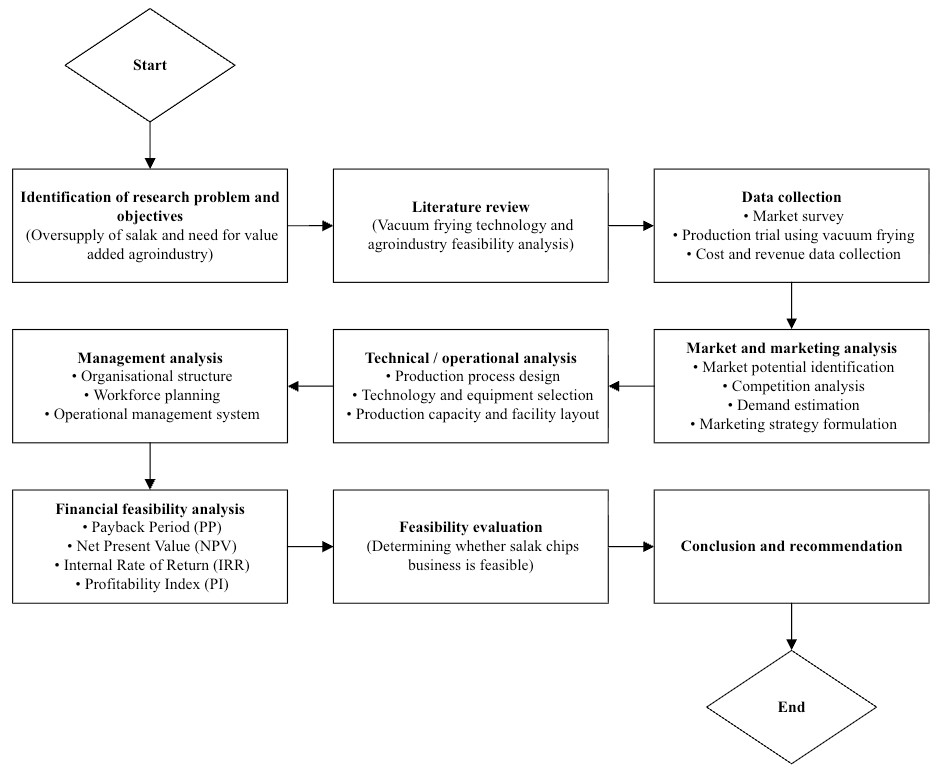
The processing of snake fruit into value-added products such as chips represents an important agro-industrial innovation to address the challenges of oversupply and declining prices during peak harvest periods. This study contributes to analyse the business feasibility of snake fruit chips based on market, technical production, management, and financial aspects. The research employed a feasibility study approach using data collected through market surveys, production trials using vacuum frying technology, and cost analysis of operational activities. Market analysis was conducted to evaluate demand potential and marketing opportunities, while technical analysis assessed the production process and operational requirements. Management analysis examined the organisational structure and labour needs of small-scale agroindustry. Financial feasibility was evaluated using investment appraisal parameters, namely Payback Period (PP), Net Present Value (NPV), Internal Rate of Return (IRR), and Profitability Index (PI), which were calculated based on projected costs, revenues, and cash flows from the snake fruit chips production system. The results show that the snake fruit chips business is financially feasible, with a PP of 5 months, NPV of IDR 346,415,523, IRR of 240.53%, and PI of 1.29, indicating strong profitability and rapid capital recovery. These results demonstrate that the adoption of vacuum frying technology combined with effective market strategies can significantly increase the added value and shelf life of snake fruit while expanding market opportunities, including export potential. Therefore, the development of snake fruit chips agroindustry represents a viable strategy to strengthen local agro-industrial competitiveness, improve farmers’ welfare, and support the achievement of Sustainable Development Goal (SDG) 12 on responsible consumption and production.
References
L. A. Ritonga, Irwan, and L. Hakim, “Analisis kelayakan agroindustri pengolahan snake fruit UD Salacca di Desa Aek Nabara Kecamatan Angkola Barat Kabupaten Tapanuli Selatan Provinsi Sumatera Utara,” Jurnal Ilmiah Mahasiswa Pertanian, vol. 6, no. 4, pp. 236–247, 2021, https://doi.org/10.17969/jimfp.v6i4.18248.
W. K. Yoga and I. G. A. Y. Rabani, “Analisis total fenol, total favonoid dan total tanin pada produk minuman probiotik sari buah snake fruit (Salacca zalaca var. Ambonensis),” Pro Food (Jurnal Ilmu dan Teknologi Pangan), vol. 8, no. 1, pp. 69–76, 2022, https://doi.org/10.29303/profood.v8i1.229.
P. Hlásná Čepková, M. Jágr, D. Janovská, V. Dvořáček, A. Kotrbova Kozak, and I. Viehmannová, “Comprehensive mass spectrometric analysis of snake fruit: Snake fruit (Salacca zalacca),” Journal of Food Quality, vol. 2021, no. 1, pp. 6621811, 2021, https://doi.org/10.1155/2021/6621811.
H. H. Ilmiah, E. Sulistyaningsih, and T. Joko, “Fruit morphology, antioxidant activity, total phenolic and flavonoid contents of Salacca zalacca (Gaertner) Voss by applications of goat manures and Bacillus velezensis B-27,” Caraka Tani: Journal of Sustainable Agriculture, vol. 36(2), pp. 270-282, 2021, http://dx.doi.org/10.20961/carakatani.v36i2.43798.
M. S. Saleh, M. J. Siddiqui, A. Mediani, N. H. Ismail, Q. U. Ahmed, S. Z. M. So'ad, and S. Saidi-Besbes, “Salacca zalacca: a short review of the palm botany, pharmacological uses and phytochemistry,” Asian Pacific Journal of Tropical Medicine, vol. 11, no. 12, pp. 645–652, 2018, https://doi.org/10.4103/1995-7645.248321.
D. F. Rosida, B. Syehan, D. C. Happyanto, F. T. Anggraeni, and N. Hapsari, “Keripik snake fruit vacuum frying sebagai alternatif pengembangan produk inovatif di daerah agroklimat Bangkalan Madura,” Jurnal Layanan Masyarakat (Journal of Public Service), vol. 4, no. 1, pp. 23–30, 2020, https://doi.org/10.20473/jlm.v4i1.2020.23-30.
N. Tumbel and S. Manurung, “Analisis mutu keripik snake fruit metode penggoreng vakum,” Indonesian Journal of Industrial Research, vol. 13, no. 1, pp. 34–43, 2021, https://media.neliti.com/media/publications/451635-none-1f91afc4.pdf.
R. Breemer, S. Palijama, and F. R. Palijama, “Pengaruh pengaturan suhu penggorengan vacum terhadap sifat-sifat kimia keripik snake fruit (Salaca edulis Reinw),” AGRITEKNO: Jurnal Teknologi Pertanian, vol. 7, no. 2, pp. 56–59, 2018, https://doi.org/10.30598/jagritekno.2018.7.2.56.
A. Muhammadali, J. Jamaluddin, and R. Fadilah, “Kualitas keripik snake fruit (Salacca zalacca) pada berbagai variasi temperatur dan waktu selama penggorengan hampa udara,” Jurnal Pendidikan Teknologi Pertanian, vol. 7, no. 1, pp. 67–78, 2021, https://doi.org/10.26858/jptp.v6i2.12434.
S. Harahap, Studi kelayakan bisnis pendekatan integratif. 2018, http://repository.uinsu.ac.id/5052/1/Studi%20Kelayakan%20Bisnis%20ISBN-ok.pdf.
D. López Fernández and M. Oliver, “Methodology, strategies, and factors for business innovation in large companies,” Int. J. Innov. Stud., vol. 9, no. 2, pp. 91–115, 2025, https://doi.org/10.1016/j.ijis.2025.02.002.
I. Farida and D. Setiawan, “Business strategies and competitive advantage: The role of performance and innovation,” J. Open Innov. Technol. Mark. Complex., vol. 8, no. 3, p. 163, 2022, https://doi.org/10.3390/joitmc8030163.
K. Onufrey and A. Bergek, “Transformation in a mature industry: The role of business and innovation strategies,” Technovation, vol. 105, p. 102190, 2021, https://doi.org/10.1016/j.technovation.2020.102190.
R. D. Hisrich, M. P. Peters, and D. A. Shepherd, Entrepreneurship, 10th ed. 2017, https://doi.org/10.1177/09708464211035645.
M. M. Helms and J. Nixon, “Exploring SWOT analysis—where are we now?,” Journal of Strategy and Management, vol. 3, no. 3, pp. 215–251, 2010, https://doi.org/10.1108/17554251011064837.
E. Gürel and M. Tat, “SWOT analysis: A theoretical review,” The Journal of International Social Research, vol. 10, no. 51, pp. 994–1006, 2017, https://doi.org/10.17719/jisr.2017.1832.
S. Kabbera, A. Tibaingana, Y. Kiwala, and J. T. Mugarura, “Triple bottom line practices and the growth agro-processing enterprises in Uganda,” Cleaner and Circular Bioeconomy, vol. 8, pp. 100081, 2024, https://doi.org/10.1016/j.clcb.2024.100081.
L. Zhang, A. Njepu, and X. Xia, “Minimum cost solution to residential energy-water nexus through rainwater harvesting and greywater recycling,” Journal of Cleaner Production, vol. 298, pp. 126742, 2021, https://doi.org/10.1016/j.jclepro.2021.126742.
Y. Zhang, A. Leischnig, N. Heirati, and S. C. Henneberg, “Dark-side-effect contagion in business relationships,” Journal of Business Research, vol. 130, pp. 260–270, 2021, https://doi.org/10.1016/j.jbusres.2021.03.047.
S. Zhang, Z. Gong, S. Wang, S. Zhao, W. Mao, B. Liu, and Y. Liu, “Comprehensive insights into oil absorption in fried foods: The role of surface characteristics,” Food Chemistry, vol. 483, pp. 144341, 2025, https://doi.org/10.1016/j.foodchem.2025.144341.
D. Kirikkaleli and J. K. Sowah, “The asymmetric and long run effect of energy productivity on quality of environment in Finland,” Journal of Cleaner Production, vol. 383, pp. 135285, 2023, https://doi.org/10.1016/j.jclepro.2022.135285.
M. Rockmore and C. B. Barrett, “The implications of aggregate measures of exposure to violence for the estimated impacts on individual risk preferences,” World Development, vol. 157, pp. 105925, 2022, https://doi.org/10.1016/j.worlddev.2022.105925.
M. A. Farag, B. Abib, S. Tawfik, N. Shafik, and A. R. Khattab, “Caviar and fish roe substitutes: Current status of their nutritive value, bio-chemical diversity, authenticity and quality control methods with future perspectives,” Trends in Food Science & Technology, vol. 110, pp. 405–417, 2021, https://doi.org/10.1016/j.tifs.2021.02.015.
F. Erpel, R. Mateos, J. Pérez-Jiménez, and J. R. Pérez-Correa, “Phlorotannins: From isolation and structural characterization, to the evaluation of their antidiabetic and anticancer potential,” Food Research International, vol. 137, pp. 109589, 2020, https://doi.org/10.1016/j.foodres.2020.109589.
A. Valdés, M. Castro-Puyana, and M. L. Marina, “Isolation of proteins from spent coffee grounds. Polyphenol removal and peptide identification in the protein hydrolysates by RP-HPLC-ESI-Q-TOF,” Food Research International, vol. 137, pp. 109368, 2020, https://doi.org/10.1016/j.foodres.2020.109368.
M.-J. Ye, Q.-L. Xu, H.-Y. Tang, W.-Y. Jiang, D.-X. Su, S. He, Q.-Z. Zeng, and Y. Yuan, “Development and stability of novel selenium colloidal particles complex with peanut meal peptides,” LWT, vol. 126, pp. 109280, 2020, https://doi.org/10.1016/j.lwt.2020.109280.
J. Liu, D. Wu, N. Zhu, Y. Wu, and G. Li, “Antibacterial mechanisms and applications of metal-organic frameworks and their derived nanomaterials,” Trends in Food Science & Technology, vol. 109, pp. 413–434, 2021, https://doi.org/10.1016/j.tifs.2021.01.012.
K. C. Goh, T. A. Kurniawan, S. Mohamed, D. Zhang, M. I. Khan, M. H. D. Othman, F. Aziz, A. Anouzla, and C. W. Onn, “Techno-economic assessment and life cycle analysis of restaurant food waste-to-electricity conversion in Malaysia and Singapore within a circular bioeconomy framework,” Biomass and Bioenergy, vol. 197, pp. 107771, 2025, https://doi.org/10.1016/j.biombioe.2025.107771.
A. N. Khairi and Nurkhasanah, N., “Bioactive compounds content of snake fruit peel, aloe vera, and stevia extracts as raw material of functional drinks.” Journal of Agri-Food Science and Technology, vol. 1(1), pp.34, 2020, https://doi.org/10.12928/jafost.v1i1.1915.
P. Puerta, L. Laguna, B. Villegas, A. Rizo, S. Fiszman, and A. Tarrega, “Oral processing and dynamics of texture perception in commercial gluten-free breads,” Food Research International, vol. 134, pp. 109233, 2020, https://doi.org/10.1016/j.foodres.2020.109233.
S. Aralas, M. Mohamed, and M. F. A. Bakar, “Antioxidant properties of selected snake fruit (Salacca zalacca) varieties in Sabah, Malaysia,” Nutrition & Food Science, vol. 39, no. 3, pp. 243–250, 2009, https://doi.org/10.1108/00346650910957492.
A. Al Faruq, Mst. H. A. Khatun, S. M. R. Azam, Md. S. H. Sarker, Md. S. Mahomud, and X. Jin, “Recent advances in frying processes for plant-based foods,” Food Chemistry Advances, vol. 1, pp. 100086, 2022, https://doi.org/10.1016/j.focha.2022.100086.
A. Patra, V. A. Prasath, P. P. Sutar, N. K. S. Pandian, and R. Pandiselvam, “Evaluation of effect of vacuum frying on textural properties of food products,” Food Research International, vol. 162, pp. 112074, 2022, https://doi.org/10.1016/j.foodres.2022.112074.
M. Soto, A. M. Pérez, A. Servent, F. Vaillant, and N. Achir, “Monitoring and modelling of physicochemical properties of papaya chips during vacuum frying to control their sensory attributes and nutritional value,” Journal of Food Engineering, vol. 299, pp. 110514, 2021, https://doi.org/10.1016/j.jfoodeng.2021.110514.
Y. Su, M. Zhang, B. Chitrakar, and W. Zhang, “Reduction of oil uptake with osmotic dehydration and coating pre-treatment in microwave-assisted vacuum fried potato chips,” Food Bioscience, vol. 39, pp. 100825, 2021, https://doi.org/10.1016/j.fbio.2020.100825.
Y. Lou, X. Fang, Z.-C. Yang, J.-L. Fei, Y.-R. Feng, Z. Qin, H.-M. Liu, Y.-X. Ma, and X.-D. Wang, “Effect of vacuum frying on the structure and bioactivity of proanthocyanidins in Chinese quince (Chaenomeles sinensis Koehne) fruit,” Food Chemistry, vol. 466, pp. 142127, 2025, https://doi.org/10.1016/j.foodchem.2024.142127.
X. Huang, G. Wu, X. Liang, H. Li, H. Zhang, Q. Jin, and X. Wang, “Physical fields assisted frying technologies for reducing oil content of fried food,” Trends in Food Science & Technology, vol. 155, pp. 104806, 2025, https://doi.org/10.1016/j.tifs.2024.104806.
C. Thongcharoenpipat and R. Yamsaengsung, “Microwave-assisted vacuum frying of durian chips: Impact of ripening level on the drying rate, physio-chemical characteristics, and acceptability,” Food and Bioproducts Processing, vol. 138, pp. 40–52, 2023, https://doi.org/10.1016/j.fbp.2023.01.001.
A. T. Ayele, M. R. Ismail-Fitry, Y. D. Bizualem, P. Kumar, E. M. Deresa, and N. C. Stanley, “Deep-fried sweetpotato chip production: A review on pretreatment, frying conditions, and quality parameters,” Journal of Agriculture and Food Research, vol. 24, pp. 102406, 2025, https://doi.org/10.1016/j.jafr.2025.102406.
C.-N. Nguyen, V.-T. Vo, and N. C. Ha, “Developing a computer vision system for real-time color measurement – A case study with color characterization of roasted rice,” Journal of Food Engineering, vol. 316, pp. 110821, 2022, https://doi.org/10.1016/j.jfoodeng.2021.110821.
Y.-H. Song, H.-Q. Yu, Y. Tan, W. Lv, D.-H. Fang, and D. Liu, “Similarity matching of food safety incidents in China: Aspects of rapid emergency response and food safety,” Food Control, vol. 115, pp. 107275, 2020, https://doi.org/10.1016/j.foodcont.2020.107275.
J. Lin, “How to reduce overpackaging of food in China: Analysis based on evolutionary game,” Sustainable Production and Consumption, vol. 31, pp. 529–545, 2022, https://doi.org/10.1016/j.spc.2022.03.012.
R. Prihatini, D. Dinarti, A. Sutanto, and Sudarsono, “Development of hermaphrodite Salacca (Salacca zalacca) SNAP marker: A novel conservation tool,” IOP Conference Series: Earth and Environmental Science, vol. 1105, no. 1, 2022, https://doi.org/10.1088/1755-1315/1105/1/012030.
M. S. Apriniarti, B. Suryobroto, T. Atmowidi, S. Kahono, and W. Manalu, “Population and activities of curculionids beetle in snake fruit (Salacca zalacca),” in IOP Conference Series: Earth and Environmental Science, vol. 299, no. 1, 2019, https://doi.org/10.1088/1755-1315/299/1/012018.
Downloads
Published
Issue
Section
License
Copyright (c) 2026 Wildan Fajar Bachtiar, Annie Mufyda Rahmatika, Galih Kusuma Aji, Sonia Dora Febri Esa, Artisya Ramadhanti, Convelica Tanaya Sugwanti, Ghefira Tsaniya Raihani, Mohd Hairy Ibrahim

This work is licensed under a Creative Commons Attribution-ShareAlike 4.0 International License.
Authors who publish with the Journal of Agri-food Science and Technology (JAFOST) agree to the following terms:
- Authors retain copyright and grant the journal right of first publication with the work simultaneously licensed under a Creative Commons Attribution License (CC BY-SA 4.0) that allows others to share the work with an acknowledgment of the work's authorship and initial publication in this journal.
- Authors are able to enter into separate, additional contractual arrangements for the non-exclusive distribution of the journal's published version of the work (e.g., post it to an institutional repository or publish it in a book), with an acknowledgment of its initial publication in this journal.
- Authors are permitted and encouraged to post their work online (e.g., in institutional repositories or on their website) prior to and during the submission process, as it can lead to productive exchanges, as well as earlier and greater citation of published work.