Integrated Effects of Hot Water Blanching on Alliin Degradation, Physical Quality, and Aroma Acceptability of Lokio (Allium chinense G. Don)
DOI:
https://doi.org/10.12928/jafost.v7i1.15777Keywords:
Alliin, Color, Hot water blanching, Pungency, TextureAbstract
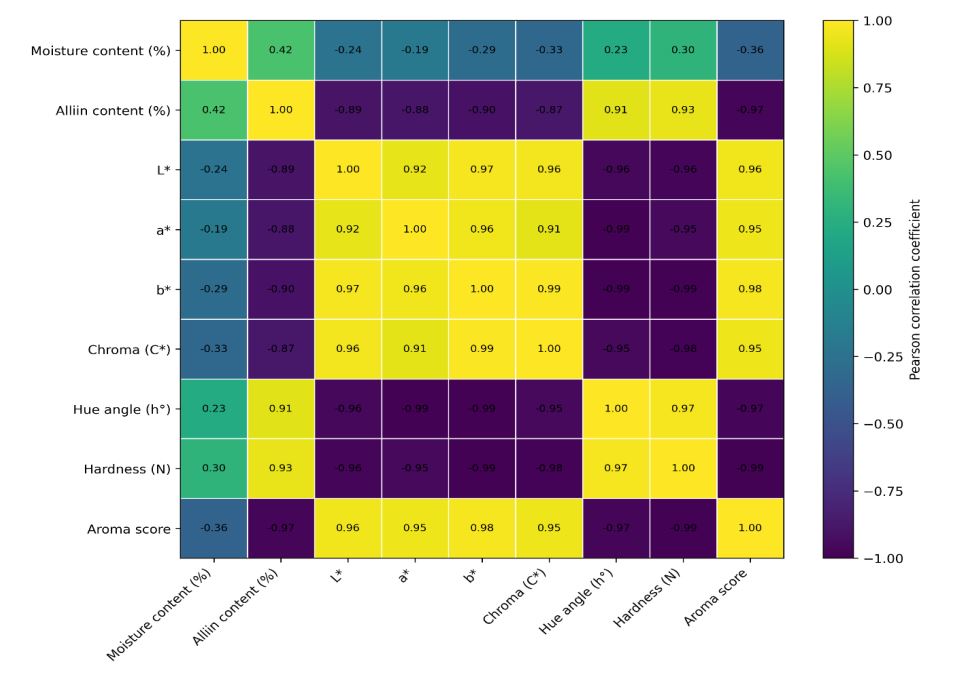
Lokio (Allium chinense G. Don) is a traditional Allium vegetable widely consumed in Indonesia and has potential as a natural seasoning. However, its utilization is limited by excessive pungency associated with alliin. This study contributed to evaluate the effects of hot water blanching temperature and duration on alliin content, moisture content, color characteristics, textural properties, and aroma acceptability of lokio. Fresh lokio bulbs were blanched at 80, 90, and 100 °C for 2, 4, 6, 8, and 10 min using a factorial randomized design. Alliin content was quantified using HPLC, while moisture, color, texture, and aroma acceptability were analyzed using standard methods. Increasing blanching temperature and duration significantly reduced alliin content and hardness (p<0.05), accompanied by increased lightness, yellowness, and chroma, as well as decreased hue angle, indicating a shift toward yellow–orange color. Aroma acceptability increased significantly with blanching severity, reflecting reduced pungency. The optimal blanching condition was identified at 100 °C for 6–8 min, which effectively reduced alliin content while maintaining acceptable texture and color quality. These findings provide practical guidance for optimizing blanching pretreatment to achieve controlled pungency reduction and improved sensory acceptance in lokio processing.
References
M. T. El-Saadony, A. M. Saad, S. A. Korma, H. M. Salem, T. A. Abd El-Mageed, S. S. Alkafaas, M. I. Elsalahaty, S. S. Elkafas, W. F. A. Mosa, A. E. Ahmed, B. T. Mathew, N. A. Albastaki, A. A. Alkuwaiti, M. K. El-Tarabily, S. F. AbuQamar, et al., “Garlic bioactive substances and their therapeutic applications for improving human health: A comprehensive review,” Front. Immunol., vol. 15, 2024, https://doi.org/10.3389/fimmu.2024.1277074.
S.-H. Kim, J. Yoon, J. Han, Y. Seo, B.-H. Kang, J. Lee, and K. Ochar, “Green onion (Allium fistulosum): An aromatic vegetable crop esteemed for food, nutritional and therapeutic significance,” Foods, vol. 12, no. 24, p. 4503, 2023, https://doi.org/10.3390/foods12244503.
D. Kumalasari, S. Supriyadi, and A. Ningrum, “Effect of temperature storage on chemical properties of lokio leaves (Allium chinense G Don),” Indones. Food Nutr. Prog., vol. 19, no. 2, p. 41, 2023, https://doi.org/10.22146/ifnp.72535.
M. J. Hossain, A. N. Alam, E.-Y. Lee, Y.-H. Hwang, and S.-T. Joo, “Umami characteristics and taste improvement mechanism of meat,” Food Sci. Anim. Resour., vol. 44, no. 3, pp. 515–532, 2024, https://doi.org/10.5851/kosfa.2024.e29.
S. Park, H.-W. Kim, C. Joo Lee, Y. Kim, and J. Sung, “Profiles of volatile sulfur compounds in various vegetables consumed in Korea using HS-SPME-GC/MS technique,” Front. Nutr., vol. 11, 2024, https://doi.org/10.3389/fnut.2024.1409008.
N. Asmaq and K. Warsito, “Effect of adding batak onions (Allium chinense G. Don.) on water content and ash content of mutton meat rendang,” Asian J. Adv. Agric. Res., vol. 23, no. 2, pp. 20–24, 2023, https://doi.org/10.9734/ajaar/2023/v23i2458.
P. Janská, Z. Knejzlík, A. S. Perumal, R. Jurok, V. Tokárová, D. V. Nicolau, F. Štěpánek, and O. Kašpar, “Effect of physicochemical parameters on the stability and activity of garlic alliinase and its use for in-situ allicin synthesis,” PLoS One, vol. 16, no. 3, p. e0248878, 2021, https://doi.org/10.1371/journal.pone.0248878.
R. M. de O. Tavares, C. F. de Assis, P. de O. Lima, P. D. S. de Lima, R. R. C. Lima, and K. S. F. da S. C. Damasceno, “Blanching effect on the quality and shelf-life characteristics of fresh cowpea grains [Vigna unguiculata (L.) Walp.],” Foods, vol. 11, no. 9, p. 1295, 2022, https://doi.org/10.3390/foods11091295.
A. Sarkar, S. Rahman, M. Roy, M. Alam, M. A. Hossain, and T. Ahmed, “Impact of blanching pretreatment on physicochemical properties, and drying characteristics of cabbage (Brassica oleracea),” Food Res., vol. 5, no. 2, pp. 393–400, 2021, https://doi.org/10.26656/fr.2017.5(2).556.
B. Zhang, Z. Qiu, R. Zhao, Z. Zheng, X. Lu, and X. Qiao, “Effect of blanching and freezing on the physical properties, bioactive compounds, and microstructure of garlic (Allium sativum L.),” J. Food Sci., vol. 86, no. 1, pp. 31–39, 2021, https://doi.org/10.1111/1750-3841.15525.
K. Najman, A. Sadowska, K. Buczak, H. Leontowicz, and M. Leontowicz, “Effect of heat-treated garlic (Allium sativum L.) on growth parameters, plasma lipid profile and histological changes in the ileum of atherogenic rats,” Nutrients, vol. 14, no. 2, p. 336, 2022, https://doi.org/10.3390/nu14020336.
R. Miao, K. Chen, F. Tian, Y. Du, and M. Xu, “Comparative evaluation of pretreatments for heat pump drying of Saimaiti apricots: Atmospheric pressure plasma jet improves drying kinetics, flavor, and nutritional quality,” J. Agric. Food Res., vol. 24, p. 102535, 2025, https://doi.org/10.1016/j.jafr.2025.102535.
J. Zhang, J. Zhang, L. Zhang, Y. Xue, and K. Zhang, “Mechanistic insights into vegetable color stability: Discoloration pathways and emerging protective strategies,” Foods, vol. 14, no. 13, p. 2222, 2025, https://doi.org/10.3390/foods14132222.
E. Cobbinah-Sam and I. Ekaette, “Thermal processing–driven functional transformations of egg components: Albumen and yolk,” Food Res. Int., vol. 224, p. 117929, 2026, https://doi.org/10.1016/j.foodres.2025.117929.
Z. Huang, Q. Zhou, W. Wu, J. Wan, and A. Jiang, “Thermal kinetics of enzyme inactivation, color changes, and allicin degradation of garlic under blanching treatments,” J. Food Process Eng., vol. 42, no. 3, 2019, https://doi.org/10.1111/jfpe.12991.
C. Liu, L. Lu, C. Yang, C. Niu, J. Wang, F. Zheng, and Q. Li, “Effects of thermal treatment on alliin and its related sulfides during black garlic processing,” LWT, vol. 159, p. 113158, 2022, https://doi.org/10.1016/j.lwt.2022.113158.
D. F. Al-Fekaiki and I. H. Al-Taai, “Preparation of an amino acid alliin from the Iraqi garlic and using it as a substrate for alliinase,” J. Pharm. Sci. Res., vol. 11, no. 5, pp. 1838–1841, 2019, [Online]. Available: https://www.faculty.uobasrah.edu.iq/uploads/publications/1623476325.pdf.
S. N. Rahmadhia, I. N. Septiani, A. Fitriani, and S. K. Putri, “Characterization of intelligent packaging from chitosan-cassava starch with butterfly pea flower extract and gambier catechin as freshness sensor,” Trends Sci., vol. 23, no. 4, p. 12075, 2025, https://doi.org/10.48048/tis.2026.12075.
S. N. Rahmadhia, D. R. Toni, and A. Fitriani, “Physical characteristics of kepok banana bud (Musa paradisiaca Linn.) flakes with variations of mocaf flour,” J. Keteknikan Pertan., vol. 12, no. 1, pp. 77–92, 2024, https://doi.org/10.19028/jtep.012.1.77-92.
A. Fitriani, M. N. Haliza, N. P. Utami, I. Nyambayo, S. Sanayei, and S. N. Rahmadhia, “Texture profile analysis of lamtoro gung (Leucaena leucocephala ssp. Glabrata (Rose) S. Zarate) tempeh,” J. Agri-Food Sci. Technol., vol. 5, no. 1, pp. 65–72, 2024, https://doi.org/10.12928/jafost.v5i1.10226.
J. Dehghannya, E. Nabizadeh, and H. Ghaffari, “The impact of fixed wave application time on the physicochemical and microstructural characteristics of potato slices during intermittent infrared–hot air drying,” LWT, vol. 227, p. 118027, 2025, https://doi.org/10.1016/j.lwt.2025.118027.
B. Maroufpour, A. M. Ziaiifar, M. Ghorbani, H. Sabbaghi, and S. Yalghi, “Hot air frying as a healthier alternative to deep fat frying for shrimp: Comparative analysis of physicochemical and sensory properties,” Appl. Food Res., vol. 5, no. 2, p. 101425, 2025, https://doi.org/10.1016/j.afres.2025.101425.
U. Akbar, J. Singh, P. Rasane, V. Nanda, A. Basak, A. Assouguem, R. Ullah, E. A. Ali, and S. Kaur, “Effect of different blanching methods on kinetics of physico-chemical, functional properties, and enzyme inactivation in baby corn,” Heliyon, vol. 10, no. 17, p. e36964, 2024, https://doi.org/10.1016/j.heliyon.2024.e36964.
M. Chobot, M. Kozłowska, A. Ignaczak, and H. Kowalska, “Development of drying and roasting processes for the production of plant-based pro-healthy snacks in the light of nutritional trends and sustainable techniques,” Trends Food Sci. Technol., vol. 149, p. 104553, 2024, https://doi.org/10.1016/j.tifs.2024.104553.
H. Xu, Y. Guan, C. Shan, W. Xiao, and M. Wu, “Development of thermoultrasound assisted blanching to improve enzyme inactivation efficiency, drying characteristics, energy consumption, and physiochemical properties of sweet potatoes,” Ultrason. Sonochem., vol. 101, p. 106670, 2023, https://doi.org/10.1016/j.ultsonch.2023.106670.
P. Furdak, G. Bartosz, and I. Sadowska‐Bartosz, “Effect of thermal treatment on the antiproliferative and antioxidant activities of garlic,” Food Sci. Nutr., vol. 13, no. 6, 2025, https://doi.org/10.1002/fsn3.70375.
Z. F. Yılmaz Oral and G. Kaban, “The effect of black garlic on the volatile compounds in heat-treated sucuk,” Foods, vol. 12, no. 20, p. 3876, 2023, https://doi.org/10.3390/foods12203876.
S. Naqash, T. Jan, H. R. Naik, S. Z. Hussain, B. N. Dar, and H. A. Makroo, “Influence of controlled curing process on physico-chemical, nutritional, and bio-active composition of brown Spanish onion,” J. Food Compos. Anal., vol. 114, p. 104823, 2022, https://doi.org/10.1016/j.jfca.2022.104823.
I. F. Islami and S. N. Rahmadhia, “The effect of sago starch (Metroxylon sp.) and chitosan as edible coating on physical and chemical characteristics of red chili (Capsicum annuum L.),” Adv. Food Sci. Sustain. Agric. Agroindustrial Eng., vol. 7, no. 3, pp. 265–273, 2024, https://doi.org/10.21776/ub.afssaae.2024.007.03.7.
R. Qalbi, S. Giovani, Q. Guo, and N. M. Adelina, “Effect of drying time on physicochemical characteristics of dragon fruit peels powder (Hylocereus polyrhizus),” J. Agri-Food Sci. Technol., vol. 4, no. 2, pp. 81–96, 2024, https://doi.org/10.12928/jafost.v4i2.9294.
M. Nowacka, M. Dadan, M. Janowicz, A. Wiktor, D. Witrowa‐Rajchert, R. Mandal, A. Pratap‐Singh, and E. Janiszewska‐Turak, “Effect of nonthermal treatments on selected natural food pigments and color changes in plant material,” Compr. Rev. Food Sci. Food Saf., vol. 20, no. 5, pp. 5097–5144, 2021, https://doi.org/10.1111/1541-4337.12824.
X. Tan, M. Ding, C. Wang, L. Huang, and J. Bai, “The transformation of pigment in fruit wine, Precise control of pigment formation, and their effect on product quality,” Foods, vol. 14, no. 13, p. 2207, 2025, https://doi.org/10.3390/foods14132207.
M. Sharma, A. Bains, B. H. Gowda, K. Sridhar, B. Stephen Inbaraj, P. Chawla, and M. Sharma, “Physicochemical and functional characterization of Cucumis sativus L. (poona kheera) mucilage and its application as a coating to inhibit enzymatic browning in fresh-cut apples,” Foods, vol. 15, no. 4, p. 657, 2026, https://doi.org/10.3390/foods15040657.
R. Shamsudin, S. H. Ariffin, W. N. Z. Z. Abdullah, N. S. Azmi, and A. A. Abdul Halim, “Modelling the kinetics of color and texture changes of Dabai (Canarium odontophyllum Miq.) during blanching,” Agronomy, vol. 11, no. 11, p. 2185, 2021, https://doi.org/10.3390/agronomy11112185.
M. Paciulli, T. Ganino, I. G. M. Meza, M. Rinaldi, M. Rodolfi, M. Morbarigazzi, and E. Chiavaro, “High pressure and thermal processing on the quality of zucchini slices,” Eur. Food Res. Technol., vol. 247, no. 2, pp. 475–484, 2021, https://doi.org/10.1007/s00217-020-03640-7.
M. E. Gonzalez and D. M. Barrett, “Thermal, high pressure, and electric field processing effects on plant cell membrane integrity and relevance to fruit and vegetable quality,” J. Food Sci., vol. 75, no. 7, 2010, https://doi.org/10.1111/j.1750-3841.2010.01763.x.
J.-E. Lim, S.-J. Ye, J.-S. Shin, H.-Y. Kim, J.-E. Bae, S.-M. Oh, and M.-Y. Baik, “Optimization of blanching condition for removing potassium from spinach using response surface methodology,” Food Sci. Biotechnol., vol. 34, no. 7, pp. 1589–1596, 2025, https://doi.org/10.1007/s10068-024-01782-y.
A. Korolev, M. Mishnev, N. I. Vatin, and A. Ignatova, “Prolonged thermal relaxation of the thermosetting polymers,” Polymers (Basel)., vol. 13, no. 23, p. 4104, 2021, https://doi.org/10.3390/polym13234104.
O. Kilic-Buyukkurt, H. Kelebek, M. Bordiga, M. Keskin, and S. Selli, “Changes in the aroma and key odorants from white garlic to black garlic using approaches of molecular sensory science: A review,” Heliyon, vol. 9, no. 8, p. e19056, 2023, https://doi.org/10.1016/j.heliyon.2023.e19056.
Z. E. Oyaluna, A. O. Abolaji, O. Bodede, J. O. Olanlokun, G. Prinsloo, P. Steenkamp, and C. P. Babalola, “Chemical analysis of alliin-rich Allium sativum (garlic) extract and its safety evaluation in Drosophila melanogaster,” Toxicol. Reports, vol. 13, p. 101760, 2024, https://doi.org/10.1016/j.toxrep.2024.101760.
Downloads
Published
Issue
Section
License
Copyright (c) 2026 Eva Mayasari, Supriyadi Supriyadi, Retno Indrati, Widiastuti Setyaningsih

This work is licensed under a Creative Commons Attribution-ShareAlike 4.0 International License.
Authors who publish with the Journal of Agri-food Science and Technology (JAFOST) agree to the following terms:
- Authors retain copyright and grant the journal right of first publication with the work simultaneously licensed under a Creative Commons Attribution License (CC BY-SA 4.0) that allows others to share the work with an acknowledgment of the work's authorship and initial publication in this journal.
- Authors are able to enter into separate, additional contractual arrangements for the non-exclusive distribution of the journal's published version of the work (e.g., post it to an institutional repository or publish it in a book), with an acknowledgment of its initial publication in this journal.
- Authors are permitted and encouraged to post their work online (e.g., in institutional repositories or on their website) prior to and during the submission process, as it can lead to productive exchanges, as well as earlier and greater citation of published work.