Effect of Steaming Time on the Bioactive Compound Content and Antioxidant Activity of Sprouted Cowpea (Vigna unguiculata) Tempeh Flour
DOI:
https://doi.org/10.12928/jafost.v7i1.15444Keywords:
Antioxidant activity, Cowpea, GABA, Phenolic content, SteamingAbstract
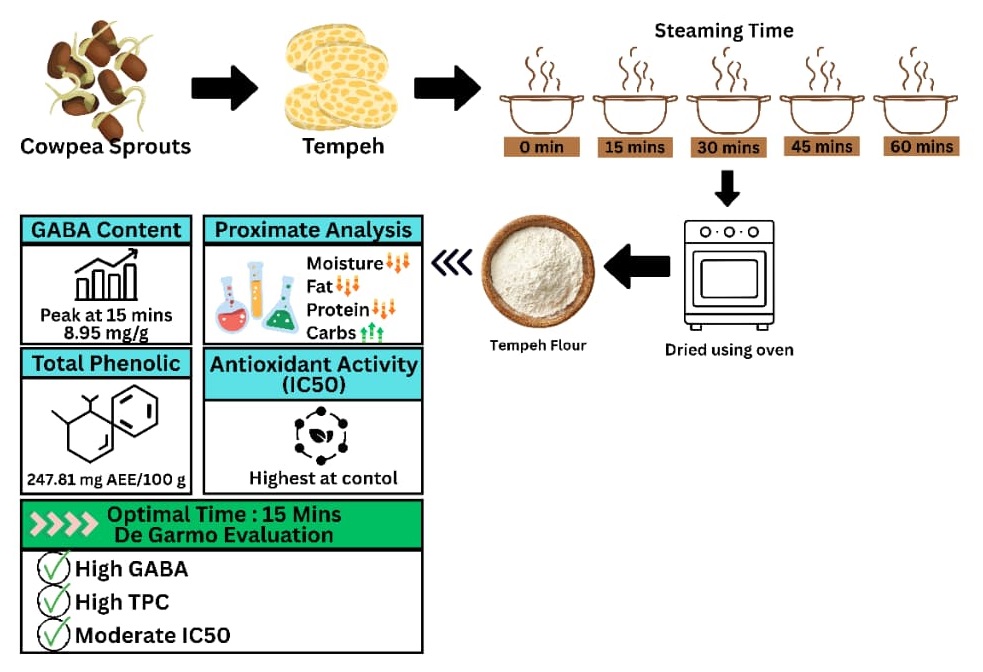
Cowpea (Vigna unguiculata) is a local legume rich in protein, minerals, vitamins, and bioactive compounds such as GABA and antioxidants. One promising innovation is the use of cowpea sprouts as raw material for tempeh production. However, tempeh has a short shelf life, which can be extended by converting it into flour. Tempeh flour often exhibits a beany flavor, that may be reduced through steaming, although this process may also decrease its nutritional and bioactive components. This study contributes to evaluating the effect of steaming time on the proximate composition, GABA, total phenolic content (TPC), and antioxidant activity (IC50) of sprouted cowpea tempeh flour. A completely randomized design with a single factor was employed, consisting of steaming times of 0, 15, 30, 45, and 60 minutes. Data were analyzed using one-way ANOVA, DMRT, correlation analysis, and determination of the optimal treatment using the De Garmo method. Results showed that steaming significantly decreased moisture, fat, and protein contents (p<0.05), while increasing ash and carbohydrate levels. The highest GABA content was observed at 15 minutes (8.95 mg/g), then declined due to thermal degradation. TPC reached its peak at 45 minutes (247.81 mg GAE/100 g). Antioxidant activity (IC50) fluctuated with steaming time, with the highest activity in the control sample (IC50 19.01 mg/mL). Correlation analysis indicated that antioxidant activity was more closely associated with total phenolic content than with GABA. Based on the De Garmo evaluation, considering GABA, TPC, and IC50, 15 minutes was identified as the optimal treatment.
References
F. A. AlGhamdi, A. B. Hassan, N. A. AlFaris, and J. Z. AlTamimi, “Effect of traditional household processing techniques on phenolic compounds, antioxidants activity and γ-aminobutyric acid of cowpea (Vigna unguiculata) pods,” Italian Journal of Food Science, vol. 35, no. 2, pp. 71–79, 2023, https://doi.org/10.15586/IJFS.V35I2.2327.
R. Wikandari, T. A. N. Utami, N. Hasniah, and Sardjono, “Chemical, nutritional, physical and sensory characterization of tempe made from various underutilized legumes,” Pakistan Journal of Nutrition, vol. 19, no. 4, pp. 179–190, 2020, https://doi.org/10.3923/pjn.2020.179.190.
A. Putri, N. W. Wisaniyasa, and I. P. Suparthana, “Effect of germination time on total phenolic content, total flavonoid content, and antioxidant activity of cowpea sprout flour (Vigna unguiculata L. Walp.),” Itepa: Jurnal Ilmu dan Teknologi Pangan, vol. 10, no. 1, pp. 1–13, 2021, https://doi.org/10.24843/itepa.2021.v10.i01.p04.
K. Vann, A. Techaparin, and J. Apiraksakorn, “Beans germination as a potential tool for GABA-enriched tofu production,” J Food Sci Technol, vol. 57, no. 11, pp. 3947–3954, 2020, https://doi.org/10.1007/s13197-020-04423-4.
N. T. H. Yen, P. N. Hoa, and P. V. Hung., “Optimal soaking conditions and addition of exogenous substances improve accumulation of γ-aminobutyric acid (GABA) in germinated mung bean (Vigna radiata),” International Journal of Food Science and Technology, vol. 57, pp.3924–3933, 2022, https://doi.org/10.1111/ijfs.15473.
I. Tsalissavrina, A. Murdiati, S. Raharjo, and L. A. Lestari, “The effects of duration of fermentation on total phenolic content, antioxidant activity, and isoflavones of the germinated jack bean tempeh (Canavalia ensiformis),” Indonesian Journal of Pharmacy, vol. 34, no. 3, 2023, https://doi.org/10.22146/ijp.6658.
T. Handoyo and N. Morita, “Structural and functional properties of fermented soybean (Tempeh) by using Rhizopus oligosporus,” Int J Food Prop, vol. 9, no. 2, pp. 347–355, 2006, https://doi.org/10.1080/10942910500224746.
N. Xu, L. Wei, and J. Lui, “Biotechnological advances and perspective of gammaaminobutyric acid production,” World Journal of Microbiology and Biotechnology, vol. 33, no. 3, pp. 1–11, 2017, https://doi.org/10.1007/s11274-017-2234-5.
R. A. Rissman, and W. C. Mobley, “Implications for treatment: GABA receptors in aging, down syndrome, and alzheimer’s disease,” Journal of Neurochemistry, vol. 117, pp. 613–622, 2011, https://doi.org/10.1111/j.1471-4159.2011.07237.x.
H. Yongjian, O. Junyan, H. Zhuoyan, Y. Jie, C. Yue, H. Shaowen, Y. Yichao, and L. Chunhong, “Intervention mechanism of repeated oral GABA administration on anxiety-like behaviours induced by emotional stress in rats,” Psychiatry Research, vol. 271, pp. 649–657, 2018, https://doi.org/10.1016/j.psychres.2018.12.025.
F. Nejati, C. G. Rizzello, R. D. Cagno, M. Sheikh-Zeinoddin, A. Diviccaro, F. Minervini, and M. Gobbetti, “Manufacture of a functional fermented milk enriched of Angiotensin-I Converting Enzyme (ACE)-inhibitory peptides and γ-amino butyric acid (GABA)”, LWT - Food Science and Technology, vol. 51, pp. 183–189, 2012, https://doi.org/10.1016/j.lwt.2012.09.017.
H. Rezazadeh, M. R. Sharifi, M. Sharifi, and N. Soltani, “Gamma-aminobutyric acid attenuates insulin resistance in type 2 diabetic patients and reduces the risk of insulin resistance in their offspring,” Biomedicine & Pharmacotherapy, vol. 138, 2021, https://doi.org/10.1016/j.biopha.2021.111440.
I. O. Minatel, C. V. Borges, M. I. Ferreira, H. A. G. Gomez, C. Y. O. Chen, and G. P. P. Lima, “Phenolic compounds: Functional properties, impact of processing and bioavailability,” Phenolic Compounds - Biological Activity, 2017, https://doi.org/10.5772/66368.
Q. Li, J. Li, M. Duan, L. Liu, Y. Fu, D.J. McClements, T. Zhao, H. Lin, J. Shi, and X. Chen, “Impact of food additive titanium dioxide on the polyphenol content and antioxidant activity of the apple juice,” LWT, vol. 154, 2022, https://doi.org/10.1016/j.lwt.2021.112574.
I. W. R. Dewi, C. Anam, and E. Widowati, “Karakteristik sensoris, nilai gizi, dan aktivitas antioksidan tempe kacang gude (Cajanus cajan) dan tempe kacang tunggak (Vigna unguiculata) dengan berbagai variasi waktu fermentasi”. Biofarmas, vol. 12, no. 2, pp. 73–72, 2014, https://smujo.id/jnpb/article/download/2194/2054.
M. M. Suprijono and A. M. Sutedja, “Efek metode blanching uap dalam pembuatan biskuit tepung tempe terhadap penerimaan konsumen”, Prosiding Seminar Nasional Pangan 2008: Peningkatan Keamanan Pangan Menuju Pasar Global, 2008, https://repositori.ukwms.ac.id/id/eprint/8393.
K. Tiansawang, P. Luangpituksa, W. Varanyanond, and C. Hansawasdi, “GABA (γ-aminobutyric acid) production, antioxidant activity in some germinated dietary seeds and the effect of cooking on their GABA content,” Food Science and Technology (Brazil), vol. 36, no. 2, pp. 313–321, 2016, https://doi.org/10.1590/1678-457X.0080.
F. A. Purwandari, E. D. N. Annisa, A. T. Rachmawati, D. Purpitasari, R. Wikandari, W. Setyaningsih, A. Ningrum, and Sardjono, “Effect of different cooking methods on chemical composition, nutritional values, and sensory properties of jack bean (Canavalia ensiformis) tempe,” Food Res, vol. 5, no. 3, pp. 327–333, 2021, https://doi.org/10.26656/fr.2017.5(3).530.
H. Raswanti, A. O. Aditya, S. R. O. Aisyah, A. Alham, and I. Hanidah “Upaya peningkatan konsumsi tempe melalui diversifikasi olahan,” Jurnal Agribisnis dan Sosial Ekonomi Pertanian, vol. 3, no. 1, pp. 359–426, 2018, https://doi.org/10.24198/agricore.v3i1.17804.
R. Surya and A. Romulo, “Steaming process does not affect the antioxidant activities of tempeh ethanol extract,” in Journal of Physics: Conference Series, IOP Publishing Ltd, 2020, https://doi.org/10.1088/1742-6596/1655/1/012023.
A. Topan, H. P. Khan, R. Rahmawati, M. F. Romadhan, and H. Hamidatun, “The effect of sprouting duration on the quality of germination cowpea flour (Vigna unguiculata (L.)),” ProFood (Jurnal Ilmu dan Teknologi Pangan), vol. 11, no. 2, pp. 279–293, 2025, https://doi.org/10.29303/profood.v11i2.566.
D. R. Affandi, D. Ishartani, and K. Wijaya, “Physical, chemical and sensory characteristics of jack bean (Canavalia ensiformis) tempeh flour at various drying temperature,” AIP Conference Proceedings, American Institute of Physics Inc., 2020, https://doi.org/10.1063/5.0004674.
G. W. Latimer, Official methods of analysis of AOAC international, 22nd ed., Oxford University Press, 2023, https://www.aoac.org/official-methods-of-analysis/.
H. Munarko, A. B. Sitanggang, F. Kusnandar, and S. Budijanto, “Phytochemical, fatty acid and proximal composition of six selected Indonesian brown rice varieties,” CYTA - Journal of Food, vol. 18, no. 1, pp. 336–343, 2020, https://doi.org/10.1080/19476337.2020.1754295.
Association of Official Analytical Chemists (AOAC), “Determination of total phenolic content using the Folin-Ciocalteu assay: Single-laboratory validation, First Action 2017.13,”, Journal of AOAC International, vol. 102, no. 1, 2019, https://doi.org/10.5740/jaoacint.18-0031.
A. Soltani, M. T. Golmakani, M. Fazaeli, M. Niakousari, and S. M. H. Hosseini, “Evaluating the effect of different physical pretreatments and cooking methods on nutritional (starch digestibility) and physicochemical properties of white rice grains (Fajr cultivar),” LWT, vol. 184, 2023, https://doi.org/10.1016/j.lwt.2023.115101.
R. Liu, C. P. Frederiksen, T. R. Rasmussen, S. Bakalis, P. E. Jensen, S. Rudic, H. N. Bordallo, and O. Gouseti, “Effect of heat treatment on the molecular and functional properties of pea protein isolate,” Food Biophys, vol. 20, no. 2, 2025, https://doi.org/10.1007/s11483-025-09954-x.
D. Nur Afifah, A. Rahma, S. S. Nuryandari, L. Alviche, P. I. Hartono, D. M. Kurniawati, H.S. Wijayanti, D. Y. Fitranti, and R. Purwanti., “Nutrition content, protein quality, and antioxidant activity of various tempeh gembus preparations,” Journal of Food and Nutrition Research, vol. 7, no. 8, pp. 605–612, 2019, https://doi.org/10.12691/jfnr-7-8-8.
D. Syukri, D. Sylvi, and S. F. Ramadani, “Effect of various cooking methods on quality and sensory characteristics of tempeh made from soybeans and corn,” Andalasian International Journal of Agriculture and Natural Sciences (AIJANS), vol. 3, no. 02, pp. 87–113, 2022, https://doi.org/10.25077/aijans.v3.i02.87-113.2022.
J.G. Xu and Q. P. Hu, “Changes in γ-aminobutyric acid content and related enzyme activities in Jindou 25 soybean (Glycine max L.) seeds druing germination,” LWT – Food Science and Technology, vol. 55, no. 1, pp. 341–346, 2014, https://doi.org/10.1016/j.lwt.2013.08.008.
Y. Cui, K. Miao, S. Niyaphorn, and X. Qu, “Production of gamma-aminobutyric acid from lactic acid bacteria: A systematic review,” International Journal of Molecular Sciences, vol. 21, no. 3, 2020, https://doi.org/10.3390/ijms21030995.
Y. Hu, X. Huang, Q. Xiao, X. Wu, Q. Tian, W. Ma, N. Shoaib, Y. Liu, H. Zhao, Z. Feng, and G. Yu, “Advances in plant GABA research: Biological functions, synthesis mechanisms and regulatory pathways,” Plants, vol. 13, no. 20, 2024, https://doi.org/10.3390/plants13202891.
T. Toyoizumi, T. Kosugi, Y. Toyama, and T. Nakajima, “Effects of high-temperature cooking on the gamma-aminobutyric acid content and antioxidant capacity of germinated brown rice (Oryza sativa L.),” CYTA - Journal of Food, vol. 19, no. 1, pp. 360–369, 2021, https://doi.org/10.1080/19476337.2021.1905721.
A. I. Bonilla, J. Usaga, C. Cortés, and A. M. Pérez, “Effect of thermal treatment on selected bioactive compounds and physicochemical properties of a blackberry-soy-flaxseed beverage,” NFS Journal, vol. 35, 2024, https://doi.org/10.1016/j.nfs.2024.100177.
M. O. Silva, and R. J. S. Castro, “First-order degradation kinetics of phenolic compounds and antioxidant properties of fresh and enzymatically hydrolyzed serguela pulp (Spondias purpurea L.),” ACS Food Sci. Technol, vol. 5, no.9, pp. 3520–3529, 2025, https://doi.org/10.1021/acsfoodscitech.5c00554.
M. Palermo, N. Pellegrini, and V. Fogliano, “The effect of cooking on the phytochemical content of vegetables,” J Sci Food Agric, vol. 94, no. 6, pp. 1057–1070, 2014, https://doi.org/10.1002/jsfa.6478.
L. Zhang, H. Qu, M. Xie, T. Shi, P. Shi, and M. Yu, “Effects of different cooking methods on phenol content and antioxidant activity in sprouted peanut,” Molecules, vol. 28, no. 12, 2023, https://doi.org/10.3390/molecules28124684.
N. V. dos A. Barros, M. de M. Rocha, M. B. A. Glória, M. A. da M. Araújo, and R. S. dos R. Moreira-Araújo, “Effect of cooking on the bioactive compounds and antioxidant activity in grains cowpea cultivars,” Revista Ciencia Agronomica, vol. 48, no. 5, pp. 824–831, 2017, https://doi.org/10.5935/1806-6690.20170097.
N. M. Hassimotto, M. I. Genovese, and F. M. Lajolo, “Antioxidant activity of dietary fruits, vegetables, and commercial frozen fruit pulps,” Journal of Agriculture and Food Chemistry, vol. 53, pp.2928–2935, 2005, https://doi.org/10.1021/jf047894h.
Downloads
Published
Issue
Section
License
Copyright (c) 2026 Hamidatun Hamidatun, Lukman Azis, Anisa Zahra, Nisa Alfilasari, Anik Nur Habyba

This work is licensed under a Creative Commons Attribution-ShareAlike 4.0 International License.
Authors who publish with the Journal of Agri-food Science and Technology (JAFOST) agree to the following terms:
- Authors retain copyright and grant the journal right of first publication with the work simultaneously licensed under a Creative Commons Attribution License (CC BY-SA 4.0) that allows others to share the work with an acknowledgment of the work's authorship and initial publication in this journal.
- Authors are able to enter into separate, additional contractual arrangements for the non-exclusive distribution of the journal's published version of the work (e.g., post it to an institutional repository or publish it in a book), with an acknowledgment of its initial publication in this journal.
- Authors are permitted and encouraged to post their work online (e.g., in institutional repositories or on their website) prior to and during the submission process, as it can lead to productive exchanges, as well as earlier and greater citation of published work.