Development and Application of an Edible Coating from Avocado Seed Starch (Persea americana Mill.) and Vetiver Root Extract (Vetiveria zizanioides L.) for Food Quality Preservation
DOI:
https://doi.org/10.12928/jafost.v7i1.14593Keywords:
Avocado seed starch, Dodol, Edible coating, Strawberry, Vetiveria zizanioides L.Abstract
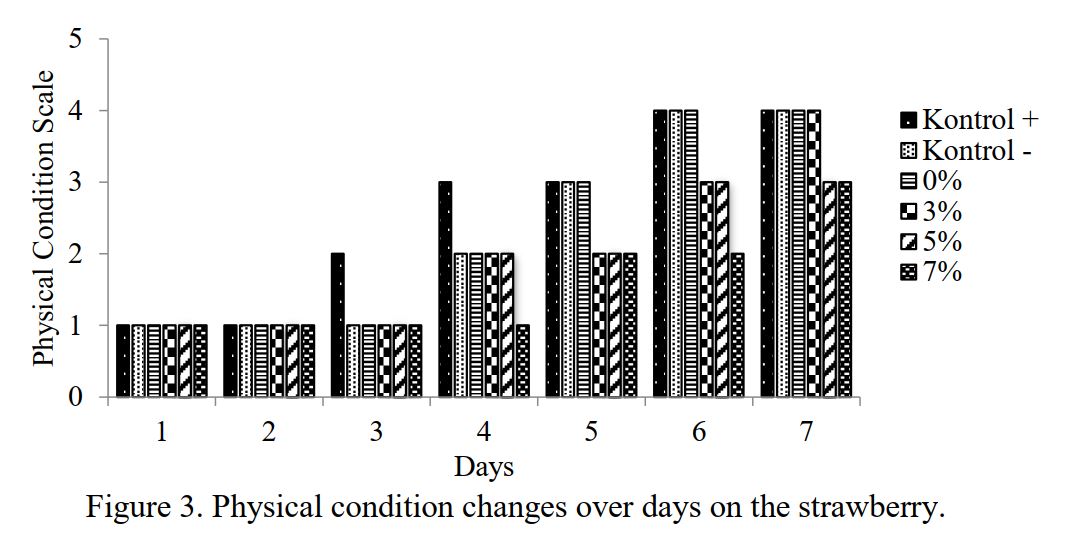
The increasing use of non-degradable plastic packaging has raised serious environmental concerns, highlighting the need for biodegradable alternatives such as starch-based edible coatings. Avocado seed starch (Persea americana Mill.) represents a promising renewable raw material; however, starch-based coatings suffer from poor water resistance and susceptibility to microbial growth. Therefore, Vetiveria zizanioides L. was incorporated as a natural antimicrobial agent. This study contributed to characterize the physical properties of the edible coating and evaluate its performance when applied to strawberries and dodol. The methods included starch and extract preparation, coating formulation, physical characterization, and application tests. The edible coatings were fabricated using avocado seed starch with vetiver root extract at concentrations of 0%, 3%, 5%, and 7%. Subsequently, characterization tests were conducted, including thickness, solubility, and elasticity tests, as well as an application test on food products, which are strawberries and dodol. The results indicate that the edible coating containing 7% vetiver root extract had the highest film thickness and solubility, while the 5% vetiver root extract had the highest elasticity. Moreover, the application test of an edible coating containing 7% vetiver root extract on strawberries showed the highest effectiveness in preserving the physical condition for up to 7 days, while the application test on dodol showed the highest effectiveness in preserving the physical condition for up to 7 weeks. These findings indicate the potential of an edible coating made from avocado seed starch and vetiver root extract as an environmentally friendly food coating to preserve the quality of food products.
References
S. Karanth, S. Feng, D. Patra, and A. K. Pradhan, “Linking microbial contamination to food spoilage and food waste: The role of smart packaging, spoilage risk assessments, and date labeling,” Front. Microbiol., vol. 14, 2023, https://doi.org/10.3389/fmicb.2023.1198124.
A. Karnwal, G. Kumar, R. Singh, M. Selvaraj, T. Malik, and A. R. M. Al Tawaha, “Natural biopolymers in edible coatings: Applications in food preservation,” Food Chem. X, vol. 25, p. 102171, 2025, https://doi.org/10.1016/j.fochx.2025.102171.
R. Prakash, A. B. Altemimi, P. C. Nath, V. K. Pandey, P. Yadav, A. Tripathi, and S. Rustagi, “Recent advances on biopolymeric plant-based edible coatings and films: Antimicrobial strategies for enhanced food safety,” Prog. Org. Coatings, vol. 208, p. 109482, 2025, https://doi.org/10.1016/j.porgcoat.2025.109482.
M. Iñiguez-Moreno, “A review of edible coatings for fruits and vegetables: Biopolymeric bases, application strategies, regulatory challenges, and future research gaps,” Int. J. Biol. Macromol., vol. 335, p. 149260, 2026, https://doi.org/10.1016/j.ijbiomac.2025.149260.
Y. A. Shah, S. Bhatia, A. Al-Harrasi, and T. S. Khan, “Advancements in the biopolymer films for food packaging applications: A short review,” Biotechnol. Sustain. Mater., vol. 1, no. 1, p. 2, 2024, https://doi.org/10.1186/s44316-024-00002-1.
M. Iñiguez-Moreno and R. B. González-González, “Effect of gelatin and salicylic acid incorporated in chitosan coatings on strawberry preservation,” Int. J. Biol. Macromol., vol. 305, p. 140918, 2025, https://doi.org/10.1016/j.ijbiomac.2025.140918.
H. Li, Z. Gao, X. Zhang, Z. Li, L. Meng, S. Li, and H. Wang, “Polysaccharide-based edible films loaded with bioactive components for food applications: A review,” Int. J. Biol. Macromol., vol. 328, p. 147589, 2025, https://doi.org/10.1016/j.ijbiomac.2025.147589.
A. Sharma and A. Singh, “Sodium alginate: A green biopolymer resource-based antimicrobial edible coating to enhance fruit shelf-life: A review,” Colloids and Interfaces, vol. 9, no. 3, p. 32, 2025, https://doi.org/10.3390/colloids9030032.
R. G. Araújo, R. M. Rodriguez-Jasso, H. A. Ruiz, M. M. E. Pintado, and C. N. Aguilar, “Avocado by-products: Nutritional and functional properties,” Trends Food Sci. Technol., vol. 80, pp. 51–60, 2018, https://doi.org/10.1016/j.tifs.2018.07.027.
S. H. F. Martins, K. V. Pontes, R. L. Fialho, and F. M. Fakhouri, “Extraction and characterization of the starch present in the avocado seed (Persea americana Mill) for future applications,” J. Agric. Food Res., vol. 8, p. 100303, 2022, https://doi.org/10.1016/j.jafr.2022.100303.
R. dwi Agustin, A. Hakim, and S. Ariani, “Perbandingan kadar metabolit sekunder ekstrak akar wangi (Vetiveria zizanioides L.) berdasarkan faktor naungan guna membantu perkuliahan kimia bahan alam,” Chem. Educ. Pract., vol. 7, no. 1, pp. 141–151, 2024, https://doi.org/10.29303/cep.v7i1.6326.
J. Filippi, “Norsesquiterpenes as markers of overheating in Indonesian vetiver oil,” Flavour Fragr. J., vol. 29, no. 3, pp. 137–142, 2014, https://doi.org/10.1002/ffj.3189.
A. David, A. Fărcaș, and S. A. Socaci, “An overview of the chemical composition and bioactivities of Vetiveria zizanioides (L.) Nash essential oil,” Trends Food Sci. Technol., vol. 140, p. 104153, 2023, https://doi.org/10.1016/j.tifs.2023.104153.
B. K. Hapsari, R. Sahabuddin, and R. I. Vebrianty, “Scented root extract (Vetiveria zizanioides L.) inhibits Bacillus cereus growth in-vitro,” Berk. Kedokt., vol. 20, no. 1, p. 99, 2024, https://doi.org/10.20527/jbk.v20i1.18918.
M. Grover, T. Behl, T. Virmani, S. Bhatia, A. Al-Harrasi, and L. Aleya, “Chrysopogon zizanioides–A review on its pharmacognosy, chemical composition and pharmacological activities,” Environ. Sci. Pollut. Res., vol. 28, no. 33, pp. 44667–44692, 2021, https://doi.org/10.1007/s11356-021-15145-1.
P. B. Yeram, A. Vora, and Y. A. Kulkarni, “In vivo and in silico toxicity studies of hydroalcoholic extract of Vetiveria zizanioides roots,” J. Ayurveda Integr. Med., vol. 16, no. 6, p. 101256, 2025, https://doi.org/10.1016/j.jaim.2025.101256.
A. L. Charles, N. Motsa, and A. A. Abdillah, “A comprehensive characterization of biodegradable edible films based on potato peel starch plasticized with glycerol,” Polymers (Basel)., vol. 14, no. 17, p. 3462, 2022, https://doi.org/10.3390/polym14173462.
F. Maruddin, R. Malaka, S. Baba, H. Amqam, M. Taufik, and S. Sabil, “Brightness, elongation and thickness of edible film with caseinate sodium using a type of plasticizer,” IOP Conf. Ser. Earth Environ. Sci., vol. 492, no. 1, p. 012043, 2020, https://doi.org/10.1088/1755-1315/492/1/012043.
ASTM D 882-02, “Standard Test Method for Tensile Properties of Thin Plastic Sheeting, ASTM International,” 2002
T. T. Pham, L. L. P. Nguyen, M. S. Dam, and L. Baranyai, “Application of edible coating in extension of fruit shelf life: Review,” AgriEngineering, vol. 5, no. 1, pp. 520–536, 2023, https://doi.org/10.3390/agriengineering5010034.
L. Chel-Guerrero, E. Barbosa-Martín, A. Martínez-Antonio, E. González-Mondragón, and D. Betancur-Ancona, “Some physicochemical and rheological properties of starch isolated from avocado seeds,” Int. J. Biol. Macromol., vol. 86, pp. 302–308, 2016, https://doi.org/10.1016/j.ijbiomac.2016.01.052.
F. Garavand, S. Jafarzadeh, I. Cacciotti, N. Vahedikia, Z. Sarlak, Ö. Tarhan, S. Yousefi, M. Rouhi, R. Castro-Muñoz, and S. M. Jafari, “Different strategies to reinforce the milk protein-based packaging composites,” Trends Food Sci. Technol., vol. 123, pp. 1–14, 2022, https://doi.org/10.1016/j.tifs.2022.03.004.
L. Arroyo-Esquivel, V. M. Jiménez, F. Vásquez, and P. Esquivel, “Plasticizers improved flexibility, homogeneity, and color stability in pitahaya (Hylocereus sp.) peel-based biopolymer films aimed at food packaging,” Ind. Crops Prod., vol. 227, p. 120757, 2025, https://doi.org/10.1016/j.indcrop.2025.120757.
M. Ebrahimi, M. J. Fabra, A. Martínez-Abad, T. Aussenac, V. Acha, and A. López-Rubio, “Water soluble lignin extract from ozonation of Miscanthus giganteus for bioactive starch packaging films,” Food Hydrocoll., vol. 168, p. 111564, 2025, https://doi.org/10.1016/j.foodhyd.2025.111564.
F. Zhao, L. Jiang, C. Wang, S. Li, D. Sun, Q. Ma, Z. Yu, Y. Liu, and W. Jiang, “Flexibility, dissolvability, heat-sealability, and applicability improvement of pullulan-based composite edible films by blending with soluble soybean polysaccharide,” Ind. Crops Prod., vol. 215, p. 118693, 2024, https://doi.org/10.1016/j.indcrop.2024.118693.
S. Nazir and I. A. Wani, “Development and characterization of an antimicrobial edible film from basil seed (Ocimum basilicum L.) mucilage and sodium alginate,” Biocatal. Agric. Biotechnol., vol. 44, p. 102450, 2022, https://doi.org/10.1016/j.bcab.2022.102450.
B. Aykanat, F. Genovese, N. Admane, V. Verrastro, S. M. Sanzani, M. M. Cavalluzzi, and A. Matera, “Effect of different postharvest pre-treatments on the overall quality of organic strawberries during cold storage,” J. Agric. Eng., vol. 56, no. 4, 2025, https://doi.org/10.4081/jae.2025.1752.
G. R. Dwivedi, S. Gupta, S. Roy, K. Kalani, A. Pal, J. P. Thakur, D. Saikia, A. Sharma, N. S. Darmwal, M. P. Darokar, and S. K. Srivastava, “Tricyclic sesquiterpenes from Vetiveria zizanoides (L.) nash as antimycobacterial agents,” Chem. Biol. Drug Des., vol. 82, no. 5, pp. 587–594, 2013, https://doi.org/10.1111/cbdd.12188.
A. Kumar, S. Das, S. Ali, S. G. Jaiswal, A. Rabbani, S. M. E. Rahman, R. Chelliah, D.-H. Oh, S. Liu, and S. Wei, “Mechanisms, applications and challenges of natural antimicrobials in food system,” Food Biosci., vol. 74, p. 107864, 2025, https://doi.org/10.1016/j.fbio.2025.107864.
M. Zhou, J. Ma, Y. Yi, T. Min, H. Wang, Z. Wei, H. Wang, and M. Zhou, “Chitosan-based edible coating containing ascorbic acid/curcumin for improving postharvest quality and storability of strawberry fruits,” J. Futur. Foods, vol. 12, 2025, https://doi.org/10.1016/j.jfutfo.2025.10.039.
V. Gigante, B. D. Pont, A. Cavallero, C. Sbrana, L. P. Fabbri, M. Gabriele, and L. Aliotta, “Designing eco-friendly edible coatings, valorising agro-wastes, to extend the shelf-life of post-harvest strawberries,” Carbohydr. Polym. Technol. Appl., vol. 11, p. 100984, 2025, https://doi.org/10.1016/j.carpta.2025.100984.
A. Choudhary, M. M. Tosif, A. Bains, G. Goksen, R. Nagraik, S. B. Dhull, N. Ali, N. Muzaffar, and P. Chawla, “Impact of organic acid cross-linking on the structure and functional properties of gum arabic and guar gum: Formulation of an edible coating for enhancing strawberry shelf life,” Food Chem. X, vol. 28, p. 102527, 2025, https://doi.org/10.1016/j.fochx.2025.102527.
A. A. R. Devi and D. P. Koeswiryono, “Analisis kualitas dodol dengan bahan campuran tepung kulit manggis,” J. Ilm. Pariwisata dan Bisnis, vol. 2, no. 11, pp. 2404–2411, 2023, https://doi.org/10.22334/paris.v2i11.608.
G. Anzalina and D. L. Rahayu, “Penentuan umur simpan dodol kacang merah menggunakan metode accelerated shelf life test (ASLT) model arrhenius,” Edufortech, vol. 5, no. 1, 2020, https://doi.org/10.17509/edufortech.v5i1.23918.
F. Nasaruddin, N. L. Chin, and Y. A. Yusof, “Effect of processing on instrumental textural properties of traditional dodol using back extrusion,” Int. J. Food Prop., vol. 15, no. 3, pp. 495–506, 2012, https://doi.org/10.1080/10942912.2010.491932.
A. Rusli, Syamsuar, A. Santi, S. Malle, F. Arfini, M. A. Arsyad, I. Syukroni, and M. G. Inthe, “Application of antimicrobial edible film incorporated with Caulerpa racemosa crude extract as active packaging of seaweed dodol,” Appl. Food Res., vol. 4, no. 2, p. 100625, 2024, https://doi.org/10.1016/j.afres.2024.100625.
N. W. Sri Agustini, K. Kusmiati, R. Admirasari, D. A. Nurcahyanto, N. Hidhayati, M. Apriastini, F. Afiati, D. Priadi, B. M. Fitriani, Y. Adalina, and R. Z. Ahmad, “Characterization of corn-starch edible film with the addition of microalgae extract Chlorella vulgaris as an antioxidant applied to dodol (glutinous-rice cake) products,” Case Stud. Chem. Environ. Eng., vol. 8, p. 100511, 2023, https://doi.org/10.1016/j.cscee.2023.100511.
Downloads
Published
Issue
Section
License
Copyright (c) 2026 Gempur Irawan Supena Putra, Syahidah Asma Amanina, Iis Tentia Agustin, Nurlia Damayanti

This work is licensed under a Creative Commons Attribution-ShareAlike 4.0 International License.
Authors who publish with the Journal of Agri-food Science and Technology (JAFOST) agree to the following terms:
- Authors retain copyright and grant the journal right of first publication with the work simultaneously licensed under a Creative Commons Attribution License (CC BY-SA 4.0) that allows others to share the work with an acknowledgment of the work's authorship and initial publication in this journal.
- Authors are able to enter into separate, additional contractual arrangements for the non-exclusive distribution of the journal's published version of the work (e.g., post it to an institutional repository or publish it in a book), with an acknowledgment of its initial publication in this journal.
- Authors are permitted and encouraged to post their work online (e.g., in institutional repositories or on their website) prior to and during the submission process, as it can lead to productive exchanges, as well as earlier and greater citation of published work.