Optimization and Interaction Effects of a Traditional Antioxidant Polyherbal Drink using Design Expert
DOI:
https://doi.org/10.12928/jafost.v7i1.14491Keywords:
Antioxidant, Ginger, Optimization, Polyherbal formulation, TurmericAbstract
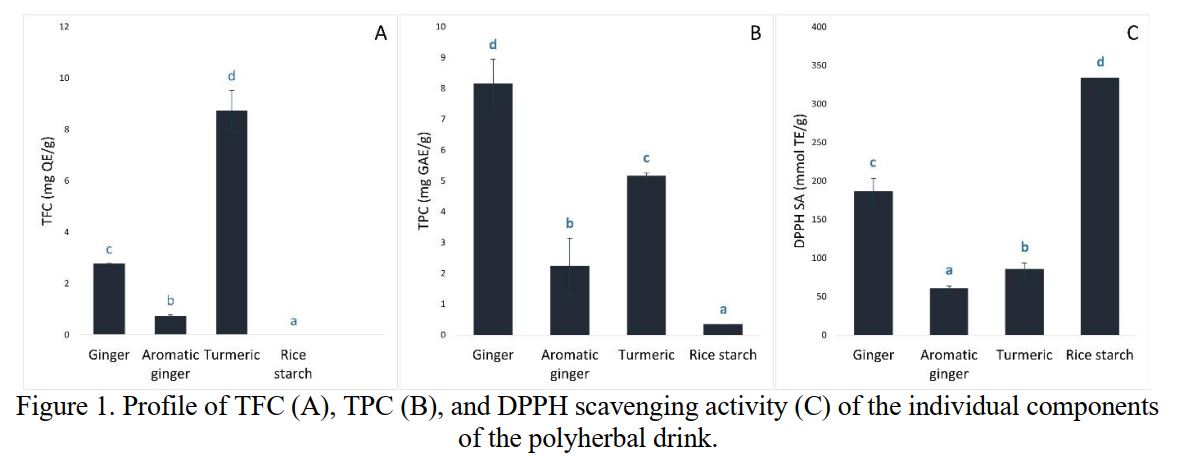
A polyherbal drink consisting of ginger, aromatic ginger, turmeric and rice starch is utilized by the people of Baturraden, Central Java, to treat masuk angin. This study contributed to optimize the ratio of the component crude drugs for obtaining a formulation with most favorable antioxidant properties. Twenty formulations were prepared by mixing powdered ginger, aromatic ginger, turmeric, and rice starch in different weight ratios. Each formulation was extracted using the decoction method for 30 minutes, with a crude drug-to-water ratio of 1:20. The extracts were subjected to the standard total flavonoid content (TFC), total phenolic content (TPC), and 2,2-diphenyl-1-picrylhydrazyl (DPPH) scavenging activity assays. The TFC, TPC, and DPPH scavenging activity was used as the response for predicting the interaction effect and optimal composition of the formulation by simplex lattice design (LSD). The results showed that the highest TFC, TPC, and DPPH scavenging activity was observed in Formula 8 (turmeric only, 10.0 ± 0.01 mg QE/g), Formula 3 (a combination of equal ratios of ginger and turmeric, 9.01 ± 0.01 mg GAE/g), and Formula 10 (rice starch only, 333.76 ± 0.04 mmol TE/g), respectively. The antagonistic interaction effect on the DPPH scavenging activity was observed in most formulations. A synergistic effect was only predicted to occur in a combination of ginger, aromatic ginger, and turmeric. The incorporation of rice starch into the formulations resulted in an antagonistic interaction. These findings support the refinement of traditional polyherbal drinks by optimizing crude drug ratios to enhance antioxidant potential.
References
C. T. Sulaiman, K. Anju, E. M. Anandan, and I. Balachandran, “Synergistic interactions of phytochemicals in polyherbal formulation enhance the chemical transformations of active constituents,” J. Appl. Spectrosc., vol. 88, pp. 181–186, 2021, https://doi.org/10.1007/s10812-021-01156-w.
W. Utaminingrum, Nofrianti, and D. Hartanti, “Ethnopharmacological study of the polyherbal formula in Baturraden, Indonesia,” Suranaree J. Sci. Technol., vol. 28, no. 5, pp. 1–8, 2021, https://www.thaiscience.info/Journals/Article/SJST/10994366.pdf.
R. E. Mutha, A. U. Tatiya, and S. J. Surana, “Flavonoids as natural phenolic compounds and their role in therapeutics: An overview,” Futur. J. Pharm. Sci., vol. 7, no. 1, p. 25, 2021, https://doi.org/10.1186/s43094-020-00161-8.
V. L. Yap, L. F. Tan, M. Rajagopal, C. Wiart, M. Selvaraja, M. Y. Leong, and P. L. Tan, “Evaluation of phytochemicals and antioxidant potential of a new polyherbal formulation TC-16: Additive, synergistic or antagonistic?,” BMC Complement. Med. Ther., vol. 23, p. 93, 2023, https://doi.org/10.1186/s12906-023-03921-0.
T. M. Mapeka, M. Sandasi, A. M. Viljoen, and S. F. van Vuuren, “Optimization of antioxidant synergy in a polyherbal combination by experimental design,” Molecules, vol. 27, no. 13, p. 4196, 2022, https://doi.org/10.3390/molecules27134196.
A. D. Rahma and F. Yunita, “Gambaran tingkat pengetahuan pengobatan tradisional terhadap masuk angin pada masyarakat Desa Kota Agung,” J. Med. Nusant., vol. 1, no. 3, pp. 122–133, 2023, https://doi.org/10.59680/medika.v1i3.
A. Puspitasari, A. Hamad, and D. Hartanti, “Crude drugs standardization, total flavonoid and phenolic content profile, and antimicrobial activity of red ginger and lemongrass combination,” J. Tumbuh. Obat Indones., vol. 17, no. 2, pp. 115–130, 2024, https://doi.org/10.31002/jtoi.v16i2.885.
A. A. Alfuraydi, I. M. Aziz, and F. N. Almajhdi, “Assessment of antioxidant, anticancer, and antibacterial activities of the rhizome of ginger (Zingiber officinale),” J. King Saud Univ. – Sci., vol. 6, no. 3, p. 103112, 2024, https://doi.org/10.1016/j.jksus.2024.103112.
P. Wichayapreechar, R. Charoenjittichai, A. Prasansuklab, M. P. Vinardell, and W. Rungseevijitprapa, “Exploring the in vitro antioxidant, anti-aging, and cytotoxic properties of Kaempferia galanga Linn. rhizome extracts for cosmeceutical formulations,” Cosmetics, vol. 11, no. 3, p. 97, 2024, https://doi.org/10.3390/cosmetics11030097.
N. Sharma, N. Gupta, R. Orfali, V. Kumar, C. N. Patel, J. Peng, and S. Perveen, “Evaluation of the antifungal, antioxidant, and anti-diabetic potential of the essential oil of Curcuma longa leaves from the North-Western Himalayas by in vitro and in silico analysis,” Molecules, vol. 27, p. 7664, 2022, https://doi.org/10.3390/molecules27227664.
T. Estiasih, J. M. Maligan, J. E. Witoyo, A. A. H. Mu’alim, K. Ahmadi, T. Mahatmanto, and E. Zubaidah, “Indonesian traditional herbal drinks: Diversity, processing, and health benefits,” J. Ethn. Foods, vol. 12, no. 1, p. 7, 2025, https://doi.org/10.1186/s42779-025-00267-5.
T. K. Wardani, E. Arianingsih, A. Syarifah, A. Hamad, and D. Hartanti, “Crude drug standardization, formula optimization, and interaction effects of a five-component antioxidant polyherbal formulation,” J. Jamu Indones., vol. 10, no. 2, pp. 93–101, 2025, https://doi.org/10.29244/jji.v10i2.353.
N. F. A. Rahim, N. Muhammad, N. Abdullah, B. A. Talip, and K. H. Poh, “The interaction effect and optimal formulation of selected polyherbal extracts towards antioxidant activity,” Food Res., vol. 4, no. 6, pp. 2042–2048, 2020, https://doi.org/10.26656/fr.2017.4(6).281.
S. Paul and M. Majumdar, “Comparative study of six antidiabetic polyherbal formulation for its multimodal approaches in diabetes management,” 3 Biotech, vol. 12, no. 5, p. 114, 2022, https://doi.org/10.1007/s13205-022-03166-7.
D. Galvan, L. Effting, H. Cremasco, and C. A. Conte-Junior, “Recent applications of mixture designs in beverages, foods, and pharmaceutical health: A systematic review and meta-analysis,” Foods, vol. 10, no. 8, p. 1941, 2021, https://doi.org/10.3390/foods10081941.
F. Wicaksana, D. Hartanti, and A. Hamad, “Antioxidant properties of various yacon leaf water extracts and physicochemical profile of decoction during refrigerated storage,” J. Farm. dan Ilmu Kefarmasian Indones., vol. 11, no. 2, pp. 128–136, 2024, https://doi.org/10.20473/jfiki.v11i12024.128-136.
D. Hartanti and A. Hamad, “Antioxidant properties and interaction effects of a novel polyherbal formulation,” Curr. Trends Biotechnol. Pharm., vol. 17, no. 4A, pp. 28–33, 2023, https://doi.org/10.5530/ctbp.2023.4s.87.
P. Kulyal, S. Acharya, A. B. Ankari, P. K. Kokkiripati, S. D. Tetali, and A. S. Raghavendra, “Variable secondary metabolite profiles across cultivars of Curcuma longa L. and C. aromatica Salisb.,” Front. Pharmacol., vol. 12, p. 659546, 2021, https://doi.org/10.3389/fphar.2021.659546.
R. Jan, A. Gani, M. M. Dar, and N. A. Bhat, “Bioactive characterization of ultrasonicated ginger (Zingiber officinale) and licorice (Glycyrrhiza glabra) freeze dried extracts,” Ultrason. Sonochem., vol. 88, p. 106048, 2022, https://doi.org/10.1016/j.ultsonch.2022.106048.
T. Chumroenphat, I. Somboonwatthanakul, S. Saensouk, and S. Siriamornpun, “Changes in curcuminoids and chemical components of turmeric (Curcuma longa L.) under freeze-drying and low-temperature drying methods,” Food Chem., vol. 339, p. 128121, 2021, https://doi.org/10.1016/j.foodchem.2020.128121.
H. Tohma, İ. Gülçin, E. Bursal, A. C. Gören, S. H. Alwasel, and E. Köksal, “Antioxidant activity and phenolic compounds of ginger (Zingiber officinale Rosc.) determined by HPLC-MS/MS,” J. Food Meas. Charact., vol. 11, pp. 556–566, 2016, https://doi.org/10.1007/s11694-016-9423-z.
S.-Y. Wang, H. Zhao, H.-T. Xu, X.-D. Han, Y.-S. Wu, F.-F. Xu, X.-B. Yang, U. Göransson, and B. Liu, “Kaempferia galanga L.: Progresses in phytochemistry, pharmacology, toxicology and ethnomedicinal uses,” Front. Pharmacol., vol. 12, p. 675350, 2021, https://doi.org/10.3389/fphar.2021.675350.
A. P. Bonto, R. N. Tiozon, N. Sreenivasulu, and D. H. Camacho, “Impact of ultrasonic treatment on rice starch and grain functional properties: A review,” Ultrason. Sonochem., vol. 71, p. 105383, 2020, https://doi.org/10.1016/j.ultsonch.2020.105383.
J. Zagórska, L. Czernicka-Boś, W. Kukula-Koch, K. Iłowiecka, and W. Koch, “Impact of thermal processing on the selected biological activities of ginger rhizome - A review,” Molecules, vol. 28, no. 1, p. 412, 2023, https://doi.org/10.3390/molecules28010412.
H. Wu, Z. Liu, Y. Zhang, B. Gao, Y. Li, X. He, J. Sun, U. Choe, P. Chen, R. A. Blaustein, and L. Yu, “Chemical composition of turmeric (Curcuma longa L.) ethanol extract and its antimicrobial activities and free radical scavenging capacities,” Foods, vol. 13, no. 10, p. 1550, 2024, https://doi.org/10.3390/foods13101550.
D. R. L. Wahyuni, W. Widowati, H. S. W. Kusuma, D. K. Pratami, C. R. Wijayanti, and C. Dewi, “Antioxidant potency of Kaempferia galanga Linn and Zingiber officinale var. Rubra rhizomes,” in 2021 IEEE International Conference on Health, Instrumentation & Measurement, and Natural Sciences, 2021. https://doi.org/10.1109/InHeNce52833.2021.9537220.
A. Windarsih, A. W. Indrianingsih, R. Suryani, T. Wiyono, E. Noviana, C. Darsih, E. Rahayu, R. Pangestuti, S. M. Asari, S. I. Pratiwi, W. Apriyana, V. T. Rosyida, and M. I. Sulistyowaty, “Evaluation of the antioxidant, antidiabetic, and antibacterial activity of Curcuma domestica, Zingiber officinale, Alpinia galanga, Curcuma xanthorrhiza, and Kaempferia galanga concurrent with its metabolite’s constituent analysis,” Chem. Biodivers., p. e00645, 2015, https://doi.org/10.1002/cbdv.202500645.
B. Shukla and P. Kushwaha, “Exploring the HPLC profiling and antioxidant potency in methanolic extracts of Curcuma longa L. rhizomes,” Drug Res. (Stuttg)., vol. 74, no. 9, p. 475-482, 2024, https://doi.org/10.1055/a-2413-3740.
I. Mustafa and N. L. Chin, “Antioxidant properties of dried ginger (Zingiber officinale Roscoe) var. Bentong,” Foods, vol. 12, no. 1, p. 178, 2023, https://doi.org/10.3390/foods12010178.
Y. M. Muflihah, G. Gollavelli, and Y.-C. Lin, “Correlation study of antioxidant activity with phenolic and flavonoid compounds in 12 Indonesian indigenous herbs,” Antioxid., vol. 10, no. 10, p. 1530, 2021, https://doi.org/10.3390/antiox10101530.
D. Hartanti, M. F. Romdhoni, and A. Hamad, “Crude drug standardization and antioxidant properties of an Indonesian antidiabetic polyherbal formulation and plant constituents,” Trop. J. Nat. Prod. Res., vol. 9, no. 5, pp. 2074–2080, 2025, https://doi.org/10.26538/tjnpr/v9i5.28.
A. Hamad and D. Hartanti, “Multi-response optimization of antioxidant and total phenols-flavonoids content of polyherbal extract drink from turmeric, Java tea, and seed-under-leaf,” BioResources, vol. 20, no. 1, pp. 1676–1690, 2025, https://doi.org/10.15376/biores.20.1.1676-1690.
A. Zeb, “Concept, mechanism, and applications of phenolic antioxidants in foods,” J. Food Biochem., vol. 44, no. 1, p. e13394, 2020, https://doi.org/10.1111/jfbc.13394.
T. Kunz, E.-J. Lee, V. Schiwek, T. Seewald, and F.-J. Methner, “Glucose – a reducing sugar? Reducing properties of sugars in beverages and food,” Brew. Sci. – Monatsschrift für Brauwiss., vol. 64, no. 7/8, pp. 61–67, 2011, https://brewingscience.de/index.php/brewingscience/article/view/410.
K. H. Poh, N. Muhammad, N. Abdullah, and B. A. Talip, “The evaluation of antioxidant activity of individual and mixture of lemongrass, curry leaves, turmeric and ginger extracts,” J. Sci. Technol., vol. 10, no. 2, pp. 66–70, 2018, https://doi.org/10.30880/jst.2018.10.02.011.
Downloads
Published
Issue
Section
License
Copyright (c) 2026 Dwi Hartanti, Alwani Hamad, Satriyo Krido Wahono, Addien Anugerah Insani, Firman Wicaksana

This work is licensed under a Creative Commons Attribution-ShareAlike 4.0 International License.
Authors who publish with the Journal of Agri-food Science and Technology (JAFOST) agree to the following terms:
- Authors retain copyright and grant the journal right of first publication with the work simultaneously licensed under a Creative Commons Attribution License (CC BY-SA 4.0) that allows others to share the work with an acknowledgment of the work's authorship and initial publication in this journal.
- Authors are able to enter into separate, additional contractual arrangements for the non-exclusive distribution of the journal's published version of the work (e.g., post it to an institutional repository or publish it in a book), with an acknowledgment of its initial publication in this journal.
- Authors are permitted and encouraged to post their work online (e.g., in institutional repositories or on their website) prior to and during the submission process, as it can lead to productive exchanges, as well as earlier and greater citation of published work.