The Effect of Using Tween 80 as A Foaming Agent on Drying Corn-Yogurt Using the Foam-Mat Method
DOI:
https://doi.org/10.12928/jafost.v7i1.14194Keywords:
Corn-yogurt, Foam-mat drying, Powder, Solubility, Tween 80Abstract
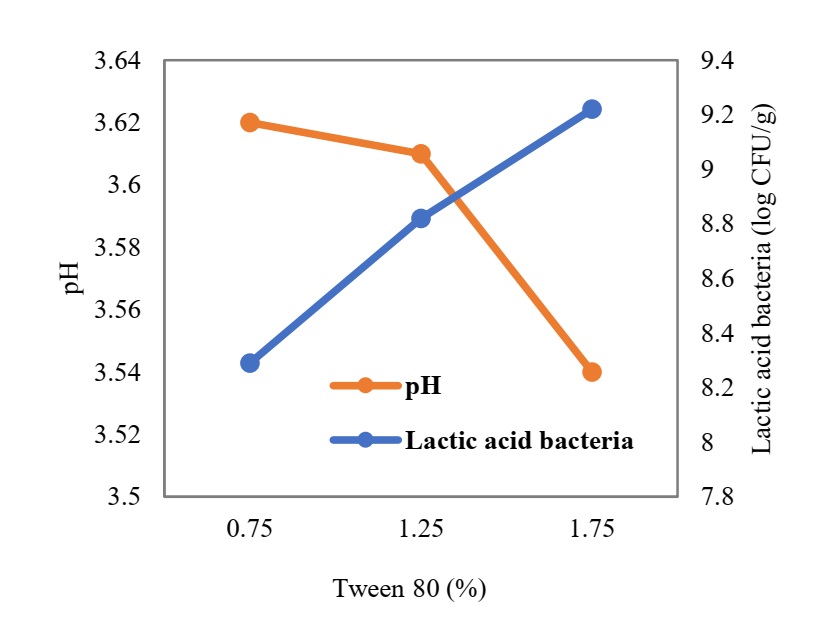
The public's appetite for foods that are both satiating and offer distinct functional benefits has driven an increasing demand for functional foods. Corn yogurt is a type of functional food now under development. Corn yogurt is a fermented product with a relatively high moisture content and low protein content. To increase the protein content, it is fortified with spirulina and soy protein isolate. To extend its shelf life, corn yogurt is made into powder form using the foam mat drying method. This study contributes to determining the effect of Tween 80 concentration as a foaming agent on the physicochemical, functional, and sensory properties of corn-yogurt powder. Corn yogurt fortified with spirulina and soy protein isolate was dried using the foam-mat method, with maltodextrin and Tween 80 as foaming agents. The foaming agents were mixed for 8 minutes until foaming occurred, and the fortified yogurt was incorporated using the folding method. The mixture was poured onto a glass plate and dried in a cabinet dryer at 60 °C for 8 h. The dried sample was ground and sieved through 80 mesh. The dried yogurt has a protein content of 4.08–4.329%. The pH of the corn yogurt was lower than the range specified by the Indonesian National Standard (3.54–3.62); hence, this product was sourer than typical yogurts. The best corn yogurt powder was prepared with 1.75% Tween 80 and had 72.67% antioxidant activity, 133.76 µg/100 g β-carotene, and 9.22×10⁷ log CFU/g lactic acid bacteria. This fortified corn yogurt powder shows potential as an alternative functional food product because of its functional compounds and high protein content.
References
N. Aini, V. Prihananto, G. Wijonarko, A. Arimah, and M. Syaifudin, “Effect of culture concentration and sweet potato prebiotic to the properties of sweet corn juice probiotic,” Agritech, vol. 37, no. 2, pp. 165–172, 2017, https://doi.org/10.22146/agritech.25892.
S. Sivasakthi, G. Usharani, and P. Saranraj, “Biocontrol potentiality of plant growth promoting bacteria (PGPR) - Pseudomonas fluorescens and Bacillus subtilis: A review,” African J. Agric. Res., vol. 9, no. 16, pp. 1265–1277, 2014, https://doi.org/10.5897/AJAR2013.7914.
M. Barkallah, M. Dammak, I. Louati, F. Hentati, B. Hadrich, T. Mechichi, M. A. Ayadi, I. Fendri, H. Attia, and S. Abdelkafi, “Effect of Spirulina platensis fortification on physicochemical, textural, antioxidant and sensory properties of yogurt during fermentation and storage,” LWT - Food Sci. Technol., vol. 84, pp. 323–330, 2017, https://doi.org/10.1016/j.lwt.2017.05.071.
A. Mohamed and I. Darwish, “Physicochemical properties, bioactive compounds and antioxidant activity of kareish cheese fortified with Spirulina platensis,” World J. Dairy Food Sci., vol. 12, no. 2, pp. 71–78, 2017, https://doi.org/10.5829/idosi.wjdfs.2017.71.78.
X. Xu, H. Cui, J. Xu, Z. Yuan, X. Liu, X. Fan, J. Li, D. Zhu, and H. Liu, “Effects of different probiotic fermentations on the quality, soy isoflavone and equol content of soy protein yogurt made from soy whey and soy embryo powder,” Lwt, vol. 157, p. 113096, 2022, https://doi.org/10.1016/j.lwt.2022.113096.
N. Aini, B. Sustriawan, Muthmainah, M. R. Maulina, V. Prihananto, and G. Wijonarko, “Estimation of the shelf-life of corn yogurt packaged in polyethene terephthalate using the accelerated shelf-life method,” Int. J. Adv. Sci. Eng. Inf. Technol., vol. 11, no. 1, pp. 298–303, 2021, https://doi.org/10.18517/ijaseit.11.1.7720.
N. Aini, V. Prihananto, G. Wijonarko, Y. Astuti, M. R. Maulina, and Muthmainah, “Quality deterioration and shelf life estimation of corn yogurt was packaged by glass bottle,” Adv. Sci. Lett., vol. 23, no. 6, pp. 5796–5798, 2017, https://doi.org/10.1166/asl.2017.8835.
G. Santos, T. P. Nunes, M. A. P. Silva, A. Rosenthal, and A. A. C. Pagani, “Development and acceptance of freeze-dried yogurt “powder yogurt”,” Int. Food Res. J., vol. 25, no. 3, pp. 1159–1165, 2018, http://cabidigitallibrary.org/doi/pdf/10.5555/20183383228.
E. A. Ismail, A. A. Aly, and A. A. Atallah, “Quality and microstructure of freeze-dried yogurt fortified with additives as protective agents,” Heliyon, vol. 6, no. 10, p. e05196, 2020, https://doi.org/10.1016/j.heliyon.2020.e05196.
M. Jouki, N. Khazaei, F. Rezaei, and R. Taghavian-Saeid, “Production of synbiotic freeze-dried yogurt powder using microencapsulation and cryopreservation of L. plantarum in alginate-skim milk microcapsules,” Int. Dairy J., vol. 122, p. 105133, 2021, https://doi.org/10.1016/j.idairyj.2021.105133.
F. R. Reis, A. C. S. de Moraes, and M. L. Masson, “Impact of foam-mat drying on plant-based foods bioactive compounds: A review,” Plants Food Hum. Nutr., vol. 76, pp. 153–160, 2021, https://doi.org/10.1007/s11130-021-00899-3.
S. Asokapandian, S. Venkatachalam, G. J. Swamy, and K. Kuppusamy, “Optimization of foaming properties and foam mat drying of muskmelon using soy protein,” J. Food Process Eng., vol. 39, no. 6, pp. 692–701, 2016, https://doi.org/10.1111/jfpe.12261.
G. Ç. Koç, Y. Tekgül, A. N. Yüksel, A. C. Khanashyam, A. Kothakota, and R. Pandiselvam, “Recent development in foam-mat drying process: Influence of foaming agents and foam properties on powder properties,” J. Surfactans Deterg., vol. 25, no. 5, pp. 539–557, 2022, https://doi.org/10.1002/jsde.12608.
C. D. de Cól, B. Tischer, S. Hickmann Flôres, and R. Rech, “Foam-mat drying of bacaba (Oenocarpus bacaba): Process characterization, physicochemical properties, and antioxidant activity,” Food Bioprod. Process., vol. 126, pp. 23–31, 2021, https://doi.org/10.1016/j.fbp.2020.12.004.
T. S. Li, R. Sulaiman, Y. Rukayadi, and S. Ramli, “Effect of gum Arabic concentrations on foam properties, drying kinetics and physicochemical properties of foam mat drying of cantaloupe,” Food Hydrocoll., vol. 116, p. 106492, 2021, https://doi.org/10.1016/j.foodhyd.2020.106492.
D. Purbasari, “Aplikasi metode foam-mat drying dalam pembuatan bubuk susu kedelai instan,” J. Agroteknologi, vol. 13, no. 01, p. 52, 2019, https://doi.org/10.19184/j-agt.v13i01.9253.
Z. Izadi, M. Mohebbi, F. Shahidi, M. Varidi, and M. R. Salahi, “Cheese powder production and characterization: A foam-mat drying approach,” Food Bioprod. Process., vol. 123, pp. 225–237, 2020, https://doi.org/10.1016/j.fbp.2020.06.019.
P. Sansomchai, R. Sroynak, and T. Tikapunya, “Powder qualities of foam-mat dried mango,” Trends Sci., vol. 20, no. 5, pp. 1–7, 2023, https://doi.org/10.48048/tis.2023.5308.
A. N. Yüksel, “Development of yogurt powder using microwave-assisted foam-mat drying,” J. Food Sci. Technol., vol. 58, no. 7, pp. 2834–2841, 2021, https://doi.org/10.1007/s13197-021-05035-2.
N. Prajapat, D. P. Patel, K. Meghwal, and S. K. Jain, “Foam mat drying of high value foods,” Int. J. Agric. Sci., vol. 15, no. 7, pp. 12455–12457, 2023, https://bioinfopublication.org/pages/article.php?id=BIA0006244.
M. A. Hossain, T. Ahmed, J. Ferdaus, and W. Zzaman, “Optimization of the foam-mat drying process to develop high-quality tomato powder: A response surface methodology approach,” Heliyon, vol. 10, no. 21, p. e39811, 2024, https://doi.org/10.1016/j.heliyon.2024.e39811.
R. Wahyuni, W. Wignyanto, S. Wijana, and S. Sucipto, “Optimization of foam mat drying process of moringa leaf powder (Moringa oleifera) as protein and amino acids sources,” Food Res., vol. 5, pp. 418–426, 2021, https://doi.org/10.26656/fr.2017.5(2).539.
H. Rizqiati, N. Nurwantoro, A. Febrisiantosa, C. A. Shauma, and R. Khasanah, “Effect of soy protein isolate on physical and chemical characteristics of kefir powder,” J. Pangan dan Agroindustri, vol. 8, no. 3, pp. 111–121, 2020, https://doi.org/10.21776/ub.jpa.2020.008.03.1.
AOAC, “Official methods of analysis of the association of official agricultural chemists international,” J. Assoc. Off. Agric. Chem., vol. 41, p. 12, 2005, https://www.researchgate.net/publication/292783651_AOAC_2005.
W. M. El-Kholy, R. A. Aamer, and A. N. A. Ali, “Utilization of inulin extracted from chicory (Cichorium intybus L.) roots to improve the properties of low-fat synbiotic yogurt,” Ann. Agric. Sci., vol. 65, no. 1, pp. 59–67, 2020, https://doi.org/10.1016/j.aoas.2020.02.002.
R. Gao, L. Xue, Y. Zhang, Y. Liu, L. Shen, and X. Zheng, “Production of blueberry pulp powder by microwave-assisted foam-mat drying: Effects of formulations of foaming agents on drying characteristics and physicochemical properties,” LWT - Food Sci. Technol., vol. 154, p. 112811, 2022, https://doi.org/10.1016/j.lwt.2021.112811.
K. Vivek, S. Mishra, and R. C. Pradhan, “Characterization of spray dried probiotic sohiong fruit powder with Lactobacillus plantarum,” Lwt, vol. 117, p. 108699, 2020, https://doi.org/10.1016/j.lwt.2019.108699.
T. Khamjae and T. Rojanakorn, “Foam-mat drying of passion fruit aril,” Int. Food Res. J., vol. 25, no. 1, pp. 204–212, 2018, http://www.ifrj.upm.edu.my/25%20(01)%202018/(26).pdf.
M. Benković, M. Pižeta, A. Jurinjak Tušek, T. Jurina, J. Gajdoš Kljusurić, and D. Valinger, “Optimization of the foam mat drying process for production of cocoa powder enriched with peppermint extract,” LWT-Food Sci. Technol., vol. 115, no. 108440, pp. 1–10, 2019, https://doi.org/10.1016/j.lwt.2019.108440.
L. C. Ribeiro, J. Maria, M. Rodrigues, and A. Afonso, “Flow behavior of cocoa pulp powder containing maltodextrin,” Brazilian J. Food Technol., vol. 23, pp. 1–8, 2020, https://doi.org/10.1590/1981-6723.03420.
T. Hariyadi, H. Santoso, and J. Retti Witono, “The influence of foaming agent and cake thickness on the drying process tomatoes using a tray dryer,” Reaktor, vol. 18, no. 03, pp. 143–148, 2018, https://doi.org/10.14710/reaktor.18.03.143-148.
Badan Standardisasi Nasional, “SNI 2982:2009 tentang Yoghurt.” p. 51, 2009.
Miskiyah, Juniawati, K. Ayu, and A. H. Mulyati, “Study on yogurt powder probiotic quality using foam-mat drying method,” IOP Conf. Ser. Earth Environ. Sci. Earth Environ. Sci., vol. 309, p. 012048, 2019, https://doi.org/10.1088/1755-1315/309/1/012048.
R. Pérez-Rosés, E. Risco, R. Vila, P. Peñalver, and S. Cañigueral, “Antioxidant activity of Tween-20 and Tween-80 evaluated through different in-vitro tests,” J. Pharm. Pharmacol., vol. 67, no. 5, pp. 666–672, 2015, https://doi.org/10.1111/jphp.12369.
R. M. S. Putri and S. N. Amrizal, “Optimization formula of instant powder functional drinks from Brunok (Acaudina molpadioides) using foam drying method,” Akuatikisle: J. Akuakultur, Pesisir dan Pulau-Pulau Kecil, vol. 4, no. 2, pp. 73–78, 2020, https://doi.org/10.29239/j.akuatikisle.4.2.73-78.
B. K. Qi, R. S. Yao, M. Lai, and S. S. Deng, “Effect of Tween 80 on production of lactic acid by Lactobacillus casei,” Songklanakarin J. Sci. Technol., vol. 31, no. 1, pp. 85–89, 2009, https://www.thaiscience.info/journals/Article/SONG/10617391.pdf.
A. Masykur and J. Kusnadi, “Properties of chemical and microbiology yogurt powder by cowpea (Vigna unguiculata L.) using freeze-drying methods (study of starter and dextrin addition),” J. Pangan dan Agroindustri, vol. 3, no. 3, pp. 1171–1179, 2015, https://jpa.ub.ac.id/index.php/jpa/article/view/240/249.
K. Das, R. Choudhary, and K. A. Thompson-Witrick, “Effects of new technology on the current manufacturing process of yogurt-to increase the overall marketability of yogurt,” Lwt, vol. 108, pp. 69–80, 2019, https://doi.org/10.1016/j.lwt.2019.03.058.
F. Savini, F. Giacometti, F. Tomasello, V. Indio, F. Gardini, F. Barbieri, L. Bardasi, M. Ramini, L. Prandini, Y. Terrefe, S. Alberto, A. De Cesare, and A. Serraino, “Impact of fish dry-curing on the behaviour of Listeria monocytogenes during the production of ready to eat fishery products,” LWT, vol. 204, p. 116381, 2024, https://doi.org/10.1016/j.lwt.2024.116381.
T. Khusniati, G. Trieska Dewi, A. P. Roswiem, S. Ayu Azhari, F. Ishfahani, and S. Sulistiani, “Carbohydrate degradation of tuber paste flour by the addition of α-amylase from two Lactobacillus species,” J. Teknol. dan Ind. Pangan, vol. 31, no. 1, pp. 60–65, 2020, https://doi.org/10.6066/jtip.2020.31.1.60.
L. Karimi and M. M. Dizajyekan, “Production of functional low-fat yogurt fortified with soy protein isolate lEILA,” Iran. J. Biosyst. Eng., vol. 52, no. 4, pp. 585–598, 2021, https://doi.org/10.2493/jjspe.87.947.
X. Zhao, M. Cheng, C. Wang, H. Jiang, and X. Zhang, “Effects of dairy bioactive peptides and lotus seeds/lily bulb powder on flavor and quality characteristics of goat milk yogurt,” Food Biosci., vol. 47, p. 101510, 2021, https://doi.org/10.1016/j.fbio.2021.101510.
L. Pan, Q. Wang, L. Qu, L. Liang, Y. Han, X. Wang, and Z. Zhou, “Pilot-scale production of exopolysaccharide from Leuconostoc pseudomesenteroides XG5 and its application in set yogurt,” J. Dairy Sci., vol. 105, no. 2, pp. 1072–1083, 2022, https://doi.org/10.3168/jds.2021-20997.
S. Sahraneshin Samani, S. Soleimanian-Zad, M. Sheikh-Zeinoddin, and M. Fathi, “Evaluation of Zataria multiflora boiss. and Carum copticum L. essential oil based nanoemulsions in inhibition of Byssochlamys fulva growth in apple juice,” J. Agric. Sci. Technol., vol. 21, no. 2, pp. 357–368, 2019, https://jast.modares.ac.ir/article_16271.html.
J. Dehghannya, M. Pourahmad, B. Ghanbarzadeh, and H. Ghaffari, “Influence of foam thickness on production of lime juice powder during foam-mat drying: Experimental and numerical investigation,” Powder Technol., vol. 328, pp. 470–484, 2018, https://doi.org/10.1016/j.powtec.2018.01.034.
S. F. M. Amin, R. Karim, Y. A. Yusof, and K. Muhammad, “Effects of enzymatic liquefaction, drying techniques, and wall materials on the physicochemical properties, bioactivities, and morphologies of zinc-amaranth (Amaranthus viridis L.) Powders,” Int. J. Food Sci., pp. 1–13, 2021, https://doi.org/10.1155/2021/1819104.
M. Malik and A. Sharma, “Optimisation of foam‐mat drying of yogurt and properties of powdered yogurt,” Int. J. Dairy Technol., vol. 72, no. 3, pp. 381–387, 2019, https://doi.org/10.1111/1471-0307.12594.
N. V Patel and A. K. Senapati, “Quality evaluation and storage study of banana-pineapple blended jam,” Int. J. Food Qual. Saf. , vol. 1, pp. 45–51, 2015, https://shorturl.at/1OUcN.
M. A. Halim, M. A. Wazed, S. Al Obaid, M. J. Ansari, A. Tahosin, M. T. Rahman, F. Noor, N. H. M. R. Mozumder, and A. A. Khatun, “Effect of storage on physicochemical properties, bioactive compounds and sensory attributes of drinks powder enriched with pumpkin (Cucurbita moschata L.),” J. Agric. Food Res., vol. 18, 2024, https://doi.org/10.1016/j.jafr.2024.101337.
O. A. Adebo and I. G. Medina-Meza, “Impact of fermentation on the phenolic compounds and antioxidant activity of whole cereal grains: A mini review,” Molecules, vol. 25, no. 4, pp. 1–19, 2020, https://doi.org/10.3390/molecules25040927.
Q. H. Pham, T. M. Ho, P. E. J. Saris, N. Mäkelä-Salmi, S. Amiri, M. Zarei, and A. Yousefvand, “Yogurts fortified with postbiotic powders derived from Lactobacillus acidophilus LA5: Physicochemical, rheological, antioxidant, and sensory properties,” Lwt, vol. 213, 2024, https://doi.org/10.1016/j.lwt.2024.117043.
S. Sulasih, A. M. Legowo, B. Iskandar, and M. Tampoebolon, “Antioxidant activity, lactic acid bacteria, viscosity, and L*a*b* value in yogurt enriched with probiotics Bifidobacterium longum and red dragon fruit (Hylocereus polyrhizus),” J. a Apl. Teknol. Pangan, vol. 7, no. 4, pp. 151–156, 2018, https://doi.org/https://doi.org/10.17728/jatp.3061.
A. Rehman, Q. Tong, S. M. Jafari, E. Assadpour, Q. Shehzad, R. M. Aadil, M. W. Iqbal, M. M. A. Rashed, B. S. Mushtaq, and W. Ashraf, “Carotenoid-loaded nanocarriers: A comprehensive review,” Adv. Colloid Interface Sci., vol. 275, p. 102048, 2020, https://doi.org/10.1016/j.cis.2019.102048.
D. F. Hasneen, N. L. Zaki, M. S. Abbas, A. S. Soliman, I. S. Ashoush, and A. E. Fayed, “Comparative evaluation of some herbs and their suitability for skimmed milk yogurt and cast Kariesh cheese fortification as functional foods,” Ann. Agric. Sci., vol. 65, no. 1, pp. 6–12, 2020, https://doi.org/10.1016/j.aoas.2020.05.001.
N. K. A. N. Ratna, G. A. K. D. Puspawati, and I. D. G. M. Permana, “The effect of maltodextrin and Tween 80 concentration on the characteristics of gumitir flower instant drink powder (Tagetes erecta L.),” J. Ilmu dan Teknol. Pangan, vol. 10, no. 4, pp. 761–777, 2021, https://doi.org/10.24843/itepa.2021.v10.i04.p21.
R. T. Cahyani and L. M. H. Nadia, “The effect of Tween 80 and maltodextrin combination on the characteristics of flavor enhancer from megalops cyprinoides,” J. Harpodon Borneo, vol. 15, no. 1, pp. 26–36, 2022, https://doi.org/10.35334/harpodon.v15i1.2502.
D. P. Isabella, G. A. K. D. Puspawati, and A. A. I. S. Widnyani, “The effect of Tween 80 concentration on characteristics of cassava leave (Manihot utilissima Pohl) pigment powder on foam mat drying method,” Itepa J. Ilmu dan Teknol. Pangan, vol. 11, no. 1, pp. 112–122, 2022, https://doi.org/10.24843/itepa.2022.v11.i01.p12.
D. K. Koli, S. G. Rudra, A. Bhowmik, and S. Pabbi, “Nutritional, functional , textural and sensory evaluation of spirulina enriched green pasta: A potential dietary and health supplement,” Foods, vol. 11, no. 979, pp. 1–18, 2022, https://doi.org/10.3390/foods11070979.
Downloads
Published
Issue
Section
License
Copyright (c) 2026 Nur Aini, Ratih Tiara Dewi, Pepita Haryanti, Vincentius Prihananto, Anita Khairunnisa, Budi Sustriawan, Hadana Sabila Arsyistawa, Annisa Fitriati, Indarto Indarto, Banun Diyah Probowati

This work is licensed under a Creative Commons Attribution-ShareAlike 4.0 International License.
Authors who publish with the Journal of Agri-food Science and Technology (JAFOST) agree to the following terms:
- Authors retain copyright and grant the journal right of first publication with the work simultaneously licensed under a Creative Commons Attribution License (CC BY-SA 4.0) that allows others to share the work with an acknowledgment of the work's authorship and initial publication in this journal.
- Authors are able to enter into separate, additional contractual arrangements for the non-exclusive distribution of the journal's published version of the work (e.g., post it to an institutional repository or publish it in a book), with an acknowledgment of its initial publication in this journal.
- Authors are permitted and encouraged to post their work online (e.g., in institutional repositories or on their website) prior to and during the submission process, as it can lead to productive exchanges, as well as earlier and greater citation of published work.