The Effect of Carrageenan and Konjac Proportion as Gelling Agents on the Physicochemical Characteristics and Hedonic Value of Arum Manis Mango Jelly Drink
DOI:
https://doi.org/10.12928/jafost.v7i1.13800Keywords:
Carrageenan, Jelly drink, Konjac, Mango arumanis, Physicochemical propertiesAbstract
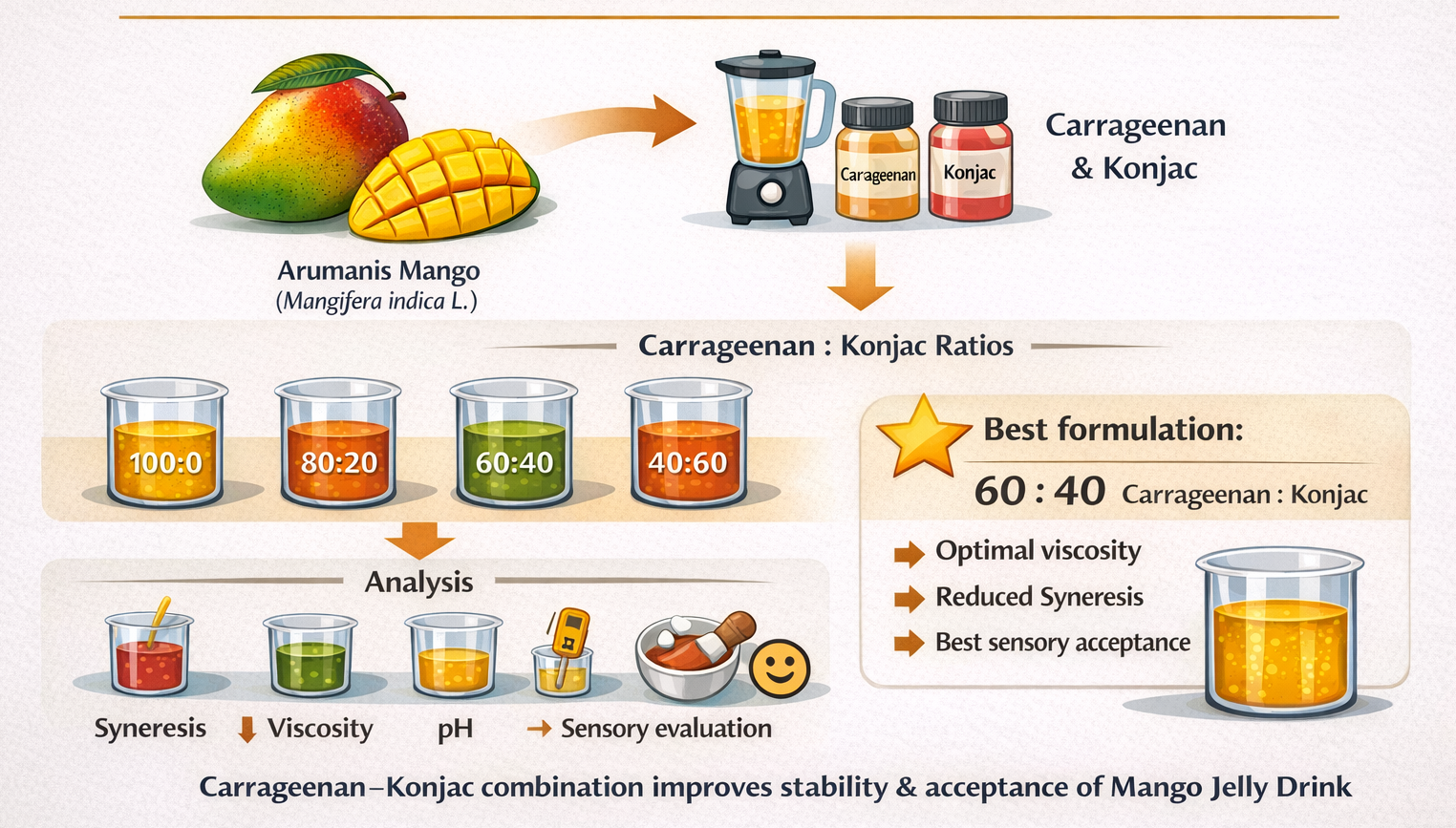
This study investigated the effect of carrageenan and konjac ratios as gelling agents on the physicochemical and sensory properties of Arumanis mango (Mangifera indica L.) jelly drink. Jelly drinks are increasingly popular functional beverages, but their texture and stability depend heavily on the gelling system applied. Carrageenan forms strong gel networks but is prone to syneresis, whereas konjac glucomannan improves viscosity and elasticity. Their combination is contributed to produce a stable and consumer-acceptable jelly drink. Four gelling agent ratios (100:0, 80:20, 60:40, and 40:60 carrageenan-to-konjac) were prepared in a Completely Randomized Design (CRD) with five replications. Parameters measured included moisture content, pH, syneresis, viscosity, and hedonic acceptance by 25 semi-trained panelists. Results showed that increasing konjac proportion significantly decreased moisture content (90.99–90.05%) and syneresis (27.87–14.59%), while enhancing viscosity (194.50–321.50 cP). The pH decreased with higher konjac levels (5.50–5.22) due to the presence of organic acids in mango interacting with konjac glucomannan. Sensory evaluation revealed that texture was significantly affected, with the 60:40 carrageenan-to-konjac ratio (P2) achieving the highest acceptance for chewiness and ease of sipping. Color, taste, and aroma showed no significant differences across treatments, although mango aroma dominated the product profile. Overall, the combination of carrageenan and konjac demonstrated a synergistic effect in improving stability and consumer preference. The 60:40 ratio was identified as the most favorable formulation. This research contributes to the development of functional jelly drinks based on tropical fruits.
References
N. Charoenphun, P. Noonim, S. Lekjing, C. Nitikornwarakul, N. H. Pham, and K. Venkatachalam, “Physicochemical properties, antioxidant activity, and flavor profile of strawberry fruit-based novel drinking jelly made with Gracilaria fisheri seaweed as a gelling agent at varying concentrations,” Gels, vol. 11, no. 1, p. 54, 2025, https://doi.org/10.3390/gels11010054.
A. Sulaswatty H. Prasetya, E. Agustian, Z. Athaillah, A. Sundowo. E. O. Gustav, and Ainezzahira, “Dragon fruit jelly drink (Hylocereus polyrhizus) low calories with addition of jamblang leaves extract (Syzygium cumini),” E3S Web Conf., vol. 503, p. 05003, 2024, https://doi.org/10.1051/e3sconf/202450305003.
Badan Pusat Statistik, “Produksi tanaman buah–buahan dan sayuran tahunan menurut jenis tanaman, 2024,” Accessed: Jun. 24, 2025.
R. Duran, R. Torres, and Y. Peralta-Ruiz, “Effect of temperature, ph and concentration of soluble solids on the rheological behavior and molecular mass of pectin obtained from mango vallenato shell (Mangifera indica L.),” Adv. J. Food Sci. Technol., vol. 16, pp. 35–40, 2018, https://doi.org/10.19026/ajfst.16.5934.
M. Robal, T. Brenner, S. Matsukawa, H. Ogawa, K. Truus, B. Rudolph, and R. Tuvikene, “Monocationic salts of carrageenans: Preparation and physico-chemical properties,” Food Hydrocoll., vol. 63, pp. 656–667, 2017, https://doi.org/10.1016/j.foodhyd.2016.09.032.
H. T. V. Lin, J. S. Tsai, H. H. Liao, and W. C. Sung, “Effect of hydrocolloids on penetration tests, sensory evaluation, and syneresis of milk pudding,” Polymers, vol. 17, no. 3, p. 300, 2025, https://doi.org/10.3390/polym17030300.
N. H. R. Parnanto, E. Nurhartadi, and L. N. Rohmah, “Karakteristik fisik, kimia dan sensori permen jelly sari pepaya (Carica papaya L.) dengan konsentrasi karagenan-konjak sebagai gelling agent,” Jurnal Teknosains Pangan, vol. 5, no. 1, 2026, https://jurnal.uns.ac.id/teknosains-pangan/article/view/4696.
P. W. Darsana, N. L. A. Yusasrini, and I. K. Suter, “Pengaruh konsentrasi konyaku terhadap sifat fisik, kimia dan sensori jelly drink air kelapa muda,” J. Ilm. Teknol. Pertan. Agrotechno, vol. 4, no. 1, p. 9, 2019, https://doi.org/10.24843/JITPA.2019.v04.i01.p02.
W. O. Owino and J. L. Ambuko, “Mango fruit processing: Options for small-scale processors in developing countries,” Agriculture, vol. 11, no. 11, p. 1105, 2021, https://doi.org/10.3390/agriculture11111105.
Jariyah, Rosida, I. Defri, and P. E. K. Wardani, “The physicochemical properties of the jelly drink produced by mixing pedada (Sonneratia caseolaris) and young coconut juices with carrageenan,” MATEC Web Conf., vol. 372, p. 02006, 2022, https://doi.org/10.1051/matecconf/202237202006.
O. D. Indriani and A. N. Khairi, “Physico-chemical characteristics of jelly drink with variation of red dragon fruit peel (Hylocereus polyrhizus) and additional sappan wood (Caesalpinia sappan),” J. Agri-Food Sci. Technol., vol. 4, no. 1, pp. 37–48, 2023, https://doi.org/10.12928/jafost.v4i1.7069.
P. R. Amalia and A. N. Khairi, “Physicochemical and sensory acceptance of jelly drink watermelon albedo (Citrullus vulgaris) with soursop juice (Annona muricata),” Food Sci. J., vol. 6, no. 1, p. 41, 2024, https://doi.org/10.33512/fsj.v6i1.22322.
N. A. H. A. Nasir, M. H. Yuswan, N. N. A. K. Shah, A. Abd Rashed, K. Kadota, and Y. A. Yusof, “Evaluation of physicochemical properties of a hydrocolloid-based functional food fortified with Caulerpa lentillifera: A D-optimal design approach,” Gels, vol. 9, no. 7, p. 531, 2023, https://doi.org/10.3390/gels9070531.
S. Sukotjo, H. Irianto, S. Leonita, and N. Y. Sari, “The effects of tomato concentration on sensory and chemical properties of jelly drink,” 6th International Conference of Food, Agriculture, and Natural Resource (IC-FANRES 2021), 2022, https://doi.org/10.2991/absr.k.220101.024.
Q. Wu, J. Buijs, S. De Groot, H. M. Van Der Kooij, J. Van Der Gucht, and T. E. Kodger, “Spatially heterogenous dynamics in colloidal gels during syneresis,” Soft Matter, vol. 19, no. 28, pp. 5336–5344, 2023, https://doi.org/10.1039/D3SM00448A.
J. Guo, C. Wang, C. Liu, and P. Wang, “Effect of konjac glucomannan on gelatinization, retrogradation, and gelling properties of frozen wheat starch,” Starch, vol. 73, no. 1–2, p. 2000025, 2021, https://doi.org/10.1002/star.202000025.
X. Geng, N. Zhao, X. Song, J. Wu, Q. Zhu, T. Wu, H. Chen, and M. Zhang, “Fabrication and characterization of konjac glucomannan/oat β-glucan composite hydrogel: Microstructure, physicochemical properties and gelation mechanism studies,” Molecules, vol. 27, no. 23, p. 8494, 2022, https://doi.org/10.3390/molecules27238494.
X. Du, J. Li, J. Chen, and B. Li, “Effect of degree of deacetylation on physicochemical and gelation properties of konjac glucomannan,” Food Res. Int., vol. 46, no. 1, pp. 270–278, 2012, https://doi.org/10.1016/j.foodres.2011.12.015.
Y. Sun, X. Xu, Q. Zhang, D. Zhang, X. Xie, H. Zhou, Z. Wu, R. Liu, and J. Pang, “Review of konjac glucomannan structure, properties, gelation mechanism, and application in medical biology,” Polymers, vol. 15, no. 8, p. 1852, 2023, https://doi.org/10.3390/polym15081852.
S. R. Derkach, N. G. Voron'ko, Yu. A. Kuchina, D. S. Kolotova, A. M. Gordeeva, D. A. Faizullin, Yu. Gusev, Yu. F. Zuev, and O. N. Makshakova, “Molecular structure and properties of κ-carrageenan-gelatin gels,” Carbohydr Polym., vol. 197, pp. 66–74, 2018, https://doi.org/10.1016/j.carbpol.2018.05.063.
X. Zhuang, L. Wang, X. Jiang, Y. Chen, and G. Zhou, “Supramolecular structure and mechanical performance of κ-carrageenan–gelatin gel,” Polymers, vol. 14, no. 20, p. 4347, 2022, https://doi.org/10.3390/polym14204347.
X. Zhuang, L. Wang, X. Jiang, Y. Chen, and G. Zhou, “Insight into the mechanism of myofibrillar protein gel influenced by konjac glucomannan: Moisture stability and phase separation behavior,” Food Chem., vol. 339, p. 127941, 2021, https://doi.org/10.1016/j.foodchem.2020.127941.
H. Zhuang, X. Li, S. Wu, B. Wang, and H. Yan, “Fabrication of grape seed proanthocyanidin-loaded W/O/W emulsion gels stabilized by polyglycerol polyricinoleate and whey protein isolate with konjac glucomannan: Structure, stability, and in vitro digestion,” Food Chem., vol. 418, p. 135975, 2023, https://doi.org/10.1016/j.foodchem.2023.135975.
J. R. Amelia, S. Pujilestari, H. Hamidatun, and P. Monica, “Karakterisasi mutu minuman jeli okra nanas dengan kombinasi karagenan-konjak,” J. Teknol. Ind. Has. Pertan., vol. 28, no. 2, 2023, https://doi.org/10.23960/jtihp.v28i2.140-149.
M. Karmila, I. D. P. K. Pratiwi, and I. W. R. Widarta, “Pengaruh konsentrasi glukomanan (Amorphophallus konjac) terhadap karakteristik jelly drink wedang jahe (Zingiber officinale),” J. Ilmu Dan Teknol. Pangan ITEPA, vol. 12, no. 4, p. 871, 2023, https://doi.org/10.24843/itepa.2023.v12.i04.p10.
Badan Standar Nasional, “Jelly Agar,” Accessed: Jun. 24, 2025, https://www.scribd.com/document/330483325/Jelly-Agar.
W. Tu, X. Liu, K. Li, B. Zhang, F. Jiang, and D. Qiao, “Highly ordered aggregation of soy protein isolate particles for enhanced gel-related properties through konjac glucomannan addition,” Food Chem., vol. 462, p. 141004, 2025, https://doi.org/10.1016/j.foodchem.2024.141004.
C. Huang, C. Blecker, X. Wei, X. Xie, S. Li, L. Chen, and D. Zhang, “Effects of different plant polysaccharides as fat substitutes on the gel properties, microstructure and digestion characteristics of myofibrillar protein,” Food Hydrocoll., vol. 150, p. 109717, 2024, https://doi.org/10.1016/j.foodhyd.2023.109717.
J. Luo, M. Van Yperselle, S. W. Rizkalla, F. Rossi, G. Slama, and F. R. J. Bornet, “Chronic consumption of short-chain fructooligosaccharides does not affect basal hepatic glucose production or insulin resistance in type 2 diabetics,” J. Nutr., vol. 130, no. 6, pp. 1572–1577, 2000, https://doi.org/10.1093/jn/130.6.1572.
W. Jian, K. C. Siu, and J. Y. Wu, “Effects of pH and temperature on colloidal properties and molecular characteristics of konjac glucomannan,” Carbohydr. Polym., vol. 134, pp. 285–292, 2015, https://doi.org/10.1016/j.carbpol.2015.07.050.
M. Zheng, Y. Wei, X. Jiao, Z. Jiang, H. Ni, Q. Li, and Y. Zhu, “Improving gel properties of glucomannan/κ-carrageenan blends by controlling ethanol ph for glucomannan purification,” Food Biophys., vol. 19, no. 2, pp. 400–411, 2024, https://doi.org/10.1007/s11483-024-09831-z.
Y. Liu, Q. Chen, Fang, J. Liu, Z. Wang, H. Chen, and F. Zhang, “The influence of konjac glucomannan on the physicochemical and rheological properties and microstructure of canna starch,” Foods, vol. 10, no. 2, p. 422, 2021, https://doi.org/10.3390/foods10020422.
Z. Bian, W. Xu, H. Zhang, M. Shi, X. Ji, S. Dong, C. Chen, G. Zhao, X. Zhuo, S. Komarneni, K. Zhang, Z. Ni, and G. Hu, “Simultaneously realizing enhancement of sensitivity for freshness monitoring and multinomial properties of carrageenan/konjac glucomannan/blueberry anthocyanin-based intelligent film by diatomite,” Int. J. Biol. Macromol., vol. 251, p. 126192, 2023, https://doi.org/10.1016/j.ijbiomac.2023.126192.
N. H. R. Parnanto, E. Nurhartadi, L. N. R. L. N. Rohmah, and L. N. Rohmah, “Karakteristik fisik, kimia dan sensori permen jelly sari pepaya (Carica papaya L.) dengan konsentrasi karagenan-konjak sebagai gelling agent,” J. Teknosains Pangan, vol. 5, no. 1, 2016, https://jurnal.uns.ac.id/teknosains-pangan/article/download/4696/4078.
Y. C. Liao, C. C. Chang, D. Nagarajan, C. Y. Chen, and J. S. Chang, “Algae-derived hydrocolloids in foods: Applications and health-related issues,” Bioengineered, vol. 12, no. 1, pp. 3787–3801, 2021, https://doi.org/10.1080/21655979.2021.1946359.
L. Li, X. Ma, R. Zhan, H. Wu, Q. Yao, W. Xu, C. Luo, Y. Zhou, Q. Liang, and S. Wang, “Profiling of volatile fragrant components in a mini-core collection of mango germplasms from seven countries,” PLOS ONE, vol. 12, no. 12, p. e0187487, 2017, https://doi.org/10.1371/journal.pone.0187487.
Downloads
Published
Issue
Section
License
Copyright (c) 2026 Siti Susanti, Hafidhi Izzati, Bhakti Etza Setiani, Hega Bintang Pratama Putra, Maela Rizky Kusumastuti

This work is licensed under a Creative Commons Attribution-ShareAlike 4.0 International License.
Authors who publish with the Journal of Agri-food Science and Technology (JAFOST) agree to the following terms:
- Authors retain copyright and grant the journal right of first publication with the work simultaneously licensed under a Creative Commons Attribution License (CC BY-SA 4.0) that allows others to share the work with an acknowledgment of the work's authorship and initial publication in this journal.
- Authors are able to enter into separate, additional contractual arrangements for the non-exclusive distribution of the journal's published version of the work (e.g., post it to an institutional repository or publish it in a book), with an acknowledgment of its initial publication in this journal.
- Authors are permitted and encouraged to post their work online (e.g., in institutional repositories or on their website) prior to and during the submission process, as it can lead to productive exchanges, as well as earlier and greater citation of published work.