Difference in Biochemical Composition and Nutritional Trait in Different Areas of Fillets of Dorsal, Venter-cha, and Ventral of Carangoides fulvoguttatus
DOI:
https://doi.org/10.12928/jafost.v6i1.11459Keywords:
Carangoides fulvoguttatus, Dorsal, Proximate nutrients, Ventrecha and ventralAbstract
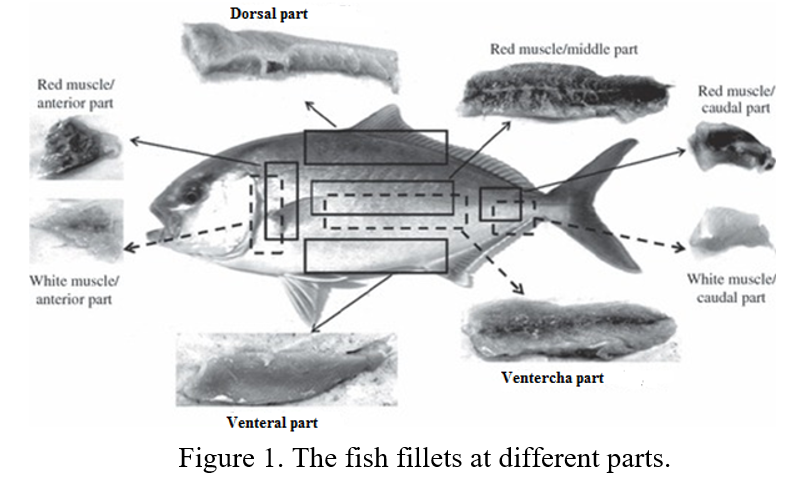
Environmental parameters are essential to the life cycle and physiological activities of fish. These environmental conditions can profoundly influence fish physiology, behavior, and their nutrition. The purpose of this study was to highlight nutritional properties of dorsal, ventercha and ventral fillets from sea fish Carangoides fulvoguttatus. Dorsal, ventercha and ventral fillet portions of Iranian sea fish (C. fulvoguttatus) analyzed for proximate constituents, energy values and pH. The proximate of C. fulvoguttatus fillets varied between three anatomical locations ventercha, dorsal and ventral. Moisture and fat content differentiated dorsal and ventercha from ventral in fish muscle. In particular, a relatively large variation observed in crude fat content, which trend of significant fat changes between the three portions was as follows: ventral>ventercha>dorsal. The results showed that the ventral part containing significantly less moisture (73.4%±0.7), but the ventercha part had protein content (15.7%±0.3) which was higher than the other two parts of muscle. The ventral part had higher fat content (7.13%±0.1). The energy value (127.08 kcal/100 g) in ventral part found the highest. The ventercha area containing highest protein content and ventral had highest lipid content (7.13%). The index of nutritional quality for protein was always higher in ventercha than in dorsal and ventral, that of fish being especially interesting because it is associated with a relatively lower energy value. The nutritional traits found best in ventral muscle due to highest dry matter and energy value with lowest moisture.
References
T. N. Bayissa, M. Geerardyn, S. Gobena, D. Vanhauteghem, G. Du Laing, M. W. Kabeta, and G. P. J. Janssens, “Impact of species and their edible parts on the macronutrient and mineral composition of fish from the same aquatic environment, the Gilgel Gibe Reservoir, Ethiopia,” J. Anim. Physiol. Anim. Nutr. (Berl)., vol. 106, pp. 220–228, 2022, https://doi.org/https://doi.org/10.1111/jpn.13553.
Anonimous, “I consumi domestici e il comportamento di acquisto delle famiglie Italiane,” Pubbl. Ismea, pp. 4–5, 2002.
R. G. Ackman, “The influence of lipids on fish quality,” Int. J. Food Sci. Technol., vol. 2, no. 2, pp. 169–181, 1967, https://doi.org/10.1111/j.1365-2621.1967.tb01339.x.
J. C. K. Manz, J. V. F. Nsoga, J. B. Diazenza, S. Sita, G. M. B. Bakana, A. Francois, M. Ndomou, I. Gouado, and V. Mamonekene, “Nutritional composition, heavy metal contents and lipid quality of five marine fish species from Cameroon coast,” Heliyon, vol. 9, no. 3, 2023, https://doi.org/10.1016/j.heliyon.2023.e14031.
C. He, R. Wang, J. Dong, and Z. Yang, “Analysis of fishy components in edible parts of Golden Pompano,” Highlights Sci. Eng. Technol., vol. 19, pp. 249–254, 2022, https://doi.org/10.54097/hset.v19i.2864.
S. Testi, A. Bonaldo, P. P. Gatta, and A. Badiani, “Nutritional traits of dorsal and ventral fillets from three farmed fish species,” Food Chem., vol. 98, no. 1, pp. 104–111, 2006, https://doi.org/10.1016/j.foodchem.2005.05.053.
F. Ameer, M. Naeem, T. Ruby, S. M. Azam, A. Imtiaz, S. Ahmad, S. Naqvi, A. Malik, M. Arshad, A. Khan, M. Hussain, H. Ali, and M. Liaqat, “Body composition of edible portion of Wild (Labeo gonius) during summer season in relation to body size from Head Panjnad, Alipur, Pakistan,” J. Popul. Ther. Clin. Pharmacol., vol. 31, no. 4, pp. 1788–1801, 2024, https://doi.org/10.53555/jptcp.v31i4.5175.
S. G. Abbas, F. Sherazi, M. Hayat, S. Manzoor, N. Raza, F. Aftab, S. Mubarik, M. I. Khan, A. Shanableh, and R. Luque, “Efficient determination of fish spoilage using colorimetric strips from sugarcane bagasse waste,” Results Eng., vol. 25, pp. 104-132, 2025, https://doi.org/10.1016/j.rineng.2025.104132.
G. Comi and L. Iacumin, “Spoilage of meat and fish,” in The Microbiological Quality of Food (Second Edition), pp. 221–248, 2025, https://doi.org/https://doi.org/10.1016/B978-0-323-91160-3.00017-9.
H. Darvishi, M. Azadbakht, A. Rezaeiasl, and A. Farhang, “Drying characteristics of sardine fish dried with microwave heating,” J. Saudi Soc. Agric. Sci., vol. 12, no. 2, pp. 121–127, 2013, https://doi.org/10.1016/j.jssas.2012.09.002.
M. Scadeng, C. McKenzie, W. He, H. Bartsch, D. J. Dubowitz, D. Stec, and J. St. Leger, “Morphology of the amazonian teleost genus arapaima using advanced 3D imaging,” Front. Physiol., vol. 11, pp. 1–19, 2020, https://doi.org/https://doi.org/10.3389/fphys.2020.00260.
A. K. M. N. Alam, Participatory Training of Trainers - A New Approach Applied in Fish Processing. Bangladesh Fisheries Research Forum, 2007.
AOAC, Official Methods of Analysis of AOAC International. 2005.
G. G. Winberg, “Methods for the estimation of production of aquatic animals,” Educ. Psychol. Meas., vol. 28, no. 3, pp. 951–951, 1968, https://doi.org/10.1177/001316446802800332.
E. B. Eder and M. N. Lewis, “Proximate composition and energetic value of demersal and pelagic prey species from the SW Atlantic Ocean,” Mar. Ecol. Prog. Ser., vol. 291, pp. 43–52, 2005, https://doi.org/10.3354/meps291043.
P. R. de Oliveira, R. S. de Jesus, G. M. Batista, and E. Lessi, “Avaliação sensorial, físico-química e microbiológica do pirarucu (Arapaima gigas, Schinz 1822) durante estocagem em gelo,” Brazilian J. Food Technol., vol. 17, no. 1, pp. 67–74, 2014, https://doi.org/10.1590/bjft.2014.010.
M. G. Martins, D. E. G. Martins, and R. da S. Pena, “Drying kinetics and hygroscopic behavior of pirarucu (Arapaima gigas) fillet with different salt contents,” Lwt, vol. 62, no. 1, pp. 144–151, 2015, https://doi.org/10.1016/j.lwt.2015.01.010.
M. G. Martins, D. E. G. Martins, and R. D. S. Pena, “Chemical composition of different muscle zones in pirarucu (Arapaima gigas),” Food Sci. Technol., vol. 37, no. 4, pp. 651–656, 2017, https://doi.org/10.1590/1678-457x.30116.
A. B. Moreira, J. V. Visentainer, N. E. De Souza, and M. Matsushita, “Fatty acids profile and cholesterol contents of three Brazilian Brycon freshwater fishes,” J. Food Compos. Anal., vol. 14, no. 6, pp. 565–574, 2001, https://doi.org/10.1006/jfca.2001.1025.
I. J. Jensen, R. Larsen, T. Rustad, and K. E. Eilertsen, “Nutritional content and bioactive properties of wild and farmed cod (Gadus morhua L.) subjected to food preparation,” J. Food Compos. Anal., vol. 31, no. 2, pp. 212–216, 2013, https://doi.org/10.1016/j.jfca.2013.05.013.
R. G. Ackman, “Nutritional composition of fats in seafoods,” Prog Food Nutr Sci, vol. 13, no. 3–4, 1989, [Online]. Available: https://pubmed.ncbi.nlm.nih.gov/2699043/.
B. Liu, H. Y. Guo, K. C. Zhu, B. S. Liu, L. Guo, N. Zhang, S. G. Jiang, and D. C. Zhang, “Nutritional compositions in different parts of muscle in the longfin batfish, Platax teira (Forsskål, 1775),” J. Appl. Anim. Res., vol. 47, no. 1, pp. 403–407, 2019, https://doi.org/10.1080/09712119.2019.1649680.
S. Watabe, H. Ioka, and K. Hashimoto, “Rigor-mortis progress of sardine and mackerel in association with ATP degradation and lactate accumulation,” Nippon Suisan Gakkaishi, vol. 55, no. 10, pp. 1833–1839, 1989.
H. L. R. Porto, A. C. L. de Castro, J. W. de J. Azevedo, L. S. Soares, C. F. C. Ferreira, M. H. L. Silva, and R. de L. Cardoso, “Assessment of the constituent minerals of fish species captured in the lower stretch of the Itapecuru River, Maranhão, Brazil,” Donnish J. Microbiol. Biotechnol. Res., vol. 3, no. 1, pp. 1–7, 2016.
M. W. H. Al-Muhanna, A. J. Mansour, and S. A. M. Al-Asadi, “Estimation of chemical components and caloric values for muscles of some local fish in Karbala province, Iraq,” IOP Conf. Ser. Mater. Sci. Eng., vol. 571, no. 1, 2019, https://doi.org/10.1088/1757-899X/571/1/012058.
V. K. Mudumala, M. K. Farejiya, and A. K. Dikshit, “Proximate composition, the diet of coastal population from four neritic tunas occurring along north western Indian EEZ,” vol. 8, pp. 34–40, 2017, [Online]. Available: www.soeagra.com/ijert.html.
E. S. Lazos, G. Aggelousis, and A. Alexakis, “Metal and proximate composition of the edible portion of 11 freshwater fish species,” J. Food Compos. Anal., vol. 2, no. 4, pp. 371–381, 1989, https://doi.org/10.1016/0889-1575(89)90009-4.
D. D. Justin, T. François, T.-T. E. Minette, W. H. Macaire, T. D. Fabrice, P. I. N. Satya, K. M. S. Lakshmi, K. M. S. Lakshmi, P. R. B. Narayana, K. S. Steve, and G. Inocent, “Effects of boiling and smoking on the proximate composition and oil quality of a commercially important freshwater fish (Chrysichthys nigrodigitatus) from Nkam river in Cameroon,” J. Food Res., vol. 7, no. 6, p. 59, 2018, https://doi.org/10.5539/jfr.v7n6p59.
S. Swain, P. B. Sawant, N. K. Chadha, E. M. Chhandaprajnadarsini, and M. Katare, “Significance of water pH and hardness on fish biological processes: A review,” Int. J. Chem. Stud., vol. 8, no. 4, pp. 830–837, 2020, https://doi.org/10.22271/chemi.2020.v8.i4e.9710.
A. Mariu, A. M. M. Chatha, S. Naz, M. F. Khan, W. Safdar, and I. Ashraf, “Effect of temperature, pH, salinity and dissolved oxygen on fishes,” J. Zool. Syst., vol. 1, no. 2, pp. 1–12, 2023, https://doi.org/10.56946/jzs.v1i2.198.
C. Edworthy, N. C. James, W. M. Potts, M. I. Duncan, and S. Dupont, “Temperate coastal fish shows resilience to extreme low pH in early larval stages,” J. Exp. Mar. Bio. Ecol., vol. 578, 2024, https://doi.org/10.1016/j.jembe.2024.152037.
S. Chowdhury and S. K. Saikia, “Effect of pH and Dissolved Oxygen induced antioxidant activity in the liver of zebrafish, Danio rerio Hamilton, 1822,” J. Biol. Stud., vol. 7, no. 2, pp. 31–42, 2024, https://doi.org/10.62400/jbs.v7i2.9125.
Downloads
Published
Issue
Section
License
Copyright (c) 2025 Ali Aberoumand, Fatemeh Fardaei

This work is licensed under a Creative Commons Attribution-ShareAlike 4.0 International License.
Authors who publish with the Journal of Agri-food Science and Technology (JAFOST) agree to the following terms:
- Authors retain copyright and grant the journal right of first publication with the work simultaneously licensed under a Creative Commons Attribution License (CC BY-SA 4.0) that allows others to share the work with an acknowledgment of the work's authorship and initial publication in this journal.
- Authors are able to enter into separate, additional contractual arrangements for the non-exclusive distribution of the journal's published version of the work (e.g., post it to an institutional repository or publish it in a book), with an acknowledgment of its initial publication in this journal.
- Authors are permitted and encouraged to post their work online (e.g., in institutional repositories or on their website) prior to and during the submission process, as it can lead to productive exchanges, as well as earlier and greater citation of published work.