Internet of Things-Enabled Edge–Cloud Digital Twin and Network-Aware Predictive Control for Anomaly-Resilient PV–Battery Microgrids
DOI:
https://doi.org/10.12928/biste.v8i6.17384Keywords:
Artificial Intelligence, Digital Twin, Edge–Cloud Computing, Internet of Things (IoT), Model Predictive ControlAbstract
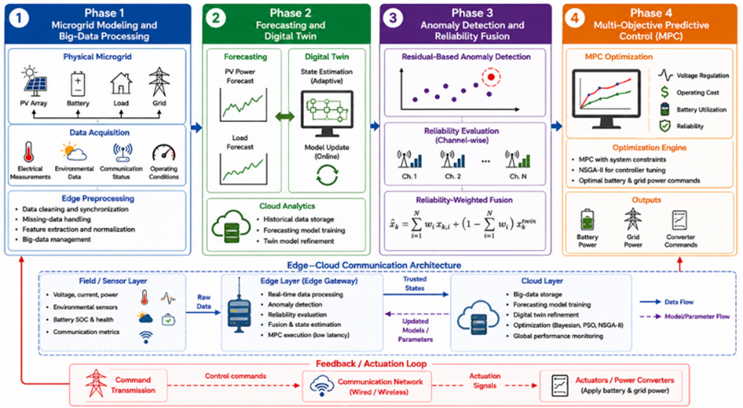
This paper presents an Artificial Intelligence (AI)-driven big-data digital-twin framework with network-aware Model Predictive Control (MPC) for anomaly-resilient PV–battery microgrids. The proposed system adopts an IoT-enabled edge–cloud architecture in which distributed sensors, battery-management units, converter actuators, an edge gateway, cloud resources, and the supervisory controller exchange measurements and control commands through bidirectional communication channels. Electrical, environmental, battery, and network-status data are processed at the edge, while the cloud supports data storage, forecasting-model training, digital-twin refinement, and optimization. Bayesian optimization is used for PV/load forecasting, particle swarm optimization for anomaly-detector tuning, and NSGA-II for multi-objective MPC parameter selection. Channel-wise reliability-weighted fusion combines physical measurements with digital-twin estimates to construct trusted controller states. The framework was evaluated under nominal, cloud–load, False-Data-Injection (FDI), and mixed cyber-physical anomaly conditions against four baseline controllers. It achieved the lowest aggregate voltage RMSE of 1.561V, corresponding to reductions of 22.57–51.28%. Under FDI, the RMSE decreased to 0.843V with a recall of 0.959, while under mixed anomalies it reached 2.674V with an F1-score of 0.684. Although PV forecasting accuracy was limited during rapid irradiance variations, the strongest improvements occurred when measurement integrity was degraded, indicating that resilience is mainly provided by reliability-weighted digital-twin fusion. The framework also achieved a 95th-percentile edge-processing latency of 2.422ms with approximately 99.86% solver success, supporting low-latency edge execution while leaving end-to-end network performance for future validation.
References
M. Uddin, H. Mo, D. Dong, S. Elsawah, J. Zhu, and J. M. Guerrero, “Microgrids: A review, outstanding issues and future trends,” Energy Strategy Rev., vol. 49, p. 101127, 2023, https://doi.org/10.1016/j.esr.2023.101127.
M. S. Alam, M. A. Hossain, M. Shafiullah, A. Islam, M. S. H. Choudhury, M. O. Faruque, and M. A. Abido, “Renewable energy integration with DC microgrids: Challenges and opportunities,” Electr. Power Syst. Res., vol. 234, p. 110548, 2024, https://doi.org/10.1016/j.epsr.2024.110548.
X. Zhang, Z. Zhang, R. Zhang, W. Liu, H. Li, and J. Peng, “Event-triggered resilient recovery learning control protocol for interconnected DC microgrids with distributed attack detection,” Sustain. Energy Grids Netw., vol. 38, p. 101364, 2024, https://doi.org/10.1016/j.segan.2024.101364.
S. M. Miraftabzadeh and M. Longo, “High-resolution PV power prediction model based on the deep learning and attention mechanism,” Sustain. Energy Grids Netw., vol. 34, p. 101025, 2023, https://doi.org/10.1016/j.segan.2023.101025.
R. Fallahifar and M. Kalantar, “Optimal planning of lithium ion battery energy storage for microgrid applications: Considering capacity degradation,” J. Energy Storage, vol. 57, p. 106103, 2023, https://doi.org/10.1016/j.est.2022.106103.
C. Zhong, H. Zhao, Y. Liu, and C. Liu, “Learning-based model predictive secondary frequency control of PV-ESS-EV microgrid,” Int. J. Electr. Power Energy Syst., vol. 159, p. 110020, 2024, https://doi.org/10.1016/j.ijepes.2024.110020.
I. Natgunanathan, V. Mak, S. Rajasegarar, and A. Anwar, “Deakin microgrid digital twin and analysis of AI models for power generation prediction,” Energy Convers. Manage.: X, vol. 18, p. 100370, 2023, https://doi.org/10.1016/j.ecmx.2023.100370.
H. M. Marhoon et al., “Microcontroller-based internet of things control system for autonomous hidden camera detection using adaptive decision-making and hybrid MCDM techniques,” Discov. Comput., vol. 29, p. 584, 2026, https://doi.org/10.1007/s10791-026-10480-8.
H. Li, Y. Yang, Y. Liu, and W. Pei, “Federated dueling DQN based microgrid energy management strategy in edge-cloud computing environment,” Sustain. Energy Grids Netw., vol. 38, p. 101329, 2024, https://doi.org/10.1016/j.segan.2024.101329.
Q. Xia, Y. Wang, Y. Zou, Z. Yan, N. Zhou, Y. Chi, and Q. Wang, “Regional-privacy-preserving operation of networked microgrids: Edge-cloud cooperative learning with differentiated policies,” Appl. Energy, vol. 370, p. 123611, 2024, https://doi.org/10.1016/j.apenergy.2024.123611.
K. Kumar, P. Kumar, S. Kar, and A. K. Bohre, “Anomaly detection technique for securing microgrid against false data attacks,” ISA Trans., vol. 153, pp. 13–27, 2024, https://doi.org/10.1016/j.isatra.2024.07.037.
M. Pan, Q. Xing, Z. Chai, H. Zhao, Q. Sun, and D. Duan, “Real-time digital twin machine learning-based cost minimization model for renewable-based microgrids considering uncertainty,” Sol. Energy, vol. 250, pp. 355–367, 2023, https://doi.org/10.1016/j.solener.2023.01.006.
K. Bitirgen and Ü. B. Filik, “A hybrid deep learning model for discrimination of physical disturbance and cyber-attack detection in smart grid,” Int. J. Crit. Infrastruct. Prot., vol. 40, p. 100582, 2023, https://doi.org/10.1016/j.ijcip.2022.100582.
Z. Lu, Y. Gao, C. Xu, and Y. Li, “Configuration optimization of an off-grid multi-energy microgrid based on modified NSGA-II and order relation-TODIM considering uncertainties of renewable energy and load,” J. Clean. Prod., vol. 383, p. 135312, 2023, https://doi.org/10.1016/j.jclepro.2022.135312.
E. O’Dwyer, I. Pan, R. Charlesworth, S. Butler, and N. Shah, “Integration of an energy management tool and digital twin for coordination and control of multi-vector smart energy systems,” Sustain. Cities Soc., vol. 62, p. 102412, 2020, https://doi.org/10.1016/j.scs.2020.102412.
R. K. Gupta, F. Sossan, and M. Paolone, “Grid-aware distributed model predictive control of heterogeneous resources in a distribution network: Theory and experimental validation,” IEEE Trans. Energy Convers., vol. 36, no. 2, pp. 1392–1402, 2021, https://doi.org/10.1109/TEC.2020.3015271.
C. Semeraro, M. Lezoche, H. Panetto, and M. Dassisti, “Digital twin paradigm: A systematic literature review,” Comput. Ind., vol. 130, p. 103469, 2021, https://doi.org/10.1016/j.compind.2021.103469.
Y. Li, X. Wei, Y. Li, Z. Dong, and M. Shahidehpour, “Detection of false data injection attacks in smart grid: A secure federated deep learning approach,” IEEE Trans. Smart Grid, vol. 13, no. 6, pp. 4862–4872, 2022, https://doi.org/10.1109/TSG.2022.3204796.
A. Othman, G. Kaddoum, J. V. C. Evangelista, M. Au, and B. L. Agba, “Digital twinning in smart grid networks: Interplay, resource allocation and use cases,” IEEE Commun. Mag., vol. 61, no. 11, pp. 120–126, 2023, https://doi.org/10.1109/MCOM.001.2200823.
N. Qi, K. Huang, Z. Fan, and B. Xu, “Long-term energy management for microgrid with hybrid hydrogen-battery energy storage: A prediction-free coordinated optimization framework,” Appl. Energy, vol. 377, p. 124485, 2025, https://doi.org/10.1016/j.apenergy.2024.124485.
K. Huang, L. Cheng, N. Qi, D. W. Gao, A. Mujeeb, and Q. Guo, “Grid-aware real-time dispatch of microgrid with generalized energy storage: A prediction-free online optimization approach,” IEEE Trans. Smart Grid, vol. 17, no. 2, pp. 892–909, 2026, https://doi.org/10.1109/TSG.2025.3627407.
N. Doumèche, Y. Allioux, Y. Goude, and S. Rubrichi, “Human spatial dynamics for electricity demand forecasting: The case of France during the 2022 energy crisis,” IEEE Trans. Power Syst., vol. 41, no. 3, pp. 1882–1891, 2026, https://doi.org/10.1109/TPWRS.2025.3648653.
E. D. Ayele, J. F. Gonzalez, and W. B. Teeuw, “Enhancing cybersecurity in distributed microgrids: A review of communication protocols and standards,” Sensors, vol. 24, no. 3, p. 854, 2024, https://doi.org/10.3390/s24030854.
G. P. Reddy, Y. V. P. Kumar, and M. K. Chakravarthi, “Communication technologies for interoperable smart microgrids in urban energy community: A broad review of the state of the art, challenges, and research perspectives,” Sensors, vol. 22, no. 15, p. 5881, 2022, https://doi.org/10.3390/s22155881.
Y.-S. Lee and C. Wang, “A cyber-physical testbed for IoT microgrid design and validation,” Electronics, vol. 13, no. 7, p. 1181, 2024, https://doi.org/10.3390/electronics13071181.
O. Ali, T.-L. Nguyen, and O. A. Mohammed, “Assessment of cyber-physical inverter-based microgrid control performance under communication delay and cyber-attacks,” Appl. Sci., vol. 14, no. 3, p. 997, 2024, https://doi.org/10.3390/app14030997.
I. Kharchouf and O. A. Mohammed, “Controller hardware-in-the-loop testbed of a distributed consensus multi-agent system control under deception and disruption cyber-attacks,” Energies, vol. 17, no. 7, p. 1669, 2024, https://doi.org/10.3390/en17071669.
M. S. Abdelrahman, I. Kharchouf, H. M. Hussein, M. Essofally, and O. A. Mohammed, “Enhancing cyber-physical resiliency of microgrid control under denial-of-service attack with digital twins,” Energies, vol. 17, no. 16, p. 3927, 2024, https://doi.org/10.3390/en17163927.
S. Shin, M. Park, T. Kim, and H. Yang, “Architecture for enhancing communication security with RBAC IoT protocol-based microgrids,” Sensors, vol. 24, no. 18, p. 6000, 2024, https://doi.org/10.3390/s24186000.
M. A. Taher, M. Tariq, and A. I. Sarwat, “Trust-based detection and mitigation of cyber attacks in distributed cooperative control of islanded AC microgrids,” Electronics, vol. 13, no. 18, p. 3692, 2024, https://doi.org/10.3390/electronics13183692.
Y. Chen, K. Hayawi, M. Fan, S. Y. Chang, J. Tang, L. Yang, R. Zhao, Z. Mao, and H. Wen, “A bilevel optimization model based on edge computing for microgrid,” Sensors, vol. 22, no. 20, p. 7710, 2022, https://doi.org/10.3390/s22207710.
L. Zhang, C. Liu, B. Li, H. Fang, and J. Gu, “A secure storage and deletion verification scheme of microgrid data based on integrating blockchain into edge computing,” Electronics, vol. 11, no. 23, p. 4033, 2022, https://doi.org/10.3390/electronics11234033.
E. Yaghoubi, E. Yaghoubi, Z. Yusupov, and M. R. Maghami, “A real-time and online dynamic reconfiguration against cyber-attacks to enhance security and cost-efficiency in smart power microgrids using deep learning,” Technologies, vol. 12, no. 10, p. 197, 2024, https://doi.org/10.3390/technologies12100197.
N. Kumari, A. Sharma, B. Tran, N. Chilamkurti, and D. Alahakoon, “A comprehensive review of digital twin technology for grid-connected microgrid systems: State of the art, potential and challenges faced,” Energies, vol. 16, no. 14, p. 5525, 2023, https://doi.org/10.3390/en16145525.
B. Sahoo, S. Panda, P. K. Rout, M. Bajaj, and V. Blazek, “Digital twin enabled smart microgrid system for complete automation: An overview,” Results Eng., vol. 25, p. 104010, 2025, https://doi.org/10.1016/j.rineng.2025.104010.
M. M. H. Sifat, S. M. Choudhury, S. K. Das, H. Pota, and F. Yang, “Novel abstractions and experimental validation for digital twin microgrid design: Lab scale studies and large scale proposals,” Appl. Energy, vol. 377, p. 124621, 2025, https://doi.org/10.1016/j.apenergy.2024.124621.
B. Canaan, Y. Makhlouf, and D. Ould Abdeslam, “Cyber-physical security for microgrids through digital twin technologies: A review and research outlook,” Energy Convers. Manage.: X, vol. 28, p. 101406, 2025, https://doi.org/10.1016/j.ecmx.2025.101406.
D. Salaorni, F. Bianchi, S. Colnago, A. Barisione, F. Trovò, and M. Restelli, “A novel digital twin for battery energy storage systems in micro-grids,” J. Energy Storage, vol. 132, p. 117745, 2025, https://doi.org/10.1016/j.est.2025.117745.
I. Poonahela, A. Krama, S. Bayhan, U. Fesli, M. B. Shadmand, H. Abu-Rub, and M. M. Begovic, “Hierarchical model-predictive droop control for voltage and frequency restoration in AC microgrids,” IEEE Open J. Ind. Electron. Soc., vol. 4, pp. 85–97, 2023, https://doi.org/10.1109/OJIES.2023.3240070.
M. Jamali, M. S. Sadabadi, M. Davari, S. Sahoo, and F. Blaabjerg, “Resilient cooperative secondary control of islanded AC microgrids utilizing inverter-based resources against state-dependent false data injection attacks,” IEEE Trans. Ind. Electron., vol. 71, no. 5, pp. 4719–4730, 2024, https://doi.org/10.1109/TIE.2023.3281698.
S. Hussain, S. M. S. Hussain, M. Hemmati, A. Iqbal, R. Alammari, S. Zanero, E. Ragaini, and G. Gruosso, “A novel hybrid cybersecurity scheme against false data injection attacks in automated power systems,” Prot. Control Mod. Power Syst., vol. 8, p. 37, 2023, https://doi.org/10.1186/s41601-023-00312-y.
K. A. Haque, M. Massaoudi, L. Al Homoud, K. R. Davis, M. Kabalan, and H. Salamy, “Cyber-physical emulation and threat scenario simulation for enhanced microgrid resilience,” IEEE Access, vol. 13, pp. 101455–101471, 2025, https://doi.org/10.1109/ACCESS.2025.3578421.
N. E. M. Barreto and A. R. Aoki, “Cyber-physical power system digital twins—A study on the state of the art,” Energies, vol. 18, no. 22, p. 5960, 2025, https://doi.org/10.3390/en18225960.
N. Basil, N. Cherif, M. B. Alhamadani, H. Hasan, and T. F. Agajie, “Comparative analysis of LSTM, HHOSOA, COAESPSO, and XGBoost models for time series load forecasting,” Int. J. Comput. Eng. Artif. Intell. (IJCEAI), vol. 1, no. 1, pp. 10–22, 2026, https://ijceai.org/index.php/ijceai/article/view/13.
D. B. Aeggegn and S. D. Hamdi, “Comparative performance analysis of Dijkstra, Bellman-Ford, and Floyd-Warshall routing algorithms in MANETs,” Int. J. Smart Control Electr. Eng. Syst., vol. 1, no. 1, pp. 22–29, 2026, https://ijscees.org/index.php/pub/article/view/10.
R. A. Al-Qassab and M. I. Aal-Nouman, “Performance evaluation of CoAP and MQTT_SN protocols,” in Emerging Technology Trends in Internet of Things and Computing, ser. Commun. Comput. Inf. Sci., vol. 1548. Cham, Switzerland: Springer, 2022, pp. 223–236, https://doi.org/10.1007/978-3-030-97255-4_17.
P. M. Khan, S. Madichetty, S. S. Koduru, S. P. Machina, and S. Mishra, “Cyber-resilient DC microgrids: PINN-based control framework against false data injection attacks,” Sustain. Comput. Inform. Syst., vol. 51, p. 101395, 2026, https://doi.org/10.1016/j.suscom.2026.101395.
R. Nandi, M. Tripathy, C. P. Gupta, and R. Singh, “MPC-based detection and resilience against bounded and unbounded FDI cyberattacks in isolated AC microgrid with battery-source DERs,” Sustain. Energy Grids Netw., vol. 43, p. 101719, 2025, https://doi.org/10.1016/j.segan.2025.101719.
O. Danaei, S. Karimi, K. M. Almustafa, and J. Katrib, “Decentralized detection and mitigation of false data injection attacks in DC microgrids using artificial neural network,” IEEE Access, vol. 13, pp. 136002–136015, 2025, https://doi.org/10.1109/ACCESS.2025.3594245.
D. Salaorni, F. Bianchi, S. Colnago, A. Barisione, F. Trovò, and M. Restelli, “A novel digital twin for battery energy storage systems in micro-grids,” J. Energy Storage, vol. 132, p. 117745, 2025, https://doi.org/10.1016/j.est.2025.117745.
P. Kumar, R. Kumar, A. Aljuhani, D. Javeed, A. Jolfaei, and A. K. M. N. Islam, “Digital twin-driven SDN for smart grid: A deep learning integrated blockchain for cybersecurity,” Sol. Energy, vol. 263, p. 111921, 2023, https://doi.org/10.1016/j.solener.2023.111921.
N. Qi, K. Huang, Z. Fan, and B. Xu, “Long-term energy management for microgrid with hybrid hydrogen-battery energy storage: A prediction-free coordinated optimization framework,” Appl. Energy, vol. 377, p. 124485, 2025, https://doi.org/10.1016/j.apenergy.2024.124485.
Alankrita, A. Pati, and N. Adhikary, “Detection and mitigation against false data injection attacks using SHT and ANN in distributed control of DC microgrid,” Electr. Power Syst. Res., vol. 241, p. 111356, 2025, https://doi.org/10.1016/j.epsr.2024.111356.
Published
How to Cite
Issue
Section
License
Copyright (c) 2026 Ammar Dawood Jasim, Zaid Shafeeq Bakr, Mohammed Al-Daloo, Mas Al-Qutbi

This work is licensed under a Creative Commons Attribution-ShareAlike 4.0 International License.
Authors who publish with this journal agree to the following terms:
- Authors retain copyright and grant the journal right of first publication with the work simultaneously licensed under a Creative Commons Attribution License that allows others to share the work with an acknowledgment of the work's authorship and initial publication in this journal.
- Authors are able to enter into separate, additional contractual arrangements for the non-exclusive distribution of the journal's published version of the work (e.g., post it to an institutional repository or publish it in a book), with an acknowledgment of its initial publication in this journal.
- Authors are permitted and encouraged to post their work online (e.g., in institutional repositories or on their website) prior to and during the submission process, as it can lead to productive exchanges, as well as earlier and greater citation of published work (See The Effect of Open Access).

This journal is licensed under a Creative Commons Attribution-ShareAlike 4.0 International License.