Big Data Acquisition in Wireless Sensor Networks Using an AI-Based Interval Type-2 Fuzzy Unequal Clustering and Selective Multi-Hop Routing Framework
DOI:
https://doi.org/10.12928/biste.v8i4.16952Keywords:
Wireless Sensor Networks, Interval Type-2 Fuzzy Logic, Unequal Clustering, Selective Multi-Hop Routing, Big DataAbstract
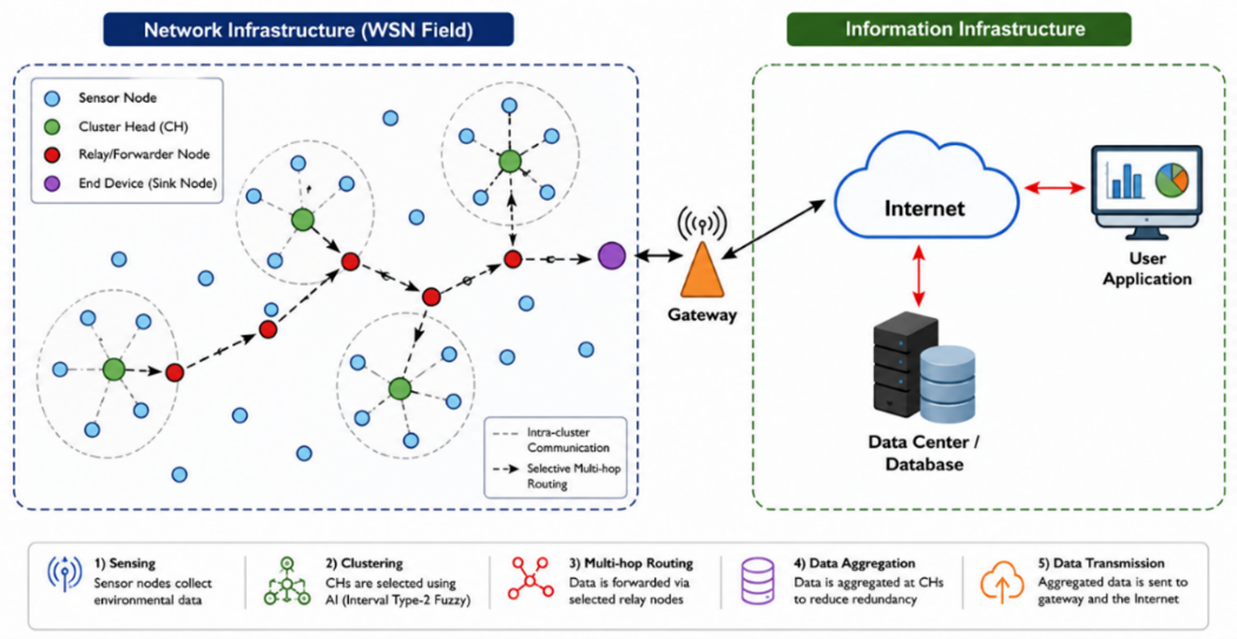
Wireless Sensor Networks (WSNs) constitute a critical data-acquisition layer for large-scale sensing and big-data analytics; however, limited battery capacity, uneven energy dissipation, hotspot formation, and excessive clustering overhead can interrupt continuous data collection and reduce network lifetime. This paper proposes an Interval Type-2 Fuzzy Unequal Clustering with Selective Multi-Hop and Adaptive Re-clustering protocol (IT2F-UC-SMH-AR) for reliable and energy-efficient WSN data acquisition. The framework combines interval Type-2 fuzzy-based cluster-head selection, unequal cluster formation, load-aware node association, selective relay-based forwarding, and energy-dependent re-clustering. By preserving sensing-node availability, balancing forwarding loads, and sustaining data delivery to the base station, the proposed protocol strengthens the upstream data pipeline required for subsequent storage, processing, and big-data analytics. Its performance is evaluated through MATLAB simulations under three deployment scenarios and compared with Low-Energy Adaptive Clustering Hierarchy (LEACH), Cluster Head Election using Fuzzy logic (CHEF), and Gupta fuzzy logic-based scheme (Gupta-FL). The results demonstrate that IT2F-UC-SMH-AR delays early node failure, improves cluster-head stability and energy balance, and maintains competitive packet delivery under different network sizes and communication distances. Its advantages become particularly evident in scenarios with increased routing complexity, where unequal clustering and selective multi-hop transmission reduce long-range communication costs. Although LEACH achieves higher throughput in some compact or dense deployments, the proposed protocol provides a more favorable trade-off between network stability, energy preservation, and reliable data acquisition. These findings establish IT2F-UC-SMH-AR as a promising framework for energy-constrained WSN applications supporting continuous, large-scale data collection.
References
Z. Shafeeq Bakr, R. Hassan, S. Al-Tahir, N. Basil, A. Ma’arif, and H. Marhoon, “A comparative study of fuzzy logic controller, ANFIS, and HHOPSO algorithms in the LEACH protocol for optimising energy efficiency and network longevity in wireless sensor networks,” International Journal of Robotics and Control Systems, vol. 5, no. 3, pp. 1678–1700, 2025, https://doi.org/10.31763/ijrcs.v5i3.1918.
Z. Wang and J. Duan, “An unequal clustering and multi-hop routing protocol based on fuzzy logic and Q-learning in WSNs,” Entropy, vol. 27, no. 2, p. 118, 2025, https://doi.org/10.3390/e27020118.
D. K. and S. Santhosh Kumar, “Comprehensive survey on cluster-based energy-efficient routing protocols in wireless sensor networks,” Wireless Personal Communications, vol. 146, pp. 4115–4144, 2026, https://doi.org/10.1007/s11277-026-12133-x.
A. Zaier, I. Lahmar, M. Yahia, and J. Lloret, “Interval type 2 fuzzy unequal clustering and sleep scheduling for IoT-based WSNs,” Ad Hoc Networks, vol. 175, p. 103867, 2025, https://doi.org/10.1016/j.adhoc.2025.103867.
W. Luo, Y. Yu, L. Zeng, D. Lin and Y. L. Guan, "ECAEP: An Energy-Efficient Clustering Approach Based on Wireless Energy Provision Mechanism for the Wireless Sensor Network," in IEEE Transactions on Mobile Computing, vol. 25, no. 8, pp. 13291-13306, Aug. 2026, https://doi.org/10.1109/TMC.2026.3673482.
I. Daanoune and A. Baghdad, “Intelligent energy-aware routing in IoT-based WSNs by reinforcement learning,” Ad Hoc Networks, vol. 176, p. 104244, 2026, https://doi.org/10.1016/j.adhoc.2026.104244.
H. Hu, X. Fan, and C. Wang, “Energy efficient clustering and routing protocol based on quantum particle swarm optimization and fuzzy logic for wireless sensor networks,” Scientific Reports, vol. 14, p. 18595, 2024, https://doi.org/10.1038/s41598-024-69360-0.
S. K. Pandey, A. Sinha, and B. Singh, “Fuzzy-based optimized cluster head selection with energy prediction for unequal clustering in wireless sensor networks,” International Journal of Distributed Sensor Networks, vol. 2026, p. 4635198, 2026, https://doi.org/10.1155/dsn/4635198.
R. Kumar, A. Dwivedi, S. Kumari, S. Joshi, V. Rohilla, and N. Kashyap, “Improved sensor network lifetime using fuzzy scheduling and hybrid goshawk hunger games optimization,” IETE Journal of Research, pp. 1–12, 2026, https://doi.org/10.1080/03772063.2026.2672006.
S. L. Ullo and G. R. Sinha, “Advances in smart environment monitoring systems using IoT and sensors,” Sensors, vol. 20, no. 11, p. 3113, 2020, https://doi.org/10.3390/s20113113.
N. Basil, N. Cherif, M. B. Alhamadani, H. Hasan, and T. F. Agajie, “Comparative analysis of LSTM, HHOSOA, COAESPSO, and XGBoost models for time series load forecasting,” IJCEAI, vol. 1, no. 1, pp. 10–20, Jun. 2026, https://ijceai.org/index.php/ijceai/article/view/13.
N. Merabtine, D. Djenouri, and D.-E. Zegour, “Towards energy efficient clustering in wireless sensor networks: A comprehensive review,” IEEE Access, vol. 9, pp. 92688–92705, 2021, https://doi.org/10.1109/ACCESS.2021.3092509.
N. Ajmi, A. Helali, P. Lorenz, and R. Mghaieth, “Multi weight chicken swarm based genetic algorithm for energy efficient clustered wireless sensor network,” Sensors, vol. 21, no. 3, p. 791, 2021, https://doi.org/10.3390/s21030791.
A. Rodríguez, C. Del-Valle-Soto, and R. Velázquez, “Energy-efficient clustering routing protocol for wireless sensor networks based on yellow saddle goatfish algorithm,” Mathematics, vol. 8, no. 9, p. 1515, 2020, https://doi.org/10.3390/math8091515.
V. Cherappa, T. Thangarajan, S. S. M. Sundaram, F. Hajjej, A. K. Munusamy, and R. Shanmugam, “Energy-efficient clustering and routing using ASFO and a cross-layer-based expedient routing protocol for wireless sensor networks,” Sensors, vol. 23, no. 5, p. 2788, 2023, https://doi.org/10.3390/s23052788.
M. R. Reddy, M. L. R. Chandra, P. Venkatramana, and R. Dilli, “Energy-efficient cluster head selection in wireless sensor networks using an improved grey wolf optimization algorithm,” Computers, vol. 12, no. 2, p. 35, 2023, https://doi.org/10.3390/computers12020035.
Q. Feng et al., “Energy-efficient clustering mechanism of routing protocol for heterogeneous wireless sensor network based on bamboo forest growth optimizer,” Entropy, vol. 24, no. 7, p. 980, 2022, https://doi.org/10.3390/e24070980.
G. Natesan, S. Konda, R. P. de Prado, and M. Woźniak, “A hybrid mayfly–Aquila optimization algorithm-based energy-efficient clustering routing protocol for wireless sensor networks,” Sensors, vol. 22, no. 17, p. 6405, 2022, https://doi.org/10.3390/s22176405.
M. A. Khodeir, J. I. Ababneh, and B. S. Alamoush, “Manta ray foraging optimization-based energy-efficient cluster head selection algorithm for wireless sensor networks,” Journal of Electrical and Computer Engineering, vol. 2022, p. 5461443, 2022, https://doi.org/10.1155/2022/5461443.
J. Amutha, S. Sharma, and S. K. Sharma, “An energy efficient cluster based hybrid optimization algorithm with static sink and mobile sink node for wireless sensor networks,” Expert Systems with Applications, vol. 203, p. 117334, 2022, https://doi.org/10.1016/j.eswa.2022.117334.
Y. Liu et al., “QEGWO: Energy-efficient clustering approach for industrial wireless sensor networks using quantum-related bioinspired optimization,” IEEE Internet of Things Journal, vol. 9, no. 23, pp. 23691–23704, 2022, https://doi.org/10.1109/JIOT.2022.3189807.
N. Malisetti and V. K. Pamula, “Energy efficient cluster based routing for wireless sensor networks using moth levy adopted artificial electric field algorithm and customized grey wolf optimization algorithm,” Microprocessors and Microsystems, vol. 93, p. 104593, 2022, https://doi.org/10.1016/j.micpro.2022.104593.
H. Altaee Naman and Z. Jaffar Mohammed Ameen, “Optimised rotating energy-efficient clustering for wireless sensor devices by sewing training-based optimisation,” Acta Polytechnica, vol. 64, no. 4, pp. 314–321, 2024, https://doi.org/10.14311/AP.2024.64.0314.
S. H. Gopalan, D. G. Takale, B. Jayaprakash, and V. Pandiya Raj, “An energy efficient routing protocol with fuzzy neural networks in wireless sensor network,” Ain Shams Engineering Journal, vol. 15, no. 10, p. 102979, 2024, https://doi.org/10.1016/j.asej.2024.102979.
S. El Khediri, A. Selmi, R. U. Khan, T. Moulahi, and P. Lorenz, “Energy efficient cluster routing protocol for wireless sensor networks using hybrid metaheuristic approaches,” Ad Hoc Networks, vol. 158, p. 103473, 2024, https://doi.org/10.1016/j.adhoc.2024.103473.
H. Wang, K. Liu, C. Wang, and H. Hu, “Energy-efficient, cluster-based routing protocol for wireless sensor networks using fuzzy logic and quantum annealing algorithm,” Sensors, vol. 24, no. 13, p. 4105, 2024, https://doi.org/10.3390/s24134105.
K. Vijayakumar and P. Thirumaraiselvan, “A unified hybrid framework for energy-aware clustering and intelligent routing in Internet of Things-based wireless sensor microsystem networks,” Microsystem Technologies, vol. 32, p. 80, 2026, https://doi.org/10.1007/s00542-026-06074-5.
D. B. Aeggegn and S. D. Hamdi, “Comparative performance analysis of Dijkstra, Bellman–Ford, and Floyd–Warshall routing algorithms in MANETs,” International Journal of Smart Control and Electrical Engineering Systems, vol. 1, no. 1, pp. 19–22, 2026, https://ijscees.org/index.php/pub/article/view/10.
K. Mohaideen Pitchai, “Energy-efficient cluster-based routing in wireless sensor networks using fuzzy-reinforcement whale optimization,” International Journal of Communication Systems, vol. 39, no. 11, p. e70536, 2026, https://doi.org/10.1002/dac.70536.
M. Abdel-Salam, W. A. Gab-Allah, E. M. Eldaydamony, et al., “An improved human memory algorithm with multi-directional and chaotic approaches for global optimization and energy-efficient cluster head selection in WSNs,” Sci. Rep., vol. 16, p. 22414, 2026, https://doi.org/10.1038/s41598-026-61131-3.
E. Alsolami, “Energy-efficient cluster-based routing in wireless sensor networks using a hybrid grey wolf and whale optimization algorithm,” Sustainable Computing: Informatics and Systems, p. 101408, 2026, https://doi.org/10.1016/j.suscom.2026.101408.
P. S. Mehra, “E-FUCA: enhancement in fuzzy unequal clustering and routing for sustainable wireless sensor network,” Complex & Intelligent Systems, vol. 8, no. 1, pp. 393–412, 2022, https://doi.org/10.1007/s40747-021-00392-z.
C. Chen et al., “D2CRP: A novel distributed 2-hop cluster routing protocol for wireless sensor networks,” IEEE Internet of Things Journal, vol. 9, no. 20, pp. 19575–19588, 2022, https://doi.org/10.1109/JIOT.2022.3148106.
M. U. Farooq et al., “POWER: Probabilistic weigh-based energy-efficient cluster routing for large-scale wireless sensor networks,” The Journal of Supercomputing, vol. 78, pp. 12765–12791, 2022, https://doi.org/10.1007/s11227-022-04372-z.
P. Rawat, P. Kumar, and S. Chauhan, “Fuzzy logic and particle swarm optimization-based clustering protocol in wireless sensor network,” Soft Computing, vol. 27, no. 9, pp. 5177–5193, 2023, https://doi.org/10.1007/s00500-023-07833-6.
V. Narayan, A. K. Daniel, and P. Chaturvedi, “E-FEERP: Enhanced fuzzy-based energy efficient routing protocol for wireless sensor network,” Wireless Personal Communications, vol. 131, pp. 371–398, 2023, https://doi.org/10.1007/s11277-023-10434-z.
R. Kumar and D. Sinha, “Quantum-inspired genetic algorithm-based energy-efficient cluster head placement in cluster-based wireless sensor networks,” SN Computer Science, vol. 7, p. 612, 2026, https://doi.org/10.1007/s42979-026-05196-x.
R. Manchanda et al., “Energy-efficient wireless sensor network for urban groundwater level monitoring using machine learning and sink mobility,” Scientific Reports, vol. 16, p. 9474, 2026, https://doi.org/10.1038/s41598-026-39435-1.
S. C. K., B. Ramesh and J. Chandrika, “An energy-aware cluster-head selection for improving network lifetime in wireless sensor networks using machine learning techniques,” Engineering, Technology & Applied Science Research, vol. 16, no. 1, pp. 31887–31894, 2026, https://doi.org/10.48084/etasr.15963.
Z. U. Khan, H. Gao, J. Ma, and M. Aman, “Quantum swarm-optimized DV-Hop algorithm for accurate localization of weak nodes in wireless sensor networks,” Scientific Reports, vol. 16, p. 9029, 2026, https://doi.org/10.1038/s41598-026-38364-3.
F. A. Mohamed et al., “Optimizing energy efficiency in wireless sensor networks through advanced cluster-based routing protocols,” Sci. Rep., vol. 16, p. 20793, 2026, https://doi.org/10.1038/s41598-025-11382-3.
M. I. Niranjana and N. Kumareshan, “Energy-efficient secure routing in wireless sensor networks using fuzzy inference clustering and attention-based multi-scale deep learning,” Scientific Reports, 2026, https://doi.org/10.1038/s41598-026-55944-5.
G. T. Santhosh et al., “Quantum-swarm cognitive routing framework using neuro-fuzzy reinforced meta-optimization for ultra-reliable VANETs,” Iranian Journal of Science and Technology, Transactions of Electrical Engineering, 2026, https://doi.org/10.1007/s40998-026-01055-w.
G. Liu, “QPSODRL: An improved quantum particle swarm optimization and deep reinforcement learning based intelligent clustering and routing protocol for wireless sensor networks,” Scientific Reports, vol. 16, p. 5526, 2026, https://doi.org/10.1038/s41598-026-35365-0.
A. Chu, T. Zhang, and C. Wang, “LEACH protocol evolution in WSN: A review of energy consumption optimization and security reinforcement,” Sensors, vol. 26, no. 7, p. 2272, 2026, https://doi.org/10.3390/s26072272.
M. Xu, Y. Zu, and J. Zhou, “Energy-efficient clustering routing for WSNs based on multiobjective quantum adaptive gray wolf optimization,” IEEE Sensors Journal, vol. 25, no. 8, pp. 14080–14098, Apr. 2025, https://doi.org/10.1109/JSEN.2025.3544543.
Y. Qu et al., “Intelligent unequal clustering in wireless sensor networks using a game-theoretic and evolutionary strategy,” Scientific Reports, vol. 15, p. 32992, 2025, https://doi.org/10.1038/s41598-025-17758-9.
S. Phoemphon, C. So-In, P. Aimtongkham, and T. G. Nguyen, “An energy-efficient fuzzy-based scheme for unequal multihop clustering in wireless sensor networks,” Journal of Ambient Intelligence and Humanized Computing, vol. 12, pp. 873–895, 2021, https://doi.org/10.1007/s12652-020-02090-z.
S. R. V. P. Reddy, M. B. M., D. S. Rajesh, C. Sujatha, and V. Gosty, “Adaptive energy stability and link-aware routing protocol for energy-efficient wireless sensor networks,” in Proc. 4th Int. Conf. Integrated Circuits and Communication Systems (ICICACS), pp. 1–8, 2026, https://doi.org/10.1109/ICICACS68679.2026.11578494.
R. Manchanda et al., “Energy-efficient clustering and routing for IoT-enabled healthcare using adaptive fuzzy logic and hybrid optimization,” Scientific Reports, vol. 15, p. 34619, 2025, https://doi.org/10.1038/s41598-025-18243-z.
J. Alotaibi, “FuzOptRoute: A fuzzy logic-integrated optimization-based energy-efficient cluster routing framework with edge computing for mobile communication networks,” The Journal of Supercomputing, vol. 81, p. 1186, 2025, https://doi.org/10.1007/s11227-025-07673-1.
M. Aissa, B. Bouhdid, A. Ben Mnaouer, B. Ouni, M. Abdelhafidh, M. Al-Bahri, and K. ALmayah, “FQL: A fuzzy Q-learning framework for reinforcement-driven clustering in flying Ad Hoc networks,” Cluster Computing, vol. 29, p. 512, 2026, https://doi.org/10.1007/s10586-026-06239-x.
Published
How to Cite
Issue
Section
License
Copyright (c) 2026 Ammar Dawood Jasim, Tareq Abed Mohammed, Mas Al-Qutbi

This work is licensed under a Creative Commons Attribution-ShareAlike 4.0 International License.
Authors who publish with this journal agree to the following terms:
- Authors retain copyright and grant the journal right of first publication with the work simultaneously licensed under a Creative Commons Attribution License that allows others to share the work with an acknowledgment of the work's authorship and initial publication in this journal.
- Authors are able to enter into separate, additional contractual arrangements for the non-exclusive distribution of the journal's published version of the work (e.g., post it to an institutional repository or publish it in a book), with an acknowledgment of its initial publication in this journal.
- Authors are permitted and encouraged to post their work online (e.g., in institutional repositories or on their website) prior to and during the submission process, as it can lead to productive exchanges, as well as earlier and greater citation of published work (See The Effect of Open Access).

This journal is licensed under a Creative Commons Attribution-ShareAlike 4.0 International License.