Self-Sustaining Embedded Edge-Vision Node for Industrial OSH Monitoring: Fusing YOLOv8n Compliance Matrix with Active-Cooled Dual-Axis Photovoltaic Tracking
DOI:
https://doi.org/10.12928/biste.v8i5.17209Keywords:
Dual-Axis Solar Tracker, Embedded Vision, Energy-Neutral IoT, PPE Compliance, Cyber-Physical Systems Decent Job, Economic Growth, Clean Energy TechnologyAbstract
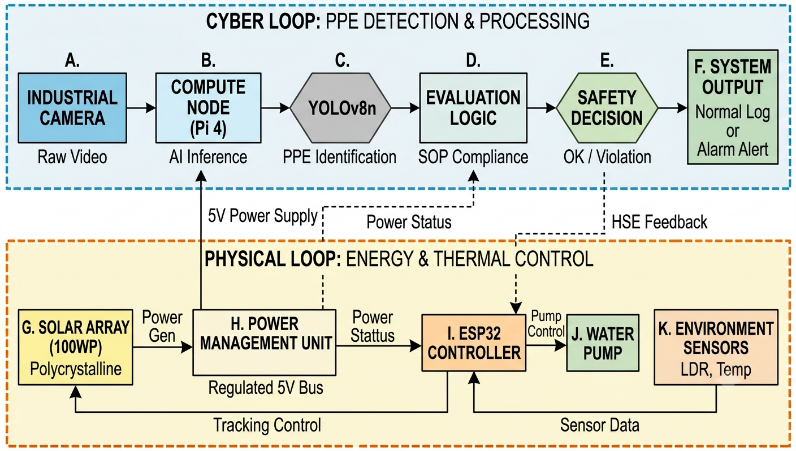
Deploying edge-computing nodes for automated Occupational Safety and Health (OSH) monitoring in remote industrial zones faces bottlenecks due to grid absence and high energy demands of continuous deep learning inference. Conversely, outdoor solar infrastructures suffer from efficiency degradation caused by static positioning and thermal stress. To address these interconnected challenges, this study proposes a self-sustaining cyber-physical edge-vision framework integrating a deep learning pipeline with an intelligent renewable energy control system, advancing SDG 8 (Decent Job) and (Economic Growth) and SDG 7 (Clean Energy Technology). The processing core leverages a lightweight YOLOv8n paradigm on a Raspberry Pi 4 to track six Personal Protective Equipment (PPE) categories via strict rule-based logical conjunctions (AND gates) for real-time compliance evaluation. To ensure power autonomy, the edge node is integrated with a 100 WP polycrystalline photovoltaic array governed by an ESP32 microcontroller executing dual-axis tracking and active cooling. Empirical validations demonstrate that while the localized pipeline maintains a throughput of 8.4–11.6 FPS, its decision integrity degrades under severe occlusions, dropping to 16.6% accuracy with an 83.3% False Alarm Rate (FAR). Crucially, the dual-axis tracking and active cooling system mitigates thermal losses, elevating photovoltaic efficiency to 17.58% and delivering an average output of 179.35 Wh. This significantly outperforms static setups (15.30% efficiency, 146.83 Wh), compensating for computational load without grid dependence. This work establishes a baseline for architectural codesign in autonomous, resilient, and energy-neutral industrial IoT deployments.
References
L. Taofeek et al., “Achieving effective operations in petrochemical industries using affordable and clean energy: Techniques, benefits, barriers and solutions,” Energy Nexus, vol. 13, p. 100280, 2026, https://doi.org/10.1016/j.clwas.2025.100453.
S. I. S. Mohammad et al., “Unlocking CRM performance through knowledge management systems: The moderating role of Industry 4.0 in Jordanian SMEs,” in Empowering Business Through Technology: Innovations Shaping Our Future, R. El Khoury, Ed., Cham: Springer Nature Switzerland, 2026, pp. 27–38, https://doi.org/10.1007/978-3-032-02056-7_3.
M. A. Mir, N. Zaidi, S. K. Chang, and N. Abdelli, “Artificial intelligence applications in food science: A review of cutting-edge technologies,” Cogent Food Agric., vol. 12, no. 1, p. 2606439, 2026, https://doi.org/10.1080/23311932.2025.2606439.
M. A. Alawad, R. H. C. Alfilh, N. Singh, S. Singh, and R. Kumar, “Adaptive energy-aware approximate multiplier with dynamic reconfiguration for IoT edge applications,” Comput. Commun., vol. 250, p. 108457, 2026, https://doi.org/10.1016/j.comcom.2026.108457.
A. H. Yuwono, D. A. Dewi, R. Balakrishnan, and R. Rahmadian, “A portable solar-powered wireless charger: Design, implementation, and performance analysis,” Buletin Ilmiah Sarjana Teknik Elektro, vol. 8, no. 3, pp. 824–836, 2026, https://doi.org/10.12928/biste.v8i3.15226.
J. Lo, L.-K. Lin, and C.-C. Hung, “Real-time personal protective equipment compliance detection based on deep learning algorithm,” Sustainability, vol. 15, no. 1, p. 391, 2022, https://doi.org/10.3390/su15010391.
P. Gawade, M. Pednekar, R. Bulbule, V. Vashikar, C. S. Raje and V. D. Raskar, "IoT-Enabled Solar Wireless Charging System for Electric Vehicles," 2026 2nd International Conference on Computing, Communication and Green Engineering (CCGE), pp. 1-6, 2026, https://doi.org/10.1109/CCGE67142.2026.11581666.
A. H. Yuwono, M. Rivai, and T. A. Sardjono, “Solar panel-based wireless battery charging system using fuzzy control method,” IOP Conf. Ser. Mater. Sci. Eng., vol. 847, no. 1, p. 012088, 2020, https://doi.org/10.1088/1757-899X/847/1/012088.
M. Ardita, A. H. Yuwono, G. Kusrahardjo, R. P. Labib, and K. A. Widodo, “Preliminary assessment on the performance of long distance wireless data transmission for disaster early warning system,” AIP Conf. Proc., vol. 3077, no. 1, p. 050067, 2024, https://doi.org/10.1063/5.0216537.
W. A. Wirawan and D. Puspitasari, “Deformation pattern and energy absorption performance of AL 6063-T5 tube crash box under axial crushing,” AIP Conf. Proc., vol. 3354, no. 1, Art. no. 030024, 2025, https://doi.org/10.1063/5.0291655.
Z. P. Muqorrobin, A. Nawawi, A. A. Ardani, S. P. Setia, and R. Rahmadian, “Off-grid solar system monitoring based on ESP-32 and INA219 in Pesanggrahan Gordomulyo,” Vokasi UNESA Bull. Eng. Technol. Appl. Sci., vol. 1, no. 2, pp. 26–37, 2024, https://doi.org/10.26740/vubeta.v1i2.34859.
W. A. Wirawan, A. Sabitah, G. Sakti, B. B. Harianto, M. A. Choiron, R. A. Ilyas, S. M. Sapuan, and J. Prasetijo, “Crashworthiness characteristic of aluminum/composite hybrid tubes under axial compression,” Results Eng., vol. 25, Art. no. 103889, 2025, https://doi.org/10.1016/j.rineng.2024.103889.
A. H. Yuwono, “Application of photodiodes as sensors in Arduino-based automatic river garbage cleaner: Automatic River Garbage Cleaner,” JEEMECS (Journal Electr. Eng. Mechatron. Comput. Sci.), vol. 8, no. 1, pp. 39–44, 2025, https://doi.org/10.26905/jeemecs.v8i1.15165.
F. Suprayogi, S. Al Fatah, and R. Wulandari, “Design of System Monitoring for Floating Solar Pane Energy Based on IoT: Blynk,” Indonesian Journal of Innovation and Applied Sciences (IJIAS), vol. 4, no. 3, pp. 217-224, 2024 https://doi.org/10.47540/ijias.v4i3.1582.
W. A. Wirawan, B. Junipitoyo, S. H. S. Putro, A. Sabitah, A. H. Suudy, R. Ridwan, and M. A. Choiron, “Collapse behavior and energy absorption characteristics of design multi-cell thin wall structure 3D-printed under quasi statistic loads,” Automot. Exper., vol. 7, no. 1, pp. 149–160, 2024, https://doi.org/10.31603/ae.10892.
A. S. Aziz, D. A. Dewi, D. Rahmatullah, M. I. Al-Qassam, A. L. Wardani, F. I. Amaliah, and O. Setyawati, “Performance evaluation of a rabbit manure-based biogas power system: Slurry dynamics, energy yield, and conversion efficiency,” Buletin Ilmiah Sarjana Teknik Elektro, vol. 8, no. 4, pp. 1207–1220, 2026, https://doi.org/10.12928/biste.v8i4.16870.
G. Gallo, F. D. Rienzo, F. Garzelli, P. Ducange, and C. Vallati, “A smart system for personal protective equipment detection in industrial environments based on deep learning at the edge,” IEEE Access, vol. 10, pp. 110862–110878, 2022, https://doi.org/10.1109/ACCESS.2022.3215148.
D. G. Lema, R. Usamentiaga, and D. García, “Low-cost system for real-time verification of personal protective equipment in industrial facilities using edge computing devices,” J. Real-Time Image Process., vol. 20, no. 6, p. 118, 2023, https://doi.org/10.1007/s11554-023-01368-7.
W. A. Wirawan, A. Sabitah, M. Mushlimin, K. Boimau, E. Widodo, and R. A. Ilyas, “The influence of laminate number and fiber orientation on the mechanical properties of carbon fiber-epoxy composite,” J. Eng. Sci., vol. 13, no. 1, pp. D1–D13, 2026, https://doi.org/10.21272/JES.2026.13(1).D1.
S. A. Dion and A. Yuwono H., “Performance evaluation of lightweight object detection models for real-time personal protective equipment detection in the construction sites,” JSiI (Jurnal Syst. Inf.), vol. 12, no. 1, pp. 1–10, 2025, https://doi.org/10.30656/jsii.v12i1.9896.
N. Tahilramani, P. Ahir, S. Saxena, V. P. Talreja, and P. Charanarur, “Edge-based AI solution for enhancing urban safety: Helmet compliance monitoring with YOLOv9 on Raspberry Pi,” Discov. Internet Things, vol. 5, no. 1, p. 113, 2025, https://doi.org/10.1007/s43926-025-00113-9.
G. G, “Real-time personal protective equipment compliance monitoring using deep learning techniques,” Int. J. Res. Appl. Sci. Eng. Technol., vol. 13, no. 2, pp. 520–525, 2025, https://doi.org/10.22214/ijraset.2025.68551.
W. A. Wirawan, D. H. Wakhidah, D. Wulandari, A. Sabitah, M. A. Choiron, J. Prasetijo, and S. M. Sapuan, “Crashworthiness performance of pentagonal multi-cell carbon filament/aluminium circular hybrid tube under axial crushing,” Results Eng., vol. 30, Art. no. 110605, 2026, https://doi.org/10.1016/j.rineng.2026.110605.
A. Barlybayev et al., “Personal protective equipment detection using YOLOv8 architecture on object detection benchmark datasets: A comparative study,” Cogent Eng., vol. 11, no. 1, p. 2333209, 2024, https://doi.org/10.1080/23311916.2024.2333209.
S. Al-Azani, H. Luqman, M. Alfarraj, A. A. Sidig, A. H. Khan, and D. Al-Hamed, “Real-time monitoring of personal protective equipment compliance in surveillance cameras,” IEEE Access, vol. 12, pp. 121882–121895, 2024, https://doi.org/10.1109/ACCESS.2024.3451117.
I. Yankson, N. Nsiah-Achampong, P. Okyere, F. Afukaar, E. Otupiri, P. Donkor, and E. Owusu-Dabo, “On site personal protective equipment signage and use by road construction workers in Ghana: A comparative study of foreign- and locally-owned companies,” BMC Public Health, vol. 21, no. 1, p. 1827, 2021, https://doi.org/10.1186/s12889-021-11883-9.
W. A. Wirawan, D. Sartika, M. Setiyo, and R. A. Ilyas, “Utilization of biomass-derived activated carbon from Tectona grandis and banana leaves for hydrogen production via water electrolysis,” Mater. Lett., vol. 416, Art. no. 140663, 2026, https://doi.org/10.1016/j.matlet.2026.140663.
M. Ahmed, L. Saraireh, A. Rahman, S. Al-Qarawi, A. Mhran, J. Al-Jalaoud, and M. Gollapalli, “Personal protective equipment detection: A deep-learning-based sustainable approach,” Sustainability, vol. 15, no. 18, p. 13990, 2023, https://doi.org/10.3390/su151813990.
U. Anjum, “A descriptive study to assess the knowledge and practice on personal protective equipment among student nurses,” Int. J. Nurs. Midwifery Res., vol. 7, no. 4, pp. 8–12, 2020, https://doi.org/10.24321/2455.9318.202028.
M. Isror, F. Nugroho, and H. Medriosa, “Evaluation of implementation of the use of personal protective equipment and construction K3 signs,” J. HMAPs, vol. 2, no. 1, pp. 1–16, 2024, https://doi.org/10.52060/hmaps.v2i1.1963.
O. Önal and E. Dandıl, “Object detection for safe working environments using YOLOv4 deep learning model,” Eur. J. Sci. Technol., no. 28, pp. 1102–1109, 2021, https://doi.org/10.31590/ejosat.951733.
S. Albahli, “A robust YOLOv8-based framework for real-time melanoma detection and segmentation with multi-dataset training,” Diagnostics, vol. 15, no. 6, p. 691, 2025, https://doi.org/10.3390/diagnostics15060691.
C. Shi, D. Zhu, J. Shen, Y. Zheng, and C. Zhou, “GBSG-YOLOv8n: A model for enhanced personal protective equipment detection in industrial environments,” Electronics, vol. 12, no. 22, p. 4628, 2023, https://doi.org/10.3390/electronics12224628.
W. T. Adi, B. Risnanto Nugroho, and H. Wardani Puruhita, “Accuracy assessment of railway track inspection equipment 'void meter' based on the Internet of Things,” SAINSTECH NUSANTARA, vol. 2, no. 3, pp. 46–57, 2025, https://doi.org/10.71225/jstn.v2i3.115.
N. F. Rachman and C. Firdhous, “Feasibility analysis of roof PLTS development for electricity fulfillment at station,” SAINSTECH NUSANTARA, vol. 1, no. 3, pp. 13–27, 2024, https://doi.org/10.71225/jstn.v1i3.69.
A. Dwi Santoso, D. Eka Mahendra, and D. Dirhamsyah, “Temperature and vibration monitoring system on electric motors from wireless remote control using Blynk app,” SAINSTECH NUSANTARA, vol. 1, no. 1, pp. 21–29, 2024, https://doi.org/10.71225/jstn.v1i1.40.
R. Mehta and V. Wasudarae Khond, “Web-based level crossing control system monitoring device (software),” SAINSTECH NUSANTARA, vol. 1, no. 2, pp. 29–36, 2024, https://doi.org/10.71225/jstn.v1i2.1.
F. Dewi, N. Faisal Rachman, and A. Prasetyo, “Design and implementation of a shunting communication voice recorder at Tegal Station using Visual Basic,” SAINSTECH NUSANTARA, vol. 1, no. 1, pp. 30–43, 2024, https://doi.org/10.71225/jstn.v1i1.39.
F. I. Kusuma, I. Fatima, L. A. Yuningtyas, and D. Octaviani, “‘E-UMKM’ mobile application to increase productivity and competitiveness of MSMEs in the digital era: Evaluation and implementation in the digital era,” Vokasi UNESA Bull. Eng. Technol. Appl. Sci., vol. 1, no. 2, pp. 48–60, 2024, https://doi.org/10.26740/vubeta.v1i2.34877.
Y. Kuku, E. J. Abdullahi, B. E. Daukere, and J. P. Oru-Bo, “Spatial pattern and distribution of Adansonia species in the Sahel Savanna ecosystem of Yobe State, Nigeria,” Vokasi UNESA Bull. Eng. Technol. Appl. Sci., vol. 2, no. 3, pp. 475–488, 2025, https://doi.org/10.26740/vubeta.v2i3.39262.
Y. F. Hendrawan and O. Chekuri, “Exploring supervised learning methods for predicting cuisines from their ingredients,” Vokasi UNESA Bull. Eng. Technol. Appl. Sci., vol. 2, no. 1, pp. 67–76, 2025, https://doi.org/10.26740/vubeta.v2i1.34153.
Ajay and P. Singh, “A literature review on brain tumour detection approaches using MRIs,” Vokasi UNESA Bull. Eng. Technol. Appl. Sci., vol. 3, no. 2, pp. 214–232, 2026, https://doi.org/10.26740/vubeta.v3i2.46521.
S. K. Singh and P. K. Singh, “Performance evaluation of the fast forward quantum optimization algorithm in digital image clustering,” Vokasi UNESA Bull. Eng. Technol. Appl. Sci., vol. 3, no. 2, pp. 233–240, 2026, https://doi.org/10.26740/vubeta.v3i2.46206.
A. Hammad, “Hybrid deep learning approach for DDoS attack detection based on multidimensional network traffic analysis,” Vokasi UNESA Bull. Eng. Technol. Appl. Sci., vol. 3, no. 2, pp. 262–268, 2026, https://doi.org/10.26740/vubeta.v3i2.39992.
Published
How to Cite
Issue
Section
License
Copyright (c) 2026 Alfarid Hendro Yuwono, Mahendra Widyartono, As'ad Shidqy Aziz, Deshinta Arrova Dewi, Usman Nurhasan, Vugar Hacimahmud Abdullayev, Ana Nuril Achadiyah, Nur Vidia Laksmi B.

This work is licensed under a Creative Commons Attribution-ShareAlike 4.0 International License.
Authors who publish with this journal agree to the following terms:
- Authors retain copyright and grant the journal right of first publication with the work simultaneously licensed under a Creative Commons Attribution License that allows others to share the work with an acknowledgment of the work's authorship and initial publication in this journal.
- Authors are able to enter into separate, additional contractual arrangements for the non-exclusive distribution of the journal's published version of the work (e.g., post it to an institutional repository or publish it in a book), with an acknowledgment of its initial publication in this journal.
- Authors are permitted and encouraged to post their work online (e.g., in institutional repositories or on their website) prior to and during the submission process, as it can lead to productive exchanges, as well as earlier and greater citation of published work (See The Effect of Open Access).

This journal is licensed under a Creative Commons Attribution-ShareAlike 4.0 International License.