A Novel Approach to Multi-Task Prediction in IoT Environments Using Dynamic Heterogeneous Graph Neural Networks
DOI:
https://doi.org/10.12928/biste.v8i3.16044Keywords:
Dynamic Graph Neural Networks, Internet of Things, Multi-Task Learning, Predictive Maintenance, Risk AssessmentAbstract
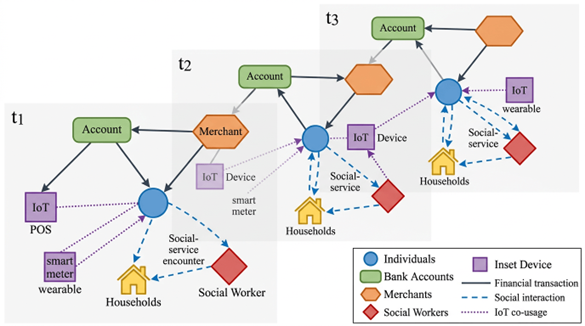
The rapid proliferation of Internet of Things (IoT) devices and digital services has created densely interconnected socio-technical networks that challenge conventional risk management. Traditional machine learning models struggle to capture multi-hop relational structure, temporal drift, and severe class imbalance, while static Graph Neural Networks (GNNs) ignore dynamic graph evolution and high-frequency IoT telemetry. This paper proposes an IoT-driven dynamic prediction framework that conceptualizes financial and social-protection infrastructures as assets requiring predictive maintenance. We introduce a multi-task dynamic heterogeneous GNN that jointly estimates credit risk in financial networks and early-warning scores for high-risk social-work cases over evolving graphs linking clients, accounts, devices, households, and practitioners. The architecture combines relation-aware message passing with a Gated Recurrent Unit (GRU) temporal encoder to integrate streaming IoT signals with longitudinal administrative data. We specify an evaluation protocol that compares the framework with logistic regression, gradient boosting, temporal sequence models, and static GCN/GraphSAGE using AUC-ROC, AUC-PR, Brier score, and operational metrics under time-based splits and rolling-window validation; future empirical studies should also employ appropriate significance tests, such as DeLong’s test and bootstrap confidence intervals. This work does not report new experiments on proprietary datasets; instead, it synthesizes recent findings in credit risk, anti-money laundering, IoT-based predictive maintenance, and child-protection analytics to argue that dynamic multi-task graph modeling can better support timely, ethically governed interventions in complex socio-technical systems.
References
S. F. Wamba, A. Gunasekaran, S. Akter, S. J. Ren, R. Dubey, and S. J. Childe, “Big data analytics and firm performance: Effects of dynamic capabilities,” Journal of Business Research, vol. 70, pp. 356-365, 2017, https://doi.org/10.1016/j.jbusres.2016.08.009.
G. Dong, M. Tang, Z. Wang, J. Gao, S. Guo, L. Cai, R. Gutierrez, B. Campbel, L. E. Barnes, and M. Boukhechba, “Graph Neural Networks in IoT: A Survey,” ACM Transactions on Sensor Networks, vol. 19, no. 2, pp. 1-50, 2023, https://doi.org/10.1145/3565973.
I. Esteves, R. Braga, J. M. N. David, and V. Stroele, “Intelligent Data Analysis of Predictive Maintenance in Industry 4.0: A Mapping Study,” Procedia Computer Science, vol. 278, pp. 316-323, 2026, https://doi.org/10.1016/j.procs.2026.02.468.
J. Garcia, L. Rios-Colque, A. Peña, and L. Rojas, “Condition Monitoring and Predictive Maintenance in Industrial Equipment: An NLP-Assisted Review of Signal Processing, Hybrid Models, and Implementation Challenges,” Applied Sciences, vol. 15, no. 10, p. 5465, 2025, https://doi.org/10.3390/app15105465.
Y. Wu, H.-N. Dai, and H. Tang, “Graph Neural Networks for Anomaly Detection in Industrial Internet of Things,” IEEE Internet of Things Journal, vol. 9, no. 12, pp. 9214-9231, Jun. 2022, https://doi.org/10.1109/JIOT.2021.3094295.
Y. Fan, T. Fu, N. I. Listopad, P. Liu, S. Garg, and M. M. Hassan, “Utilizing correlation in space and time: Anomaly detection for Industrial Internet of Things (IIoT) via spatiotemporal gated graph attention network,” Alexandria Engineering Journal, vol. 106, pp. 560-570, 2024, https://doi.org/10.1016/j.aej.2024.08.048.
S. Yang, W. Pan, M. Li, M. Yin, H. Ren, Y. Chang, Y. Liu, S. Zhang, and F. Lou, “Industrial Internet of Things Intrusion Detection System Based on Graph Neural Network,” Symmetry, vol. 17, no. 7, p. 997, 2025, https://doi.org/10.3390/sym17070997.
N. Bakhshinejad, U. Nguyen, S. Ghahremani, and R. Soltani, “A Graph-Based Deep Learning Model for the Anti-Money Laundering Task of Transaction Monitoring,” in Proceedings of the 16th International Joint Conference on Computational Intelligence - Volume 1: NCTA, pp. 496-507, 2024, https://doi.org/10.5220/0013071700003837.
A. Usman, N. Naveed, and S. Munawar, “Intelligent Anti-Money Laundering Fraud Control Using Graph-Based Machine Learning Model for the Financial Domain,” Journal of Cases on Information Technology, vol. 25, no. 1, 2023, https://doi.org/10.4018/JCIT.316665.
M. Rosholm, S. T. Bodilsen, B. Michel, and A. S. Nielsen, “Predictive risk modeling for child maltreatment detection and enhanced decision-making: Evidence from Danish administrative data,” PLoS One, vol. 19, no. 7, p. e0305974, 2024, https://doi.org/10.1371/journal.pone.0305974.
F. Johannessen and M. Jullum, “Finding money launderers using heterogeneous graph neural networks,” The Journal of Finance and Data Science, vol. 11, p. 100175, 2025, https://doi.org/10.1016/j.jfds.2025.100175.
T. Li, G. Kou, and Y. Peng, “A new representation learning approach for credit data analysis,” Information Sciences, vol. 627, pp. 115-131, 2023, https://doi.org/10.1016/j.ins.2023.01.068.
B. Feng, H. Xu, W. Xue, and B. Xue, “Every Corporation Owns Its Structure: Corporate Credit Rating via Graph Neural Networks,” in Pattern Recognition and Computer Vision: 5th Chinese Conference, PRCV 2022, Shenzhen, China, November 4-7, 2022, Proceedings, Part I, pp. 688-699, 2022, https://doi.org/10.1007/978-3-031-18907-4_53.
T. Melese, T. Berhane, A. Mohammed, and A. Walelgn, “Credit-Risk Prediction Model Using Hybrid Deep — Machine-Learning Based Algorithms,” Scientific Programming, vol. 2023, no. 1, p. 6675425, 2023, https://doi.org/10.1155/2023/6675425.
V. Chang, S. Sivakulasingam, H. Wang, S. T. Wong, M. A. Ganatra, and J. Luo, “Credit Risk Prediction Using Machine Learning and Deep Learning: A Study on Credit Card Customers,” Risks, vol. 12, no. 11, p. 174, 2024, https://doi.org/10.3390/risks12110174.
L. Wei, J. Dong, and H. Yu, “NERHF: a hybrid machine learning-driven efficient credit risk control framework,” Sci Rep, vol. 16, p. 1170, 2026, https://doi.org/10.1038/s41598-025-30905-6.
S. Das, X. Huang, S. Adeshina, P. Yang, and L. Bachega, “Credit Risk Modeling with Graph Machine Learning,” INFORMS Journal on Data Science, vol. 2, no. 2, pp. 197-217, 2023, https://doi.org/10.1287/ijds.2022.00018.
X. Han, Y. Yang, J. Chen, M. Wang, and M. Zhou, “Symmetry-Aware Credit Risk Modeling: A Deep Learning Framework Exploiting Financial Data Balance and Invariance,” Symmetry, vol. 17, no. 3, p. 341, 2025, https://doi.org/10.3390/sym17030341.
D. Cardoso and L. Ferreira, “Application of Predictive Maintenance Concepts Using Artificial Intelligence Tools,” Applied Sciences, vol. 11, no. 1, p. 18, 2021, https://doi.org/10.3390/app11010018.
B. Ton, R. Basten, J. Bolte, J. Braaksma, A. Di Bucchianico, P. van de Calseyde, F. Grooteman, T. Heskes, N. Jansen, W. Teeuw, T. Tinga, and M. Stoelinga, “PrimaVera: Synergising Predictive Maintenance,” Applied Sciences, vol. 10, no. 23, p. 8348, 2020, https://doi.org/10.3390/app10238348.
C. Resende, D. Folgado, J. Oliveira, B. Franco, W. Moreira, A. Oliveira-Jr, A. Cavaleiro, and R. Carvalho, “TIP4.0: Industrial Internet of Things Platform for Predictive Maintenance,” Sensors, vol. 21, no. 14, p. 4676, 2021, https://doi.org/10.3390/s21144676.
P. Mallioris, E. Aivazidou, and D. Bechtsis, “Predictive maintenance in Industry 4.0: A systematic multi-sector mapping,” CIRP Journal of Manufacturing Science and Technology, vol. 50, pp. 80-103, 2024, https://doi.org/10.1016/j.cirpj.2024.02.003.
D. Ma, “Predictive maintenance technology for industrial production equipment using cloud platform,” Diagnostyka, vol. 26, no. 2, p. 2025211, 2025, https://doi.org/10.29354/diag/205035.
Y. M. Al-Naggar, N. Jamil, M. F. Hassan, and A. R. Yusoff, “Condition monitoring based on IoT for predictive maintenance of CNC machines,” Procedia CIRP, vol. 102, pp. 314-318, 2021, https://doi.org/10.1016/j.procir.2021.09.054.
J. Jeba Emilyn, D. Vinod Kumar, S. David Samuel Azariya, M. Prakash, and A. Sam Thamburaj, “Deep Learning-based Predictive Maintenance for Industrial IoT Applications,” 2024 International Conference on Inventive Computation Technologies (ICICT), pp. 1197-1202, 2024, https://doi.org/10.1109/ICICT60155.2024.10544377.
J. Hurtado, D. Salvati, R. Semola, M. Bosio, and V. Lomonaco, “Continual learning for predictive maintenance: Overview and challenges,” Intelligent Systems with Applications, vol. 19, p. 200251, 2023, https://doi.org/10.1016/j.iswa.2023.200251.
G. May, S. Cho, A. Majidirad, and D. Kiritsis, “A Semantic Model in the Context of Maintenance: A Predictive Maintenance Case Study,” Applied Sciences, vol. 12, no. 12, p. 6065, 2022, https://doi.org/10.3390/app12126065.
Y. Lu, Y. Li, R. Zhang, W. Chen, B. Ai, and D. Niyato, “Graph Neural Networks for Wireless Networks: Graph Representation, Architecture and Evaluation,” IEEE Wireless Communications, vol. 32, no. 1, pp. 150-156, 2025, https://doi.org/10.1109/MWC.006.2400131.
F. Ares-Robledo, H. Rifà-Pous, and R. Clarisó, “Graph neural networks for anomaly detection: a systematic review of dynamic temporal approaches,” Artificial Intelligence Review, 2026, https://doi.org/10.1007/s10462-026-11532-7.
H. Guo, Z. Zhou, and D. Zhao, “GNN-Based Energy-Efficient Anomaly Detection for IoT Multivariate Time-Series Data,” ICC 2023 - IEEE International Conference on Communications, pp. 2492-2497, 2023, https://doi.org/10.1109/ICC45041.2023.10278988.
Y. Shi, Y. Qu, Z. Chen, Y. Mi, and Y. Wang, “Improved credit risk prediction based on an integrated graph representation learning approach with graph transformation,” European Journal of Operational Research, vol. 315, no. 2, pp. 786-801, 2024, https://doi.org/10.1016/j.ejor.2023.12.028.
S. Zandi, K. Korangi, M. Óskarsdóttir, C. Mues, and C. Bravo, “Attention-based dynamic multilayer graph neural networks for loan default prediction,” European Journal of Operational Research, vol. 321, no. 2, pp. 586-599, 2025, https://doi.org/10.1016/j.ejor.2024.09.025.
Y. Zhu and D. Wu, “P2P credit risk management with KG-GNN: a knowledge graph and graph neural network-based approach,” Journal of the Operational Research Society, vol. 76, no. 5, pp. 866-880, 2025, https://doi.org/10.1080/01605682.2024.2398762.
B. Liu, I. Li, J. Yao, Y. Chen, G. Huang, and J. Wang, “Unveiling the Potential of Graph Neural Networks in SME Credit Risk Assessment,” 2024 5th International Conference on Intelligent Computing and Human-Computer Interaction (ICHCI), pp. 562-566, 2024, https://doi.org/10.1109/ICHCI63580.2024.10808129.
M. Sun, W. Sun, Y. Sun, S. Liu, M. Jiang, and Z. Xu, “Applying Hybrid Graph Neural Networks to Strengthen Credit Risk Analysis,” 2024 3rd International Conference on Cloud Computing, Big Data Application and Software Engineering (CBASE), pp. 373-377, 2024, https://doi.org/10.1109/CBASE64041.2024.10824660.
S. Shi, W. Luo, R. Tse, and G. Pau, “SparseGraphSage: A Graph Neural Network Approach for Corporate Credit Rating,” in Proceedings of the 2024 13th International Conference on Software and Computer Applications (ICSCA ‘24), pp. 124-129, 2024, https://doi.org/10.1145/3651781.3651800.
B. J. Feng, X. Cheng, H. N. Xu et al., “Corporate Credit Ratings Based on Hierarchical Heterogeneous Graph Neural Networks,” Machine Intelligence Research, vol. 21, pp. 257-271, 2024, https://doi.org/10.1007/s11633-023-1425-9.
D. Wang, Z. Zhang, Y. Zhao, K. Huang, Y. Kang, and J. Zhou, “Financial Default Prediction via Motif-preserving Graph Neural Network with Curriculum Learning,” in Proceedings of the 29th ACM SIGKDD Conference on Knowledge Discovery and Data Mining (KDD ‘23), pp. 2233-2242, 2023, https://doi.org/10.1145/3580305.3599351.
X. Li, X. Shan, and W. Yin, “Heterogeneous Graph Pre-training Based Model for Secure and Efficient Prediction of Default Risk Propagation among Bond Issuers,” arXiv preprint arXiv:2501.03268, 2024, https://doi.org/10.14722/aiscc.2024.23007.
H. Xu, K. Yu, M. Wei, Y. Zhu, and Y. Liu, “Intelligent Anti-Money Laundering Transaction Pattern Recognition System Based on Graph Neural Networks,” TechRxiv, vol. 2, no. 1, pp. 93-108, 2024, https://doi.org/10.36227/techrxiv.173337595.54829678/v1.
H. Lu and H. Wang, “Graph Contrastive Pre-training for Anti-money Laundering,” International Journal of Computer Intelligence Systems, vol. 17, p. 307, 2024, https://doi.org/10.1007/s44196-024-00720-4.
B. Deprez, W. Wei, W. Verbeke, B. Baesens, K. Mets, and T. Verdonck, “Advances in Continual Graph Learning for Anti‐Money Laundering Systems: A Comprehensive Review,” WIREs Computational Statistics, vol. 17, no. 3, 2025, https://doi.org/10.1002/wics.70040.
K. S. Choi et al., “Deep graph neural network-based prediction of acute suicidal ideation in young adults,” Scientific Reports, vol. 11, p. 15828, 2021, https://doi.org/10.1038/s41598-021-95102-7.
M. Khalid and A. Sano, “Exploiting social graph networks for emotion prediction,” Scientific Reports, vol. 13, p. 6069, 2023, https://doi.org/10.1038/s41598-023-32825-9.
N. Bijlani, O. M. Maldonado, R. Nilforooshan, CR&T Group, P. Barnaghi, and S. Kouchaki, “Utilizing graph neural networks for adverse health detection and personalized decision making in sensor-based remote monitoring for dementia care,” Computers in Biology and Medicine, vol. 183, p. 109287, 2024, https://doi.org/10.1016/j.compbiomed.2024.109287.
E. V. Chumakova, D. G. Korneev, M. S. Gasparian, and I. S. Makhov, “Application of neural network technologies to assess the competence of personnel in the tasks of controlling the operational risk of a credit institution,” Business Informatics, vol. 18, no. 2, pp. 7-21, 2024, https://doi.org/10.17323/2587-814X.2024.2.7.21.
E. Chumakova, D. Korneev, M. Gasparian, V. Titov, and I. Makhov, “Developing a Neural Network to Assess Staff Competence and Minimize Operational Risks in Credit Organizations,” International Research Journal of Multidisciplinary Scope, vol. 5, no. 2, pp. 461-471, 2024, https://doi.org/10.47857/irjms.2024.v05i02.0542.
D. B. Marshall and D. J. English, “Neural network modeling of risk assessment in child protective services,” Psychological Methods, vol. 5, no. 1, pp. 102-124, 2000, https://doi.org/10.1037/1082-989x.5.1.102.
C.-H. Poon, J. Kwok, C. Chow, and J.-H. Choi, “LineMVGNN: Anti-Money Laundering with Line-Graph-Assisted Multi-View Graph Neural Networks,” AI, vol. 6, no. 4, p. 69, 2025, https://doi.org/10.3390/ai6040069.
H. Zhi and M. Zolotova, “Wearable Devices & Elderly: A Bibliometric Analysis of 2014-2024,” Healthcare, vol. 13, no. 16, p. 2066, 2025, https://doi.org/10.3390/healthcare13162066.
Y. Dong, N. V. Chawla, and A. Swami, “Metapath2vec: Scalable Representation Learning for Heterogeneous Networks,” Proceedings of the 23rd ACM SIGKDD International Conference on Knowledge Discovery and Data Mining, pp. 135-144, 2017, https://doi.org/10.1145/3097983.3098036.
N. Yang, C. Gu, Y. Huang, P. Wen, S. Zhao, and S. Feng, “Remaining Useful Life Prediction of Electromechanical Equipment based on Particle Filter and LSTM,” 2022 IEEE International Conference on Sensing, Diagnostics, Prognostics, and Control (SDPC), pp. 87-91, 2022, https://doi.org/10.1109/SDPC55702.2022.9915827.
R. Bokka, N. K. Pola, M. Karumudi, P. Chinnasamy, S. Priyadharshini.D, and K. K, “Edge Computing for Real-Time Analytics in Embedded IoT Systems,” 2025 Global Conference on Information Technology and Communication Networks (GITCON), pp. 1-6, 2025, https://doi.org/10.1109/GITCON65266.2025.11377137.
L. Lukmanjaya W, T. Butler, S. Cox, O. Perez-Concha, L. Bromfield, and G. Karystianis, “Leveraging AI to Investigate Child Maltreatment Text Narratives: Promising Benefits and Addressable Risks,” JMIR Pediatrics and Parenting, vol. 8, p. e73579, 2025, https://doi.org/10.2196/73579.
Z. Hu, Y. Dong, K. Wang, and Y. Sun, “Heterogeneous Graph Transformer,” in Proceedings of The Web Conference 2020, pp. 2704-2710, 2020, https://doi.org/10.1145/3366423.3380027.
A. Pareja, G. Domeniconi, J. Chen, T. Ma, T. Suzumura, H. Kanezashi, T. Kaler, T. Schardl, and C. Leiserson, “EvolveGCN: Evolving Graph Convolutional Networks for Dynamic Graphs,” in Proceedings of the AAAI Conference on Artificial Intelligence, vol. 34, no. 04, pp. 5363-5370, 2020, https://doi.org/10.1609/aaai.v34i04.5984.
T. Liu, X. Zhang, R. Chen, X. Deng, and B. Fu, “Development, comparison, and validation of four intelligent, practical machine learning models for patients with prostate-specific antigen in the gray zone,” Front. Oncol., vol. 13, 1157384, 2023, https://doi.org/10.3389/fonc.2023.1157384.
Published
How to Cite
Issue
Section
License
Copyright (c) 2026 Chia-Ching Lin, Yih-Chang Chen

This work is licensed under a Creative Commons Attribution-ShareAlike 4.0 International License.
Authors who publish with this journal agree to the following terms:
- Authors retain copyright and grant the journal right of first publication with the work simultaneously licensed under a Creative Commons Attribution License that allows others to share the work with an acknowledgment of the work's authorship and initial publication in this journal.
- Authors are able to enter into separate, additional contractual arrangements for the non-exclusive distribution of the journal's published version of the work (e.g., post it to an institutional repository or publish it in a book), with an acknowledgment of its initial publication in this journal.
- Authors are permitted and encouraged to post their work online (e.g., in institutional repositories or on their website) prior to and during the submission process, as it can lead to productive exchanges, as well as earlier and greater citation of published work (See The Effect of Open Access).

This journal is licensed under a Creative Commons Attribution-ShareAlike 4.0 International License.