Hybrid Vision Transformer for Brain and Lung Tumor Detection: A Multi-Modal Approach Using MRI (BraTS) and CT (LUNA16) Datasets
DOI:
https://doi.org/10.12928/biste.v7i4.14766Keywords:
Vision Transformer (ViT), Hybrid Transformer Architecture, Multi-Modal Medical Imaging, MRI–CT Fusion, Tumor Detection, Explainable AI in Radiology, BraTS, LUNA16Abstract
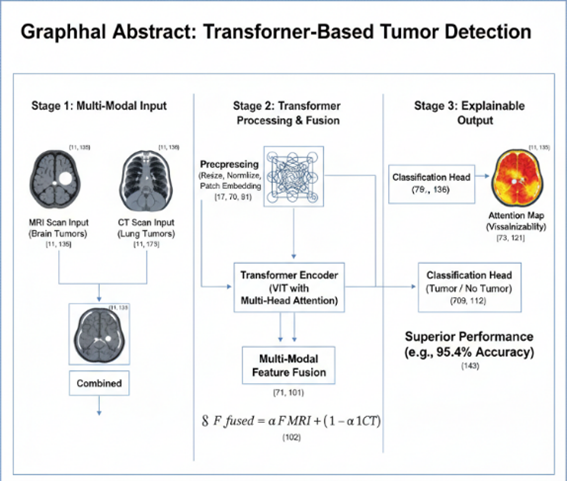
The integration of artificial intelligence (AI) into medical imaging has transformed clinical diagnostics, yet existing CNN-based systems still struggle with capturing global spatial context and generalizing across modalities. This study addresses this gap by proposing a hybrid Vision Transformer (ViT) architecture for tumor detection in MRI and CT scans, evaluated on two benchmark datasets: BraTS (brain MRI) and LUNA16 (lung CT). The research contribution is a unified, end-to-end transformer model that processes heterogeneous modalities without traditional feature-level fusion. The proposed method incorporates convolutional layers for local feature extraction alongside transformer blocks for long-range dependency modeling. Extensive experiments demonstrate that our model achieves a 2.5% higher Dice score and 3.1% higher F1-score compared to state-of-the-art CNN-based baselines, with accuracy reaching 95.4% on BraTS and 93.6% on LUNA16. Attention-based heatmaps further enhance explainability by highlighting clinically relevant tumor regions. These results show that hybrid transformers offer a robust and interpretable framework for multi-modal tumor detection, paving the way for more reliable and transparent AI-assisted radiological diagnostics.
References
Y. Habchi, H. Kheddar, Y. Himeur, and M. C. Ghanem, “Machine learning and transformers for thyroid carcinoma diagnosis: A review,” arXiv preprint arXiv:2403.13843, 2024, https://doi.org/10.1016/j.jvcir.2025.104668.
M. Vafaeezadeh, H. Behnam, and P. Gifani, “Ultrasound image analysis with vision transformers,” Diagnostics, vol. 14, no. 5, p. 542, 2024, https://doi.org/10.3390/diagnostics14050542.
S. Khalighi, K. Reddy, A. Midya, K. B. Pandav, A. Madabhushi, and M. Abedalthagafi, “Artificial intelligence in neuro-oncology: advances and challenges in brain tumor diagnosis, prognosis, and precision treatment,” NPJ Precis Oncol, vol. 8, no. 1, p. 80, 2024, https://doi.org/10.1038/s41698-024-00575-0.
M. Pallumeera, J. C. Giang, R. Singh, N. S. Pracha, and M. S. Makary, “Evolving and Novel Applications of Artificial Intelligence in Cancer Imaging,” Cancers (Basel), vol. 17, no. 9, p. 1510, 2025, https://doi.org/10.3390/cancers17091510.
C. Matsoukas, J. F. Haslum, M. Sorkhei, M. Söderberg, and K. Smith, “Pretrained vits yield versatile representations for medical images,” arXiv preprint arXiv:2303.07034, 2023, https://doi.org/10.48550/arXiv.2303.07034.
S. K. Agrawal, I. P. Dubey, A. K. Nair, A. Jain, A. Mahato, and R. Kumar, “Neuroimaging informatics framework for analysing rare brain metastasis patterns in pleural mesothelioma using hybrid PET CT,” Neuroscience Informatics, p. 100207, 2025, https://doi.org/10.1016/j.neuri.2025.100207.
M. Zubair, M. Hussai, M. A. Al-Bashrawi, M. Bendechache, and M. Owais, “A Comprehensive Review of Techniques, Algorithms, Advancements, Challenges, and Clinical Applications of Multi-modal Medical Image Fusion for Improved Diagnosis,” arXiv preprint arXiv:2505.14715, 2025, https://doi.org/10.1016/j.cmpb.2025.109014.
H.T. Gayap and M. A. Akhloufi, “Deep machine learning for medical diagnosis, application to lung cancer detection: a review,” BioMedInformatics, vol. 4, no. 1, pp. 236-284, 2025, https://doi.org/10.3390/biomedinformatics4010015.
A. M. Freire et al. “Clinical Annotation and Medical Image Anonymization for AI Model Training in Lung Cancer Detection,” In International Conference on Human-Computer Interaction, pp. 309-325, 2025, https://doi.org/10.1007/978-3-031-93848-1_21.
P. Khosravi, T. J. Fuchs, and D. J. Ho, “Artificial Intelligence–Driven Cancer Diagnostics: Enhancing Radiology and Pathology through Reproducibility, Explainability, and Multimodality,” Cancer Res, vol. 85, no. 13, pp. 2356–2367, 2025, https://doi.org/10.1158/0008-5472.CAN-24-3630.
A. Clement David-Olawade et al., “AI-Driven Advances in Low-Dose Imaging and Enhancement—A Review,” Diagnostics, vol. 15, no. 6, p. 689, 2025, https://doi.org/10.3390/diagnostics15060689.
S. Usmani et al., “Deep learning (DL)‐based advancements in prostate cancer imaging: Artificial intelligence (AI)‐based segmentation of 68Ga‐PSMSA PET for tumor volume assessment,” Precis Radiat Oncol, vol. 9, no. 2, pp. 120-132, 2025, https://doi.org/10.1002/pro6.70014.
D.-D. Chitca, V. Popescu, A. Dumitrescu, C. Botezatu, and B. Mastalier, “Advancing Colorectal Cancer Diagnostics from Barium Enema to AI-Assisted Colonoscopy,” Diagnostics, vol. 15, no. 8, p. 974, 2025, https://doi.org/10.3390/diagnostics15080974.
S. R. Ani et al., “Towards Classification of Ovarian Cancer: A Vision Transformer Model,” in 2024 27th International Conference on Computer and Information Technology (ICCIT), pp. 2665–2670, 2024, https://doi.org/10.1109/ICCIT64611.2024.11022029.
M. Fathima and M. Moulana, “Revolutionizing breast cancer care: AI-enhanced diagnosis and patient history,” Comput Methods Biomech Biomed Engin, vol. 28, no. 5, pp. 642–654, 2025, https://doi.org/10.1080/10255842.2023.2300681.
A. Chaudhari, S. Saratkar, and T. Thute, “AI-Enhanced Imaging Techniques for Understanding Alzheimer’s Progression,” in 2025 International Conference on Machine Learning and Autonomous Systems (ICMLAS), pp. 1174–1179, 2025, https://doi.org/10.1109/ICMLAS64557.2025.10969042.
M. Hu, J. Qian, S. Pan, Y. Li, R. L. J. Qiu, and X. Yang, “Advancing medical imaging with language models: featuring a spotlight on ChatGPT,” Phys Med Biol, vol. 69, no. 10, p. 10TR01, 2024, https://doi.org/10.1088/1361-6560/ad387d.
B. D. Simon, K. B. Ozyoruk, D. G. Gelikman, S. A. Harmon, and B. Türkbey, “The future of multimodal artificial intelligence models for integrating imaging and clinical metadata: A narrative review,” Diagn. Interv. Radiol, vol. 31, no. 4, p. 303, 2024, https://doi.org/10.4274/dir.2024.242631.
U. U. Salunke and B. R. Mote, “Brain Tumor Detection: Recent Advances and Technique,” Harnessing AI and Machine Learning for Precision Wellness, pp. 431–456, 2025, https://doi.org/10.4018/979-8-3693-9521-9.ch016.
B. R. Mote, “Brain Tumor Detection,” Harnessing AI and Machine Learning for Precision Wellness, p. 431, 2025, https://doi.org/10.4018/979-8-3693-9521-9.ch016.
V. Deendyal, L. Ghazaryan, E. Linden, L. Allen, and N. G. Thaker, “Artificial Intelligence for Early Breast Cancer Detection,” AI in Precision Oncology, vol. 2, no. 1, pp. 33-46, 2025, https://doi.org/10.1089/aipo.2024.0051.
M. Saraei, M. Lalinia and E. -J. Lee, "Deep Learning-Based Medical Object Detection: A Survey," in IEEE Access, vol. 13, pp. 53019-53038, 2025, https://doi.org/10.1109/ACCESS.2025.3553087.
Y. Wu, K. Hu, D. Z. Chen, and J. Wu, “Ai-enhanced virtual reality in medicine: A comprehensive survey,” arXiv preprint arXiv:2402.03093, 2024, https://doi.org/10.48550/arXiv.2402.03093.
Y. Wu, S. Xia, Z. Liang, R. Chen, and S. Qi, “Artificial intelligence in COPD CT images: identification, staging, and quantitation,” Respir Res, vol. 25, no. 1, p. 319, 2024, https://doi.org/10.1186/s12931-024-02913-z.
P. Pradepan, “A comprehensive review of deepfakes in medical imaging: Ethical concerns, detection techniques and future directions,” Applied Computer Science, vol. 21, no. 2, pp. 139–153, 2025, https://doi.org/10.35784/acs_7054.
Published
How to Cite
Issue
Section
License
Copyright (c) 2025 Hewa Majeed Zangana, Mohammed Aquil Mirza, Sharyar Wani, Xinwei Cao, Marwan Omar

This work is licensed under a Creative Commons Attribution-ShareAlike 4.0 International License.
Authors who publish with this journal agree to the following terms:
- Authors retain copyright and grant the journal right of first publication with the work simultaneously licensed under a Creative Commons Attribution License that allows others to share the work with an acknowledgment of the work's authorship and initial publication in this journal.
- Authors are able to enter into separate, additional contractual arrangements for the non-exclusive distribution of the journal's published version of the work (e.g., post it to an institutional repository or publish it in a book), with an acknowledgment of its initial publication in this journal.
- Authors are permitted and encouraged to post their work online (e.g., in institutional repositories or on their website) prior to and during the submission process, as it can lead to productive exchanges, as well as earlier and greater citation of published work (See The Effect of Open Access).

This journal is licensed under a Creative Commons Attribution-ShareAlike 4.0 International License.