Modified Orca Algorithm Based on the Navigation Behavior for Optimal Unit Commitment in Power Systems
DOI:
https://doi.org/10.12928/biste.v7i3.13645Keywords:
Metaheuristic Optimization, Unit Commitment, Orca Algorithm, Power System, Economic DispatchAbstract
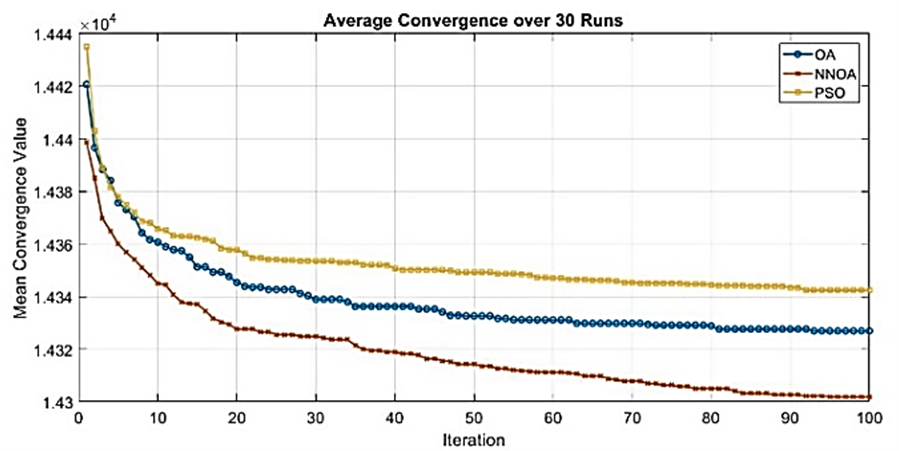
This study presents the Novel Navigation Orca Algorithm (NNOA), an innovative optimization algorithm derived from Orca Algorithm (OA). NNOA addresses the unit commitment (UC), a complex issue in power systems that focuses on scheduling generator units to meet power demand while taking into account each generator's limitations, with the goal of lowering operating costs and gas emissions. NNOA exhibits orca hunting behavior through echolocation, utilizing the Doppler effect principle to promote adaptive movement and circumvent local optima, as in contrast to OA's wave-based exploration. The algorithm was evaluated utilizing IEEE 30-bus system data, focused on the Integrated Economic and Emission Dispatch (IEED) objective. The performance was evaluated against OA and Particle Swarm Optimization (PSO) through convergence analysis over 10 and 30 trials, each consisting of 100 iterations. NNOA decreased the IEED value by 1.33% in regard to OA and 1.51% in regard to PSO. NNOA achieved convergence in 10 iterations, whereas OA required 35, indicating 71.4% faster convergence rate. Wilcoxon rank-sum tests demonstrated significant differences between NNOA, OA, and PSO pairings. NNOA's per-iteration computation time exceeds the time needed by PSO, but it remains economical and profitable. Significantly, NNOA contributes minimizing the fuel consumption and emissions cost, which has a positive environmental impact. It effectively adheres to the required constraints, which include the hourly power demand and generator output limits. Future research is encouraged to apply NNOA to larger-scale power systems and explore its hybridization with PSO to enhance computational efficiency, result consistency, and robustness in practical grid operations.
References
W. Strielkowski, L. Civín, E. Tarkhanova, M. Tvaronavičienė, and Y. Petrenko, “Renewable Energy in the Sustainable Development of Electrical Power Sector: A Review,” Energies, vol. 14, no. 24, p. 8240, 2021, https://doi.org/10.3390/en14248240.
F. Al Mubarak, R. Rezaee, and D. A. Wood, “Economic, Societal, and Environmental Impacts of Available Energy Sources: A Review,” Eng, vol. 5, no. 3, pp. 1232–1265, 2024, https://doi.org/10.3390/eng5030067.
M. Mudakir, A. Aripriharta, and A. P. Wibawa, “Analysis of battery energy storage system (BESS) performance in reducing the impact of variable renewable energy generation intermittency on the electricity system,” J. Mechatronics, Electr. Power, Veh. Technol., vol. 15, no. 2, pp. 158–176, 2024, https://doi.org/10.55981/j.mev.2024.1032.
S. Khan, M. Murshed, I. Ozturk, and K. Khudoykulov, “The roles of energy efficiency improvement, renewable electricity production, and financial inclusion in stimulating environmental sustainability in the Next Eleven countries,” Renew. Energy, vol. 193, pp. 1164–1176, 2022, https://doi.org/10.1016/j.renene.2022.05.065.
C. O’Malley, P. de Mars, L. Badesa, and G. Strbac, “Reinforcement learning and mixed-integer programming for power plant scheduling in low carbon systems: Comparison and hybridisation,” Appl. Energy, vol. 349, p. 121659, 2023, https://doi.org/10.1016/j.apenergy.2023.121659.
F. Shaheen et al., “Cleaner Technology and Natural Resource Management: An Environmental Sustainability Perspective from China,” Clean Technol., vol. 4, no. 3, pp. 584–606, 2022, https://doi.org/10.3390/cleantechnol4030036.
N. Yan, G. Ma, X. Li, and J. M. Guerrero, “Low-Carbon Economic Dispatch Method for Integrated Energy System Considering Seasonal Carbon Flow Dynamic Balance,” IEEE Trans. Sustain. Energy, vol. 14, no. 1, pp. 576–586, 2023, https://doi.org/10.1109/TSTE.2022.3220797.
S. Padhi, B. P. Panigrahi, and D. Dash, “Solving Dynamic Economic Emission Dispatch Problem with Uncertainty of Wind and Load Using Whale Optimization Algorithm,” J. Inst. Eng. Ser. B, vol. 101, no. 1, pp. 65–78, 2020, https://doi.org/10.1007/s40031-020-00435-y.
A. S. Alsowaidi and S. M. Modaresi, “Solving the Unit Commitment Problem of 10-Generators Set by PSO with Different Spinning-Reserve Values Obtained From Hour-Hour Load Demand Increasing,” ITEGAM- J. Eng. Technol. Ind. Appl. (ITEGAM-JETIA), vol. 10, no. 49, 2024, https://doi.org/10.5935/jetia.v10i49.1260.
C. Venkatesh Kumar and M. Ramesh Babu, “An Exhaustive Solution of Power System Unit Commitment Problem Using Enhanced Binary Salp Swarm Optimization Algorithm,” J. Electr. Eng. Technol., vol. 17, no. 1, pp. 395–413, 2022, https://doi.org/10.1007/s42835-021-00889-0.
R. H. Wuijts, M. van den Akker, and M. van den Broek, “Effect of modelling choices in the unit commitment problem,” Energy Syst., vol. 15, no. 1, pp. 1–63, 2024, https://doi.org/10.1007/s12667-023-00564-5.
R. Ragunathan and B. Ramadoss, “An improved golden jackal optimization algorithm for combined economic emission dispatch problems,” Int. J. Adv. Appl. Sci., vol. 13, no. 2, p. 249, 2024, https://doi.org/10.11591/ijaas.v13.i2.pp249-259.
A. Akbari-Dibavar, B. Mohammadi-Ivatloo, K. Zare, T. Khalili, and A. Bidram, “Economic-Emission Dispatch Problem in Power Systems With Carbon Capture Power Plants,” IEEE Trans. Ind. Appl., vol. 57, no. 4, pp. 3341–3351, 2021, https://doi.org/10.1109/TIA.2021.3079329.
N. Yang et al., “A Comprehensive Review of Security-constrained Unit Commitment,” J. Mod. Power Syst. Clean Energy, vol. 10, no. 3, pp. 562–576, 2022, https://doi.org/10.35833/MPCE.2021.000255.
A. O. Olasoji, D. T. O. Oyedokun, S. O. Omogoye, and C. Thron, “Review of frequency response strategies in renewable-dominated power system grids: Market adaptations and unit commitment formulation,” Sci. African, vol. 26, p. e02357, 2024, https://doi.org/10.1016/j.sciaf.2024.e02357.
A. Aharwar, R. Naresh, V. Sharma, and V. Kumar, “Unit commitment problem for transmission system, models and approaches: A review,” Electr. Power Syst. Res., vol. 223, p. 109671, 2023, https://doi.org/10.1016/j.epsr.2023.109671.
V. Kumar, R. Naresh, and A. Singh, “Investigation of solution techniques of unit commitment problems: A review,” Wind Eng., vol. 45, no. 6, pp. 1689–1713, 2021, https://doi.org/10.1177/0309524X21992446.
N. Muralikrishnan, L. Jebaraj, and C. C. A. Rajan, “A Comprehensive Review on Evolutionary Optimization Techniques Applied for Unit Commitment Problem,” IEEE Access, vol. 8, pp. 132980–133014, 2020, https://doi.org/10.1109/ACCESS.2020.3010275.
S. Syama, J. Ramprabhakar, R. Anand, and J. M. Guerrero, “An integrated binary metaheuristic approach in dynamic unit commitment and economic emission dispatch for hybrid energy systems,” Sci. Rep., vol. 14, no. 1, p. 23964, 2024, https://doi.org/10.1038/s41598-024-75743-0.
A. Aripriharta et al., “Analysis of System Operation Optimization In Steam Power Plants with the Lagrange Method,” J. Ecotipe (Electronic, Control. Telecommun. Information, Power Eng.), vol. 11, no. 1, pp. 29–37, 2024, https://doi.org/10.33019/jurnalecotipe.v11i1.4479.
K. Rajwar, K. Deep, and S. Das, “An exhaustive review of the metaheuristic algorithms for search and optimization: taxonomy, applications, and open challenges,” Artif. Intell. Rev., vol. 56, no. 11, pp. 13187–13257, 2023, https://doi.org/10.1007/s10462-023-10470-y.
L. Widayanti, A. N. Afandi, H. W. Herwanto, and V. A. Fitria, “Metaheuristic Optimization in Dynamic Unit Commitment of Power Systems: Current Trends and Future Prospects,” JOIV Int. J. Informatics Vis., vol. 8, no. 4, p. 2261, 2024, https://doi.org/10.62527/joiv.8.4.2423.
R. Vatambeti and P. K. Dhal, “Synergistic Optimization of Unit Commitment Using PSO and Random Search,” Contemp. Math., pp. 698-710, 2024, https://doi.org/10.37256/cm.5120243638.
Y. Xue, H. Zhu, J. Liang, and A. Słowik, “Adaptive crossover operator based multi-objective binary genetic algorithm for feature selection in classification,” Knowledge-Based Syst., vol. 227, p. 107218, 2021, https://doi.org/10.1016/j.knosys.2021.107218.
S. A. Mohamed, N. Anwer, and M. M. Mahmoud, “Solving optimal power flow problem for IEEE-30 bus system using a developed particle swarm optimization method: towards fuel cost minimization,” Int. J. Model. Simul., vol. 45, no. 1, pp. 307–320, 2025, https://doi.org/10.1080/02286203.2023.2201043.
Y. Liu et al., “Simulated annealing-based dynamic step shuffled frog leaping algorithm: Optimal performance design and feature selection,” Neurocomputing, vol. 503, pp. 325–362, 2022, https://doi.org/10.1016/j.neucom.2022.06.075.
Y. Zhang, Z. Jin, and Y. Chen, “Hybrid teaching–learning-based optimization and neural network algorithm for engineering design optimization problems,” Knowledge-Based Syst., vol. 187, p. 104836, 2020, https://doi.org/10.1016/j.knosys.2019.07.007.
M. Abdel-Basset, R. Mohamed, and M. Elhoseny, “Metaheuristic algorithms and medical applications,” in Metaheuristics Algorithms for Medical Applications, pp. 1–26, 2024, https://doi.org/10.1016/B978-0-443-13314-5.00013-8.
E. H. Houssein, M. K. Saeed, G. Hu, and M. M. Al-Sayed, “Metaheuristics for Solving Global and Engineering Optimization Problems: Review, Applications, Open Issues and Challenges,” Arch. Comput. Methods Eng., vol. 31, no. 8, pp. 4485–4519, 2024, https://doi.org/10.1007/s11831-024-10168-6.
B. Benaissa, M. Kobayashi, M. Al Ali, T. Khatir, and M. El Amine Elaissaoui Elmeliani, “Metaheuristic optimization algorithms: An overview,” HCMCOU J. Sci. – Adv. Comput. Struct., pp. 33–61, 2024, https://doi.org/10.46223/HCMCOUJS.acs.en.14.1.47.2024.
Y. Bouteraa and M. Khishe, “Fractal and chaotic map-enhanced grey wolf optimization for robust fire detection in deep convolutional neural networks,” Sci. Rep., vol. 15, no. 1, p. 11495, 2025, https://doi.org/10.1038/s41598-025-95519-4.
H. J. Apon, A. Ahmed, A. U. R. Adib, and R. Ahshan, “Integrated planning of emission reduction based unit commitment and generation dispatch solution for sustainable power system,” Electr. Power Syst. Res., vol. 244, p. 111535, 2025, https://doi.org/10.1016/j.epsr.2025.111535.
A. N. Afandi et al., “Trip Pattern Impact of Electric Vehicles in Optimized Power Production using Orca Algorithm,” J. Eng. Technol. Sci., vol. 56, no. 04, pp. 463–473, 2024, https://doi.org/10.5614/j.eng.technol.sci.2024.56.4.3.
B. M. Wright, V. B. Deecke, G. M. Ellis, A. W. Trites, and J. K. B. Ford, “Behavioral context of echolocation and prey‐handling sounds produced by killer whales (Orcinus orca) during pursuit and capture of Pacific salmon (Oncorhynchus spp.),” Mar. Mammal Sci., vol. 37, no. 4, pp. 1428–1453, 2021, https://doi.org/10.1111/mms.12836.
A. A. Leu, J. A. Hildebrand, A. Rice, S. Baumann-Pickering, and K. E. Frasier, “Echolocation click discrimination for three killer whale ecotypes in the Northeastern Pacific,” J. Acoust. Soc. Am., vol. 151, no. 5, pp. 3197–3206, 2022, https://doi.org/10.1121/10.0010450.
A. Kaveh, S. M. Hosseini, and A. Zaerreza, “A Physics-based Metaheuristic Algorithm Based on Doppler Effect Phenomenon and Mean Euclidian Distance Threshold,” Period. Polytech. Civ. Eng., vol. 66, no. 3, pp. 820-842, 2022, https://doi.org/10.3311/PPci.20133.
R. P. Badoni et al., “An Exploration and Exploitation-Based Metaheuristic Approach for University Course Timetabling Problems,” Axioms, vol. 12, no. 8, p. 720, 2023, https://doi.org/10.3390/axioms12080720.
H. Shokouhandeh, M. Ahmadi Kamarposhti, I. Colak, and K. Eguchi, “Unit Commitment for Power Generation Systems Based on Prices in Smart Grid Environment Considering Uncertainty,” Sustainability, vol. 13, no. 18, p. 10219, 2021, https://doi.org/10.3390/su131810219.
M. U. Bashir, W. U. H. Paul, M. Ahmad, D. Ali, and M. S. Ali, “An Efficient Hybrid TLBO-PSO Approach for Congestion Management Employing Real Power Generation Rescheduling,” Smart Grid Renew. Energy, vol. 12, no. 08, pp. 113–135, 2021, https://doi.org/10.4236/sgre.2021.128008.
D. Salman and M. Kusaf, “Short-Term Unit Commitment by Using Machine Learning to Cover the Uncertainty of Wind Power Forecasting,” Sustainability, vol. 13, no. 24, p. 13609, 2021, https://doi.org/10.3390/su132413609.
M. Elkamel, A. Ahmadian, A. Diabat, and Q. P. Zheng, “Stochastic optimization for price-based unit commitment in renewable energy-based personal rapid transit systems in sustainable smart cities,” Sustain. Cities Soc., vol. 65, p. 102618, 2021, https://doi.org/10.1016/j.scs.2020.102618.
V. A. Fitria, A. N. Afandi, and Aripriharta, “Exploring the Orca Predation Algorithm for Economic Dispatch Optimization in Power Systems,” BenchCouncil Trans. Benchmarks, Stand. Eval., vol. 4, no. 3, p. 100187, 2024, https://doi.org/10.1016/j.tbench.2024.100187.
S. Mishra, A. G. Shaik, and O. P. Mahela, “Swarm Intelligent Search and Rescue method for economic emission load dispatch of renewable integrated power system considering uncertainty,” Swarm Evol. Comput., vol. 95, p. 101928, 2025, https://doi.org/10.1016/j.swevo.2025.101928.
B. Postolov and A. Iliev, “New metaheuristic methodology for solving security constrained hydrothermal unit commitment based on adaptive genetic algorithm,” Int. J. Electr. Power Energy Syst., vol. 134, p. 107163, 2022, https://doi.org/10.1016/j.ijepes.2021.107163.
F. W. Shabangu, R. Daniels, R. K. Jordaan, P. J. N. de Bruyn, M. A. van den Berg, and T. Lamont, “Killer whale acoustic patterns respond to prey abundance and environmental variability around the Prince Edward Islands, Southern Ocean,” R. Soc. Open Sci., vol. 11, no. 1, 2024, https://doi.org/10.1098/rsos.230903.
G. Richard et al., “Passive acoustic monitoring reveals feeding attempts at close range from soaking demersal longlines by two killer whale ecotypes,” Mar. Mammal Sci., vol. 38, no. 1, pp. 304–325, 2022, https://doi.org/10.1111/mms.12860.
[47] H. Drias, L. S. Bendimerad, and Y. Drias, “A Three-Phase Artificial Orcas Algorithm for Continuous and Discrete Problems,” Int. J. Appl. Metaheuristic Comput., vol. 13, no. 1, pp. 1–20, 2022, https://doi.org/10.4018/IJAMC.304073.
A. Kaveh and S. M. Hosseini, “Improved Bat Algorithm Based on Doppler Effect for Optimal Design of Special Truss Structures,” J. Comput. Civ. Eng., vol. 36, no. 6, 2022, https://doi.org/10.1061/(ASCE)CP.1943-5487.0001042.
S. Kigsirisin and H. Miyauchi, “Short-Term Operational Scheduling of Unit Commitment Using Binary Alternative Moth-Flame Optimization,” IEEE Access, vol. 9, pp. 12267–12281, 2021, https://doi.org/10.1109/ACCESS.2021.3051175.
M. K. Elshaarawy, “Metaheuristic-driven CatBoost model for accurate seepage loss prediction in lined canals,” Multiscale Multidiscip. Model. Exp. Des., vol. 8, no. 5, p. 235, 2025, https://doi.org/10.1007/s41939-025-00800-8.
M. R. A. Putra et al., “Robust SVM optimization using PSO and ACO for accurate lithium-ion battery health monitoring,” Mech. Eng. Soc. Ind., vol. 5, no. 1, pp. 71–80, 2025, https://doi.org/10.31603/mesi.12280.
S. K. Joshi and J. C. Bansal, “Parameter tuning for meta-heuristics,” Knowledge-Based Syst., vol. 189, p. 105094, 2020, https://doi.org/10.1016/j.knosys.2019.105094.
A. I. Vlad, A. A. Romanyukha, and T. E. Sannikova, “Parameter Tuning of Agent-Based Models: Metaheuristic Algorithms,” Mathematics, vol. 12, no. 14, p. 2208, 2024, https://doi.org/0.3390/math12142208.
M. Jain, V. Saihjpal, N. Singh, and S. B. Singh, “An Overview of Variants and Advancements of PSO Algorithm,” Appl. Sci., vol. 12, no. 17, p. 8392, 2022, https://doi.org/10.3390/app12178392.
J. Wang, X. Wang, X. Li, and J. Yi, “A Hybrid Particle Swarm Optimization Algorithm with Dynamic Adjustment of Inertia Weight Based on a New Feature Selection Method to Optimize SVM Parameters,” Entropy, vol. 25, no. 3, p. 531, 2023, https://doi.org/10.3390/e25030531.
Y. Jiang, Q. Wu, S. Zhu, and L. Zhang, “Orca predation algorithm: A novel bio-inspired algorithm for global optimization problems,” Expert Syst. Appl., vol. 188, p. 116026, 2022, https://doi.org/10.1016/j.eswa.2021.116026.
T. Li, A. Rezaeipanah, and E. M. Tag El Din, “An ensemble agglomerative hierarchical clustering algorithm based on clusters clustering technique and the novel similarity measurement,” J. King Saud Univ. - Comput. Inf. Sci., vol. 34, no. 6, pp. 3828–3842, 2022, https://doi.org/10.1016/j.jksuci.2022.04.010.
Y. Jiang, Q. Wu, S. Zhu, and L. Zhang, “Orca predation algorithm: A novel bio-inspired algorithm for global optimization problems,” Expert Syst. Appl., vol. 188, no. October 2021, 2022, https://doi.org/10.1016/j.eswa.2021.116026.
D. H. Salunkhe, G. Michel, S. Kumar, M. Sanguineti, and D. Chablat, “An efficient combined local and global search strategy for optimization of parallel kinematic mechanisms with joint limits and collision constraints,” Mech. Mach. Theory, vol. 173, p. 104796, 2022, https://doi.org/10.1016/j.mechmachtheory.2022.104796.
L. Yiyang, J. Xi, B. Hongfei, W. Zhining, and S. Liangliang, “A General Robot Inverse Kinematics Solution Method Based on Improved PSO Algorithm,” IEEE Access, vol. 9, pp. 32341–32350, 2021, https://doi.org/10.1109/ACCESS.2021.3059714.
A. F. Güven, N. Yörükeren, and O. Ö. Mengi, “Multi-objective optimizatio n and sustainable design: a performance comparison of metaheuristic algorithms used for on-grid and off-grid hybrid energy systems,” Neural Comput. Appl., vol. 36, no. 13, pp. 7559–7594, 2024, https://doi.org/10.1007/s00521-024-09585-2.
Published
How to Cite
Issue
Section
License
Copyright (c) 2025 Lilis Widayanti, Arif Nur Afandi, Heru Wahyu Herwanto

This work is licensed under a Creative Commons Attribution-ShareAlike 4.0 International License.
Authors who publish with this journal agree to the following terms:
- Authors retain copyright and grant the journal right of first publication with the work simultaneously licensed under a Creative Commons Attribution License that allows others to share the work with an acknowledgment of the work's authorship and initial publication in this journal.
- Authors are able to enter into separate, additional contractual arrangements for the non-exclusive distribution of the journal's published version of the work (e.g., post it to an institutional repository or publish it in a book), with an acknowledgment of its initial publication in this journal.
- Authors are permitted and encouraged to post their work online (e.g., in institutional repositories or on their website) prior to and during the submission process, as it can lead to productive exchanges, as well as earlier and greater citation of published work (See The Effect of Open Access).

This journal is licensed under a Creative Commons Attribution-ShareAlike 4.0 International License.