Optimization of DC Fast Charging in CHAdeMO Systems Using Thunderstorm Algorithm with Thermal and Health Constraints
DOI:
https://doi.org/10.12928/biste.v8i1.14505Keywords:
DC Fast Charging, Battery Thermal Management, State of Health, Thunderstorm Algorithm, CHAdeMO ProtocolAbstract
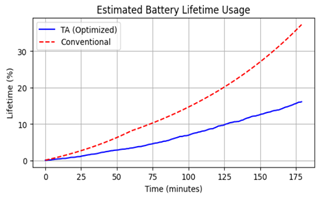
The significant increase in the use of electric vehicles (EVs) demands the development of fast charging systems that are not only efficient but also maintain battery integrity. One of the primary challenges in direct current (DC) charging is balancing speed with minimizing degradation caused by thermal stress. This study proposes a charging optimization model based on the Thunderstorm Optimization Algorithm (TA) for CHAdeMO-based DC systems. A lithium-ion equivalent circuit battery model was used to simulate electrochemical and thermal dynamics. The model introduces an adaptive charging current profile designed with a dynamic boundary configuration, defined here as the iterative adjustment of current limits according to real-time thermal and health constraints. Compared to conventional constant current–constant voltage (CC–CV) methods, TA considers maximum temperature, State of Health (SoH), and target State of Charge (SoC) simultaneously. The simulation (180 minutes, passive cooling, Python-based) showed that TA reduced SoH degradation to 1.3% and battery life usage to 18.4%—the latter defined as cumulative stress energy normalized to initial capacity—compared to 2.9% and 22.5% for CC–CV. Additionally, TA achieved a higher average charging power (26.1 kW vs. 24.8 kW) without exceeding 50 °C. Although the algorithm requires more computational effort than CC–CV, its moderate complexity suggests feasibility for real-time integration in battery management systems. These findings highlight TA as a promising adaptive and sustainability-oriented charging strategy.
References
B. V. Vani, D. Kishan, M. W. Ahmad, and B. N. K. Reddy, “An efficient battery swapping and charging mechanism for electric vehicles using bat algorithm,” Comput. Electr. Eng., vol. 118, p. 109357, 2024, https://doi.org/10.1016/j.compeleceng.2024.109357.
S. Jaman, B. Verbrugge, O. H. Garcia, M. Abdel-Monem, B. Oliver, T. Geury, and O. Hegazy, “Development and validation of V2G technology for electric vehicle chargers using combo CCS type 2 connector standards,” Energies, vol. 15, no. 19, p. 7364, 2022, https://doi.org/10.3390/en15197364.
H. Liu, J. Li, and Z. Chen, “An analytical model for the CC–CV charge of Li-ion batteries with application to degradation analysis,” J. Energy Storage, vol. 29, p. 101342, 2020, https://doi.org/10.1016/j.est.2020.101342.
B. Babu, P. Simon, and A. Balducci, “Fast charging materials for high power applications,” Adv. Energy Mater., vol. 10, no. 22, p. 2001128, 2020, https://doi.org/10.1002/aenm.202001128.
M. A. H. Rafi and J. Bauman, “A comprehensive review of DC fast-charging stations with energy storage: Architectures, power converters, and analysis,” IEEE Trans. Transp. Electrification, vol. 7, no. 2, pp. 345–368, 2021, https://doi.org/10.1109/TTE.2020.3015743.
A. Aksoz, B. Asal, E. Biçer, S. Oyucu, M. Gençtürk, and S. Golestan, “Advancing electric vehicle infrastructure: A review and exploration of battery-assisted DC fast charging stations,” Energies, vol. 17, no. 13, p. 3117, 2024, https://doi.org/10.3390/en17133117.
M. A. Elkasrawy, S. O. Abdellatif, G. A. Ebrahim, and H. A. Ghali, “Real-time optimization in electric vehicle stations using artificial neural networks”, Electr. Eng., vol. 105, no. 1, pp. 79–89, 2023, https://doi.org/10.1007/s00202-022-01647-9.
A. Zentani, A. Almaktoof, and M. T. Kahn, “A comprehensive review of developments in electric vehicles fast charging technology.” Appl. Sci., vol. 14, no. 11, p. 4728, 2024, https://doi.org/10.3390/app14114728.
M. A. Ravindran, R. Rajesh, S. K. Mohan, and S. Kumar, “A novel technological review on fast charging infrastructure for electric vehicles: Challenges, solutions, and future research directions,” Alex. Eng. J., vol. 69, pp. 1–20, 2023, https://doi.org/10.1016/j.aej.2023.10.009.
Y. O. Shaker, D. Yousri, A. Osama, A. Al-Gindy, E. Tag-Eldin, and D. Allam, “Optimal charging/discharging decision of energy storage community in grid-connected microgrid using multi-objective hunger game search optimizer,” IEEE Access, vol. 9, pp. 120774–120794, 2021, https://doi.org/10.1109/ACCESS.2021.3101839.
A. N. Afandi, F. C. W. A. and M. Ali, “Aplikasi ORCA algorithm pada optimasi penyediaan daya sistem berbasis mobilitas kendaraan listrik,” Jurnal JEETech, vol. 4, no. 2, pp. 103–108, 2023, https://doi.org/10.32492/jeetech.v4i2.4204.
M. Abd Elaziz, A. Oliva, and S. Mirjalili, “Advanced metaheuristic optimization techniques in applications of deep neural networks: A review,” Neural Comput. Appl., vol. 34, no. 22, pp. 19741–19768, 2022, https://doi.org/10.1007/s00521-021-05960-5.
S. Samsurizal, A. N. Afandi, and M. R. Faiz, “A comparative analysis of fast charging performance and battery life against charging current variations,” ITEGAM J. Eng. Technol. Ind. Appl., vol. 11, no. 52, pp. 81–86, 2025, https://doi.org/10.5935/jetia.v11i52.1536.
C. Zhang, J. Jiang, Y. Gao, W. Zhang, Q. Liu, and X. Hu, “Charging optimization in lithium-ion batteries based on temperature rise and charge time,” Appl. Energy, vol. 194, pp. 569–577, 2017, https://doi.org/10.1016/j.apenergy.2016.10.059.
A. Tomaszewska, Z. Chu, X. Feng, S. O’Kane, and E. Marinescu, “Lithium-ion battery fast charging: A review,” eTransportation, vol. 1, p. 100011, 2019, https://doi.org/10.1016/j.etran.2019.100011.
Y. Bouazzi, Z. Yahyaoui, and M. Hajji, “Deep recurrent neural networks based Bayesian optimization for fault diagnosis of uncertain GCPV systems depending on outdoor condition variation,” Alex. Eng. J., vol. 86, pp. 335–345, 2024, https://doi.org/10.1016/j.aej.2023.11.053.
Y. Wu, J. Li, S. Li, and Z. Chen, “Optimal battery thermal management for electric vehicles with battery degradation minimization”, Applied Energy, 353, 122090, 2024, https://doi.org/10.1016/j.apenergy.2023.122090.
R. R. Kumar, C. Bharatiraja, K. Udhayakumar, S. Devakirubakaran, K. S. Sekar, and L. Mihet-Popa, “Advances in batteries, battery modeling, battery management system, battery thermal management, SOC, SOH, and charge/discharge characteristics in EV applications,” IEEE Access, vol. 11, pp. 105761–105809, 2023, https://doi.org/10.1109/ACCESS.2023.3318121.
A. N. Afandi, “Thunderstorm algorithm for assessing thermal power plants of the integrated power system operation with an environmental requirement,” FORTEI JEERI, vol. 2, no. 1, pp. 1–9, 2021, https://doi.org/10.46962/forteijeeri.v2i1.18.
A. N. Afandi, “ORCA algorithm for unit commitment considering electric vehicle inclusion,” FORTEI JEERI, vol. 2, no. 1, pp. 1–9, 2021, https://doi.org/10.46962/forteijeeri.v2i1.18.
L. Gumilar, A. N. Afandi, A. Aripriharta, and M. Sholeh, “Interconnection of battery charging station and renewable energy in electrical power system,” in Proc. Int. Seminar on Application for Technology of Information and Communication (iSemantic), pp. 232–237, 2020, https://doi.org/10.1109/iSemantic50169.2020.9234209.
J. G. Qu, Z. Y. Jiang, and J. F. Zhang, “Investigation on lithium-ion battery degradation induced by combined effect of current rate and operating temperature during fast charging,” J. Energy Storage, vol. 52, p. 104811, 2022, https://doi.org/10.1016/j.est.2022.104811.
S. Ou, “Estimate long-term impact on battery degradation by considering electric vehicle real-world end-use factors,” Journal of Power Sources, 573, 233133, 2023, https://doi.org/10.1016/j.jpowsour.2023.233133.
X. Zhou et al., “Machine learning assisted multi-objective design optimization for battery thermal management system,” Applied Thermal Engineering, vol. 253, p. 123826, 2024, https://doi.org/10.1016/j.applthermaleng.2024.123826.
H. Alqahtani and G. Kumar, "Efficient Routing Strategies for Electric and Flying Vehicles: A Comprehensive Hybrid Metaheuristic Review," in IEEE Transactions on Intelligent Vehicles, vol. 9, no. 9, pp. 5813-5852, 2024, https://doi.org/10.1109/TIV.2024.3358872.
S. Sachan, S. Deb, and S. N. Singh, “Different charging infrastructures along with smart charging strategies for electric vehicles. Sustainable Cities and Society,” Sustainable Cities and Society, vol. 60, p. 102238, 2020, https://doi.org/10.1016/j.scs.2020.102238.
L. Jiang, X. Diao, Y. Zhang, J. Zhang, and T. Li, “Review of the charging safety and charging safety protection of electric vehicles,” World Electric Vehicle Journal, vol. 12, no. 4, p. 184, 2021, https://doi.org/10.3390/wevj12040184.
I. González Pérez, A. J. Calderón Godoy, and F. J. Folgado, “IoT real time system for monitoring lithium-ion battery long-term operation in microgrids,” Journal of Energy Storage, 2022, https://doi.org/10.1016/j.est.2022.104596.
D. Zhang, L. Li, W. Zhang, M. Cao, H. Qiu, and X. Ji, “Research progress on electrolytes for fast-charging lithium-ion batteries,” Chinese Chemical Letters, vol. 34, no. 1, p. 107122, 2023, https://doi.org/10.1016/j.cclet.2022.01.015.
H. Çınar, and I. Kandemir, “Active energy management based on meta-heuristic algorithms of fuel cell/battery/supercapacitor energy storage system for aircraft,” Aerospace, vol. 8, no. 3, p. 85, 2021, https://doi.org/10.3390/aerospace8030085.
C. Jia, W. Qiao, J. Cui, and L. Qu, “Adaptive model-predictive-control-based real-time energy management of fuel cell hybrid electric vehicles,” IEEE Transactions on Power Electronics, vol. 38, no. 2, pp. 2681-2694, 2022, https://doi.org/10.1109/TPEL.2022.3214782.
S. Saad, F. Ossart, J. Bigeon, E. Sourdille, and H. Gance, “Global Sensitivity Analysis Applied to Train Traffic Rescheduling: A Comparative Study,” Energies, vol. 14, no. 19, p. 6420, 2021, https://doi.org/10.3390/en14196420.
S. C. Wang and Y. H. Liu, “A PSO-based fuzzy-controlled searching for the optimal charge pattern of Li-ion batteries,” IEEE Transactions on Industrial Electronics, vol. 62, no. 5, pp. 2983-2993, 2024 https://doi.org/10.1109/TIE.2014.2363049.
S. Arora, A. Kapoor, and W. Shen, “A novel thermal management system for improving discharge/charge performance of Li-ion battery packs under abuse,” Journal of Power Sources, vol. 378, pp. 759-775, 2018, https://doi.org/10.1016/j.jpowsour.2017.12.030.
N. Nakhodchi, H. Bakhtiari, M. H. Bollen, and S. K. Rönnberg, S. K. “Including uncertainties in harmonic hosting capacity calculation of a fast EV charging station utilizing Bayesian statistics and harmonic correlation,” Electric Power Systems Research, 214, 108933, 2023, https://doi.org/10.1016/j.epsr.2022.108933.
X. Chen, Y. Hu, S. Li, Y. Wang, D. Li, C. Luo, Y. Yang, “State of health (SoH) estimation and degradation modes analysis of pouch NMC532/graphite Li-ion battery,” Journal of Power Sources, vol. 498, p. 229884, 2021, https://doi.org/10.1016/j.jpowsour.2021.229884.
M. J. Eagon, D. K. Kindem, H. Panneer Selvam, and W. F. Northrop, “Neural network-based electric vehicle range prediction for smart charging optimization,” Journal of Dynamic Systems, Measurement, and Control, vol. 144, no. 1, p. 011110. 2022, https://doi.org/10.1115/1.4053306.
Y. Wang, A. Liu, Y. Zhu, H. Zhang, Y. Chen and S. -J. Park, “An Adaptive Fast Charging Strategy Considering the Variation of DC Internal Resistance,” in IEEE Transactions on Power Electronics, vol. 38, no. 4, pp. 4464-4474, 2023, https://doi.org/10.1109/TPEL.2022.3230928.
M. H. Abbasi, Z. Arjmandzadeh, J. Zhang, B. Xu, and V. Krovi, “Deep reinforcement learning based fast charging and thermal management optimization of an electric vehicle battery pack,” Journal of Energy Storage, vol. 95, p. 112466, 2024, https://doi.org/10.1016/j.est.2024.112466.
Published
How to Cite
Issue
Section
License
Copyright (c) 2025 Samsurizal Samsurizal, Arif Nur Afandi, Mohamad Rodhi Faiz

This work is licensed under a Creative Commons Attribution-ShareAlike 4.0 International License.
Authors who publish with this journal agree to the following terms:
- Authors retain copyright and grant the journal right of first publication with the work simultaneously licensed under a Creative Commons Attribution License that allows others to share the work with an acknowledgment of the work's authorship and initial publication in this journal.
- Authors are able to enter into separate, additional contractual arrangements for the non-exclusive distribution of the journal's published version of the work (e.g., post it to an institutional repository or publish it in a book), with an acknowledgment of its initial publication in this journal.
- Authors are permitted and encouraged to post their work online (e.g., in institutional repositories or on their website) prior to and during the submission process, as it can lead to productive exchanges, as well as earlier and greater citation of published work (See The Effect of Open Access).

This journal is licensed under a Creative Commons Attribution-ShareAlike 4.0 International License.