Design and Application of a Cyber Physical Based Data Logger System for Charging Stations
DOI:
https://doi.org/10.12928/biste.v7i3.13266Keywords:
Charging Station, IoT-based Data Logger, Electrical Energy, Electric Vehicles, Remote MonitoringAbstract
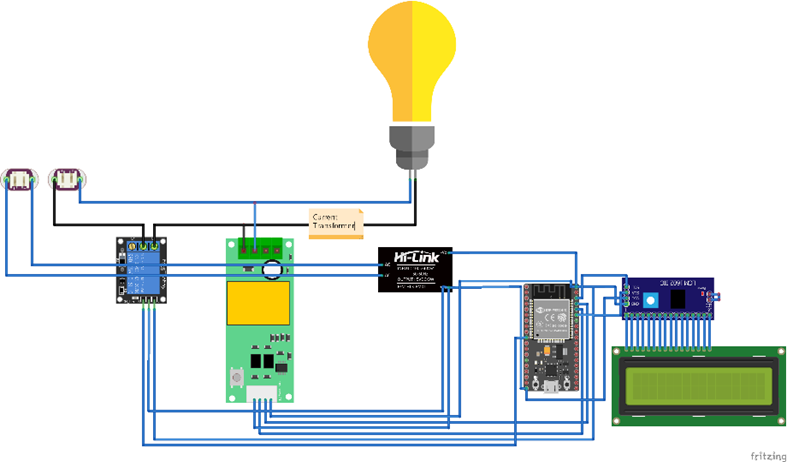
The rapid advancement of technology, particularly in transportation, has led to a growing public interest in electric vehicles. Government support, exemplified by Presidential Regulation No. 55 of 2019, further encourages this shift. With more electric vehicles on the road, the need for adequate charging infrastructure is critical. This research aims to design, test, and implement a charging device that records electric vehicle usage, displays data on an LCD, and allows monitoring through a website. Using the research and development (R&D) method, a highly effective design was developed. The data recording system employs the PZEM-004T sensor and ESP32 microcontroller to send data to a database. Validation tests showed high accuracy and precision, with current accuracy at 98.79% and precision at 99.24%, and voltage accuracy at 99.59% and precision at 99.87%. The device was installed in the basement of UPT TIK UNS and tested with three electric vehicles, each with different power requirements. The average power growth every ten minutes was 0.063 kWh for the first vehicle, 0.164 kWh for the second, and 0.139 kWh for the third. These results demonstrate that the device functions well, the design is successful, and it provides consistent, accurate, and precise energy growth measurements.
References
P. Jain, A. Tandon and R. C. Bansal, “Integration of Renewable Energy Sources (RES) into Electric Vehicle (EV) Charging Infrastructure: State-of-the-Art Review,” in Electric Vehicle Charging Infrastructures and its Challenges, pp. 171–214, 2025, https://doi.org/10.1007/978-981-96-0361-9_9.
V. G. Madaram, P. K. Biswas, C. Sain, S. B. Thanikanti, and P. K. Balachandran, “Advancement of electric vehicle technologies, classification of charging methodologies, and optimization strategies for sustainable development - A comprehensive review,” Heliyon, vol. 10, no. 20, p. e39299, 2024, https://doi.org/10.1016/j.heliyon.2024.e39299.
F. Jiang et al., “A comprehensive review of energy storage technology development and application for pure electric vehicles,” J Energy Storage, vol. 86, p. 111159, 2024, https://doi.org/10.1016/j.est.2024.111159.
M. Davoodi, H. Jafari Kaleybar, M. Brenna, and D. Zaninelli, “Sustainable Electric Railway System Integrated with Distributed Energy Resources: Optimal Operation and Smart Energy Management System,” International Transactions on Electrical Energy Systems, vol. 2025, no. 1, p. 6626245, 2025, https://doi.org/10.1155/etep/6626245.
L. Arning, C. Silva, and H. Kaths, “Review of Current Practice and Research on E-Bikes in Transport Models,” Transp Res Rec, vol. 2677, no. 12, pp. 436–448, 2023, https://doi.org/10.1177/03611981231168848.
W. Sutopo, M. Hisjam, and H. Wicaksono, “Estimating the market share of electric motorcycles: A system dynamics approach with the policy mix and sustainable life cycle costs,” Energy Policy, vol. 195, p. 114345, 2024, https://doi.org/10.1016/j.enpol.2024.114345.
V. M. Macharia, V. K. Garg, and D. Kumar, “A review of electric vehicle technology: Architectures, battery technology and its management system, relevant standards, application of artificial intelligence, cyber security, and interoperability challenges,” IET Electrical Systems in Transportation, vol. 13, no. 2, p. e12083, 2023, https://doi.org/10.1049/els2.12083.
G. G. Njema, R. B. O. Ouma, and J. K. Kibet, “A Review on the Recent Advances in Battery Development and Energy Storage Technologies,” Journal of Renewable Energy, vol. 2024, no. 1, p. 2329261, 2024, https://doi.org/10.1155/2024/2329261.
I. Rachmawati and R. A. M. Rahardi, “Analysis of Electric Vehicle Purchase Intentions in Indonesia Using the Extension C-TAM-TPB Model,” International Journal of Current Science Research and Review, vol. 06, no. 12, 2023, https://doi.org/10.47191/ijcsrr/V6-i12-61.
D. F. Hakam and S. Jumayla, “Electric vehicle adoption in Indonesia: Lesson learned from developed and developing countries,” Sustainable Futures, vol. 8, p. 100348, 2024, https://doi.org/10.1016/j.sftr.2024.100348.
T. W. Sasongko, U. Ciptomulyono, B. Wirjodirdjo, and A. Prastawa, “Identification of electric vehicle adoption and production factors based on an ecosystem perspective in Indonesia,” Cogent Business & Management, vol. 11, no. 1, p. 2332497, 2024, https://doi.org/10.1080/23311975.2024.2332497.
I. Pambudi and V. Juwono, “Electric Vehicles in Indonesia: Public Policy, Impact, and Challenges,” Asian Journal of Social and Humanities, vol. 2, no. 2, pp. 1631–1644, 2023, https://doi.org/10.59888/ajosh.v2i2.173.
A. Pamidimukkala, S. Kermanshachi, J. M. Rosenberger, and G. Hladik, “Barriers and motivators to the adoption of electric vehicles: A global review,” Green Energy and Intelligent Transportation, vol. 3, no. 2, p. 100153, 2024, https://doi.org/10.1016/j.geits.2024.100153.
A. Mohammed, O. Saif, M. Abo-Adma, A. Fahmy, and R. Elazab, “Strategies and sustainability in fast charging station deployment for electric vehicles,” Sci Rep, vol. 14, no. 1, p. 283, 2024, https://doi.org/10.1038/s41598-023-50825-7.
I. Mahmud, M. B. Medha, and M. Hasanuzzaman, “Global challenges of electric vehicle charging systems and its future prospects: A review,” Research in Transportation Business & Management, vol. 49, p. 101011, 2023, https://doi.org/10.1016/j.rtbm.2023.101011.
A. Lazuardy et al., “Technological, Environmental, Economic, and Regulation Barriers to Electric Vehicle Adoption: Evidence from Indonesia,” World Electric Vehicle Journal, vol. 15, no. 9, 2024, https://doi.org/10.3390/wevj15090422.
H. and S. L. and Z. S. and M. S.-M. Gemein Olaf-Gerd and Niemi-Hugaerts, “Smart Cities,” in Springer Handbook of Internet of Things, pp. 523–554, 2024, https://doi.org/10.1007/978-3-031-39650-2_23.
Y. and S. H. Sagarna Juan and Barabanova, “Smart Agriculture,” in Springer Handbook of Internet of Things, pp. 555–587, 2024, https://doi.org/10.1007/978-3-031-39650-2_24.
A. and G. P. Fotopoulou Eleni and Zafeiropoulos, “Smart Homes and Buildings,” in Springer Handbook of Internet of Things, pp. 675–689, 2024, https://doi.org/10.1007/978-3-031-39650-2_28.
L. and M. J. M. F. and B. A. and A. N. and L. G. F. and L. A. F. and S. H. and K. E. E. Caradot Nicolas and Alfonso, “Smart Water Management,” in Springer Handbook of Internet of Things, pp. 805–824, 2024, https://doi.org/10.1007/978-3-031-39650-2_33.
I. Khalid Saifullah and Ahmad, “Optimizing Operations in IoT-Enabled Smart Grid,” in Springer Handbook of Internet of Things, pp. 611–637, 2024, https://doi.org/10.1007/978-3-031-39650-2_26.
M. Karagiannis Georgios and Djurica, “Connected Vehicles,” in Springer Handbook of Internet of Things, pp. 691–725, 2024, https://doi.org/10.1007/978-3-031-39650-2_29.
A. Lentini, “IoT Roadmap for Smart Factories and Supply Chain Organizations,” in Springer Handbook of Internet of Things, pp. 909–961, 2024, https://doi.org/10.1007/978-3-031-39650-2_38.
M. and C. D. and B. Z. Ståhlbröst Anna and Runardotter, “Living Labs,” in Springer Handbook of Internet of Things, pp. 865–881, 2024, https://doi.org/10.1007/978-3-031-39650-2_36.
S. Devasya et al., “IoT in Large-Scale Events,” in Springer Handbook of Internet of Things, 639–674, 2023, https://doi.org/10.1007/978-3-031-39650-2_27.
C. and B. A. and G. C. and Z. S. Martinez Cristina and Bueti, “IoT for SDGs,” in Springer Handbook of Internet of Things, pp. 763–786, 2024, https://doi.org/10.1007/978-3-031-39650-2_31.
S. Mejjaouli and S. Alnourani, “Electric vehicles charging infrastructure framework using internet of things,” J Clean Prod, vol. 480, p. 144056, 2024, https://doi.org/10.1016/j.jclepro.2024.144056.
L. Govik, “Digital platforms for sharing and booking electrical vehicle charging infrastructure,” Int J Sustain Transp, vol. 18, no. 9, pp. 777–790, 2024, https://doi.org/10.1080/15568318.2024.2407139.
G. Saravanan, R. Tripathy, R. U. Rao, and M. S. Seshasai, “Cloud-IoT framework for EV charge station allocation and scheduling: A spotted hyena jellyfish search optimization approach,” Sustainable Computing: Informatics and Systems, vol. 46, p. 101118, 2025, https://doi.org/10.1016/j.suscom.2025.101118.
M. and O. M. and B. Z. El Himer Sarah and Ouaissa, “IoT System for Smart Electric Car Charging Station Using Micro-CPV Unit,” in Emerging Disruptive Technologies for Society 5.0 in Developing Countries: Challenges and Applications, pp. 223–235, 2025, https://doi.org/10.1007/978-3-031-63701-8_19.
Y. A. A. S. Aldeen, M. M. Jaber, M. H. Ali, S. K. Abd, A. Alkhayyat, and R. Q. Malik, “Electric charging station management using IoT and cloud computing framework for sustainable green transportation,” Multimed Tools Appl, vol. 83, no. 10, pp. 28705–28728, 2024, https://doi.org/10.1007/s11042-023-16630-0.
W. Duo, M. Zhou and A. Abusorrah, "A Survey of Cyber Attacks on Cyber Physical Systems: Recent Advances and Challenges," in IEEE/CAA Journal of Automatica Sinica, vol. 9, no. 5, pp. 784-800, 2022, https://doi.org/10.1109/JAS.2022.105548.
A. Kaur and J. M. Chatterjee, “Applications of Cyber-Physical Systems,” in Cyber‐Physical Systems, pp. 289–310, 2022, https://doi.org/10.1002/9781119836636.ch13.
D. B. Rawat, J. J. P. C. Rodrigues, and I. Stojmenovic, Cyber-Physical Systems: From Theory to Practice. USA: CRC Press, Inc., 2015, https://doi.org/10.1201/b19290.
M. J. Hornos and M. Quinde, “Development methodologies for IoT-based systems: challenges and research directions,” J Reliab Intell Environ, vol. 10, no. 3, pp. 215–244, 2024, https://doi.org/10.1007/s40860-024-00229-9.
K. Y. Sevak and B. George, “The evolution of Internet of Things (IoT) research in business management: a systematic review of the literature,” Journal of Internet and Digital Economics, vol. 4, no. 3, pp. 242–265, 2024, https://doi.org/10.1108/JIDE-12-2023-0026.
M. F. Pekşen, U. Yurtsever, and Y. Uyaroğlu, “Enhancing electrical panel anomaly detection for predictive maintenance with machine learning and IoT,” Alexandria Engineering Journal, vol. 96, pp. 112–123, 2024, https://doi.org/10.1016/j.aej.2024.03.106.
H. J. El-Khozondar et al., “A smart energy monitoring system using ESP32 microcontroller,” e-Prime - Advances in Electrical Engineering, Electronics and Energy, vol. 9, p. 100666, 2024, https://doi.org/10.1016/j.prime.2024.100666.
A. Fan et al., "Large Language Models for Software Engineering: Survey and Open Problems," 2023 IEEE/ACM International Conference on Software Engineering: Future of Software Engineering (ICSE-FoSE), 2023, https://doi.org/10.1109/ICSE-FoSE59343.2023.00008.
H. Edison, X. Wang and K. Conboy, "Comparing Methods for Large-Scale Agile Software Development: A Systematic Literature Review," in IEEE Transactions on Software Engineering, vol. 48, no. 8, pp. 2709-2731, 2022, https://doi.org/10.1109/TSE.2021.3069039.
J. E. M. Perea Martins, “Introducing the concepts of measurement accuracy and precision in the classroom,” Phys Educ, vol. 54, no. 5, p. 055029, 2019, https://doi.org/10.1088/1361-6552/ab3143.
Published
How to Cite
Issue
Section
License
Copyright (c) 2025 Faisal Rahutomo, Bagus Putra Nugraha, Atinkut Molla Mekonnen, Bashiru Olalekan Ariyo

This work is licensed under a Creative Commons Attribution-ShareAlike 4.0 International License.
Authors who publish with this journal agree to the following terms:
- Authors retain copyright and grant the journal right of first publication with the work simultaneously licensed under a Creative Commons Attribution License that allows others to share the work with an acknowledgment of the work's authorship and initial publication in this journal.
- Authors are able to enter into separate, additional contractual arrangements for the non-exclusive distribution of the journal's published version of the work (e.g., post it to an institutional repository or publish it in a book), with an acknowledgment of its initial publication in this journal.
- Authors are permitted and encouraged to post their work online (e.g., in institutional repositories or on their website) prior to and during the submission process, as it can lead to productive exchanges, as well as earlier and greater citation of published work (See The Effect of Open Access).

This journal is licensed under a Creative Commons Attribution-ShareAlike 4.0 International License.