A Hybrid LSTM-CNN Approach Using Multilingual BERT for Sentiment Analysis of GERD Tweets
DOI:
https://doi.org/10.12928/biste.v7i2.13281Keywords:
Combined LSTM and CNN Approach, Tweets in Multiple Languages, GERD, Opinion Mining, Multilingual BERT EmbeddingsAbstract
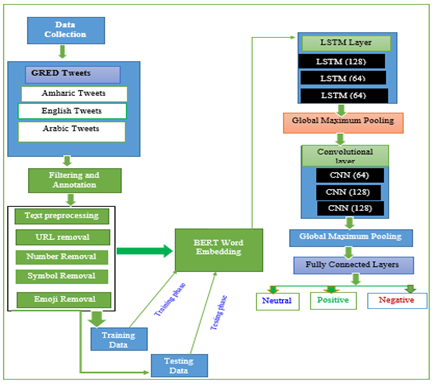
Analyzing public sentiment through platforms like Twitter is a common approach for understanding opinions on political matters. This study introduces a deep learning sentiment analysis model that integrates Long Short-Term Memory (LSTM) and Convolutional Neural Networks (CNN) to assess attitudes toward the Grand Ethiopian Renaissance Dam (GERD). LSTM is utilized to capture long-range dependencies in text, while CNN identifies significant local patterns. An initial dataset of 30,000 unlabeled tweets was collected in 2024 G.C., out of which 17,064 were labeled as positive, negative, or neutral. The labeled tweets were divided into 13,112 for training and the remaining for testing. The hybrid LSTM-CNN model demonstrated superior performance compared to the standalone models, delivering more accurate and balanced sentiment classification. A major feature of this study is the analysis of tweets written in Amharic, Arabic, and English. The model was trained over 35 epochs with a batch size of 46 and a learning rate of 0.001. Using multilingual BERT (mBERT) embeddings notably enhanced the model’s performance, with training and testing accuracies reaching 95.3% and 92%, respectively. The hybrid model also achieved a precision, recall, and F1-score of 90%. In a focused analysis of Arabic tweets, 3,710 were negative, 9,793 positive, and 4,814 neutral. These results emphasize the influence of linguistic diversity and class distribution on classification performance. While mBERT showed strong results, addressing class imbalance and expanding language-specific features remains crucial for further improvements.
References
S. Taruna and N. Bhartiya, “Parameter based Cluster Head Election in Wireless Sensor Network: A Fuzzy Approach,” International Journal of Computer Applications, vol. 106, no. 7, 2014, https://www.ijcaonline.org/archives/volume106/number7/18530-9733/.
G. A. Endaylalu and Y. Arsano, “Grand Ethiopian Renaissance Dam Project Controversies: Understanding the role of worldviews and nexus,” African Anthropologist, vol. 22, no. 2, 2024, https://doi.org/10.4314/aa.v22i2.7.
K. G. Wheeler, M. Jeuland, J. W. Hall, E. Zagona, and D. Whittington, “Understanding and managing new risks on the Nile with the Grand Ethiopian Renaissance Dam,” Nature communications, vol. 11, no. 1, p. 5222, 2020, https://doi.org/10.1038/s41467-020-19089-x.
A. Pandey and D. K. Vishwakarma, "Progress, achievements, and challenges in multimodal sentiment analysis using deep learning: A survey," Applied Soft Computing, vol. 142, p. 111206, 2023, https://doi.org/10.1016/j.asoc.2023.111206.
D. Mengistu, W. Bewket, A. Dosio, and H. J. Panitz, “Climate change impacts on water resources in the Upper Blue Nile (Abay) River Basin, Ethiopia,” J. Hydrol., vol. 592, p. 125614, 2021, https://doi.org/10.1016/j.jhydrol.2020.125614.
T. Yeshitila, M. A. Moges, T. A. Dessalegn, and A. M. Melesse. Climate-induced flood inundation in Fogera-Dera Floodplain, Lake Tana basin, Ethiopia. Elsevier Inc. 2019. https://doi.org/10.1016/B978-0-12-815998-9.00032-4.
M. P. McCartney and M. Menker Girma, “Evaluating the downstream implications of planned water resource development in the Ethiopian portion of the Blue Nile River,” Water Int., vol. 37, no. 4, pp. 362–379, 2012, https://doi.org/10.1080/02508060.2012.706384.
M. El Bastawesy, S. Gabr, and I. Mohamed, “Assessment of hydrological changes in the Nile River due to the construction of Renaissance Dam in Ethiopia,” Egypt. J. Remote Sens. Sp. Sci., vol. 18, no. 1, pp. 65–75, 2015, https://doi.org/10.1016/j.ejrs.2014.11.001.
O. Appel, F. Chiclana, J. Carter, and H. Fujita, “A hybrid approach to the sentiment analysis problem at the sentence level,” Knowledge-Based Systems, vol. 108, pp. 110-124, 2016, https://doi.org/10.1016/j.knosys.2016.05.040.
A. T. S. To, “Department of Computer Science,” J. Comput. Appl. Math., vol. 34, no. 2, p. N14, 1991, https://doi.org/10.1016/S0377-0427(91)90073-S.
H. Thakkar and D. Patel, “Approaches for Sentiment Analysis on Twitter: A State-of-Art study” arXiv preprint arXiv:1512.01043, 2022, https://doi.org/10.48550/arXiv.1512.01043.
M. Heikal, M. Torki, and N. El-Makky, “Sentiment Analysis of Arabic Tweets using Deep Learning,” in Procedia Computer Science, vol. 142, pp. 114–122, 2018, https://doi.org/10.1016/j.procs.2018.10.466.
T. Kishore and J. Praveenchandar, "An Effective Stock Market Prediction using an Advanced Machine Learning Algorithm and Emotional Analysis," 2024 3rd International Conference on Applied Artificial Intelligence and Computing (ICAAIC), pp. 493-498, 2024, https://doi.org/10.1109/ICAAIC60222.2024.10575869.
L. Zhang, S. Wang, and B. Liu, “Deep Learning for Sentiment Analysis: A Survey”, Wiley interdisciplinary reviews: data mining and knowledge discovery, vol. 8, no. 4, p. e1253, 2018, https://doi.org/10.1002/widm.1253.
J. Khan, A. Alam and Y. Lee, "Intelligent Hybrid Feature Selection for Textual Sentiment Classification," in IEEE Access, vol. 9, pp. 140590-140608, 2021, https://doi.org/10.1109/ACCESS.2021.3118982.
C. Kaushik and A. Mishra, “A Scalable, Lexicon Based Technique for Sentiment Analysis,” Int. J. Found. Comput. Sci. Technol., vol. 4, no. 5, pp. 35–56, 2014, https://doi.org/10.5121/ijfcst.2014.4504.
D. S. Abdelminaam, N. Neggaz, I. A. E. Gomaa, F. H. Ismail and A. A. Elsawy, "ArabicDialects: An Efficient Framework for Arabic Dialects Opinion Mining on Twitter Using Optimized Deep Neural Networks," in IEEE Access, vol. 9, pp. 97079-97099, 2021, https://doi.org/10.1109/ACCESS.2021.3094173.
M. E. Moussa, E. H. Mohamed, and M. H. Haggag, “A generic lexicon-based framework for sentiment analysis,” International Journal of Computers and Applications, vol. 42, no. 5, pp. 463-473, 2020, https://doi.org/10.1080/1206212X.2018.1483813.
S. Gayed, S. Mallat, and M. Zrigui, “A systematic review of sentiment analysis in arabizi,” In International KES Conference on Intelligent Decision Technologies, pp. 128-133, 2023, https://doi.org/10.1007/978-981-99-2969-6_11.
N. Khalifa and H. Kadhem, "A Development of a Sentiment Analysis Model for the Bahraini Dialects," 2024 Arab ICT Conference (AICTC), pp. 44-51, 2024, https://doi.org/10.1109/AICTC58357.2024.10735036.
J. H. Yu, and D. Chauhan, “Trends in NLP for personalized learning: LDA and sentiment analysis insights,” Education and Information Technologies, vol. 30, no. 4, pp. 4307-4348, 2025, https://doi.org/10.1007/s10639-024-12988-2.
M. G. Astarkie, B. Bala, G. J. Bharat Kumar, S. Gangone, & Y. Nagesh, “A novel approach for sentiment analysis and opinion mining on social media tweets,” In Proceedings of the International Conference on Cognitive and Intelligent Computing: ICCIC 2021, vol. 2, pp. 143-151, 2023, https://doi.org/10.1007/978-981-19-2358-6_15.
K. Du, F. Xing, R. Mao, and E. Cambria, "Financial Sentiment Analysis: Techniques and Applications," ACM Computing Surveys, vol. 56, no. 9, pp. 1–42, 2024, https://doi.org/10.1145/3649451.
J. R. Jim, M. A. R. Talukder, P. Malakar, M. M. Kabir, K. Nur, and M. F. Mridha, "Recent advancements and challenges of NLP-based sentiment analysis: A state-of-the-art review," Natural Language Processing Journal, vol. 4, p. 100059, 2024, https://doi.org/10.1016/j.nlp.2024.100059.
Y. Mao, Q. Liu, and Y. Zhang, "Sentiment analysis methods, applications, and challenges: A systematic literature review," Journal of King Saud University - Computer and Information Sciences, vol. 36, p. 102048, 2024, https://doi.org/10.1016/j.jksuci.2024.102048.
Y. Mao, Q. Liu, and Y. Zhang, "Sentiment analysis methods, applications, and challenges: A systematic literature review," Journal of King Saud University - Computer and Information Sciences, vol. 36, p. 102048. 2024, https://doi.org/10.1016/j.jksuci.2024.102048.
M. M. Rahman, A. I. Shiplu, Y. Watanobe and M. A. Alam, "RoBERTa-BiLSTM: A Context-Aware Hybrid Model for Sentiment Analysis," in IEEE Transactions on Emerging Topics in Computational Intelligence, 2025, https://doi.org/10.1109/TETCI.2025.3572150.
S. T. Eberhardt, J. Schaffrath, D. Moggia, B. Schwartz, M. Jaehde, and J. A. Rubel, “Decoding emotions: Exploring the validity of sentiment analysis in psychotherapy,” Psychotherapy Research, vol. 34, no. 2, pp. 174–189, 2024, https://doi.org/10.1080/10503307.2024.2322522.
N. Darraz, I. Karabila, A. El-Ansari, N. Alami, and M. El Mallahi, “Integrated sentiment analysis with BERT for enhanced hybrid recommendation systems,” Expert Syst. Appl., vol. 240, p. 125533, 2024, https://doi.org/10.1016/j.eswa.2024.125533.
N. C. Hellwig, J. Fehle, and C. Wolff, “Exploring large language models for the generation of synthetic training samples for aspect-based sentiment analysis in low resource settings,” Expert Syst. Appl., vol. 244, p. 125871, 2024, https://doi.org/10.1016/j.eswa.2024.125871.
R. K. Ray and A. Singh, “From online reviews to smartwatch recommendation: An integrated aspect-based sentiment analysis framework,” Expert Syst. Appl., vol. 243, p. 125809, 2024, https://doi.org/10.1016/j.eswa.2024.125809.
Y. Li, X. Lan, H. Chen, K. Lu, and D. Jiang, “Multimodal PEAR chain-of-thought reasoning for multimodal sentiment analysis,” ACM Trans. Multimedia Comput. Commun. Appl., vol. 20, no. 9, pp. 1–23, 2024, https://doi.org/10.1145/3672398.
Published
How to Cite
Issue
Section
License
Copyright (c) 2025 Atinkut Molla Mekonnen, Yirga Yayeh Munaye, Yenework Belayneh Chekol

This work is licensed under a Creative Commons Attribution-ShareAlike 4.0 International License.
Authors who publish with this journal agree to the following terms:
- Authors retain copyright and grant the journal right of first publication with the work simultaneously licensed under a Creative Commons Attribution License that allows others to share the work with an acknowledgment of the work's authorship and initial publication in this journal.
- Authors are able to enter into separate, additional contractual arrangements for the non-exclusive distribution of the journal's published version of the work (e.g., post it to an institutional repository or publish it in a book), with an acknowledgment of its initial publication in this journal.
- Authors are permitted and encouraged to post their work online (e.g., in institutional repositories or on their website) prior to and during the submission process, as it can lead to productive exchanges, as well as earlier and greater citation of published work (See The Effect of Open Access).

This journal is licensed under a Creative Commons Attribution-ShareAlike 4.0 International License.