Training on Making Mangrove-Based Beauty Soap Innovation Products in Sungsang IV Village, South Sumatra
DOI:
https://doi.org/10.12928/spekta.v6i1.9463Keywords:
Beauty Soap, Mangrove, Product Innovation, Sungsang IV, TrainingAbstract
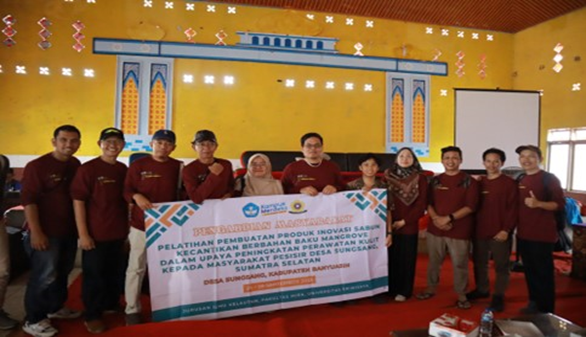
Background: In an effort to enhance the utilization of mangrove forests based on local coastal resources, a community service initiative was conducted in Sungsang Village, Banyuasin Regency, on 25-26 September 2024. The training focused on teaching 40 participants how to produce beauty liquid soap from Sonneratia caseolaris (mangrove) leaf extract.
Contribution: This activity Contributes to improve the technical skills of making beauty liquid soap from mangrove plants as an effort to optimize the utilization of mangrove forest vegetation in Sungsang Village.
Method: The method of this service activity is a training in making liquid soap through product prototype demonstration and direct assistance.
Results: In general, the participants' knowledge about making beauty liquid soap from mangroves has increased after undergoing training activities.
Conclusion: The pre-test and post-test evaluation of the 40 participants showed a significant improvement in their understanding, with the evaluation graph showing a shift from low to better levels of knowledge. While there were variations in the level of understanding about beauty liquid soap.
References
B. S. Barus, R. Aryawati, M. Hendri, A. Agussalim, G. Diansyah, and S. H. Dwinanti, “Pengenalan dan Pelatihan Fish Finder kepada Masyarakat Nelayan di Desa Sungsang IV Kabupaten Banyuasin Sumatera Selatan,” J. Pengabdi. Masy., vol. 2, no. 1, pp. 144–151, Jan. 2022. https://doi.org/10.31004/abdira.v2i1.82.
A. Saputra, “A review: The potential of microalgae as a marine food alternative in Banyuasin Estuary, South Sumatra, Indonesia,” Egypt. J. Aquat. Biol. Fish., vol. 25, no. 2, pp. 1053–1065, Mar. 2021, doi: 10.21608/ejabf.2021.170654.
R. Y. Nugroho, R. Rozirwan, and F. Fauziyah, “Biodiversitas Gastropoda dan Krustasea di Zona Intertidal Hutan Mangrove Estuari Sungai Musi, Sumatera Selatan,” SIMBIOSA, vol. 11, no. 2, pp. 61–71, Dec. 2022, doi: 10.33373/sim-bio.v11i2.4653.
D. I. Salsabila, “Pengolahan Buah Mangrove Pedada (Sonneratta caseolaris) Sebagai Sirup di Kawasan Sukorejo, Gresik,” Sewagati, vol. 7, no. 1, Oct. 2022, doi: 10.12962/j26139960.v7i1.445.
E. Efriyeldi, “Peningkatan Pengetahuan dan Keterampilan Kelompok Konservasi Laskar Mandiri dalam Pengolahan Buah dan Daun Mangrove Menjadi Beraneka Makanan di Desa Kayu Ara Permai Kecamatan Sungai Apit,” J. Rural Urban Community Empower., vol. 3, no. 2, pp. 61–69, Apr. 2022, doi: 10.31258/jruce.3.2.61-69.
F. Peng, J. Li, S. Yang, C. Zhong, R. Zhou, and S. Shi, “Ancient Geographical Barriers Drive Differentiation among Sonneratia caseolaris Populations and Recent Divergence from S. lanceolata,” Frontiers in Plant Science. frontiersin.org, 2016, doi: 10.3389/fpls.2016.01618.
M. Muliani, B. R. Tampangallo, and R. Rosmiati, “Aktivitas Anti-White Spot Syndrome Virus (Wssv) Ekstrak Tanaman Mangrove Sonneratia Caseolaris Dan S. Lanceolata Pada Udang Windu, Penaeus monodon” Pros. Forum Inovasi Teknologi Akuakultur, 2016, [Online]. Available: https://ejournal-balitbang.kkp.go.id/index.php/fita/article/view/1750.
S. Naskar, “Leaf epIcutIcuLar and poLLen uLtrastructuraL comparIsons of Sonneratia apetala Buch.-ham. and S. caSeolariS (L.) engLer (sonneratIaceaea),” Modern Phytomorphology. core.ac.uk, 2015, [Online]. Available: https://core.ac.uk/download/pdf/144733027.pdf.
M. Delta, R. Rozirwan, and M. Hendri, “Aktivitas Antioksidan Ekstrak Daun Dan Kulit Batang Mangrove Sonneratia Alba Di Tanjung Carat, Kabupaten Banyuasin, Provinsi Sumatera Selatan,” vol. 13, pp. 129–144, Jul. 2021, doi: 10.36706/maspari.v13i2.14577.
J. B. Whang, J. H. Song, B. Choi, and J. H. Lee, “The effect of augmented reality on purchase intention of beauty products: The roles of consumers’ control,” J. Bus. Res., 2021, [Online]. Available: https://www.sciencedirect.com/science/article/pii/S0148296321002939.
M. O. Gani, H. Roy, M. S. Rahman, A. R. Faroque, “Effect of social media influence on consumer’s purchase intention of organic beauty products: the role of customer’s engagement and generativity,” International J. Spa and Wellness, 2022, doi: 10.1080/24721735.2022.2096292.
F. Maulidha and H. Dewajani, “Pemilihan Jenis Minyak Dalam Pembuatan Sabun Mandi Cair Dengan Metode Hot Process,” Distilat J. Teknol. Separasi, vol. 8, no. 4, pp. 876–882, May 2023, doi: 10.33795/distilat.v8i4.490.
A. P. Legi, H. Jaya Edy, and S. S. Abdullah, “Formulasi dan uji aktivitas antibakteri sediaan sabun cair ekstrak etanol daun sirsak (Annona muricata Linn) terhadap bakteri Staphylococcus aureus,” Pharmacon, vol. 10, no. 3, pp. 1058–1065, 2021. https://doi.org/10.35799/pha.10.2021.35610
R. Syofiani et al., “Peningkatan Peluang Wirausaha di Nagari Koto Tuo Melalui Pelatihan Pembuatan Sabun Cuci Piring,” Abdimas Mandalika, vol. 3, no. 1, p. 27, Aug. 2023, doi: 10.31764/am.v3i1.16845.
A. A. G. Indraningrat, M. D. Wijaya, and I. A. A. Idawati, “PKM Pembuatan Sabun Berbahan Dasar Minyak Jelantah Pada Kelompok Guru Program Keahlian Tata Boga di SMK Negeri 1 Tembuku Bangli,” Community Serv. J., vol. 6, no. 1, pp. 40–46, Nov. 2023, doi: 10.22225/csj.6.1.2023.40-46.
R. Goyal, P. Kumar, and V. P. Singh, “Automated question and answer generation from texts using text-to-text transformers,” Arab. J. Sci. and Engineering, 2024, doi: 10.1007/s13369-023-07840-7.
A. Ushio, F. Alva-Manchego, and J. Camacho-Collados, “An empirical comparison of LM-based question and answer generation methods,” arXiv Prepr. arXiv, 2023, [Online]. Available: https://arxiv.org/abs/2305.17002.
D. N. Sukapiring, “Pelatihan Pembuatan Paper Soap (Sabun Kertas) di Desa Sidodadi Ramunia Kecamatan Beringin Kabupaten Deli Serdang,” J. Abdi Masy. Indones., vol. 2, no. 1, pp. 211–216, Jan. 2022, doi: 10.54082/jamsi.208.
M. J. Saptenno, L. B. Saptenno, and N. R. Timisela, “Faktor Yang Mempengaruhi Tingkat Kesadarana Masyarakat Pesisir Terhadap Pengelolaan Sampah di Perairan Teluk Ambon Kota Ambon,” J. Ilmu Lingkung., vol. 20, no. 2, pp. 365–374, Apr. 2022, doi: 10.14710/jil.20.2.365-374.
Y. Jiang, L. Liu, B. Jin, Y. Liu, and X. Liang, “Critical review on the environmental behaviors and toxicity of triclosan and its removal technologies,” Sci. Total Environ., 2024, [Online]. Available: https://www.sciencedirect.com/science/article/pii/S0048969724031607.
D. Zhang and S. Lu, “A holistic review on triclosan and triclocarban exposure: Epidemiological outcomes, antibiotic resistance, and health risk assessment,” Sci. Total Environ., 2023, [Online]. Available: https://www.sciencedirect.com/science/article/pii/S0048969723007301.
D. A. G. Situmorang, R. Rozirwan, and M. Hendri, “Isolasi dan aktivitas antibakteri jamur endofit pada mangrove Avicennia marina dari Pulau Payung Kabupaten Banyuasin Sumatera Selatan,” J. Penelit. Sains, vol. 23, no. 3, p. 125, Nov. 2021, doi: 10.56064/jps.v23i3.661.
Rozirwan, R. Y. Nugroho, M. Hendri, Fauziyah, W. A. E. Putri, and A. Agussalim, “Phytochemical profile and toxicity of extracts from the leaf of Avicennia marina (Forssk.) Vierh. collected in mangrove areas affected by port activities,” South African J. Bot., vol. 150, pp. 903–919, Nov. 2022, doi: 10.1016/j.sajb.2022.08.037.
A. C. Marques, M. Mariana, and E. Cairrao, “Triclosan and its consequences on the reproductive, cardiovascular and thyroid levels,” International Journal of Molecular Sciences. mdpi.com, 2022, [Online]. Available: https://www.mdpi.com/1422-0067/23/19/11427.
O. I. Dar, R. Aslam, D. Pan, S. Sharma, M. Andotra, A. Kaur, A. Jia and C. Faggio, “Source, bioaccumulation, degradability and toxicity of triclosan in aquatic environments: A review,” Environmental Technology & Innovation. Elsevier, 2022, [Online]. Available: https://www.sciencedirect.com/science/article/pii/S2352186421007501.
P. Shrestha, Y. Zhang, W. J. Chen, and T. Y. Wong, “Triclosan: Antimicrobial mechanisms, antibiotics interactions, clinical applications, and human health,” J. Environ. Science and Health, 2020, doi: 10.1080/26896583.2020.1809286.
Downloads
Published
How to Cite
Issue
Section
License
Copyright (c) 2025 Rozirwan, Tengku Zia Ulqodry, Wike Ayu Eka Putri, Gusti Diansyah, Yoga Winarta, Redho Yoga Nugroho

This work is licensed under a Creative Commons Attribution-ShareAlike 4.0 International License.
Authors who publish with SPEKTA (Jurnal Pengabdian Kepada Masyarakat: Teknologi dan Aplikasi) agree to the following terms:
- Authors retain copyright and grant the journal the right of first publication with the work simultaneously licensed under a Creative Commons Attribution License (CC BY-SA 4.0) that allows others to share the work with an acknowledgment of the work's authorship and initial publication in this journal.
- Authors are able to enter into separate, additional contractual arrangements for the non-exclusive distribution of the journal's published version of the work (e.g., post it to an institutional repository or publish it in a book), with an acknowledgment of its initial publication in this journal.
- Authors are permitted and encouraged to post their work online (e.g., in institutional repositories or on their website) prior to and during the submission process, as it can lead to productive exchanges, as well as earlier and greater citation of published work.

This work is licensed under a Creative Commons Attribution-ShareAlike 4.0 International License.