Technical Assistance in Producing Alternative Feed Using Silage Techniques to Boost Productivity Among Duck Farmers in Buket Pulo Village
DOI:
https://doi.org/10.12928/spekta.v7i1.16187Keywords:
Alternative feed, Community empowerment, Duck farmers, Livestock productivity, Silage techniquesAbstract
Background: The village of Buket Pulo has potential for duck farming development. However, farmers’ limited knowledge and skill in processing alternative feed using silage techniques have resulted in high production costs and suboptimal livestock productivity.
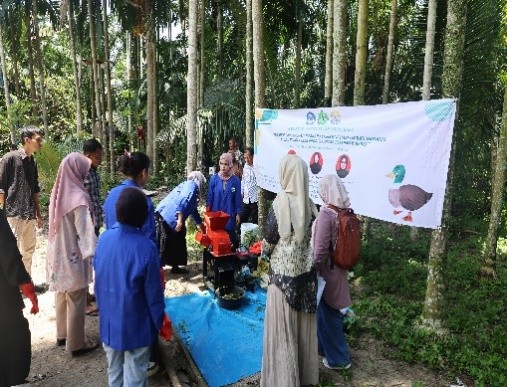
Contribution: This community service activity aims to improve farmers’ skills in producing alternative feed using silage techniques by utilizing local waste as a sustainable feed source. The activity integrates participatory mentoring and hands-on practice to improve farmers’ technical capacity in feed production.
Method: This study employed a quantitative descriptive approach combined with the participatory action research (PAR) method. Participants were selected through purposive sampling. Data collection was conducted via pre-test and post-test, observation, and focus group discussion (FGDs). The data were analyzed descriptively to assess improvements in participants’ knowledge and skills.
Results: Training on the production of alternative feed using silage techniques demonstrated an increase in farmers’ knowledge, as evidenced by the difference between the pre-test score (40,6) and the post-test score (86,6), representing a 113% increase. In addition, observations of participants’ practical skills yielded an average score of 88,6%, which falls in to the very good category.
Conclusion: The results of the activity indicate that guidance on the production of alternative feed using silage techniques is effective in improving farmers’ knowledge and skills. This participatory guidance model has the potential to be applied to other farming communities to support increased productivity and efficiency in livestock farming.
References
B. Jha, B. Krishna, and C. Asit, “Duck farming: a potential source of livelihood in tribal village. J Animal Health Production. 2017; 5: 39–43.
L. Herlina, A. Fitriani, M. Sulistyati, and K. N. Salsabilah, “Evaluation of Duck Farming and its Development Strategy: The Case of Smallholder Farmers in Indramayu District, Indonesia,” Advances In Animal and Veterinary Sciences, 2025, https://doi.org/10.17582/journal.aavs/2025/13.3.474.483
A. Astati, “Optimizing Plantation Waste for Alternative Feed in Integrated Crop-Livestock System: A Case Study from Bulukumba, South Sulawesi,” Anoa J. Anim. Husb., [Online]. Available: https://journal.uin-alauddin.ac.id/index.php/anoa/article/view/64783.
H. P. S. Makkar, “Review: Feed demand landscape and implications of food-not feed strategy for food security and climate change,” Animal, vol. 12, no. 8, pp. 1744–1754, 2018, https://doi.org/10.1017/S175173111700324X
C. A. Wongnaa, “Profitability and choice of commercially prepared feed and farmers’ own prepared feed among poultry producers in Ghana,” J. Agric. Food Res., vol. 12, p. 100611, Jun. 2023, https://doi.org/10.1016/j.jafr.2023.100611
A. Dede, I. H. Muh, W. Ari, M. A. Fandini, Q. Cori, and S. Suhardi, “Building resilient rural livestock systems: Capacity enhancement and sustainable growth in Karang Tunggal, East Kalimantan,” Asos. Ris. Ilmu, 2024, https://doi.org/10.61132/aspirasi.v2i5.1046
A. Parawansya, R. H. Lestari, and I. Indriani, “Pembuatan Silase sebagai Solusi Pakan Ternak pada Musim Kemarau di Desa Bonto Bulaeng Kabupaten Bantaeng: Making Silage as Livestock Feed Solution in the Dry Season in Bonto Bulaeng Village, Bantaeng Regency,” Pengabdianmu: J. Ilm. Pengabdi. Kepada Masyarakat, 2025, https://doi.org/10.33084/pengabdianmu.v10iSuppl-1.8431
F. Oktavi, M. Al-laitsi, M. A. Fadilah, L. A. Murdini, and A. S. Saputra, “Socialization Of The Use Of Vegetable Waste In Nawangsasi Village For Animal Feed In The Form Of Silage,” J. Abdisci, vol. 3, no. 3, pp. 346–355, Jul. 2025, https://doi.org/10.62885/abdisci.v3i3.867
M. Ilyas, H. Hamid, N. P. Qureshi, and M. Z. Talpur, “Impact of silage storage method and feeding level on nutrient digestibility, milk production, and profitability in smallholder dairy systems,” Trop. Anim. Health Prod., vol. 58, no. 2, p. 90, Mar. 2026, https://doi.org/10.1007/s11250-026-04895-0
Z. Du, “Silage preparation and sustainable livestock production of natural woody plant,” Front. Plant Sci., vol. 14, Sep. 2023, https://doi.org/10.3389/fpls.2023.1253178
A. L. Van Eenennaam and S. J. Werth, “Animal board invited review: Animal agriculture and alternative meats – learning from past science communication failures,” Animal, vol. 15, no. 10, p. 100360, Oct. 2021, https://doi.org/10.1016/j.animal.2021.100360
Y. Yusriani, N. Usrina, and M. Sabri, “Potential of Agricultural By-Product as Ruminant Feed in North Aceh District,” 2022, https://doi.org/10.2991/absr.k.220102.027
P. C. Azine, “Livestock feeding practices in South Kivu, Eastern Democratic Republic of Congo: challenges and opportunities,” Discov. Anim., vol. 2, no. 1, p. 8, Feb. 2025, https://doi.org/10.1007/s44338-025-00053-2
N. Suningsih, M. Hakim, and N. Nur’aini, “Training on the Application of Silage Technology for Vegetable Waste as Feed for Ducks in Kayu Manis Village,” J. Pengabdi. Masyarakat, 2024, https://doi.org/10.32815/jpm.v5i1.1259
D. Oli, B. Gyawali, S. Acharya, and S. Oshikoya, “Factors influencing learning attitude of farmers regarding adoption of farming technologies in farms of Kentucky, USA,” Smart Agric. Technol., vol. 10, p. 100801, Mar. 2025, https://doi.org/10.1016/j.atech.2025.100801
S. Wang, “Silage Preparation, Processing and Efficient Utilization,” Agriculture, vol. 15, no. 2, p. 128, Jan. 2025, https://doi.org/10.3390/agriculture15020128
A. M. Silva, J. R. M. Ruas, L. K. F. Vieira, F. P. Monção, and L. D. S. Oliveira, “Tomato Residue Silage as a Sustainable Feed for Lambs with Implications for Performance, Water Use and Meat Quality,” Sustainability, 2025, https://doi.org/10.3390/su17219453
K. Bułkowska, I. Białobrzewski, and T. Pokój, “Kinetic modeling and optimization of biogas production from maize silage for sustainable energy systems,” Sustain. Energy Technol. and Assessments, 2025, https://doi.org/10.1016/j.seta.2025.104395
J. Sun, “Silage Fermentation: A Potential Microbial Approach for the Forage Utilization of Cyperus esculentus L. By-Product,” Fermentation, vol. 7, no. 4, p. 273, Nov. 2021, https://doi.org/10.3390/fermentation7040273
C. O. Okoye, “The performance of lactic acid bacteria in silage production: A review of modern biotechnology for silage improvement,” Microbiol. Res., vol. 266, p. 127212, Jan. 2023, https://doi.org/10.1016/j.micres.2022.127212
M. C. Simanjuntak, T. G. Putra, and W. W. Dharsono, “Proses pembuatan silase penyediaan hijauan pakan ternak berkualitas dan kontinu sepanjang tahun guna meningkatkan produktivitas ternak ruminansia di Nabire Papua,” Indonesian Journal of Engagement, Community Service. 2023. https://doi.org/10.53067/ijecsed.v3i1.98
U. Khasanah, S. N. I. Trisnawati, A. Isma, and S. N. Alanur, “Metodologi pengabdian kepada masyarakat: Teori dan implementasi,” Penerbit Tahta Group, 2024, [Online]. Available: http://tahtamedia.co.id/index.php/issj/article/view/1066.
V. S. D. Soedarwo, I. Ramadhani Fuadiputra, M. Reevany Bustami, and G. K. Jha, “Participatory Action Research (PAR) Model for Developing A Tourism Village in Indonesia,” J. Local Gov. Issues, vol. 5, no. 2, pp. 193–206, Sep. 2022, https://doi.org/10.22219/logos.v5i2.21279
L. A. Palinkas, S. M. Horwitz, C. A. Green, J. P. Wisdom, N. Duan, and K. Hoagwood, “Purposeful Sampling for Qualitative Data Collection and Analysis in Mixed Method Implementation Research,” Adm. Policy Ment. Heal. Ment. Heal. Serv. Res., vol. 42, no. 5, pp. 533–544, Sep. 2015, https://doi.org/10.1007/s10488-013-0528-y
F. Fatati, A. N. Lubis, M. Farhan, and S. Novianti, “Faktor yang Mempengaruhi Lama Waktu Pelaku SISKA untuk Memenuhi Kebutuhan Hijauan Pakan Ternak Sapi Di Provinsi Jambi,” J. Ilm. Ilmu-Ilmu Peternak., vol. 27, no. 1, pp. 102–114, Jun. 2024, https://doi.org/10.22437/jiiip.v27i1.32245
H. Al Biruni, N. Mayasari, Ph.D, and B. Ayuningsih, “Pengaruh Lama Fermentasi pada Penggunaan Dedak Fermentasi terhadap Kualitas Fisik dan pH Silase Tebon Jagung (Zea Mays),” J. Sumber Daya Hewan, vol. 5, no. 2, pp. 35–41, Feb. 2025, https://doi.org/10.24198/jsdh.v5i2.46534
S. Masdah, N. P. Mayarestya, N. Nuruniyah, and A. D. Meilantika, “Education on Utilization of Online Queuing Application Based on Khanza Health Information System for Patients and Families,” SPEKTA (Jurnal Pengabdian Kepada Masyarakat Teknologi dan Aplikasi). 2025. https://doi.org/10.12928/spekta.v6i1.13054
M. Fikri, R. G. Wicaksono, F. P. Benedicta, and R. Silda, “Peningkatan Pengetahuan dan Keterampilan Peternak Melalui Pembuatan Silase Sebagai Sumber Pakan Ternak Domba Garut di Desa Penancangan Kota Serang,” LOSARI J. Pengabdian Kepada Masyarakat, 2025, https://doi.org/10.53860/losari.v7i2.535
A. N. Churriyah, H. Tussadia, M. Yusuf, R. Rahmat, and P. Astaman, “Pelatihan Pembuatan Silase Jerami Jagung sebagai Pakan Ternak di Desa Tadui Kecamatan Mamuju,” Abdimas Galuh, 2025, [Online]. Available: https://jurnal.unigal.ac.id/abdimasgaluh/article/view/20871
W. L. N. Aliyya, E. Sutanto, A. Sharon, and A. H. Afandi, “Pengembangan Kelompok Ternak Berbasis Pembuatan Pakan Silase di Wilayah Bengawan Solo Desa Siser,” J. Pengabdi. Kepada Masyarakat, 2023, [Online]. Available: http://ejournal.sisfokomtek.org/index.php/jpkm/article/view/1616.
A. Subarno, C. Dyah Sulistyaningrum Indrawati, P. Ninghardjanti, W. Winarno, and M. Choerul Umam, “Enhancing AI-Powered PowerPoint Skills: Training Impact on Vocational Teachers in Surakarta,” SPEKTA (Jurnal Pengabdi. Kpd. Masy. Teknol. dan Apl., vol. 6, no. 1, pp. 122–141, 2025, https://doi.org/10.12928/spekta.v6i1.13056
H. Hasanah, J. Achmadi, E. Pangestu, and M. A. Anas, “The effect of using water spinach on the physical quality of pellets,” 6th International Semin. Anim. Nutrition and Feed Science, 2022, https://doi.org/10.2991/absr.k.220401.058
B. Bakrie, “Sustainability Analysis of Intensive Duck Farming System in Sliyeg District, Indonesia: MDS and MICMAC Analysis Approach,” Int. J. Sustain. Dev. Plan., vol. 18, no. 10, pp. 3181–3193, Oct. 2023, https://doi.org/10.18280/ijsdp.181019
H. Sun, “Fermentation Technology in Aquafeeds: A Review,” Microorganisms, 2026, https://doi.org/10.3390/microorganisms14020416
N. C. Mafefa and A. N. Banamtuan, “Agricultural Waste Processing Technologies (Silage and Ammoniation) for Ruminant Feed in Drylands: Literature Review,” J. Trop. Anim. Sci. Technol., vol. 8, no. 1, pp. 49–55, Jan. 2026, https://doi.org/10.32938/jtast.v8i1.10645
Downloads
Published
How to Cite
Issue
Section
License
Copyright (c) 2026 Maulida Sari

This work is licensed under a Creative Commons Attribution-ShareAlike 4.0 International License.
Authors who publish with SPEKTA (Jurnal Pengabdian Kepada Masyarakat: Teknologi dan Aplikasi) agree to the following terms:
- Authors retain copyright and grant the journal the right of first publication with the work simultaneously licensed under a Creative Commons Attribution License (CC BY-SA 4.0) that allows others to share the work with an acknowledgment of the work's authorship and initial publication in this journal.
- Authors are able to enter into separate, additional contractual arrangements for the non-exclusive distribution of the journal's published version of the work (e.g., post it to an institutional repository or publish it in a book), with an acknowledgment of its initial publication in this journal.
- Authors are permitted and encouraged to post their work online (e.g., in institutional repositories or on their website) prior to and during the submission process, as it can lead to productive exchanges, as well as earlier and greater citation of published work.

This work is licensed under a Creative Commons Attribution-ShareAlike 4.0 International License.