A Digital Comic-Based Approach to Cyberbullying Prevention for Improving Internet Safety Among Elementary School Students
DOI:
https://doi.org/10.12928/spekta.v7i1.16146Keywords:
Cyberbullying, Digital comic, Digital literacy, Elementary education, Internet safetyAbstract
Background: The rapid growth of digital technology use among elementary school students has increased their exposure to cyberbullying and unsafe online behavior. Preliminary observations conducted at Sekolah Anak Tangguh an Nuha identified several challenges, including limited digital literacy awareness, insufficient interactive learning media, and a lack of understanding regarding cyberbullying prevention among students.
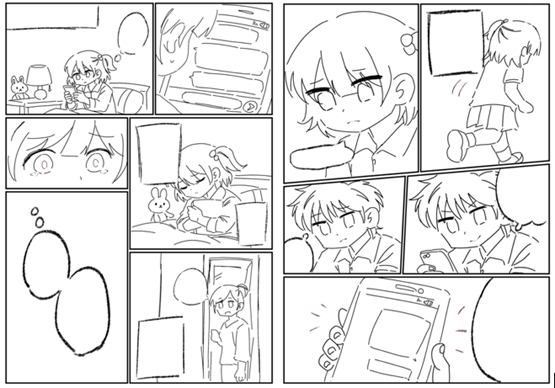
Contribution: This community service program introduces a digital comic-based educational intervention that integrates visual storytelling, digital ethics, and participatory learning activities to enhance students’ awareness of cyberbullying and responsible internet use. The program offers an innovative approach by combining contextual digital narratives with interactive classroom engagement specifically designed for elementary school students.
Method: The program employed a participatory community service method with an educational intervention approach involving 35 elementary school students. The implementation stages included needs assessment, digital comic development, guided learning activities, mentoring sessions, and evaluation through pre-test and post-test assessments, observations, and questionnaires.
Results: The findings revealed a significant improvement in students’ understanding of cyberbullying following the intervention. The proportion of students categorized at the high understanding level increased from 20.0% to 60.0%, while the percentage of students in the low understanding category decreased from 42.9% to 11.4%. In addition, students demonstrated greater engagement and more active participation throughout the learning activities.
Conclusion: Digital comic-based learning represents an effective and engaging approach for strengthening digital literacy and cyberbullying awareness among elementary school students.
References
Unicef, “Children in a digital world.” United Nations Children’s Fund, 2017.
N. E. Veraksa, A. N. Veraksa, D. A. Bukhalenkova, and R. Saljo, “Exploring the development of executive functions in children in a digital world,” Eur. J. of Psychology of Education, 2022, https://doi.org/10.1007/s10212-021-00584-8.
S. Madrim, “APJII: 23% Warga Indonesia Belum Punya Akses ke Internet.”, 2024.
D. R. K. Bharati, “Building a Safe Environment: Cyberbullying in Schools Empowering Teachers, Children and Parents: Identification, Prevention and Response Mechanisms,” Parents Identification, Prev. Response, 2025.
R. M. Kowalski, G. W. Giumetti, A. N. Schroeder, and M. R. Lattanner, “Bullying in the digital age: A critical review and meta-analysis of cyberbullying research among youth.,” Psychol. Bull., vol. 140, no. 4, pp. 1073–1137, Jul. 2014, https://doi.org/10.1037/a0035618
R. S. Tokunaga, “Following you home from school: A critical review and synthesis of research on cyberbullying victimization,” Comput. Human Behav., vol. 26, no. 3, pp. 277–287, May 2010, https://doi.org/10.1016/j.chb.2009.11.014
B. Bukhori, N. A. H. Nuriyyatiningrum, and Darmu'in, “Determinant factors of cyberbullying behaviour among Indonesian adolescents,” Inter. J. Adolesc. and Youth, 2024, https://doi.org/10.1080/02673843.2023.2295442.
M. N. I. Saleh and F. Hanum, “Stakeholders’ perspectives on whole-school approaches to prevent and address bullying and cyberbullying in Indonesian high schools,” Social Sciences &Humanities Open. 2025, https://doi.org/10.1016/j.ssaho.2025.102336
B. R. Robin, “Digital Storytelling: A Powerful Technology Tool for the 21st Century Classroom,” Theory Pract., vol. 47, no. 3, pp. 220–228, Jul. 2008, https://doi.org/10.1080/00405840802153916
A. Sadik, “Digital storytelling: a meaningful technology-integrated approach for engaged student learning,” Educ. Technol. Res. Dev., vol. 56, no. 4, pp. 487–506, Aug. 2008, https://doi.org/10.1007/s11423-008-9091-8
R. Mayer, Multimedia Learning. Cambridge University Press, 2020.
N. Fab-Ukozor and I. Ojiakor, “Social Media and Youth Empowerment: An Empirical Inquiry,” pp. 18–27, Aug. 2020, https://doi.org/10.5281/zenodo.3751050
W. Cassidy, C. Faucher, and M. Jackson, “Cyberbullying among youth: A comprehensive review of current international research and its implications and application to policy and practice,” Sch. Psychol. Int., vol. 34, no. 6, pp. 575–612, Dec. 2013, https://doi.org/10.1177/0143034313479697
E. S. Durand, “Closing the Imagination Gap With African and African American Fantasy Literature,” J. Adolesc. Adult Lit., vol. 64, no. 6, pp. 721–723, May 2021, https://doi.org/10.1002/jaal.1157.
C. Lovelock, R. Temple, C. Creswell, and C. McMellon, “A qualitative study exploring the benefits of involving young people in mental health research,” Heal. Expect., 2023, https://doi.org/10.1111/hex.13722
J. Creswell, C. N. Poth, and P. Rawlins, “Mapping design trends and evolving directions using the Sage handbook of mixed methods research design,” Mix. methods Res. Des., 2023.
J. Nouri, “The flipped classroom: for active, effective and increased learning – especially for low achievers,” Int. J. Educ. Technol. High. Educ., vol. 13, no. 1, p. 33, Dec. 2016, https://doi.org/10.1186/s41239-016-0032-z
C. Collins, J. Dolata, E. Pike, and A. Sehgal, “Increasing research capacity in community organizations: Findings from the Community Research Scholars Initiative,” Eval. Program Plann., vol. 96, p. 102189, Feb. 2023, https://doi.org/10.1016/j.evalprogplan.2022.102189
R. Barragán-Sánchez, R. Romero-Tena, and M. García-López, “Educational Robotics to Address Behavioral Problems in Early Childhood,” Educ. Sci., vol. 13, no. 1, p. 22, Dec. 2022, https://doi.org/10.3390/educsci13010022
M. Nazim, A. A. F. Alzubi, and A.-H. Fakih, “EFL teachers’ student-centered pedagogy and assessment practices: challenges and solutions,” J. Educ. Learn., vol. 18, no. 1, pp. 217–227, Feb. 2024, https://doi.org/10.11591/edulearn.v18i1.21142
B. Gavurova and M. Tarhanicova, “Methods for Estimating Avoidable Costs of Excessive Alcohol Consumption,” Int. J. Environ. Res. Public Health, vol. 18, no. 9, p. 4964, May 2021, https://doi.org/10.3390/ijerph18094964
B. Bunari, J. Setiawan, M. A. Ma’arif, R. Purnamasari, H. Hadisaputra, and S. Sudirman, “The influence of flipbook learning media, learning interest, and learning motivation on learning outcomes,” J. Educ. Learn., vol. 18, no. 2, pp. 313–321, May 2024, https://doi.org/10.11591/edulearn.v18i2.21059
G. Huesca, A. Rodríguez-Rosales, V. Lara-Prieto, M. I. Ruiz-Cantisani, and J. Acevedo, “Effectiveness of Challenge-Based Learning in Undergraduate Engineering Programs from Competencies and Gender Perspectives,” Educ. Sci., vol. 14, no. 3, p. 255, Feb. 2024, https://doi.org/10.3390/educsci14030255
H.-Y. Phuong, “The Impact of Training Vietnamese EFL Learners for Self-Assessment on Writing Performance,” Int. J. Instr., vol. 17, no. 2, pp. 237–258, Apr. 2024, https://doi.org/10.29333/iji.2024.17214a
M. Bond, V. I. Marín, C. Dolch, S. Bedenlier, and O. Zawacki-Richter, “Digital transformation in German higher education: student and teacher perceptions and usage of digital media,” Int. J. Educ. Technol. High. Educ., vol. 15, no. 1, p. 48, Dec. 2018, https://doi.org/10.1186/s41239-018-0130-1
J. Liu, “Secure Cloud-Aided Approximate Nearest Neighbor Search on High-Dimensional Data,” IEEE Access, vol. 11, pp. 109027–109037, 2023, https://doi.org/10.1109/ACCESS.2023.3321457
M. Kebritchi, A. Lipschuetz, and L. Santiague, “Issues and Challenges for Teaching Successful Online Courses in Higher Education,” J. Educ. Technol. Syst., vol. 46, no. 1, pp. 4–29, Sep. 2017, https://doi.org/10.1177/0047239516661713
K. Campbell, “Gender and Technology: Social Context and Intersectionality,” in Handbook of Research in Educational Communications and Technology, Cham: Springer International Publishing, 2020, pp. 115–204. https://doi.org/10.1007/978-3-030-36119-8_7
M. Bower, “Technology‐mediated learning theory,” Br. J. Educ. Technol., vol. 50, no. 3, pp. 1035–1048, May 2019, https://doi.org/10.1111/bjet.12771
S. Hinduja and J. W. Patchin, “Cultivating youth resilience to prevent bullying and cyberbullying victimization,” Child Abuse Negl., vol. 73, pp. 51–62, Nov. 2017, https://doi.org/10.1016/j.chiabu.2017.09.010
J. S. Lee and L. K. Sylvén, “The role of Informal Digital Learning of English in Korean and Swedish EFL learners’ communication behaviour,” Br. J. Educ. Technol., vol. 52, no. 3, pp. 1279–1296, May 2021, https://doi.org/10.1111/bjet.13082
D. Baraldsnes, “Bullying Prevention and School Climate: Correlation between Teacher Bullying Prevention Efforts and their Perceived School Climate,” Int. J. Dev. Sci. Biopsychosoc. Mech. Chang. Hum. Dev. Psychopathol. - Perspect. from Psychol. Neurosci. Genet., vol. 14, no. 3–4, pp. 85–95, Oct. 2020, https://doi.org/10.3233/DEV-200286
K.-M. Jackman, C. A. Latkin, J. L. Maksut, M. E. Trent, T. H. Sanchez, and S. D. Baral, “Patient Portals as Highly Acceptable Tools to Support HIV Preventative Behaviors Among Adolescent and Young Sexual Minority Men,” J. Adolesc. Heal., vol. 67, no. 2, pp. 278–281, Aug. 2020, https://doi.org/10.1016/j.jadohealth.2020.03.029
A. Joshi, S. Kale, S. Chandel, and D. Pal, “Likert Scale: Explored and Explained,” Br. J. Appl. Sci. Technol., vol. 7, no. 4, pp. 396–403, Jan. 2015, 10.9734/BJAST/2015/14975
M. A. Campbell, “Cyber Bullying: An Old Problem in a New Guise?,” Aust. J. Guid. Couns., vol. 15, no. 1, pp. 68–76, Jul. 2005, https://doi.org/10.1375/ajgc.15.1.68
Downloads
Published
How to Cite
Issue
Section
License
Copyright (c) 2026 syarifah Fadillah rezky, Siti Julianita Siregar, Rita Hamdani, Meri Sri Wahyuni

This work is licensed under a Creative Commons Attribution-ShareAlike 4.0 International License.
Authors who publish with SPEKTA (Jurnal Pengabdian Kepada Masyarakat: Teknologi dan Aplikasi) agree to the following terms:
- Authors retain copyright and grant the journal the right of first publication with the work simultaneously licensed under a Creative Commons Attribution License (CC BY-SA 4.0) that allows others to share the work with an acknowledgment of the work's authorship and initial publication in this journal.
- Authors are able to enter into separate, additional contractual arrangements for the non-exclusive distribution of the journal's published version of the work (e.g., post it to an institutional repository or publish it in a book), with an acknowledgment of its initial publication in this journal.
- Authors are permitted and encouraged to post their work online (e.g., in institutional repositories or on their website) prior to and during the submission process, as it can lead to productive exchanges, as well as earlier and greater citation of published work.

This work is licensed under a Creative Commons Attribution-ShareAlike 4.0 International License.